
Most property owners and facilities managers discover this the hard way: they hire a contractor who handles residential gutters every day, gets the install done quickly, and six months later they’re dealing with overflow at every building entrance, pooling water against the foundation, and a warranty claim that goes nowhere. The gutters look fine. But they were sized, spaced, and attached for a house — not a commercial building.
Commercial gutter installation is a fundamentally different discipline. The roof drainage loads are higher, the code requirements are stricter, the material specifications are more demanding, and the consequences of getting it wrong extend well beyond a cosmetic water stain. We’re talking slip-and-fall liability at high-traffic entries, voided property insurance claims, and structural damage to foundations and fascia systems that carry real capital replacement costs.
This guide walks through what a properly engineered commercial gutter system actually looks like — the sizing methodology, material selection, structural attachment standards, and code-driven design decisions that separate a compliant, long-lasting installation from one that’s just checking a box on a punch list.
Here’s where most contractors fall silent. Ask them how they sized your gutters and you’ll get answers like “we went a size up to be safe” or “those are the big six-inch ones.” That’s not engineering. That’s guesswork — and on a commercial property, guesswork creates liability.
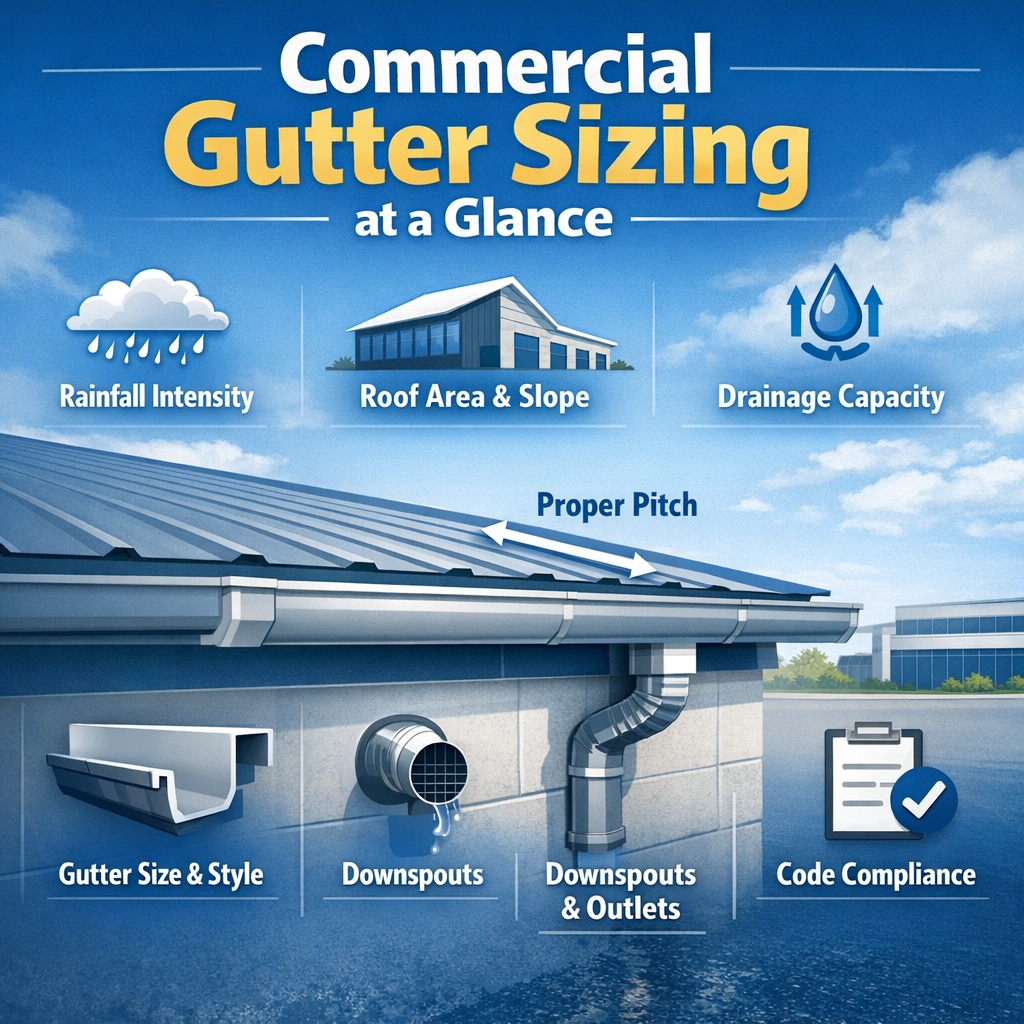
Commercial gutter sizing is governed by two primary standards: SMACNA (Sheet Metal and Air Conditioning Contractors’ National Association) guidelines and IBC Section 1503, which covers roof drainage requirements for commercial construction. These aren’t optional frameworks — they’re the baseline a properly licensed commercial contractor works from before a single hanger goes into the wall.
The core calculation is straightforward in concept, even if the inputs require local data:
Required flow capacity (GPM) = Drainage area (sq ft) × Rainfall intensity (in/hr) ÷ 96.23
The rainfall intensity figure comes from your local 100-year storm event data — the intensity at which a drainage system must perform without failure. In much of North Carolina, that figure runs between 3.5 and 5.5 inches per hour depending on jurisdiction.
Here’s why this matters in real terms: a 10,000 square foot flat commercial roof in a moderate-intensity rain zone can generate 400 to 600 gallons per minute of runoff during a major storm. A standard residential K-style gutter system — even a large one — is not built to move that volume. The downspouts alone become the bottleneck, and water backs up, overflows at the eaves, and lands exactly where foot traffic is highest.
Undersized commercial gutters don’t just fail aesthetically. When overflow occurs consistently at building entries and sidewalks, the property owner carries direct exposure for slip-and-fall incidents. On top of that, if a water intrusion claim is filed with your commercial property insurer and an adjuster determines the drainage system was inadequate for the building’s roof area, that claim can be denied outright. Proper sizing isn’t just good practice — it’s protection.
The residential gutter conversation usually ends at “aluminum or copper?” For commercial applications, that question is just the starting point. The material selection involves gauge specifications, profile geometry, coating systems, and thermal performance — all of which affect how long the system lasts and how it performs under real commercial loads.
Standard residential aluminum gutters run at 0.027″ gauge. That’s adequate for a residential roof section. Commercial installations call for a different standard:
K-style gutters are what most people picture — the decorative profile you see on residential homes. They work well for residential applications. On commercial buildings, the calculation changes.
Rectangular box gutters — typically in 4″×4″, 4″×5″, or 6″×6″ configurations — are the standard for metal buildings, warehouses, multi-tenant retail, and larger commercial structures. Here’s why:
| Material | Gauge/Thickness | Best Application | Thermal Movement | Coating Requirement | Lifespan (Maintained) |
|---|---|---|---|---|---|
| Galvanized Steel | 24-gauge (commercial standard) | Warehouses, metal buildings, heavy-load applications | Moderate — requires expansion joints at 40 ft | Paint or Kynar 500 coating recommended | 20–30 years |
| Aluminum (Heavy) | 0.040″ – 0.050″ | Office buildings, retail, light commercial | Higher — joints required more frequently | Kynar 500 or PVDF coating for longevity | 20–30 years |
| Copper | 16–20 oz | Historic buildings, high-end commercial, visible architectural applications | Low — more dimensionally stable | None required — natural patina is protective | 50+ years |
| Galvalume Steel | 24-gauge | Coastal, chemical exposure environments, HVAC-heavy rooftops | Moderate | Pre-coated from mill — verify compatibility | 25–35 years |
| Standard Aluminum (residential) | 0.027″ | Not recommended for commercial use | High without proper joint placement | Standard paint — limited durability | 10–15 years under commercial loads |
On commercial buildings with gutter runs exceeding 40 linear feet — which is routine — thermal expansion joints are not optional. Steel expands approximately ⅛ inch per 10°F of temperature change per 10 linear feet of run. In a climate like the NC Triad, where temperatures swing 50°F or more between seasons, a 60-foot run can experience nearly an inch of thermal movement across a year. Without expansion joints at the correct intervals, seams pull apart, sealants fail, and you’re looking at water intrusion within two to three years of installation.
This is one of the most common failure points we see on commercial gutter systems that were installed without real commercial expertise. The gutters themselves aren’t defective — the design ignored basic physics. For a deeper look at how proper gutter installation principles apply across different building types, Smithrock’s commercial exterior services cover the full scope of what an engineered system requires.
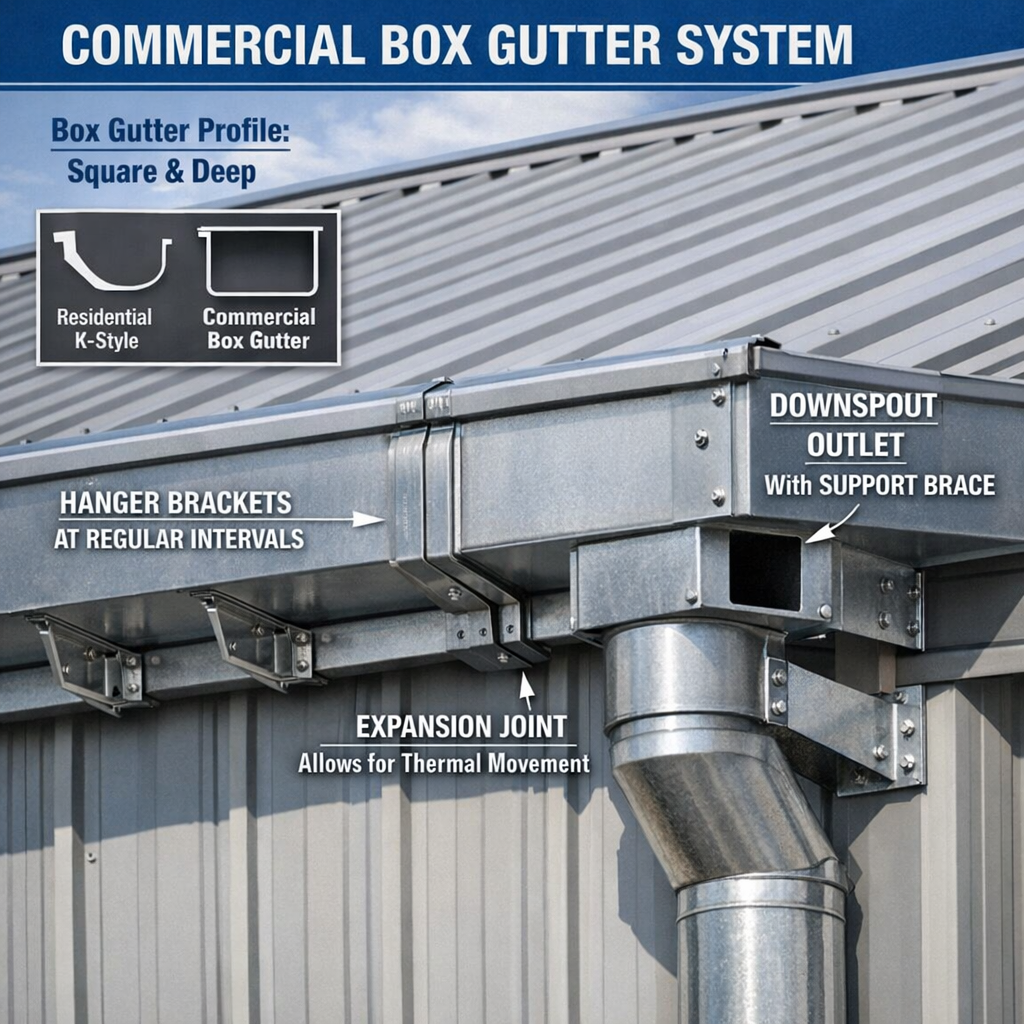
Residential gutter installation guides recommend hanger spacing of 24 to 36 inches on center. That spacing is based on residential roof sections, residential debris loads, and residential water volumes. Apply it to a commercial building and you’ve created a system that’s structurally undersized from day one.
IBC Section 1503.4 requires secondary (emergency) overflow drains on controlled drainage roofs — meaning any flat or low-slope commercial roof designed to hold water temporarily before draining. The overflow system must be sized at 100% of the primary drainage capacity.
In plain terms: if your primary downspout system handles 400 GPM, your overflow scuppers must also handle 400 GPM. This isn’t a suggestion — it’s a code requirement with direct implications for building permits and certificate of occupancy on new commercial construction. On retrofit work, it’s a liability consideration that every property owner should understand before signing an installation contract.
Many jurisdictions — including those across the NC Triad — require permits for commercial gutter installation above a certain linear footage or building height threshold. This affects project timelines, and it affects contractor liability. A contractor who skips the permit process isn’t saving you time. They’re leaving you exposed if a future inspection, insurance claim, or property sale surfaces an unpermitted system. Any legitimate commercial gutter contractor will tell you upfront what the local permit requirements are for your specific project.
One of the most telling gaps in how other contractors approach commercial gutter work is treating every commercial building as if it’s the same job at a bigger scale. It’s not. A metal-panel warehouse, a Class A office building, a multi-tenant retail strip, and a multi-family residential complex have fundamentally different drainage requirements, attachment substrates, aesthetic standards, and maintenance realities.
Metal buildings and warehouses: Box gutters in 24-gauge galvanized or Galvalume steel, attached to metal purlins with self-tapping structural screws, with expansion joints at every 40-foot interval. Internal scupper integration is common. Aesthetic simplicity is the priority.
Class A office buildings: Heavier aluminum (0.040″–0.050″) with Kynar 500 coating for color retention and long-term finish quality. Profile selection often involves coordination with the building’s exterior design. Visibility matters here — the system needs to perform and look intentional.
Multi-tenant retail / strip centers: High foot traffic at building entries makes overflow sizing particularly important from a liability standpoint. Downspout placement needs to route water away from storefronts and parking areas, not just away from the foundation. Maintenance access is also a design consideration when multiple tenants share responsibility for different sections.
Multi-family residential (commercial scale): Often governed by both IBC and local residential codes depending on building height and construction type. Gutter systems need to handle multiple roof sections draining independently. Snow and ice load calculations matter more here because ice damming at multi-unit rooflines creates concentrated overflow risks.
Understanding which category your building falls into — and which specific drainage, attachment, and code requirements apply — is the conversation that should happen before any measurements are taken. That’s not how most residential-first contractors approach a commercial call. But it’s how a contractor with genuine commercial experience starts every project. The article Protect Your Business: The Ultimate Guide to Gutter Installation covers additional considerations for commercial property owners evaluating their drainage systems.
Commercial gutter installation is becoming more technically demanding, not less. Code cycles are tightening, building envelopes are more complex, and the liability exposure from inadequate drainage is real and documented. Here are three specific steps worth taking before your next commercial project breaks ground.
1. Commission a Hydraulic Drainage Audit Using Current SMACNA Standards
The 2024 revision cycle introduced updated rainfall intensity data for dozens of metropolitan regions. If your project is in a flood-prone corridor or a municipality that has adopted revised IBC drainage tables, the sizing calculations from even three years ago may be insufficient. Engage a licensed mechanical or civil engineer — not just your roofing contractor — to run hydraulic load analysis against current SMACNA Architectural Sheet Metal Manual criteria before system specifications are finalized. This single step eliminates the most common source of post-installation disputes.
2. Specify Kynar 500-Coated Aluminum or Galvalume with a Written Finish Warranty
In 2026, supply chain normalization means there is no longer a cost justification for specifying bare aluminum or uncoated galvanized steel on any visible commercial application. Kynar 500 coatings are available at competitive lead times from major coil manufacturers. Require a minimum 30-year chalk and fade warranty in writing, tied to a specific coil coating supplier, not just the installer’s verbal assurance. This protects the building owner and creates a clear standard for any future warranty claims.
3. Build a Preventive Maintenance Schedule Into the Installation Contract
The most overlooked clause in commercial gutter contracts is post-installation service. Negotiate at least two annual inspections — one in late fall before freeze cycles and one in early spring after snow load season — into the original scope. Specify that sealant joints, expansion joints, and downspout connections are included in each inspection. A maintained system lasts 30–40 years. An unmaintained one on the same building fails in under 15. The cost difference between those two outcomes dwarfs the price of a maintenance agreement. For reference on what a thorough commercial inspection covers, the article The Ultimate Commercial Roof Inspection Checklist outlines the scope and documentation standards that apply to the full building envelope.
Commercial gutter installation operates under a separate set of engineering, code, and material requirements. Where residential systems typically use 5- or 6-inch K-style gutters in lightweight aluminum, commercial systems are sized using hydraulic calculations based on roof square footage, drainage slope, and regional rainfall intensity data from IBC or SMACNA standards. Materials are heavier gauge, attachment methods are engineered for structural loads, and expansion joint placement must account for thermal movement across longer runs. The contractor qualifications, permitting process, and liability exposure are all fundamentally different from a residential project.
There is no single standard size. Commercial gutter sizing is determined by a hydraulic calculation that accounts for the total roof drainage area in square feet, the roof’s effective drainage slope, and the design rainfall intensity for the specific geographic location — typically expressed in inches per hour at a 100-year storm frequency. Most commercial applications use gutters ranging from 6 to 8 inches wide, with larger box gutter profiles common on warehouse and industrial buildings. Downspout sizing is calculated independently and must match the gutter’s drainage capacity. Any specification that skips this calculation is not code-compliant.
A properly installed and maintained commercial gutter system — using 0.040-inch or heavier aluminum with a Kynar 500 finish, or 24-gauge Galvalume steel — should last 30 to 40 years. The most significant variable is not material quality but maintenance consistency. Sealant joints at end caps and miters typically need reapplication every 7 to 10 years. Expansion joints should be inspected annually. Systems that receive no preventive maintenance frequently fail within 12 to 15 years due to standing water from blockages, sealant deterioration, and fastener corrosion — none of which are material failures.
Material selection depends on building type, aesthetic requirements, and budget. Heavy-gauge aluminum (0.040″ to 0.050″) with a Kynar 500 PVDF coating is the most common specification for Class A office, retail, and multi-family applications because it combines corrosion resistance, long-term color stability, and fabrication flexibility. Galvalume and galvanized steel in 24-gauge are standard for metal buildings and industrial facilities where aesthetics are secondary and structural attachment to metal framing is required. Copper remains an option for historic or high-end architectural applications but carries a significant cost premium. Aluminum-zinc alloy coatings offer strong performance in coastal and high-humidity environments.
In most jurisdictions, yes. Commercial gutter installation is typically considered part of the building’s stormwater management system and falls under the International Building Code or local equivalents. Permits are generally required for new installations, full replacements, and any work that modifies the roof drainage design. Some municipalities also require a licensed contractor of record for commercial exterior work. The permitting process may involve submission of drainage calculations, material specifications, and attachment details for review. Skipping the permit process on a commercial building creates liability exposure for the building owner and can affect insurance coverage in the event of a water damage claim.
Commercial gutter installation costs vary significantly based on building perimeter, gutter profile and material specification, number of downspouts, fascia or substrate condition, and access complexity. As a general range, most commercial installations fall between $15 and $40 per linear foot installed, with high-end architectural systems or difficult-access applications exceeding that range. A complete scope should include material, fabrication, attachment hardware, sealants, downspouts, and any required fascia repair. Obtaining multiple bids with identical written specifications is the only reliable way to compare pricing, as scope definitions vary widely between contractors.
Most commercial properties benefit from a minimum of two inspections and cleanings per year — one in late fall to clear debris before winter freeze cycles, and one in early spring after snow load season ends. Buildings surrounded by deciduous trees or located in high-debris environments may require quarterly service. Each inspection should cover debris removal from gutters and downspouts, confirmation that water flows freely to all outlets, a visual check of sealant joints and expansion joints, and a review of downspout discharge points for erosion or blockage. Documenting inspection results creates a maintenance record that supports warranty claims and due diligence in property transactions.
Commercial gutter installation is a system-level decision, not a line-item purchase. The choices made during specification — material gauge, profile, attachment method, expansion joint placement, overflow design — determine how well a building manages water for the next three to four decades. Getting those decisions right requires working with contractors who understand the difference between a residential upgrade and a commercial drainage system, and who treat engineering, code compliance, and long-term performance as non-negotiable starting points.
If your building is due for a new installation, a full replacement, or even a professional assessment of what’s currently in place, the best next step is a conversation with a team that works at commercial scale every day. Contact Us to discuss your project requirements, timeline, and specifications — and to get a proposal built around what your building actually needs.

Smithrock Roofing © Copyright 2026 • All Rights Reserved • Privacy Policy • Maintained by Mongoose Digital Marketing