
Most gutter content you’ll find online reads like it was written for a house somewhere in the middle of the country — a generic, flat-lot home surrounded by tidy maple trees and sandy loam soil. That advice isn’t wrong exactly. It’s just not written for your home in Winston-Salem.
The Piedmont Triad has its own climate patterns, its own geology, and its own tree canopy. When those factors don’t show up in an installer’s planning process, the gutters they put on your house may look fine on day one and fail quietly over the next few years. Fascia boards rot. Foundations absorb moisture they shouldn’t. Gutter guards clog with debris that the marketing photos never showed.
This guide is built specifically for Winston-Salem homeowners who want to understand what a properly designed gutter system looks like here — not somewhere else. We’ll cover rainfall intensity, sizing calculations, the very real problem of red clay soil drainage, and how to match gutter guard selection to the trees actually growing on your property. By the time you’re done reading, you’ll know the right questions to ask any installer before they touch your fascia board.
Rainfall totals are one thing. Rainfall intensity is something else entirely, and it’s intensity that exposes undersized gutters.
Winston-Salem receives roughly 44 inches of rain annually — close to the national average. But that number doesn’t tell the full story. The Piedmont Carolinas are known for intense convective storms, particularly from late spring through early fall. It’s not unusual for a mid-afternoon thunderstorm to drop an inch or more of rain in 20 to 30 minutes. That kind of event pushes gutter systems past their design limits fast, and the damage it causes — water sheeting behind the gutter, pooling against the foundation, eroding the soil at the drip line — accumulates with every storm that follows.
A properly sized gutter system starts with the drainage area calculation. Here’s how it works in plain terms:
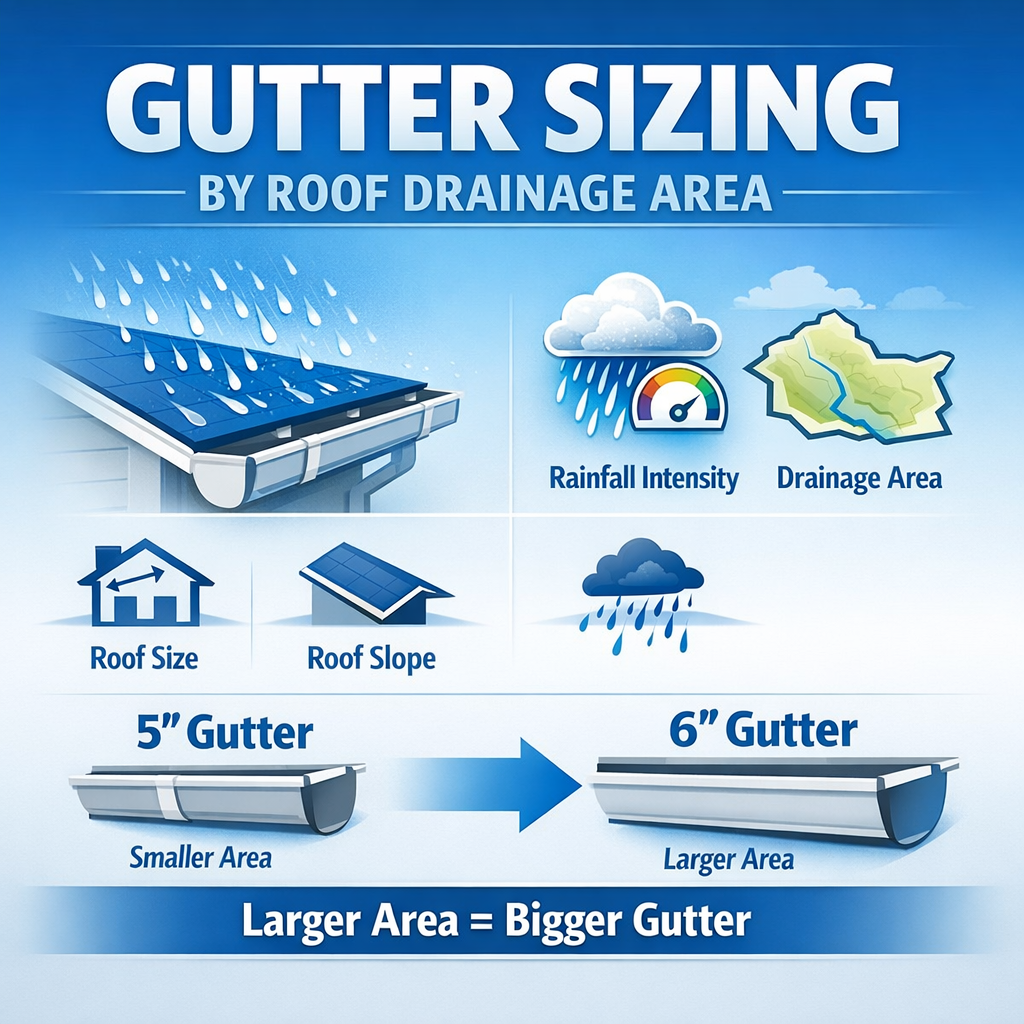
Every section of gutter serves a defined portion of your roof. That area, measured in square feet, combined with your local peak rainfall intensity (measured in inches per hour), determines the minimum flow capacity your gutter needs to handle without overflowing.
The industry formula uses a factor called the design flow rate, expressed in gallons per minute (GPM). The relevant variables are:
What this means practically: a standard 4-inch K-style gutter — still offered and installed by many local contractors — maxes out at roughly 7 to 9 GPM depending on slope. A 5-inch K-style handles 12 to 14 GPM. A 6-inch K-style can manage 18 to 20 GPM. On a roof section with 800 square feet or more of drainage area, a 4-inch gutter during a Piedmont afternoon storm isn’t just undersized — it’s overrun before the storm is halfway done.
Even a correctly sized gutter fails if it isn’t pitched properly. The industry standard calls for a ¼-inch drop per 10 linear feet of run. This creates enough slope to move water consistently toward the downspout outlet without creating a visible sag in the gutter line.
Installers who skip the pitch calculation — or who eyeball it — create gutters that hold standing water at low spots. Standing water accelerates corrosion, adds weight stress to hangers, and becomes a breeding environment for mosquitoes. It’s one of the most common reasons homeowners call for a repair within a few years of a new installation, and it’s entirely preventable with a level and a measuring tape during setup.
Here’s a failure mode that almost no gutter content addresses, and it’s one that matters specifically in Forsyth County.
Winston-Salem sits on Piedmont red clay — dense, iron-rich soil that drains poorly and becomes nearly impermeable when it reaches saturation. Most homeowners think of gutter systems as roof-level water management. That’s accurate as far as it goes. But a gutter system’s job isn’t complete when water reaches the bottom of the downspout. Where that water goes from there is just as important.
When a downspout discharges water within two to three feet of your foundation, you’re depositing that water onto a surface that, in red clay conditions, has nowhere to go quickly. Saturated clay holds moisture against your footings rather than moving it away. Over time, this creates hydrostatic pressure — the outward force exerted by water-laden soil pressing against foundation walls or footings. It’s a leading contributor to basement seepage, crawl space moisture problems, and in severe cases, foundation movement.
The standard recommendation for clay-soil environments is a minimum downspout extension of four to six feet. Underground drainage integration — where downspout water is piped away from the foundation entirely and daylighted at a point further down the grade — is the more complete solution for properties where grade doesn’t naturally slope away from the house. For a detailed walkthrough of how this process works, the article No More Puddles: Your Guide to Buried Downspout Drainage covers the options and tradeoffs worth understanding before you commit to an approach.
Key considerations for Winston-Salem downspout placement:
Gutter guard marketing almost universally shows the same image: a few large maple leaves sitting harmlessly on top of a mesh screen, repelled by water into the yard. If your property has maple trees, that imagery is reasonably accurate. If you live in Winston-Salem, there’s a good chance your trees are doing something more complicated.
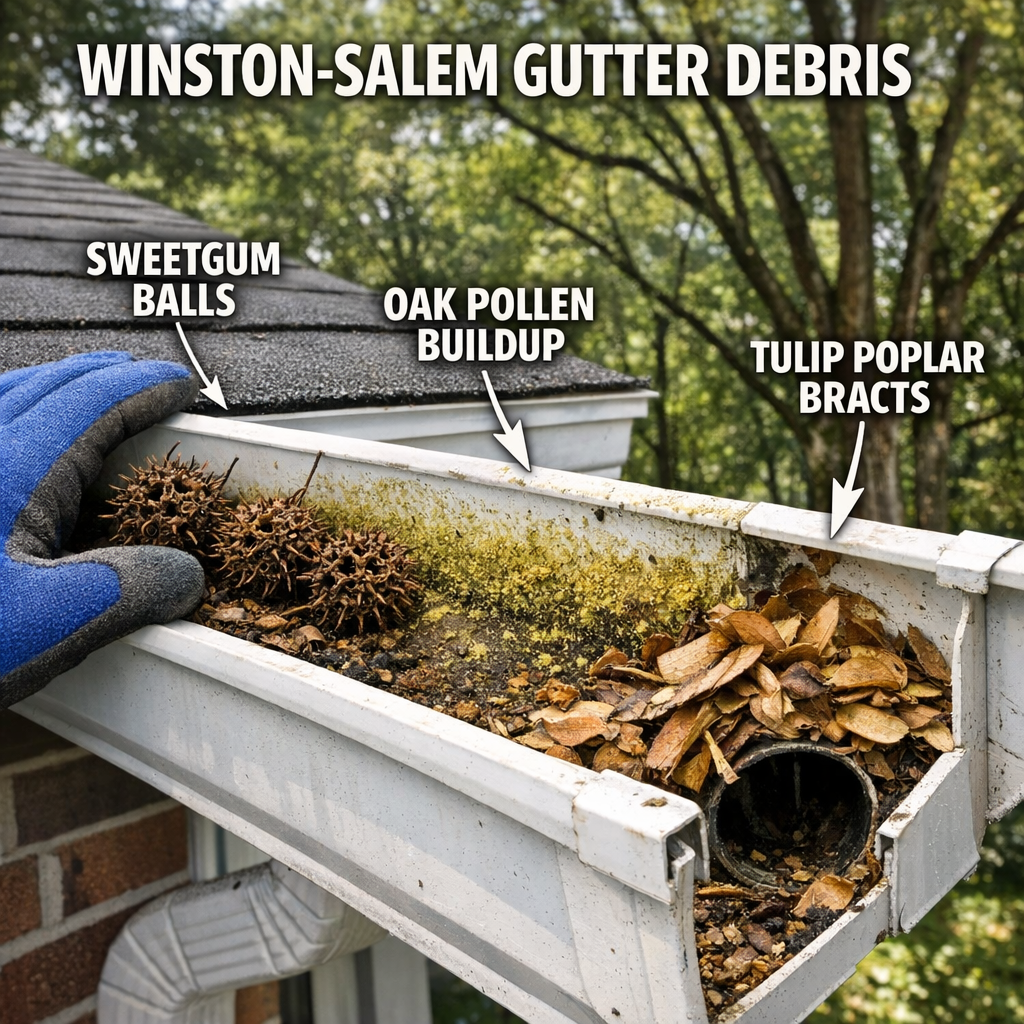
The Triad’s urban canopy is dominated by several species that produce debris profiles most gutter guard systems weren’t designed around:
Oak trees shed leaves that are relatively manageable on their own, but also produce large volumes of acorn caps, twig debris, and — critically — oak pollen in spring. Oak pollen is a fine, waxy particle that coats surfaces and, on micro-mesh guards, can create a surface-loading effect that slows or blocks water infiltration even when no visible debris is present.
Sweetgum trees are among the most common street trees in Winston-Salem’s older neighborhoods. They drop large, spiky seed balls through the fall and winter that tend to lodge in K-style gutters and around downspout outlets. But the finer tannin-rich leaf fragments and the small capsule debris they shed in summer are the harder problem — they slip through coarser screen guards and accumulate in the gutter channel below.
Tulip poplars drop large leaves but also shed a consistent stream of bract material and seed pods from late summer through fall. These are bulky enough that most guard types handle them at the leaf level, but their sheer volume can overwhelm gutters in yards with multiple mature specimens.
| Tree Species | Primary Debris Type | Problem for Micro-Mesh | Problem for Reverse Curve | Problem for Screen/Insert |
|---|---|---|---|---|
| Oak | Leaves, acorn caps, fine pollen | Pollen surface-loading reduces flow over time | Acorn caps and twig debris can lodge at the nose | Coarse screens pass fine pollen and small debris through |
| Sweetgum | Spiky seed balls, fine tannin fragments | Fine tannin debris may surface-load in spring/fall | Seed balls lodge at the curve opening | Seed balls can wedge into screen cells and hold debris above them |
| Tulip Poplar | Large leaves, bract material, seed pods | Large leaf volume can mat on screen surface in fall | Generally handles large leaves well; bract material may enter | Inserts may compress under high leaf volume |
| Pine | Needles, sap, pollen cones | Needles penetrate most mesh types; sap accelerates clogging | Needles enter freely along the curve gap | Needles pass through virtually all screen types |
| Mixed canopy | Variable year-round | Micro-mesh with fine weave (50–micron or finer) performs best | Not recommended without regular maintenance | Periodic cleaning required regardless of screen type |
The honest takeaway here is that no gutter guard system eliminates maintenance entirely — a claim that should make any homeowner skeptical of contractors who lead with that promise. What a well-matched guard does is reduce maintenance frequency, protect the gutter channel from the debris types most prevalent on that specific property, and extend the useful life of the gutter system overall. Getting that match right requires knowing what’s actually growing on your lot, not just which brand is easiest to install. For a deeper look at how different guard systems perform against real-world debris, the article Gutter Guards: More Trouble Than They’re Worth? offers a candid assessment worth reading before you commit to a product.
A new gutter system is only as durable as the structure it’s attached to. Two pre-installation assessments separate competent gutter contractors from crews who are simply hanging metal and moving on.
Gutters are fastened to the fascia board — the horizontal trim board that runs along the eave of your roof. When fascia boards are healthy, a properly installed gutter stays anchored for decades. When fascia boards are compromised by rot, moisture infiltration, or insect damage, new gutters will begin to pull away from the house within a few years regardless of how well the installation was executed.
A thorough fascia inspection before new gutter installation should check for:
If fascia board replacement is needed, it should happen before new gutters go up — not as an afterthought after the first heavy rain reveals the problem.
Hidden hanger systems — where a bracket spans the full interior of the gutter and fastens through the face — have largely replaced spike-and-ferrule systems in quality installations, and for good reason. Hidden hangers distribute load across the gutter profile rather than concentrating it at a single spike point, which matters significantly in the Triad’s ice and heavy-debris seasons.
Hanger spacing should be no greater than 24 inches on center for most residential applications. Installations with 36-inch spacing — common in faster, lower-cost jobs — have noticeably higher rates of gutter sag and fastener failure under ice load or after sustained debris accumulation. For properties with significant tree coverage, tight hanger spacing isn’t optional; it’s the baseline.
Most Winston-Salem gutter contractors advertise seamless gutters, and the core claim is accurate — a continuous run of aluminum formed on-site eliminates the intermediate seams that were historically the most common leak point. But “seamless” doesn’t mean seam-free.
Every seamless gutter system still requires seamed end caps — the pieces that close off each end of a gutter run. These are field-fabricated joints, and they represent the point where 60 to 70 percent of gutter leak callbacks originate. Properly installed end caps use a combination of mechanical fasteners and high-quality sealant applied to the interior joint. When the sealant is skimped on, or when a low-grade product is used, those end caps begin leaking within a season or two.
Asking an installer how they prepare and seal end caps is a direct and reasonable quality-screening question. A contractor who has done this work carefully and consistently will have a clear, specific answer.
Winston-Salem’s spring storm season typically begins in earnest by late March. Booking a gutter inspection and any replacement work in January or February means you’re ahead of the scheduling backlog that develops when contractors are fielding emergency calls during active weather. Early scheduling also gives time for proper fascia assessment — and any necessary board replacement — before new gutters are ever fabricated.
In 2026, the most protective step any homeowner can take is demanding specificity in writing before work begins. A credible contractor should be able to provide documentation covering gutter profile and gauge, hanger type and spacing, downspout sizing and placement, end cap sealing method, and how existing fascia condition will be assessed and communicated. Vague verbal assurances cost nothing to make and nothing to break. A written scope creates accountability.
General contractor review platforms show overall satisfaction, but the most useful signal for gutter work is what customers report after the first significant rainfall following installation. Search specifically for reviews that mention follow-up, callbacks, or how the contractor responded when something didn’t perform correctly. In the Triad’s variable weather, how a company handles post-installation issues is as informative as the installation itself. You can read what Winston-Salem homeowners have said about their experience with Smithrock on our Reviews page.
The key distinction is whether damage is isolated or systemic. A single leaking end cap or a loose downspout bracket is a repair. Gutters that are visibly sagging along multiple runs, pulling away from the fascia at several points, showing persistent overflow despite being clear of debris, or exhibiting widespread surface corrosion typically warrant full replacement. If your gutters were installed more than 20 years ago and are showing any of these signs, replacement is usually the more cost-effective long-term choice.
Most residential properties in the Winston-Salem area are well-served by five-inch K-style gutters paired with three-by-four-inch rectangular downspouts. However, homes with steep roof pitches, large roof surface areas, or significant tree canopy coverage may benefit from six-inch gutters, which carry noticeably more water volume during the intense rainfall events common to the Triad region. Downspout placement and frequency matter as much as gutter width — a properly sized system depends on both working together.
Seamless gutters eliminate the intermediate field seams that are historically the most common leak point in sectional systems, so the core advantage is real. That said, seamless gutters still require seamed end caps at each run terminus, and these joints represent the majority of leak callbacks in even well-installed seamless systems. The quality of end cap preparation and sealing matters as much as the seamless run itself. A seamless gutter with poorly sealed end caps will underperform a carefully installed sectional system.
Fascia condition is foundational. Gutters are mechanically fastened to the fascia board, and any rot or structural compromise in that substrate will cause hangers to fail — regardless of how well the gutter itself was installed. A responsible installer will inspect fascia condition before fabricating and hanging new gutters. If deteriorated sections are identified, they should be replaced before installation proceeds, not patched afterward. Skipping fascia inspection is one of the most common contributors to early gutter failure in the Triad.
No gutter guard system eliminates maintenance entirely, particularly in areas with significant tree coverage like much of the Winston-Salem and broader Forsyth County region. Guards substantially reduce the frequency of interior debris accumulation, but fine organic material — seed casings, pine needles, shingle grit — can still enter or accumulate on guard surfaces over time. Properties surrounded by mature oaks or pines should expect periodic inspection regardless of guard type. The honest value of a quality guard system is meaningful reduction in maintenance frequency, not elimination of it.
Several questions separate contractors who do this work carefully from those who prioritize speed over quality. Ask what gauge aluminum they use for gutters and whether they can show documentation. Ask what hanger type and spacing they use, and why. Ask specifically how they prepare and seal end caps. Ask whether they inspect fascia condition before installation and how they communicate findings to the homeowner. Ask for a written scope of work before any contract is signed. A contractor who answers these questions with specificity and confidence has almost certainly installed gutters in a way that reflects those answers.
*See also: [Gutters Winston-Salem NC: What Local Homes Really Need](https://smithrock-roofing.com/gutters-winston-salem-nc-what-local-homes-really-need/)*
*See also: [Chimney Cap Installation Guide | Winston-Salem Homeowners](https://smithrock-roofing.com/chimney-cap-installation-guide-winston-salem-homeowners/)*
*See also: [Roofing Company Winston-Salem NC | Local Climate Experts](https://smithrock-roofing.com/roofing-company-winston-salem-nc-local-climate-experts/)*
*See also: [Winston-Salem Roofing Company | Local Experts You Can Trust](https://smithrock-roofing.com/winston-salem-roofing-company-local-experts-you-can-trust/)*
New gutters in Winston-Salem are a straightforward project when the right contractor approaches them with the right standards — correct sizing for the home’s actual roof geometry, quality material gauges, proper hanger spacing, sound fascia beneath every run, and end caps sealed with the same care given to everything else. The details that separate a ten-year system from a twenty-five-year system aren’t exotic. They’re the basics, applied consistently.
If your gutters are showing signs of age, pulling away from the roofline, overflowing in ordinary rain, or if you simply want an honest assessment of where things stand before the next storm season arrives, the right starting point is a conversation with someone who can look at the full picture — not just the gutters, but the fascia, the drainage path, and the specific demands your property places on the system.

Smithrock Roofing © Copyright 2026 • All Rights Reserved • Privacy Policy • Maintained by Mongoose Digital Marketing