What’s actually sitting on top of your chimney matters more than most High Point homeowners realize. That small metal cover — or the absence of one — determines whether your chimney sheds Piedmont rain or drinks it in, whether wildlife treats your flue as an open invitation, and whether your fireplace drafts properly on a cold January night. At Smithrock Roofing, we’ve spent decades on rooftops across High Point, Greensboro, Winston-Salem, Kernersville, and the surrounding Triad communities, and we can tell you this: the uncapped or poorly capped chimney is one of the most common — and most preventable — sources of expensive masonry and interior damage we see.
This guide goes deeper than the usual “caps keep out water and animals” summary. We’ll explain how chimney caps actually work as part of your home’s exterior system, why our local climate makes them especially important, what materials hold up here and which ones don’t, and a few things about North Carolina wildlife law that might surprise you.
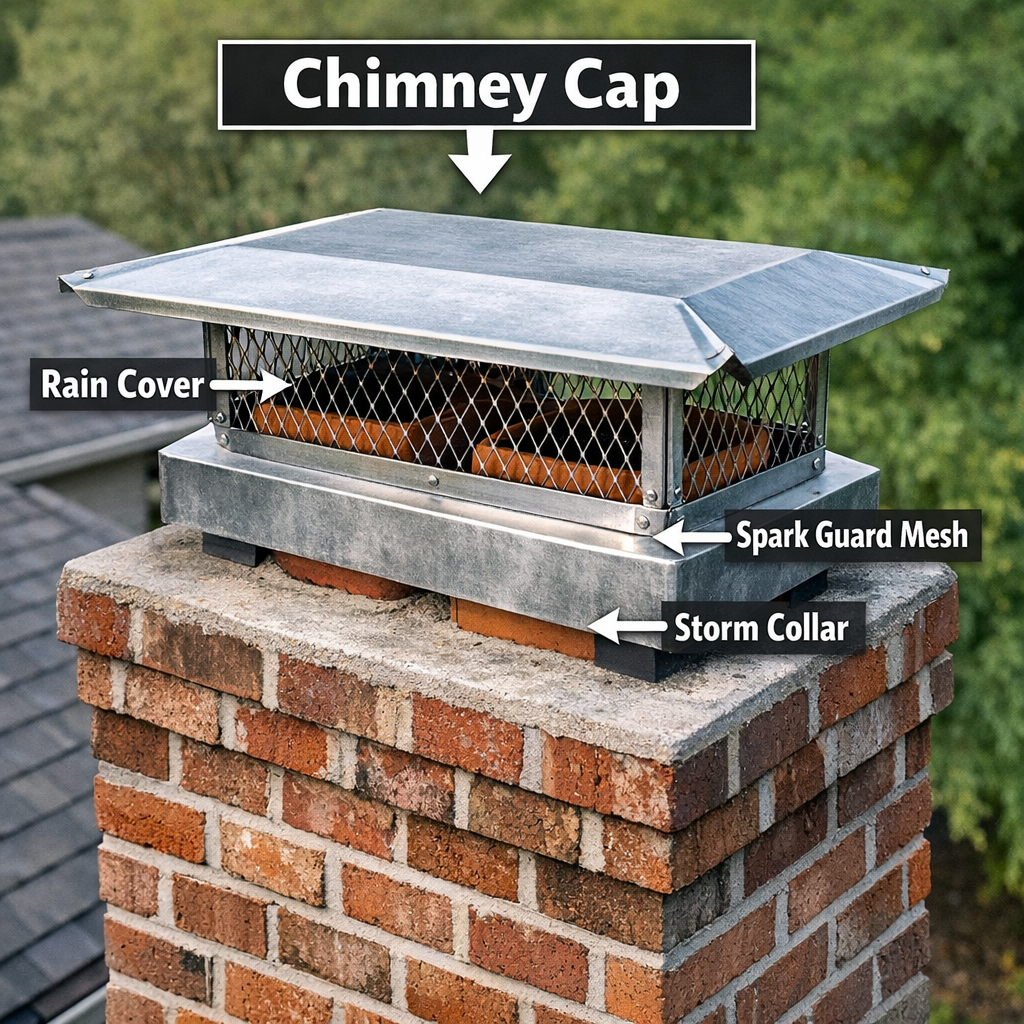
A lot of online content uses “chimney cap” and “chimney cover” interchangeably, and that’s a problem — because these are three different components with three different jobs and three different ways of failing. If a contractor can’t tell you which one you need, that’s worth noticing.
| Component | What It Is | What It Protects | Common Failure Signs |
|---|---|---|---|
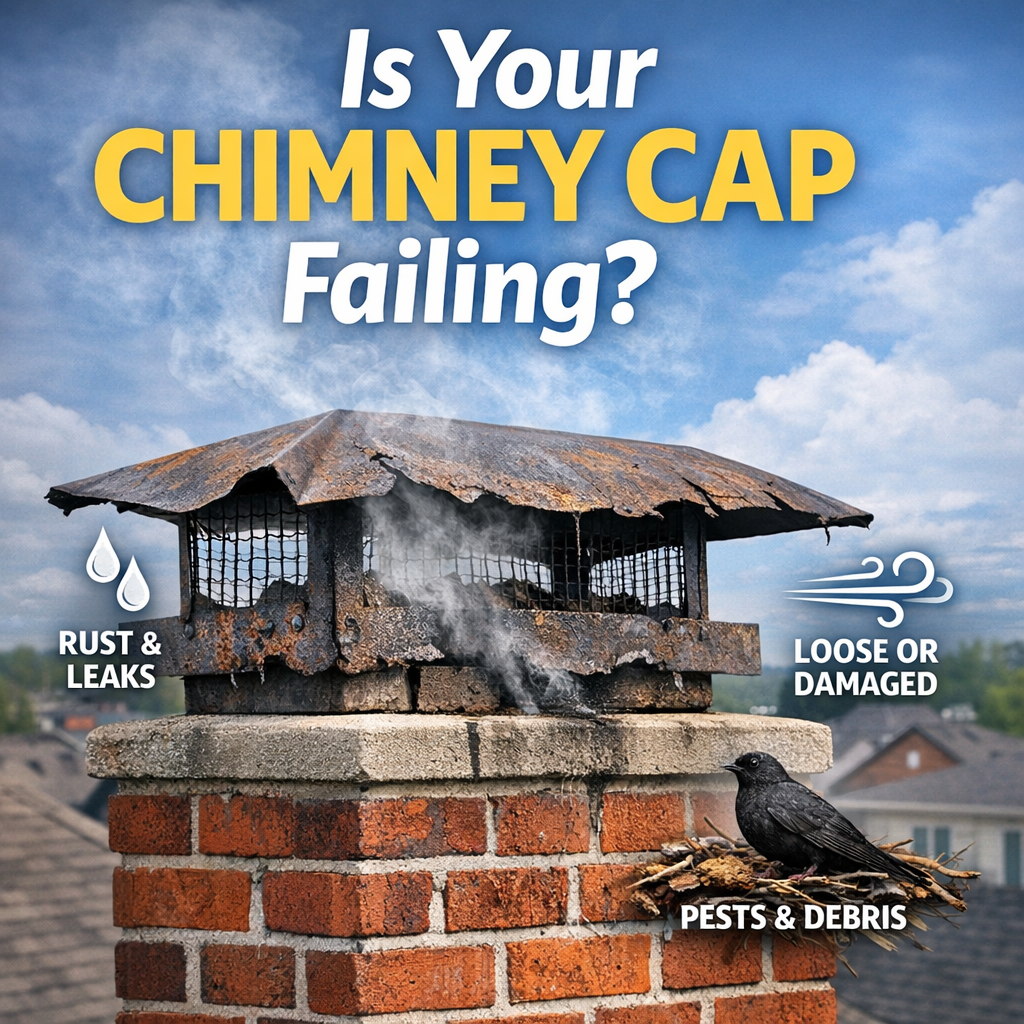
| Chimney cap | A metal cover (usually with mesh sides) mounted over the flue opening | The flue interior — keeps out rain, animals, and debris while letting smoke exit | Rust streaks, rattling or flapping in wind, missing or bent mesh, visible animal entry |
| Chimney crown | The sloped concrete or mortar surface at the top of a masonry chimney | The brick and mortar structure below it — sheds water away from the chimney body | Hairline cracks, spalling (flaking) brick faces near the top, white mineral staining |
| Chase cover | A flat metal pan covering the top of a framed, sided chimney chase (common with prefab fireplaces) | The wood-framed chase and the appliance inside it | Rust stains running down the siding, pooling water on top, visible sagging |
Why does this distinction matter? Because a homeowner who calls about a “leaking chimney cap” often has a cracked crown or a rusted-through chase cover — and fixing the wrong component means the leak continues. When we inspect a chimney in the Triad, we evaluate all three together, because they fail together. Water that gets past a damaged cap accelerates crown deterioration; a cracked crown lets water behind the cap’s mounting point. It’s a system, and it should be treated like one.
Here’s something most chimney cap pages won’t explain: in our part of North Carolina, the biggest enemy of your chimney isn’t a single storm. It’s the freeze-thaw cycle.
The Piedmont Triad doesn’t get the deep, sustained freezes of the mountains. Instead, we get dozens of nights every winter where the temperature dips below freezing and then climbs back above it the next day. That repeated crossing of the freezing point is exactly what destroys masonry, and here’s the mechanism:
This is why we say uncapped chimneys in High Point fail from the top down. By the time you notice brick fragments in the yard or staining on an interior wall near the fireplace, the freeze-thaw process has usually been at work for several seasons.
Here’s a distinction almost nobody makes: a properly designed chimney cap doesn’t just cover the flue opening — it protects the crown, too. A cap with an adequate overhang and a drip edge directs water clear of the crown’s surface instead of letting it sheet directly onto the concrete. A flue-mount cap with a stingy lid, by contrast, keeps rain out of the pipe while the crown around it slowly disintegrates.
When we recommend a cap for a Triad home, the crown’s condition and exposure are part of the conversation. That’s the difference between selling an accessory and protecting a structure.
If you’ve heard a chattering, fluttering sound coming from your chimney in late spring or summer, there’s a good chance you have chimney swifts — small, fast-flying birds that nest almost exclusively inside chimneys. High Point and the rest of the Triad sit squarely in their summer nesting range.
Here’s what matters for homeowners: chimney swifts are protected under the federal Migratory Bird Treaty Act. Once swifts have built a nest and laid eggs in your flue, it is illegal to remove them or cap the chimney until the young have fledged and left — typically by late summer. No reputable contractor will cap an actively occupied chimney, and you shouldn’t let anyone talk you into it.
What this means in practice:
This is the kind of detail that comes from actually working on chimneys in this region, season after season. It also changes how you should schedule the work — which is exactly why we bring it up before it becomes a surprise.
Every chimney cap page on the internet says “mesh keeps animals out.” Almost none of them explain that the size of the mesh openings is a genuine technical decision with real consequences in both directions.
Standards like NFPA 211, the national standard for chimneys, fireplaces, and venting systems, treat the cap and its termination as part of the venting system — not a decorative add-on. That’s the right way to think about it.
One more distinction the template pages skip: the right cap depends on what’s venting through the flue.
If your home has multiple flues — say, a wood-burning fireplace and a gas furnace venting through the same chimney — a single multi-flue cap may serve both, but it has to be sized and mounted correctly. Which brings us to materials and fit.
“Stainless steel is durable” is true but unhelpful. Here’s the practical breakdown for our climate, where humidity, heavy rain, and pollen-to-frost seasonal swings work on metal year-round:
A chimney cap that’s the wrong size doesn’t just look off — it changes how your fireplace breathes. Two things have to be right:
The mounting style has to match your chimney. A single clay flue tile that extends above the crown takes a flue-mount cap clamped directly to the tile. A chimney with multiple flues, or with flue tiles flush to the crown, typically needs an outside-mount cap that anchors to the crown itself and covers the entire top. Forcing a flue-mount cap onto the wrong configuration leaves gaps for water and wildlife — and we see it on DIY installations all the time.
The lid height affects draft. The cap’s lid needs adequate clearance above the flue opening so exhaust can exit freely in all wind conditions. A lid set too low compresses the exit path and can create downdrafts — that puff of smoke into the room when the wind gusts. On homes in exposed locations or near taller rooflines, wind dynamics at the chimney top are a real factor, and occasionally a specialty draft-correcting cap is the right call rather than a standard model.
This is why a proper cap recommendation starts with measurement and inspection, not a catalog. Flue dimensions, crown condition, fuel type, mesh requirements, and the chimney’s exposure all feed into the choice — and getting it right the first time means you won’t think about your chimney cap again for decades.
That’s the goal, honestly. A well-chosen, well-installed cap is the kind of improvement you forget about — while it quietly protects your masonry, your liner, and your living room through every Piedmont winter.
1. Schedule a top-down chimney inspection before the fall rush. Spring and summer are the best windows to have a professional evaluate your crown, flue tiles, and existing cap (or confirm one is missing). Inspectors book up fast once the first cold snap hits the Triad, so getting on the calendar early means any cap installation or crown repair happens before you actually need the fireplace.
2. Upgrade to stainless steel or copper if your current cap is galvanized. Galvanized caps were the budget standard for decades, but they rust through in Piedmont humidity. If your cap shows orange staining or flaking, plan its replacement in 2026 with a stainless or copper model — both resist corrosion for the long haul and typically carry far stronger warranties.
3. Pair the cap project with a chimney sweep and waterproofing check. A new cap protects the flue going forward, but it doesn’t undo existing creosote buildup or saturated masonry. Bundling a sweep and a crown/masonry waterproofing assessment with the cap installation gets the whole system to a clean baseline in a single visit.
Yes. An uncapped flue is an open hole in your roofline — rain, snow, animals, and debris all enter freely. Many older High Point homes were built before caps became standard, and the water damage just accumulates slowly until it shows up as a leaking firebox, rusted damper, or spalling brick.
A stainless steel or copper cap, properly sized and installed, routinely lasts decades — often as long as the chimney itself. Galvanized steel caps are the exception; they tend to rust and fail much sooner in our humid climate, which is why we steer most homeowners away from them.
Mechanically, some flue-mount caps are simple to clamp on. The risk is everything else: working at roof height, correctly matching the mount style to your flue configuration, sizing the lid height for proper draft, and spotting crown or tile damage while you’re up there. Most of the failed caps we replace are DIY installations that were the wrong style or size.
Watch for rust streaks on the chimney or cap, a lid that’s visibly bent or loose, debris or animal noise in the flue, smoke puffing back into the room on windy days, or water showing up in the firebox after rain. Any one of these is worth an inspection before the problem reaches your liner or masonry. Our article on common chimney cap problems you can’t ignore walks through each warning sign in detail.
A chimney cap is a small component with an outsized job, and getting the fit, material, and installation right the first time is what makes it a forget-about-it improvement. Smithrock Roofing has been providing chimney cap inspection and installation on homes throughout High Point and Kernersville for years, and we know exactly how Piedmont weather tests a chimney top. If you’re not sure what’s sitting on your flue right now — or whether anything is — Get a Free Estimate and we’ll take a look.
Smithrock Roofing © Copyright 2026 • All Rights Reserved • Privacy Policy • Maintained by Mongoose Digital Marketing