Replacing the windows in your home is one of those projects that feels straightforward until you start getting quotes. Suddenly you’re comparing frame materials, glass packages, installation methods, and warranty language, and every contractor sounds like they’re offering something different. Most homeowners in the Greensboro area end up making this decision without the full picture, and that gap between what they knew and what they wish they’d known is where problems start.
This guide is written for NC Triad homeowners who want honest, practical guidance, not a sales pitch. We’ll cover the technical decisions that actually determine whether your window replacement succeeds long-term, what to ask any contractor before signing, and why our area’s conditions require more than a generic approach.
(https://www.energy.gov/energysaver/window-types-and-technologies).”; item5_title=”The Local Factor”; item5_body=”Many older homes from this era have sill rot at bottom corners that is invisible from outside. Always have the sill condition inspected before agreeing to insert replacement.”; footer=”Smithrock Roofing, Greensboro, NC”]
Before you discuss window styles, glass coatings, or frame colors, there is one structural decision that will shape everything else about your project. Most contractors skip past it entirely.
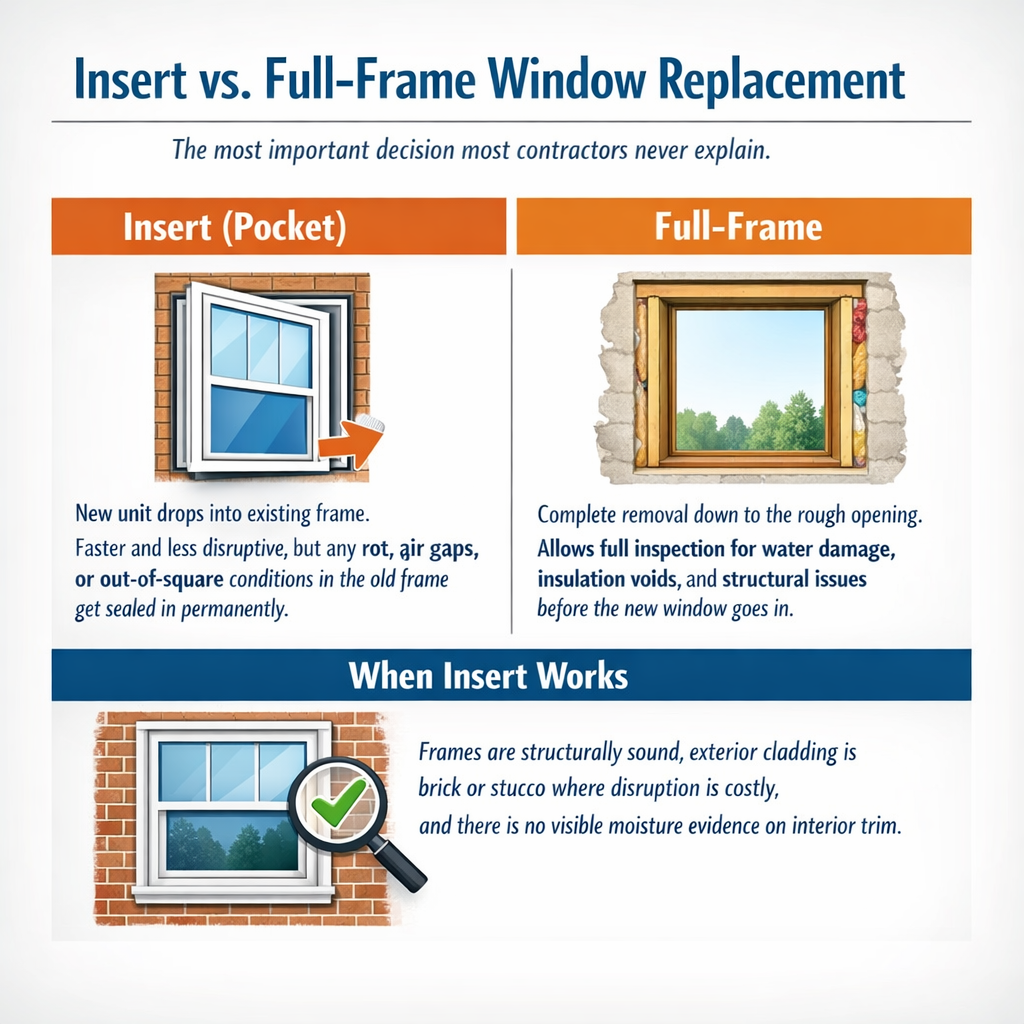
An insert replacement, sometimes called a pocket replacement, means the new window unit slides into the existing frame and is secured there. The original frame, jambs, and exterior cladding all stay in place. The work is faster, less disruptive, and involves less labor.
That convenience comes with a real risk. If your existing frame has rot, hidden air infiltration channels, or has racked out of square over the years, you are enclosing those problems permanently. The new window will sit inside the old frame, reducing your visible glass area slightly, and will perform only as well as the structural condition beneath it allows.
Insert replacement is the right approach when frames are genuinely sound, typically in brick or stucco exteriors where peeling back the cladding would be costly and disruptive, and in homes where there is zero evidence of moisture intrusion at the sill or interior trim.
Full-frame replacement means removing everything down to the rough opening, the original frame, jambs, exterior trim, and all. That opens up the entire perimeter for inspection, which is the only reliable way to find water damage, insulation voids, and structural irregularities before you seal them behind new materials.
Full-frame installation also gives your contractor a clean opportunity to air-seal properly at the rough opening level. This is where the real energy performance gains happen. A well-specified window in a poorly sealed opening will still underperform.
A significant share of older homes in our area were originally fitted with aluminum-clad wood frames, a construction approach that was common in that era and performed reasonably well when new. Over decades, however, the bottom corners of those frames are prone to sill rot that develops from the inside out. It is frequently invisible from the exterior and easy to miss on a quick walkthrough.
A contractor proposing insert replacement for homes in this age cohort should be inspecting the sill condition before recommending that approach. If they are not doing that, or if they are not raising the question at all, ask them directly. The answer tells you something important about how they work.
Need a hand with this in Winston-Salem, Greensboro and the NC Triad? Call (336) 971-0464 or request a free estimate. Honest answers, no pressure.
Our area sits in IECC Climate Zone 4A which the building science community classifies as mixed-humid. That classification has practical implications that most window contractors operating in this market never address.
A mixed-humid climate asks your windows to perform two partially conflicting functions depending on the season.
In summer, you need windows that limit solar heat gain, particularly on south, west, and east exposures, to reduce the load on your air conditioning system. In winter, south-facing windows that allow some passive solar gain can actually help offset heating costs. The standard pitch you will hear from most contractors, Low-E glass with argon fill, is not wrong, but it is incomplete. It does not account for the fact that the ideal glass specification varies by which direction each window faces.
The relevant performance metrics are:
Before any contractor finalizes a glass specification for your home, ask them this directly: “What SHGC are you recommending for my south-facing windows versus my north-facing windows, and why?”
A contractor who responds with a single glass package for every window in the house, regardless of orientation, is not performing a genuine energy assessment. They are offering a product catalog. A contractor who can walk through your home’s orientation, explain the tradeoffs for each exposure, and justify their specifications is demonstrating a different level of competence.
This is not a trick question. It is a basic diagnostic that any qualified window contractor should be prepared to answer without hesitation.
The table below breaks down the key specifications homeowners in Greensboro should understand before evaluating any window quote.
| Specification | What It Measures | Zone 4A Target | Common Contractor Claim | What to Watch For |
|---|---|---|---|---|
| U-Factor | Overall heat transfer through the entire window unit | ≤ 0.27 (ENERGY STAR minimum) | “Our windows are ENERGY STAR certified” | ENERGY STAR is the floor, not the ceiling. Ask for the actual U-factor number. |
| SHGC | Solar heat passing through glass | < 0.25 for south/west; flexible for north | “Low-E glass reduces heat gain” | One SHGC for all orientations is lazy specification. Push for orientation-specific glass. |
| Visible Transmittance (VT) | How much natural light passes through | Higher is better for livability | Rarely mentioned | Low SHGC coatings can reduce natural light; ask for VT alongside SHGC. |
| Air Leakage (AL) | Air infiltration through the window unit | ≤ 0.30 cfm/ft² | Often not mentioned at all | A low AL rating on the unit means nothing if rough opening air sealing is skipped during install. |
| Condensation Resistance (CR) | Resistance to condensation on interior surface | Higher score = better (0–100 scale) | Sometimes listed on premium windows | Relevant for Greensboro’s humid summers; low CR windows will show condensation that can damage interior trim over time. |
Every contractor in this market will mention a warranty. “Lifetime warranty” appears on so many proposal documents that it has lost almost all meaning. Here is what that language typically obscures.
The manufacturer’s limited lifetime warranty on a vinyl or fiberglass window typically covers the sealed glass unit against seal failure (fogging between panes) and covers the frame and hardware against defects in materials. This is genuine coverage that has real value, a quality sealed unit should not fog within ten or fifteen years under normal conditions.
When evaluating window proposals, ask every contractor the same question: “What does your labor warranty cover, and for how long?” A one-year labor warranty is industry standard. A contractor offering five years of labor warranty coverage is making a meaningful commitment to the quality of their installation, because they will be responsible for correcting any workmanship issues that surface over that period.
At Smithrock Roofing, we back our installation work with a 5-year labor warranty because we know that genuine craftsmanship holds up to that standard of accountability.
Online reviews are useful social proof, but they are not a vetting framework. A high review count tells you that many customers were satisfied. It does not tell you whether the contractor carries appropriate insurance, uses their own trained employees, or pulls permits when required. Here is a more complete approach.
Window replacement in North Carolina falls under contractor licensing requirements governed by the NC Licensing Board for General Contractors. For projects exceeding the applicable threshold, a General Contractor license is required. You can verify any contractor’s license status directly at nclbgc.orgnot by asking the contractor.
A significant number of window companies operating in the Greensboro market function as lead-generation or sales organizations that subcontract the actual installation work to separate crews. The company you sign with may have a clean license history, while the crew showing up at your home has no direct accountability to you at all.
Before signing anything, ask: “Will the crew installing my windows be direct employees of your company, or subcontractors?” This is not an accusatory question, it is a reasonable request for clarity. The answer affects warranty accountability if something goes wrong, liability exposure if a worker is injured on your property, and installation consistency across the project.
Ask for a Certificate of Insurance before work begins, and ask to be listed as an additional insured for the duration of the project. The certificate should show:
A reputable contractor will provide this document without hesitation. Reluctance or delay around this request is a more reliable warning sign than any number of negative reviews.
Depending on project scope, window replacements in Greensboro may require a building permit. Many contractors skip this step to save time and administrative cost. This creates a real problem for homeowners at resale, unpermitted work can complicate title insurance, trigger buyer inspection issues, and in some cases require remediation before closing.
Ask directly: “Will you pull permits for this project if required?” A straightforward yes, followed by the contractor explaining when permits are and are not required for window work under current local codes, is what you want to hear.
If your home is located in a historic overlay neighborhood, window replacement is not purely a contractor selection question. It is also a regulatory compliance question.
The City of Greensboro’s Historic Preservation Commission has review requirements for exterior alterations in designated historic districts. Window replacements that alter the character of original fenestration, including changes to divided light patterns, frame profiles, or glass reflectivity, may require commission review and approval before work begins.
Installing non-compliant windows in a historic district can result in required reversal of the work at the homeowner’s expense. This is a local detail that national window brands and out-of-market contractors consistently miss. Working with a contractor who knows the local regulatory landscape, and who will research your property’s overlay status before proposing a scope of work, protects you from an expensive compliance problem after the fact.
You can check your property’s historic overlay status through the City of Greensboro GIS Portal or by contacting the Planning and Development department directly.
The quality of a window replacement project is largely determined before the first window is removed. Here is what a thorough pre-installation process should include:
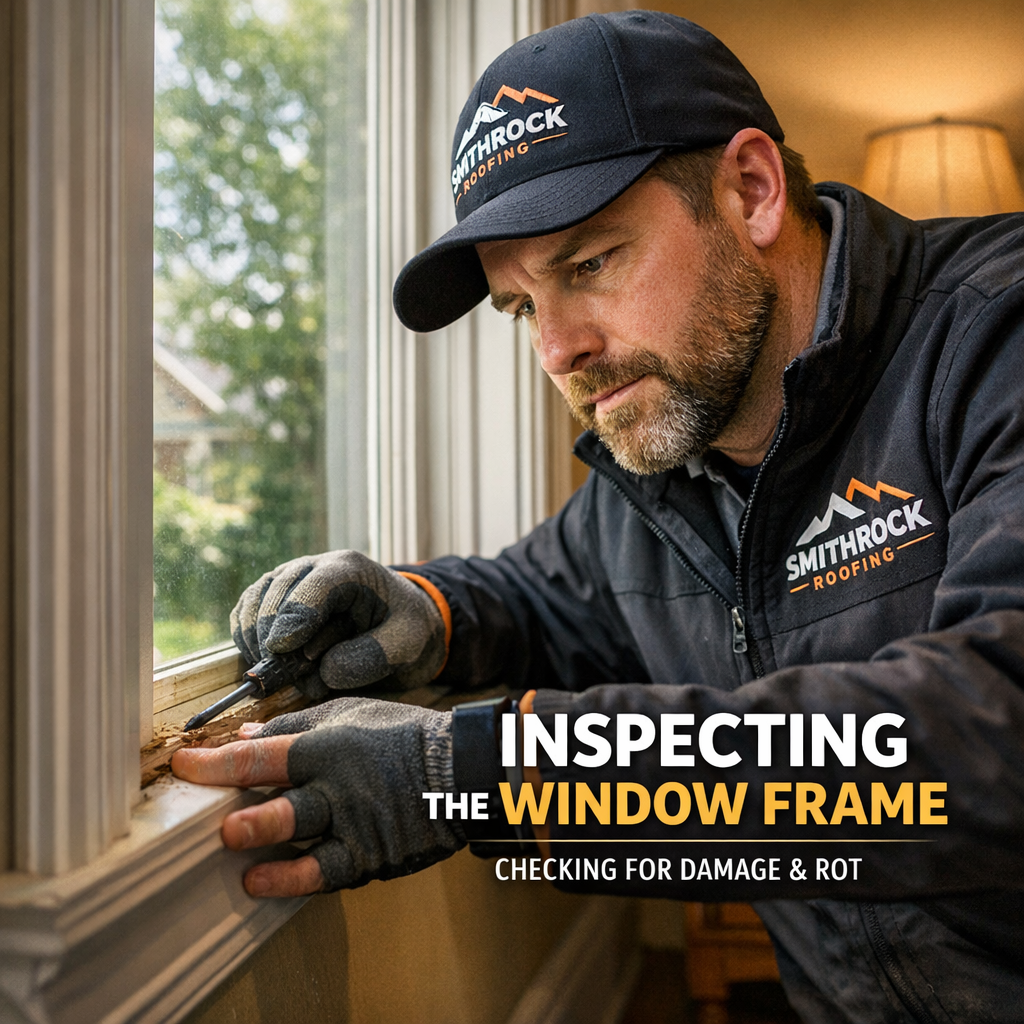
Every existing window opening should be examined for signs of moisture intrusion, rot, out-of-square conditions, and frame integrity before the installation method is determined. This is not optional due diligence, it is the step that determines whether insert or full-frame replacement is the right approach for each individual opening.
A qualified contractor should identify the orientation of each major window grouping, north, south, east, west, and use that information to specify the appropriate glass package. In a home with windows on multiple exposures, a single glass specification is rarely optimal.
Before finalizing a contract, the contractor should confirm whether permits are required for the project scope under current local building code requirements, and account for that process in the project timeline.
For homes in or near potential historic overlay zones, the contractor should verify the property’s regulatory status and disclose any HPC review requirements before proposing a scope of work.
Ask the contractor to explain their air sealing approach at the rough opening. Spray foam, backer rod, and flashing tape are all legitimate tools, what matters is that there is a deliberate plan, not an assumption that caulking the interior trim is sufficient.
Replacing your windows is a long-term investment in your home’s comfort, efficiency, and structural health. The contractor you choose will affect how that investment performs for the next twenty to thirty years. Taking the time to ask the right questions, and understanding enough about the technical decisions involved to evaluate the answers, is the most reliable protection you have.
Smithrock Roofing has served homeowners across the NC Triad for decades, and our approach to window replacement starts with an honest assessment of what your home actually needs, not what is easiest to install. If you are ready to have a straightforward conversation about your windows, we are ready to come take a look.
Insert replacement involves installing a new window unit into an existing frame that is structurally sound and free of rot or moisture damage. Full-frame replacement removes the entire window assembly, frame, sill, casing, and all, down to the rough opening. The right approach depends on the condition of your existing frames, not on what is faster or simpler to install. A qualified contractor should inspect each opening individually before recommending a method, because different windows on the same home may legitimately require different approaches.
Permit requirements depend on the scope of the work. Cosmetic replacements that do not alter the opening size or structural components may not require a permit, while full-frame replacements or any work that modifies the rough opening typically does. If your home is located within or adjacent to a historic district, additional review by the relevant preservation authority may apply regardless of scope. A reputable contractor should confirm the permit status of your specific project before work begins and account for that process in the project timeline.
The direction a window faces determines how much direct solar heat it admits at different times of day and across seasons. South-facing windows in our climate can be a net energy benefit in winter if they are specified with a higher solar heat gain coefficient, while west-facing windows are typically better served by lower SHGC values to reduce afternoon heat gain in summer. A single glass specification applied uniformly across all windows in a home is rarely the optimal solution. A contractor familiar with climate zone performance standards should review your home’s orientation and specify glass packages accordingly.
Well-manufactured replacement windows installed correctly, with proper air sealing at the rough opening, appropriate flashing, and frames suited to the existing conditions, should perform reliably for twenty to thirty years. The variables that most commonly shorten that lifespan are improper installation, inadequate air and water sealing at the opening, and installing into a damaged or moisture-compromised frame without addressing the underlying condition first. The installer’s process and material choices matter at least as much as the window unit itself.
Homeowners in Greensboro and High Point deserve a window replacement contractor who approaches each project with the same thoroughness they would want applied to their own home, honest assessments, appropriate specifications, and installation work that holds up over decades, not just through the first inspection. Smithrock Roofing has built its reputation across the NC Triad by doing exactly that, and we are ready to bring that same approach to your project. For more information about what sets our work apart, visit our Replacement Windows Greensboro NC article and let’s start with a straightforward conversation about what your home actually needs. Get a Free Estimate
Need a local pro? Learn more about our window replacement in Greensboro.

Smithrock Roofing © Copyright 2026 • All Rights Reserved • Privacy Policy • Maintained by Mongoose Digital Marketing