If you’ve been putting off a roof inspection or replacement in Kernersville, you’re not alone. Most homeowners don’t think about their roof until something goes wrong — a water stain on the ceiling, a shingle in the yard after a storm, or a neighbor who just had their roof replaced and got you thinking. The problem is, by the time a roof announces itself, the damage is usually deeper than it looks.
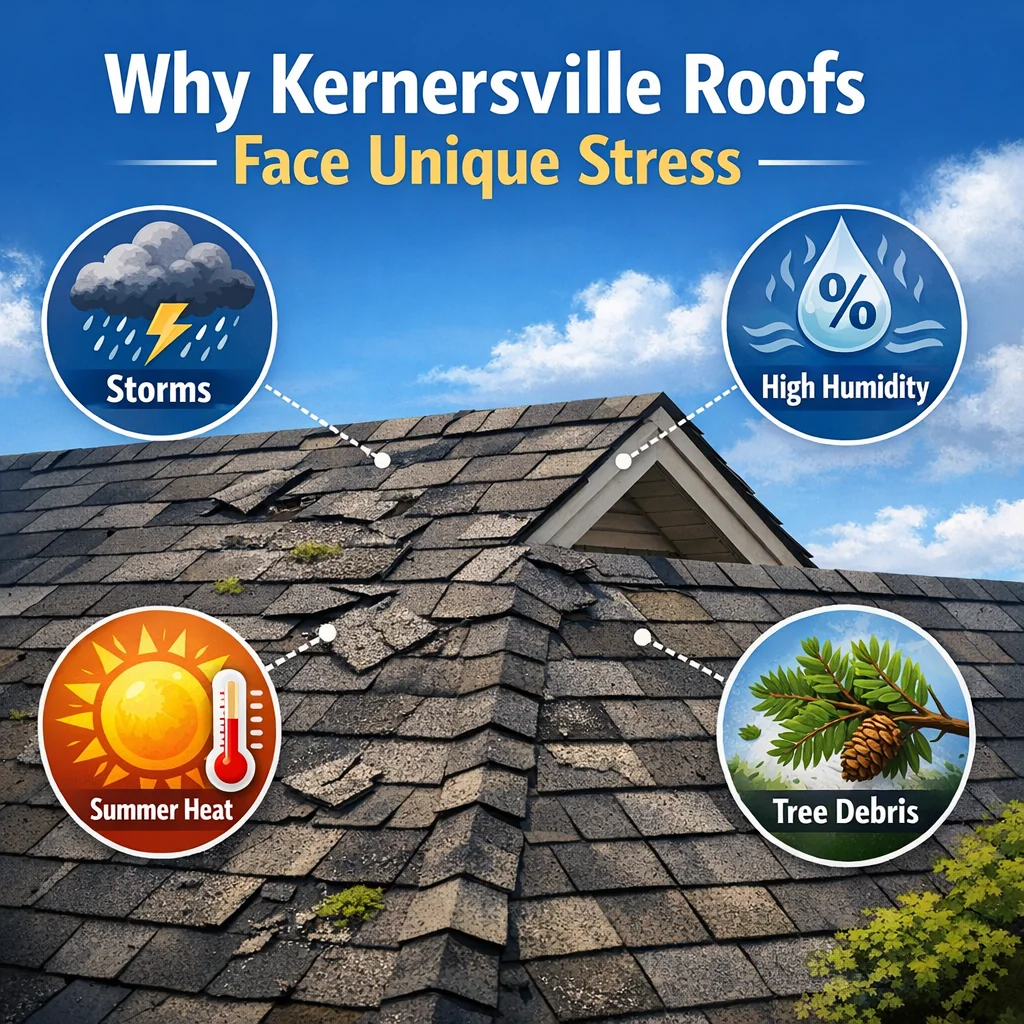
What makes roofing in Kernersville different from a generic roofing job anywhere in the Southeast is something most contractors won’t take the time to explain: this specific part of the NC Triad puts your roof under a set of compounding stressors that require more than a standard approach. Humidity, wind exposure, an older housing stock, and an insurance landscape shaped by real storm history all matter here — and they all affect what your roof actually needs.
This guide is written for Kernersville homeowners who want straight answers. Whether you’re evaluating a repair, planning a full replacement, or just trying to figure out what questions to ask a contractor, you’ll leave with a clear picture of how roofing decisions should actually be made in this market.
Kernersville doesn’t sit in a vacuum. Geographically, it occupies a transition zone between the Appalachian foothills to the west and the flatter Piedmont plateau to the east. That position matters more than most homeowners realize.
The foothills funnel cooler, moisture-laden air eastward through gaps in the terrain, and that air meets the warmer, humid air that builds across the Piedmont during spring and summer. The result is a sustained high-humidity environment that is particularly aggressive on roofing materials. Kernersville averages roughly 45 inches of rainfall annually, and the dew point frequently climbs high enough during summer months that moisture can condense on roof surfaces even without rain.
For your roof, this means one thing above all others: biological growth.
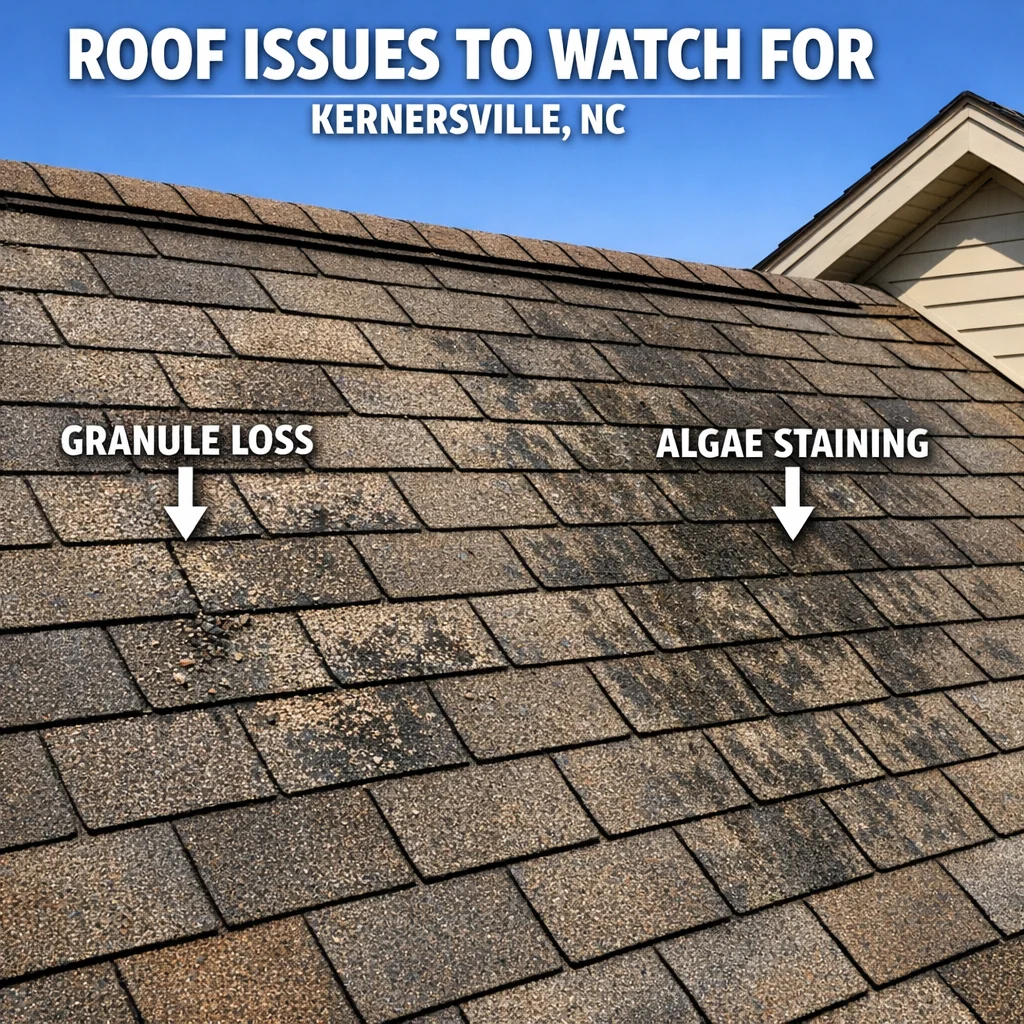
If you’ve ever noticed dark streaking on one side of a Kernersville roof — the kind that looks like a gray or black stain working its way down from the ridge — you’re looking at Gloeocapsa magma. It’s a cyanobacterium (a type of algae) that feeds on the limestone filler in standard asphalt shingles, and it thrives in the shaded, slow-drying conditions that north-facing slopes experience in this climate.
South-facing slopes dry out faster from direct sun exposure. North-facing slopes stay wet longer, hold humidity longer, and give algae the moisture it needs to establish. The visible staining is the surface symptom. Below the surface, algae growth gradually degrades the shingle’s UV-protective granule layer, which accelerates shingle aging and reduces reflectivity. Left untreated, what starts as a cosmetic issue becomes a structural one.
This is why, when Smithrock Roofing inspects a Kernersville home, the north-facing slope is always the starting point. It tells us more about how a roof has been aging than any other single indicator.
What to do about it: When selecting replacement shingles for a Kernersville home, algae-resistant products with copper-infused granules are the appropriate specification for this climate band — not a premium add-on, but a practical baseline. Copper ions inhibit algae attachment, which meaningfully extends the life of the roof in this specific humidity environment.
Kernersville’s position along Interstate 40 places it within a wind corridor that many homeowners underestimate. The relatively flat, open terrain along this stretch of the Triad allows wind to accelerate without the friction breaks that more wooded or hilly terrain provides. During severe weather events — and Forsyth County sees them regularly — sustained wind speeds in this corridor can reach the threshold where shingle uplift becomes a genuine risk.
Wind damage to shingles is often subtle. It doesn’t always look like missing shingles. More commonly, it presents as:
This is why proper deck fastening patterns and the use of high-wind-rated shingle products aren’t details to skip over during a replacement project. They’re the difference between a roof that holds in a 70-mph event and one that doesn’t.
A large share of Kernersville’s residential neighborhoods were developed during a building boom that ran from roughly the mid-1970s through the early 1990s. These homes are now 30 to 50 years old — which means many of them are on their second roof or approaching the point where a replacement is overdue.
What most homeowners don’t know is that replacing a roof on a home from this era is not a straightforward tear-off-and-reinstall job. The original roofing systems on these homes were designed to lower ventilation standards than what modern shingle manufacturers require. And this creates a specific, often overlooked problem.
Modern shingle manufacturers — including CertainTeed, whose Landmark shingles Smithrock Roofing installs — specify ventilation ratios as a condition of their limited lifetime warranties. The most common standard is a 1:150 net free area ratio (one square foot of ventilation for every 150 square feet of attic floor space), though some products allow a 1:300 ratio when ventilation is balanced between intake and exhaust.
Many homes built in the 1970s and 1980s were constructed to older standards that fall short of these ratios. Ridge vents, if they exist at all, may be undersized. Soffit intake venting is often blocked by insulation that was added without maintaining the required airway above it.
Here’s why this matters practically: if a contractor installs new shingles over an attic ventilation system that doesn’t meet the manufacturer’s specified ratio, the manufacturer’s warranty is automatically voided — even if the shingles themselves are installed perfectly. The homeowner ends up with a brand-new roof but no valid warranty coverage.
At Smithrock Roofing, we assess attic ventilation as part of every replacement evaluation on Kernersville homes. If the ventilation is insufficient, we address it before the new shingles go on. That’s not an upsell — it’s the only way to ensure the investment is fully protected. You can learn more about what’s covered and how it works on our Warranty page.
North Carolina’s Residential Code (Section R905) governs underlayment selection based on roof pitch, and this matters for Kernersville homes more than homeowners typically expect. The reason: Kernersville’s older neighborhoods contain a mix of steep traditional ranch rooflines and lower-slope additions that were added as families expanded their homes during the 1980s and 1990s.
A steep-slope section (greater than 4:12 pitch) and a low-slope addition (between 2:12 and 4:12 pitch) require different underlayment specifications:
| Roof Section | Pitch Range | NC Code Requirement | Recommended Approach |
|---|---|---|---|
| Steep-slope main roof | 4:12 and above | Single layer #15 felt (minimum) | Synthetic underlayment preferred for durability |
| Low-slope addition | 2:12 to 4:12 | Two layers of #15 felt OR single layer of self-adhering modified bitumen | Self-adhering membrane recommended in this humidity zone |
| Low-slope addition | Below 2:12 | Not suitable for standard asphalt shingles | Alternative roofing system required (EPDM, TPO, or modified bitumen) |
| Ice and water shield zones | Eave areas in freeze-thaw regions | Required at eaves to 24″ inside heated wall line | Additional coverage at valleys and penetrations strongly advised |
This table illustrates why a single-system approach to a mixed-pitch Kernersville home can fail. The contractor who quotes the job without distinguishing between these sections is either cutting corners or doesn’t know what they’re doing.
Kernersville and the surrounding Forsyth County area have seen measurable hail and wind events over the years. The geography that creates the humidity corridor also positions this area downstream of severe weather systems that track across the Piedmont. Homeowners who’ve lived here for more than a decade have likely experienced at least one storm significant enough to raise questions about roof damage.
The challenge with storm damage is that it isn’t always visible from the ground — and even when it is, the type of damage matters significantly when it comes to insurance.
This is one of the most important distinctions in post-storm roofing, and it’s one that many NC insurers leverage to deny or minimize claims. Understanding it before a roofer arrives puts you in a much stronger position.
Cosmetic hail damage refers to impact marks on shingles that affect appearance but do not compromise the shingle’s ability to shed water or protect the roof deck. North Carolina is one of several states where insurers may include cosmetic damage exclusions in their policies, meaning this type of damage may not qualify for a claim payout.
Functional hail damage refers to impact that actually compromises the shingle’s performance — specifically, impacts that fracture the fiberglass mat beneath the surface granules, displace granules from the impact point exposing the underlying asphalt, or cause shingle cracking. This type of damage creates points where water infiltration becomes likely over time, and it typically meets the threshold for a valid insurance claim under standard homeowner policies.
How to tell the difference matters. A contractor who calls every hail impact “functional damage” without demonstrating the specific indicators is not giving you reliable information — which can create problems if the claim is contested. A credible inspection will distinguish between the two and document them separately. For a deeper look at what inspectors actually look for on storm-affected roofs, the article on hail damage roof repair covers the hidden signs homeowners most often miss.
One of the most valuable steps a Kernersville homeowner can take after a significant storm is to begin their own documentation before any contractor sets foot on the property. This isn’t about distrust — it’s about protecting your position with your insurer.
This distinction directly affects what your roofing contractor should recommend, and any experienced contractor in the Kernersville market should be able to walk you through it.
Actual Cash Value (ACV) policies pay out the depreciated value of your roof at the time of damage. A 15-year-old roof that cost a certain amount to install originally won’t be paid out at that original value — it will be paid at that value minus depreciation for age and wear. In practice, this means the insurance payout may cover only a portion of the replacement cost, and the homeowner is responsible for the remainder.
Replacement Cost Value (RCV) policies are designed to cover the actual cost of replacing the damaged roof at current material and labor prices, minus the deductible. They typically pay out in two stages: an initial ACV payment, followed by a recoverable depreciation payment once the work is completed and documented.
Understanding which policy type you have before storm damage occurs — not after — is the kind of preparation that saves significant stress when a claim situation actually arises.
One of the most common misconceptions homeowners bring to a roofing project is the idea that selecting a shingle is the primary decision. In reality, the shingle is the most visible component of a system with five or six interdependent layers — and weak performance at any single layer undermines everything above it.
A properly designed roof system for a Kernersville home includes:
Roof deck — Typically OSB or plywood, which must be sound, properly fastened, and free of moisture damage before anything else goes on. Deck fastening patterns matter: the IRC specifies nail spacing and penetration depth that directly affect wind uplift resistance. Shortcuts here create vulnerabilities that won’t be apparent until the next major storm.
Drip edge — A metal flashing installed at eaves and rakes before underlayment, which directs water away from the fascia. Frequently omitted on budget jobs; required under NC code and critical for preventing fascia rot on homes with significant tree canopy (common in Kernersville’s established neighborhoods).
Ice and water shield — A self-adhering membrane applied at vulnerable areas: eaves, valleys, penetrations, and around skylights. In Kernersville, where freeze-thaw cycling can occur even in mild winters due to cold air funneling through mountain gaps, eave coverage to at least 24 inches inside the heated wall line is the minimum. Extended valley coverage is strongly advisable.
Underlayment — The secondary water barrier beneath the shingles. Synthetic underlayment outperforms traditional felt in this humidity environment: it resists tearing during installation, doesn’t absorb moisture, and maintains dimensional stability across temperature cycles.
Shingles — The primary weathering surface. CertainTeed Landmark shingles, which Smithrock Roofing installs as a standard product, are a dimensional architectural shingle rated for wind resistance and available with StreakFighter® algae-resistance technology, which is the appropriate specification for Kernersville’s climate.
Ventilation — As discussed above, this is not an afterthought. The ventilation system is what keeps the attic at a temperature and humidity level that allows the entire roof system to perform as designed. Inadequate ventilation causes heat buildup in summer (which cooks shingles from below), moisture accumulation in winter (which rots decking and voids warranties), and ice dam formation on eaves in freeze-thaw conditions.
When you’re comparing estimates in Kernersville, the detail level of a proposal tells you more about the contractor than the total number does. A trustworthy contractor’s proposal should specify:
A proposal that lists only “tear-off, new shingles, haul away” is not an estimate. It’s a number on paper that tells you nothing about what you’re actually getting. The right questions separate experienced professionals from cut-rate operators, and homeowners who ask them are always better protected.
A contractor who works regularly in Kernersville should be able to speak specifically to the challenges this market presents — not generic talking points about “NC weather.” They should know that north-facing slopes on homes in this humidity corridor need algae-resistant specification. They should be fluent in the ventilation requirements relevant to the 1970s–1990s housing stock that makes up a significant share of Kernersville neighborhoods. They should understand the local insurance claim landscape and be able to help you document damage accurately without overstating it.
This level of local expertise isn’t common. Most regional contractors operate with a general playbook that doesn’t account for the specific compounding stressors that Kernersville roofs face.
Not all certifications carry equal weight. Here’s a practical breakdown of what matters when vetting a contractor in this market:
| Credential | What It Means | Why It Matters |
|---|---|---|
| CertainTeed PREMIER ShingleMark Master Certified | Top tier of CertainTeed’s installer certification program | Unlocks access to SureStart PLUS extended warranty coverage; certifies installation quality standards |
| Licensed & Insured (NC) | State contractor license + general liability + workers’ compensation | Protects the homeowner from liability during the project |
| BBB A+ Rating | Sustained record of customer satisfaction and complaint resolution | Third-party verified reputation signal |
| Manufacturer Warranty Registration | Contractor registers your installation with the manufacturer | Required to activate extended warranty terms; ensures homeowner has documented coverage |
| Local References (not just reviews) | Verifiable completed projects in your immediate area | Confirms real local experience, not just general regional coverage |
Smithrock Roofing holds CertainTeed PREMIER ShingleMark Master Certified status — the highest certification tier CertainTeed offers — along with an A+ BBB rating backed by over 312 five-star reviews across Triad-area homeowners. Our team brings 60-plus combined years of experience specifically in exterior roofing systems, and every installation is registered with the manufacturer to ensure warranty coverage is fully active from day one. See what our customers have to say on our Reviews page.
Before signing anything with any contractor — including us — a Kernersville homeowner should walk through these questions:
These questions don’t require you to be a roofing expert. They require you to ask clearly and listen to whether the answers are specific or vague.
For Kernersville homeowners who haven’t gone through a full replacement before, knowing what to expect takes a significant amount of uncertainty out of the process.
1. Inspection and Assessment
A thorough inspection covers the full roof surface, attic access, ventilation measurement, flashing condition, and deck assessment from the interior where accessible. This takes time to do properly. Any contractor who gives you a replacement quote from the driveway without accessing the roof or attic is not giving you an accurate scope.
2. Proposal and Material Selection
After the inspection, the proposal should document all findings, recommended scope, product specifications, and warranty terms. This is your opportunity to ask the questions listed above. Material selection — shingle line, color, and any algae-resistance specification — happens at this stage.
3. Scheduling and Preparation
Weather-dependent scheduling is a reality in roofing. A reputable contractor will be clear about the anticipated timeline and communicate any changes promptly. Homeowners should plan for some disruption during the project day: vibration, noise, and equipment on the property are standard. Protecting items in the attic space from debris dislodged during tear-off is worth doing in advance.
4. Tear-Off and Deck Inspection
Once the old roofing material is removed, the deck is inspected in full. Any compromised decking identified during the initial assessment — or discovered after tear-off — should be addressed before new underlayment goes down. This is normal on older homes and should be anticipated, not treated as a surprise add-on.
5. System Installation
Drip edge, ice and water shield, underlayment, and shingles are installed in the correct sequence. Flashing at all penetrations, valleys, and transitions is completed as an integrated part of the system — not as an afterthought. Ridge cap is the final component.
6. Cleanup and Final Walkthrough
A professional crew leaves the job site clean. Magnetic nail sweeps, debris removal, and a final walkthrough with the homeowner are standard practice at Smithrock Roofing. The homeowner should receive documentation of the completed installation, manufacturer warranty registration confirmation, and labor warranty terms in writing.
Your roof is one of the few parts of your home that works completely without acknowledgment until it stops working. In a market like Kernersville — where humidity, wind exposure, an older housing stock, and an active insurance landscape all add up to a uniquely demanding environment — the difference between a roof that performs for 30 years and one that struggles through 15 comes down almost entirely to how well the system was specified and installed in the first place.
Smithrock Roofing has been serving Kernersville and the broader NC Triad for years, and we’ve built our reputation on one principle: treating homeowners the way we’d want to be treated when we’re the ones spending money on a major home repair. That means honest assessments, thorough proposals, certified installations, and workmanship we stand behind.
If you’re ready to have someone look at your roof and give you a straight answer about what it actually needs, we’d be glad to schedule that inspection.
If you’re planning ahead or already dealing with a roofing issue, these three steps will put you in the strongest position heading into the year:
1. Schedule a Preventive Inspection Before Storm Season
Spring in the NC Triad brings severe weather quickly. Booking a professional inspection in late winter — before the rush of storm-related calls — means you get thorough attention, accurate documentation, and time to plan any needed repairs without pressure. An inspection conducted now costs you nothing with Smithrock Roofing and gives you a clear picture of where your system stands.
2. Review Your Homeowner’s Insurance Policy for Roofing Coverage
Insurance language around wind, hail, and age-related depreciation changes regularly. In 2026, more carriers operating in North Carolina are tightening requirements around roof age and material type. Before you need to file a claim, understand what your current policy actually covers. If you’ve had recent storm damage, a roofing contractor with insurance claim experience — not a public adjuster soliciting door to door — should be your first call.
3. Document Your Roof’s Current Condition with Photos and a Written Report
Homeowners who have a dated, documented baseline report of their roof’s condition are in a significantly stronger position when filing an insurance claim or selling a home. Ask for a written inspection summary that notes the age of materials, condition of flashings, and any existing areas of concern. This documentation becomes part of your home’s file and can directly affect how a claim or home inspection goes.
The answer depends on several factors: the age of your existing roof, the extent and location of the damage, and how much of the system is still performing correctly. A missing shingle on a roof that’s otherwise in good shape is typically a repair. Widespread granule loss, multiple leak points, damaged decking, or a roof that’s approaching the end of its expected lifespan usually indicate that replacement is the more cost-effective long-term decision. A thorough inspection by a qualified contractor — not a quick visual from the driveway — is the only way to give you an honest answer.
Yes. Smithrock Roofing has direct experience working alongside homeowners through the insurance claim process for wind and hail damage. We document damage thoroughly, communicate with adjusters, and help ensure that what’s written into the claim scope actually reflects what the roof needs. We do not act as a public adjuster, but we do advocate for proper scope and workmanship from start to finish.
Architectural asphalt shingles remain the most widely used material in this region for good reason — they balance performance, longevity, and value in a climate that includes humidity, summer heat, and periodic severe weather. For homeowners looking for extended durability or specific aesthetic goals, metal roofing and premium shingle lines rated for higher wind resistance are worth considering. The right material depends on your home’s structure, your long-term plans, and what your insurance carrier accepts.
Most residential roof replacements in Kernersville are completed in a single day for standard-sized homes when weather cooperates. Larger or more complex rooflines, homes with multiple penetrations or steep pitches, or projects that uncover significant decking repair needs may extend into a second day. A reputable contractor will give you a realistic timeline before work begins and communicate promptly if anything changes once the tear-off is underway.
Kernersville homeowners deserve a roofing contractor who understands the local climate, works honestly through every stage of the project, and backs their work with warranties that mean something. Smithrock Roofing proudly serves Kernersville, Winston-Salem, and the surrounding Triad communities with the same standard of care on every job — whether it’s a storm inspection, a full replacement, or a repair that just needs to be done right. If you’re ready for a straight answer about your roof, Contact Smithrock Roofing and schedule your free estimate today.

Smithrock Roofing © Copyright 2026 • All Rights Reserved • Privacy Policy • Maintained by Mongoose Digital Marketing