Replacing or upgrading the siding on your home is one of the most visible investments you can make. It protects the wall assembly behind it, shapes how your home looks from the street, and quietly does a lot of heavy lifting against rain, wind, and heat year after year. For homeowners in Winston-Salem and across the NC Triad, that job is more demanding than it might be in other parts of the country — and the reasons why are worth understanding before you make any decisions.
At Smithrock Roofing, we’ve spent decades working on the exteriors of homes throughout Winston-Salem, Greensboro, High Point, Kernersville, Clemmons, Rural Hall, and King. What we’ve learned from that experience is that good siding work isn’t just about picking a material from a catalog. It’s about understanding the specific conditions your home faces, matching the right product and profile to your home’s architecture, and installing every panel with the attention to detail that determines whether your siding lasts fifteen years or forty.
This guide covers what most siding content never does: the climate realities of the Piedmont Triad, how installation quality shapes long-term performance, what to look for in a contractor, and how to navigate the real-world decisions homeowners in this area face.
The Piedmont Triad sits in a humid subtropical climate zone. Summers here are long, warm, and persistently humid — relative humidity regularly climbs above 70% through June, July, and August. Winters are mild by northern standards but still deliver freeze-thaw cycles that stress panel joints and any gaps in a cladding system.
What this means practically is that moisture doesn’t just come at your siding from the outside during a rainstorm. In a humid climate, moisture-laden air is always probing for a way into the wall assembly. If the system installed behind your siding — the housewrap, the drainage plane, the flashing at windows and penetrations — isn’t continuous and correctly detailed, that moisture finds a way in and stays there.
This is a point that separates experienced exterior contractors from those who simply hang panels. A premium fiber cement board installed over poorly lapped, untaped housewrap will develop moisture problems behind the cladding that you won’t see until they’ve damaged wall sheathing or insulation. Conversely, a quality vinyl system installed over a correctly detailed weather-resistive barrier will perform reliably for decades.
The drainage plane — the controlled gap and barrier between the cladding and the sheathing — is not a luxury feature. In Winston-Salem’s climate, it is the foundation of a siding system that actually works.
A growing number of builders and remodelers in the Southeast are specifying rainscreen gap installation for this reason. A rainscreen detail creates a deliberate air space behind the cladding that allows any moisture that does penetrate to drain out and dry rather than becoming trapped. It’s an added step that pays for itself in wall longevity, particularly on north-facing elevations and homes with significant shade coverage.
Winston-Salem’s temperature range is wider than many homeowners account for. Summer highs push into the mid-to-upper 90s. Winter cold snaps can dip into the teens. That’s a swing of 80 degrees or more across the year — and siding materials respond to that range differently.
Vinyl siding, in particular, expands and contracts meaningfully with temperature change. This is not a flaw; it’s a physical property of the material. But it means installation technique matters enormously. Panels must be nailed through the center of the nailing slot — never tight — to allow the panel to move freely. Contractors who drive nails flush against the panel edge are essentially pinning it in place, and the result when summer heat arrives is buckling, warping, or panel fracture.
This is one of the most common installation failures in the region, and it is almost entirely preventable with correct technique. It’s the kind of detail that doesn’t show up on a quote but absolutely shows up on your siding five summers later.
Winston-Salem has one of the more impressive urban tree canopies among mid-sized cities in the Southeast. That canopy is a genuine quality-of-life asset — it moderates temperatures, softens neighborhoods visually, and gives historic areas like Reynolda, Buena Vista, and Sherwood Forest much of their character.
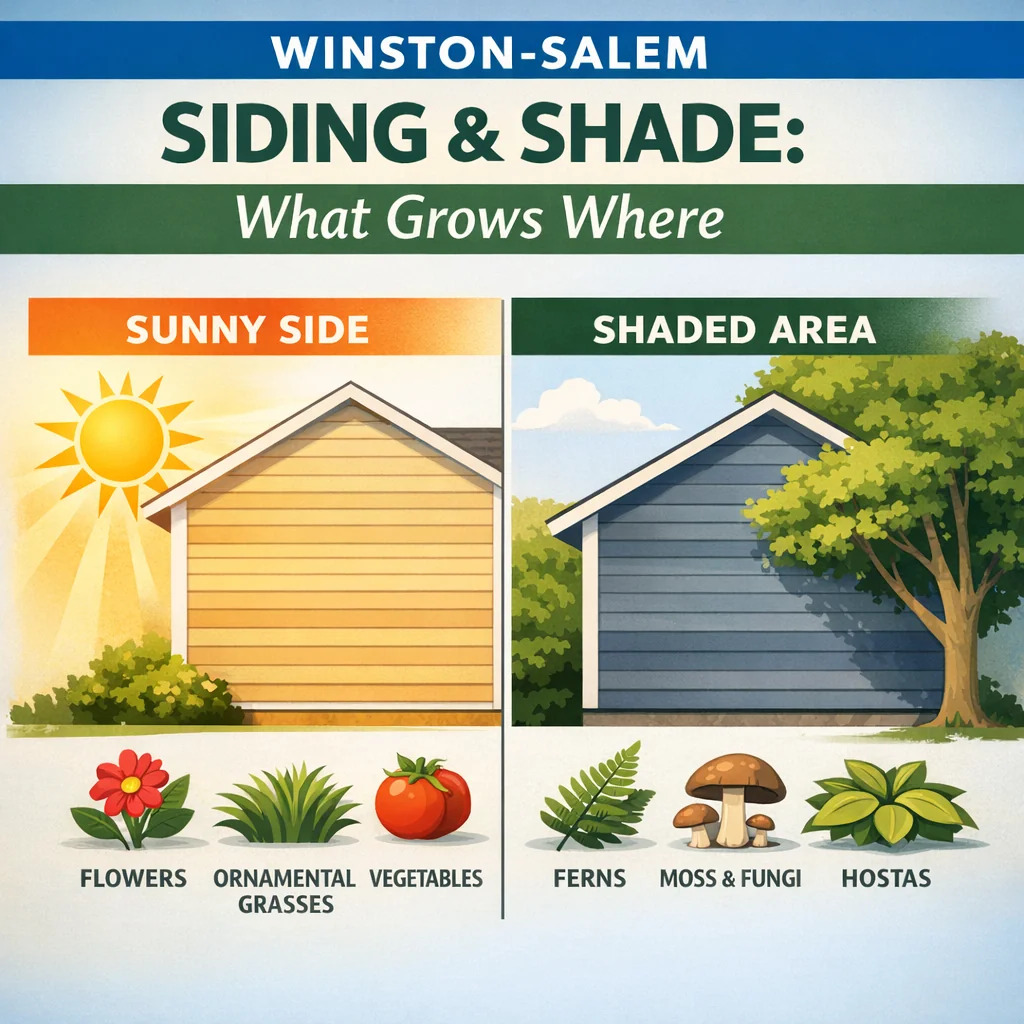
It also creates a specific problem for siding that almost no contractor in the area discusses openly: shaded elevations accumulate biological growth — algae, mildew, and lichen — at a dramatically faster rate than sun-exposed walls.
Here’s why. Sun-exposed siding dries quickly after rain. UV exposure inhibits biological growth. Shaded walls, particularly north-facing elevations under a dense canopy, stay damp longer after every rain event. That persistent moisture, combined with organic debris from nearby trees, creates conditions where algae and mildew establish themselves far more aggressively than on open exposures.
What this means for material selection:
When you’re evaluating siding materials, ask your contractor directly: what surface treatment or additive does this product use to resist algae and mildew growth? If they can’t answer, that’s useful information.
Winston-Salem’s residential neighborhoods span a wide architectural range. West End and portions of Ardmore feature Victorian and craftsman bungalows with detailed trim profiles and narrow lap exposures that are central to their character. Buena Vista and Sherwood Forest include colonial and Tudor-influenced homes. Newer developments in Lewisville, Clemmons, and Kernersville run toward traditional and transitional styles.
The siding product that performs best in a laboratory test isn’t automatically the right choice for a specific home. Profile, texture, and finish quality — how convincingly a product replicates traditional wood detailing — matter as much as durability specs when you’re working on a period home.
A few specifics worth knowing:
Homeowners in Winston-Salem’s locally recognized historic districts — including West End and portions of Ardmore — may face preservation guidelines that govern exterior material changes. These guidelines exist to maintain the architectural integrity of neighborhoods that are part of the city’s identity.
This is not a bureaucratic obstacle. It’s a framework that, when understood, actually helps homeowners make better decisions. Some specific points worth knowing:
Most homeowners evaluate siding bids on product and price. The installation details that actually determine how long a siding job performs are largely invisible — which makes it important to know what questions to ask.
Here are the installation factors that matter most:
Weather-resistive barrier (housewrap) installation:
– All seams should be lapped shingle-fashion — upper layers overlapping lower — so water cannot track horizontally behind the cladding
– All laps and seams should be taped with a compatible flashing tape; stapled-only or untaped housewrap is inadequate in a humid climate
– Penetrations (outlets, hose bibs, light fixtures) require individual detailing; a single unsealed penetration can compromise a large section of wall
Window and door flashing:
– Window-to-wall integration is one of the most common failure points in siding installations
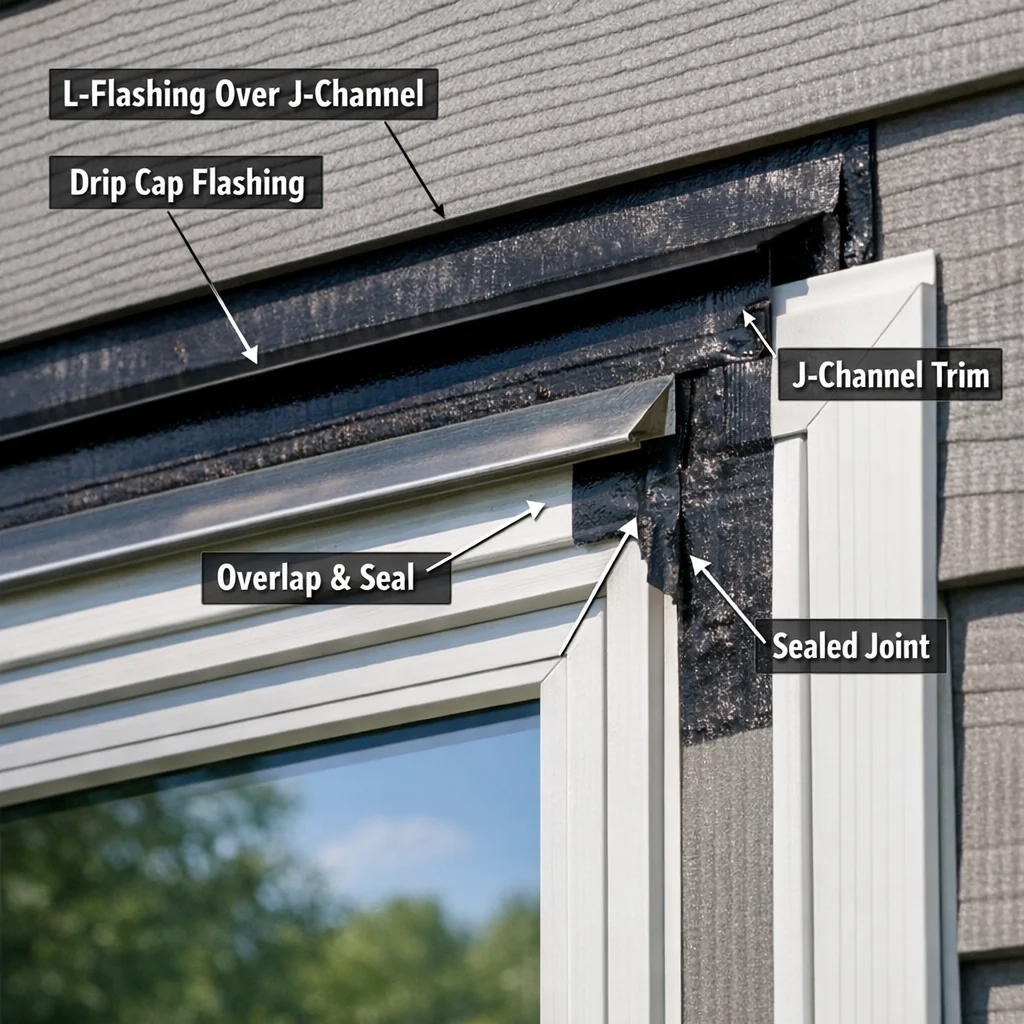
– Head flashing above windows must extend over the top of the housewrap; sill pan flashing below windows must drain outward
– J-channel at windows and doors should be back-caulked before installation; relying solely on field caulk at the exterior joint is insufficient long-term
Nailing technique for vinyl:
– Nails through the center of the nail slot, not the edges
– Panels left with a small gap at each end to allow thermal movement
– Panels should hang freely — if you can’t slide a panel slightly by hand after installation, it’s likely nailed too tight
Substrate assessment before installation:
– Any responsible contractor should examine the condition of the wall sheathing as old siding is removed
– Soft, spongy, or visibly damaged sheathing must be replaced before new siding is installed — installing over compromised sheathing shortens the life of the new product and masks a moisture problem that will only worsen
– This is not upselling; it is the minimum standard of a job done correctly
The table below covers the materials most commonly used in the Triad area. It reflects real-world performance considerations specific to this climate — not manufacturer marketing claims.
| Material | Moisture Resistance | Mold/Algae Risk | Thermal Expansion | Maintenance Level | Historic District Use | Best Application |
|---|---|---|---|---|---|---|
| Fiber Cement (Factory Finish) | Excellent | Low (factory finish resists adhesion) | Low | Low–Moderate (repaint 10–15 yr) | Often approved | Most home styles; shaded elevations |
| Fiber Cement (Field Painted) | Good | Moderate (paint film integrity is variable) | Low | Moderate–High | Often approved | Period homes where custom color required |
| Insulated Vinyl | Good | Low (mold-inhibiting additives) | High (requires correct nailing) | Very Low | Rarely approved | Suburban homes; north-facing walls |
| Standard Vinyl | Good | Low–Moderate | High | Very Low | Not approved | Value-focused applications; non-historic |
| Engineered Wood Composite | Moderate–Good (product dependent) | Moderate (varies by product) | Moderate | Moderate | Sometimes approved | Craftsman, cottage styles |
| Traditional Wood | Good (with maintenance) | High (requires consistent upkeep) | Low | High | Approved / preferred | Strict historic district applications |
| Stone Veneer Accent | Excellent | Very Low | Very Low | Very Low | Case-by-case | Accent zones; foundation courses |
Homeowners often notice something is wrong well before they know what to do about it. These are the signs most commonly seen on homes across the Triad that indicate siding repair or full replacement deserves a serious look:
Noticing one or more of these signs doesn’t automatically mean full replacement is necessary. A thorough inspection will identify whether targeted repairs or full re-siding is the right course — and a contractor giving you an honest answer on that question is a contractor worth listening to. For a broader look at how siding issues can interact with other exterior systems, the article on roof and siding repair covers how moisture entry points often span both systems.
Smithrock Roofing has been serving Winston-Salem and the surrounding NC Triad for years, and our approach to siding work reflects the same standards we bring to every exterior project. We carry an A+ BBB rating, 312+ five-star reviews, and more than 60 combined years of field experience across our team.
When we take on a siding project, the process starts with a real inspection — not a sales conversation. We look at what’s there, what’s behind it, and what your home actually needs. We explain what we find in plain language and give you the information to make a confident decision, whether that ends up being a repair, a partial replacement, or a full re-siding project.
We work with premium materials that are appropriate for this climate and for the specific conditions of your home. We pay attention to the installation details — flashing, moisture barriers, nailing technique, substrate condition — that most homeowners never see but that determine whether a siding job holds up for fifteen years or forty.
And when the work is done, we back it with a 5-year labor warranty in addition to the manufacturer’s warranty on materials. Because a job done right should stay right.
If you’re seeing warning signs on your home’s exterior, or if you’re ready to upgrade siding that’s reached the end of its service life, we’re ready to take a look. Reach out to Smithrock Roofing and let’s start with an honest conversation about what your home needs.
As you plan your home’s exterior for the year ahead, three steps will put you in the strongest position heading into next season:
1. Schedule a Preventive Exterior Audit Before Spring
Winter moisture and freeze-thaw cycles do quiet damage. Before spring rains arrive, have a qualified contractor walk your home’s exterior and assess where siding, flashing, and trim have taken on seasonal stress. Catching small failures in late winter means addressing them before water has another season to work deeper into the structure.
2. Document Your Current Siding Condition With Photos
Homeowners who keep a simple photo record of their exterior — taken once a year from consistent angles — build a valuable baseline. When something changes, you can see exactly when it appeared and how quickly it’s progressing. This record also supports insurance claims if storm damage becomes a factor.
3. Ask Your Contractor About Whole-System Compatibility
In 2026, more homeowners are thinking about siding alongside insulation upgrades and window replacements as a coordinated package. If any of those projects are on your horizon, talk to your siding contractor early. Doing work in the right sequence avoids tearing out new material to access what’s behind it — and lets you address moisture barriers and air sealing holistically rather than piecemeal.
Lifespan varies by material and installation quality, but vinyl siding in the NC Triad generally lasts between 20 and 40 years when properly installed and maintained. Fiber cement tends to perform well over 30 to 50 years with routine painting and caulk upkeep. Winston-Salem’s mix of humid summers, UV exposure, and occasional winter ice events can accelerate wear on siding that wasn’t installed with appropriate moisture barriers or that has gone without maintenance — so age alone isn’t the only factor to evaluate.
Yes, and in many cases that’s exactly the right call. If damage is localized — storm impact, a small area of rot, a few warped panels — targeted repair or partial replacement is often sufficient. The honest answer depends on what’s underneath the visible damage. If the sheathing or moisture barrier behind the affected panels is compromised, the repair scope may need to expand. A thorough inspection will clarify what’s actually necessary rather than defaulting to full replacement.
There’s no single right answer, but fiber cement and premium vinyl are both widely used in the Triad for good reason. Fiber cement handles humidity and temperature swings well, resists rot and insects, and holds paint for extended periods. Vinyl requires less maintenance and performs reliably when installed correctly with proper ventilation. The best choice for your home depends on its existing construction, your maintenance preferences, your aesthetic goals, and what the specific conditions of your exterior call for — which is why a site inspection matters more than a blanket recommendation. Our article comparing vinyl vs. Hardie Board vs. Everlast siding in Winston-Salem goes deeper on how these materials stack up against each other in this specific climate.
A well-run siding project begins with an inspection of the existing exterior — checking not just the siding itself but the substrate, moisture barriers, flashing, and trim details underneath. From there, material selection and project scope are confirmed. During installation, old siding is removed, the sheathing is inspected and repaired as needed, moisture barriers are addressed, and new siding is installed with attention to nailing patterns, overlap, and all the penetration and transition details that determine long-term performance. A final walkthrough confirms the work meets quality standards before the project closes out.
When your home’s exterior needs attention — whether it’s a failing panel, aging vinyl, or siding that’s simply ready for an upgrade — working with a team that knows the local climate, holds its work to a documented standard, and backs it with a real warranty makes a meaningful difference. Smithrock Roofing has earned the trust of homeowners across Winston-Salem and Kernersville by doing the work right the first time and giving straight answers along the way. If you’re ready to find out what your home’s exterior actually needs, Get a Free Estimate and let’s start with an honest conversation.

Smithrock Roofing © Copyright 2026 • All Rights Reserved • Privacy Policy • Maintained by Mongoose Digital Marketing