Most homeowners start researching replacement windows the same way — they search for a price range, scan a few tables organized by window style and frame material, and figure they have a reasonable handle on what the project will cost. That’s a reasonable starting point, but here’s the honest truth: those price tables tell you less than you think.
The average cost of replacement windows is a real number worth understanding. But the decisions that live around that number — the ones most contractors never walk you through and most articles never explain — are what actually determine whether your project performs the way you’re expecting it to five or ten years from now.
At Smithrock Roofing, we’ve spent decades helping homeowners across the NC Triad make smart decisions about their home’s exterior. Windows are part of that conversation, and we’ve seen firsthand what happens when homeowners get great windows installed wrong, or when the right window goes into a compromised frame that nobody bothered to address. The result is always the same: money spent twice.
This guide is built to fix that. We’re going to cover what drives window replacement costs, but more importantly, we’re going to cover the decisions underneath the price — the ones that separate a project that holds up from one that quietly disappoints you for years.
Before any conversation about window styles or frame materials, there’s a more foundational question that shapes everything — including your total project cost, the disruption to your home, and the long-term performance of the installation.
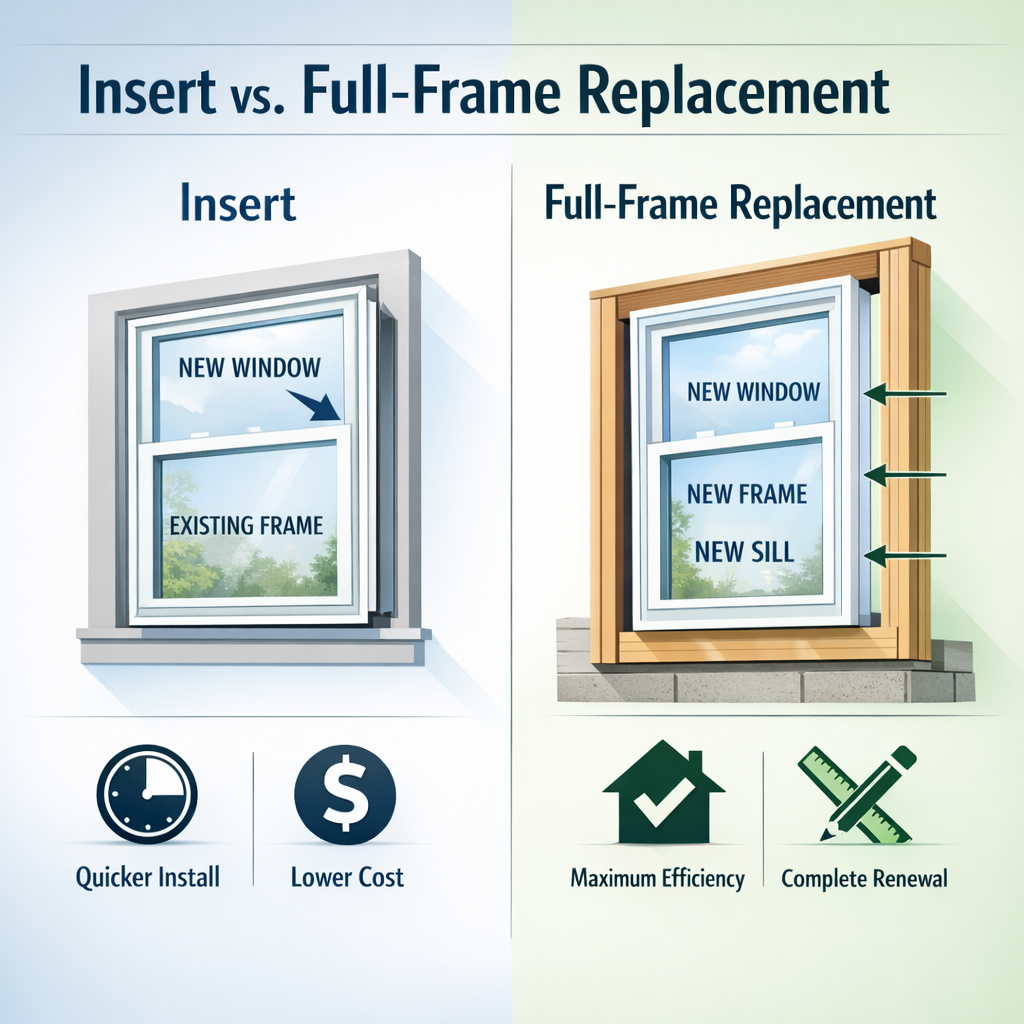
That question is whether your project calls for an insert replacement (also called a pocket replacement) or a full-frame replacement.
The industry often glosses over this distinction, partly because one option is faster and simpler to sell. Understanding the difference is the single most important thing you can do before you start collecting quotes.
In an insert replacement, the existing window frame stays in place. The old sash, glass, and hardware are removed, and a new window unit is fitted into the existing frame opening. The exterior trim, interior casing, and siding remain undisturbed.
This is a legitimate approach — when the existing frame is structurally sound, plumb, square, and free of moisture damage. It’s less disruptive, typically faster to complete, and the narrower scope of work is reflected in lower labor costs.
It works well when:
– The existing frame shows no signs of rot, warping, or water infiltration
– The rough opening is dimensionally stable and square
– The exterior trim and surrounding wall assembly are in good condition
– The project goal is primarily upgrading glass performance or replacing failing hardware
Full-frame replacement means removing everything — sash, frame, exterior trim, and often the interior casing — right down to the rough opening in the wall framing. A new construction or full-frame replacement window is then installed, and all trim and flashing work is rebuilt from scratch.
This is the correct approach when the existing frame is compromised in any way. And here’s the part that matters: choosing an insert replacement on a damaged or deteriorating frame isn’t a money-saving decision. It’s a delayed expense with interest. You’re sealing new materials over an existing problem, and that problem will continue developing underneath.
Visual indicators that full-frame replacement is necessary:
– Soft, spongy, or discolored wood at the sill or jamb corners
– Water staining on the interior wall below or beside the window
– Paint failure, peeling, or efflorescence on exterior trim near the frame
– Visible gaps or separation between the existing frame and the surrounding wall
– A window that no longer operates smoothly due to frame racking or settling
– Evidence of previous repair work patching rot or water intrusion
Insert replacements take less time per window. Because labor is typically a significant portion of the total project cost, a job that moves faster has better margins for the installer. This creates a subtle but real bias in the market toward recommending insert replacements even in situations where full-frame work is clearly the right call.
We’re not saying every contractor cuts corners here — but we are saying that a recommendation for insert replacement should come with a documented inspection of the existing frame condition. If a contractor is recommending pocket replacement without getting eyes on your sill and frame condition, that’s worth asking about directly.
Most window shopping conversations focus on style (double-hung, casement, bay) and frame material (vinyl, wood, fiberglass, aluminum). Those are real variables worth understanding. But two windows with identical styles and similar price points can perform dramatically differently in the real world — and the difference lives in the performance specifications, not the marketing language.
Every window sold in the United States can carry an NFRC (National Fenestration Rating Council) label. This label gives you four objective, independently verified numbers that tell you far more than any brochure.
U-Factor
This measures how well the window prevents heat from escaping your home. The lower the number, the better the insulation value. U-Factor is particularly important in heating-dominated climates — anywhere you spend significant months of the year keeping warmth in. A window with a low U-Factor reduces the demand on your heating system and prevents cold surface condensation during winter months.
Solar Heat Gain Coefficient (SHGC)
SHGC measures how much solar radiation passes through the glass into your home, on a scale of 0 to 1. A higher number means more solar heat enters. This is where climate zone matters enormously — and where many homeowners unknowingly buy the wrong window.
Buying a window with the wrong SHGC for your climate can actually increase your energy costs — even if the window is Energy Star certified. If you want to go deeper on how glass coatings interact with solar performance, The Low-Down on Low-E Glass: Your Guide to Smarter Windows is a useful resource for understanding exactly how these coatings are engineered and what tradeoffs they involve.
Visible Transmittance (VT)
VT measures how much visible light passes through the glass, also on a 0-to-1 scale. Higher is more light. Low-E coatings that reduce SHGC will often reduce VT as well, so there’s a tradeoff to manage between solar control and natural daylight. This matters especially in rooms where daylighting quality affects how the space feels and functions.
Air Leakage (AL)
This is perhaps the most underappreciated number on the label. AL measures how much air passes through the window assembly under standardized test conditions. Lower is better. Industry guidance suggests looking for AL ratings at or below 0.30 — though certified windows are required to meet a minimum threshold.
Air leakage matters enormously because, in many climate zones, air infiltration through poorly sealed window assemblies contributes more to energy loss than the glazing specification itself. A window with excellent U-Factor and SHGC values that’s installed with inadequate air sealing will underperform a more modest window installed correctly.
Energy Star certification means a window meets minimum performance thresholds for its climate zone. That’s meaningful — it weeds out the worst performers. But the range of performance among Energy Star certified windows is wide.
When you’re comparing quotes, ask contractors to provide the NFRC ratings for the specific windows being proposed. Don’t compare price without comparing the underlying performance numbers. Two windows at similar price points may have meaningfully different U-Factor or air leakage ratings that affect long-term performance and comfort.
Published price ranges for replacement windows are real, but they typically reflect the window unit and basic installation labor. The full project cost often includes additional line items that are conspicuously absent from the estimates homeowners first see.
Understanding these before you collect quotes puts you in a position to compare proposals accurately rather than being surprised mid-project.
If there’s any wood rot behind the existing window frame — at the sill, the rough sill, or the surrounding framing members — that condition needs to be addressed before the new window goes in. This work is often not visible until the old window is removed, which creates a legitimate scope ambiguity. A trustworthy contractor will discuss this as a conditional add-on and give you a range for what remediation typically costs. A less transparent contractor will surface this after demolition, when your options are limited.
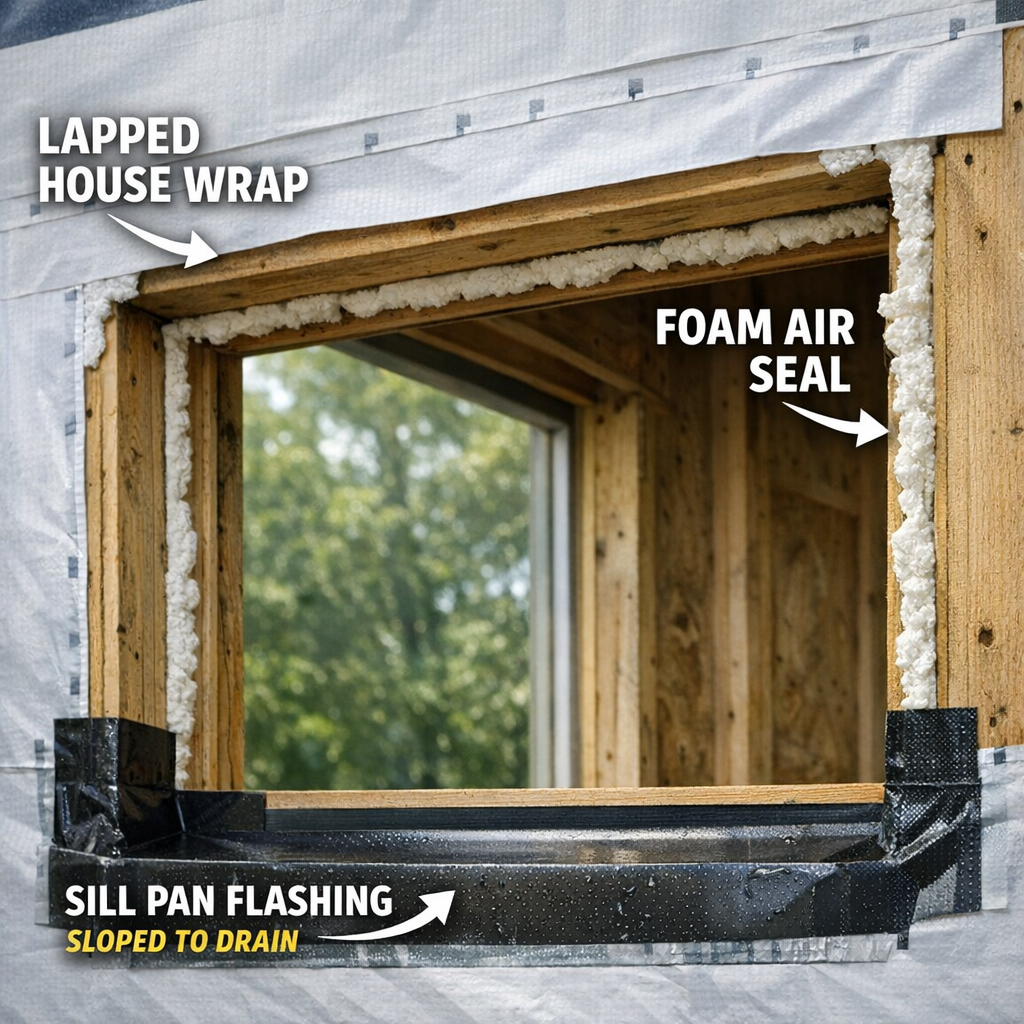
Window replacement is an intervention in your wall assembly’s moisture management system. The new window needs to integrate correctly with the water-resistive barrier (house wrap or building paper) behind the siding, and the flashing — particularly at the sill — needs to be properly sloped, lapped, and terminated to direct water away from the rough opening.
When this is done correctly, it restores the drainage plane around the window. When it’s omitted or done poorly, water infiltration problems can develop quietly over several years before they become visible damage. This work is not always itemized in quotes, and its absence is a meaningful quality differentiator.
Many jurisdictions require a building permit for window replacement, particularly for full-frame projects or cases where the opening size is changing. Permit responsibility — who pulls it, who pays for it — should be clearly stated in any contract. Some contractors exclude permits from their base quote. Others handle it transparently as part of the project. Either approach is legitimate as long as it’s explicit.
If your home was built before 1978, federal EPA regulations under the Renovation, Repair, and Painting (RRP) Rule apply to your window replacement project. This requires that the contractor be certified in lead-safe work practices, use specific containment and cleanup procedures, and dispose of debris according to regulatory guidelines.
This isn’t optional, and it’s not a minor footnote — it affects project planning, labor time, disposal costs, and contractor certification requirements. If you have a pre-1978 home and a contractor hasn’t raised this topic with you, that’s a conversation worth initiating directly.
Insert replacements typically leave interior casings intact. Full-frame replacements often disturb them. Whether interior trim restoration is included in the quoted scope — or is a separate cost — is a detail that matters to your final budget and to how the finished project looks.
“Get multiple quotes” is advice everyone gives and nobody explains. Here’s what that actually means in practice when you’re comparing window replacement proposals.
Quotes that look similar on the surface can represent dramatically different scopes of work. The lowest number often signals that something has been removed from the scope rather than that the contractor is more efficient. Your job is to identify exactly what’s present in each proposal and what’s absent.
Use this as a baseline checklist when reviewing any proposal:
| Line Item | What to Look For | Why It Matters |
|---|---|---|
| Window unit specification | Brand, product line, series, and NFRC ratings | Allows apples-to-apples performance comparison |
| Installation type | Insert or full-frame, explicitly stated | Changes scope, disruption, and long-term outcomes |
| Flashing and air sealing protocol | Specifically described, not just implied | Determines moisture management and energy performance |
| Interior trim | Included, excluded, or conditional | Affects finish quality and final project cost |
| Haul-away and disposal | Included or separately priced | Old windows and debris have disposal costs |
| Permit responsibility | Contractor or homeowner; included or billed separately | Regulatory and liability clarity |
| Frame condition contingency | How rot or damage discovered during removal is handled | Prevents mid-project surprises |
| Warranty structure | Manufacturer warranty on product; labor warranty on installation | Determines who covers what if problems arise |
| Lead paint protocol | Noted if home is pre-1978 | Regulatory compliance and safety |
| Installer certification | Any noted credentials (AAMA InstallationMasters or equivalent) | Affects manufacturer warranty validity and installation quality |
Beyond what’s in the quote, how a contractor conducts themselves during the quoting process tells you something important.
Here’s something the industry doesn’t say loudly enough: a well-installed mid-grade window will outperform a poorly installed premium window in almost every measurable way.
The rough opening — the framed cavity in your wall where the window sits — needs to be carefully air-sealed around the window frame after installation. This means addressing the gap between the window frame and the rough framing with appropriate materials: low-expansion spray foam, backer rod and sealant, or a combination depending on gap width and location.
When this step is omitted or rushed, air moves freely through that interface. In a heating-dominated climate, that means warm indoor air escaping and cold exterior air infiltrating — regardless of what the window’s U-Factor says on the label. The window performs to spec in laboratory conditions and underperforms in your home because the installation didn’t create an airtight system.
This is why the Air Leakage rating on the NFRC label reflects the window’s tested performance as a unit — not the performance of the installed assembly as a whole. Installation quality is the variable that connects the rated product to the real-world outcome.
Frame material conversations in most window articles stop at durability and aesthetics. The building science layer that gets skipped is thermal bridging.
Thermal bridging occurs when a material with high thermal conductivity creates a path for heat to travel through the wall assembly, bypassing insulation. Aluminum frames are particularly susceptible — aluminum conducts heat readily, which means the frame itself becomes a thermal pathway that undermines the glazing’s insulating performance. This is why aluminum windows, even with thermally broken frames, are generally not recommended for cold-climate applications despite being cost-competitive.
Vinyl has lower thermal conductivity than aluminum, which is part of why it dominates the replacement window market. Fiberglass has conductivity similar to glass itself — which is why fiberglass frames are considered by many building scientists to be the most thermally consistent choice. The frame doesn’t fight the glazing’s performance; it works with it.
Wood frames have excellent thermal properties but introduce moisture management complexity — they expand and contract seasonally, require maintenance, and are vulnerable to rot in poorly managed wall assemblies.
Understanding thermal bridging doesn’t mean you need to make the most expensive choice in every situation. It means you understand why frame material matters beyond what a product brochure tells you.
The most expensive window failure scenarios we see aren’t about the window itself failing. They’re about water finding a path into the wall assembly around the window and causing damage that takes years to become visible — rot in the structural framing, mold in the wall cavity, deterioration of interior finishes.
A properly installed replacement window integrates with three moisture management components:
The water-resistive barrier (WRB) — the house wrap or building paper behind the siding that prevents bulk water from entering the wall cavity. Window installation should lap and integrate with the WRB so there are no uncovered pathways to the sheathing.
The sill pan flashing — a sloped, waterproof layer at the bottom of the window rough opening that catches any water that gets past the window unit and directs it to drain outward. If the sill pan isn’t properly sloped and terminated, water sits in the rough opening and migrates inward.
The head flashing — at the top of the window, flashing should direct water away from the window opening and integrate with the WRB above it. Omitting this or doing it incorrectly is one of the most common sources of water intrusion around windows.
When you’re vetting a contractor, asking specifically how they handle sill pan flashing and WRB integration is a legitimate technical question. A contractor with real installation expertise will have a specific, confident answer. A contractor who treats window installation as a pure product swap may not. You can also explore our Windows service to see how Smithrock approaches installation quality for every project we take on.
There’s a distinction that almost never appears in consumer-facing content but that building professionals understand clearly: “replacement windows” are a specific product category with deliberate design compromises built in.
Replacement windows — the insert style — are engineered with narrower frames and reduced glass area specifically to fit within existing rough openings without disturbing surrounding finishes. That’s a genuine convenience. But it also means you’re typically getting less glass area than the original window, slightly reduced sightlines, and a frame assembly designed around installation convenience rather than maximum performance.
In most scenarios, this tradeoff is entirely reasonable. You’re modernizing the home’s performance without the disruption and cost of full-frame work.
But there are situations where replacement windows are genuinely the wrong product:
Knowing which product category your project actually calls for — and having a contractor who makes that recommendation based on your specific conditions rather than product availability or installation speed — is one of the most valuable things an honest contractor can offer.
As you move forward with a window replacement project, three specific steps will meaningfully improve your outcome and protect your investment.
1. Use ENERGY STAR’s Updated Product Finder Tool
The ENERGY STAR Most Efficient designation is updated annually, and the 2026 criteria reflect tighter performance thresholds across climate zones. Before speaking with any contractor, use the official ENERGY STAR Product Finder to identify window products that qualify for your specific climate zone. This gives you a credible baseline for evaluating contractor proposals and ensures you’re comparing products that will perform — not just products that are available.
2. Get a Pre-Bid Home Energy Assessment
Before collecting contractor quotes, consider scheduling a professional home energy assessment or blower door test through a certified BPI (Building Performance Institute) professional. This evaluation identifies exactly where your home is losing energy, whether windows are the primary culprit or a contributing factor alongside insulation or air sealing deficiencies, and what performance outcomes you can realistically expect from window replacement alone. Armed with this information, you’re in a far stronger position to evaluate proposals and push back on upselling.
3. Verify AAMA Certification Before Committing
The American Architectural Manufacturers Association (AAMA) certification program independently tests window products for air infiltration, water resistance, and structural performance. Before signing any contract, ask for the AAMA certification documentation for the specific product being proposed — not a category of products, but the actual unit being installed in your home. Contractors and manufacturers who resist providing this documentation are worth treating with appropriate skepticism. For a broader look at what separates a reliable window investment from a disappointing one, the article Everything You Need to Know About Window Replacement Cost covers the full cost picture in useful detail.
A replacement window — also called an insert window — is designed to fit within your existing window frame without disturbing the surrounding trim, siding, or interior finishes. A new construction window includes a nail fin flange and is installed directly into a rough opening, requiring full removal of the existing frame and surrounding finishes. Replacement windows are ideal when the existing frame is structurally sound. New construction windows are the correct choice when the frame is deteriorated, when you’re changing window size or configuration, or when you’re building new.
The number varies significantly based on home size, age, and original construction. A modest single-story home may have as few as eight to ten windows, while larger two-story homes commonly have fifteen to twenty-five or more. The total count affects overall project scope and gives you more negotiating leverage when working with contractors, as larger whole-home projects are often more competitively priced per unit than single-window replacements.
For most North American climate zones, double-pane windows with low-E coatings and argon gas fill represent a strong performance baseline. Triple-pane windows offer measurably better insulation values and are particularly well-suited to cold climates where extreme winter temperatures are the primary concern. However, triple-pane units are heavier and come at a higher price point. The right choice depends on your climate zone, the orientation of specific windows in your home, and how long you plan to remain in the property. An energy assessment can help clarify whether the upgrade is likely to pay off in your specific situation.
Fiberglass frames consistently rank highest for longevity and dimensional stability. Fiberglass expands and contracts at nearly the same rate as glass, which reduces seal failure over time, and it resists moisture, rot, and UV degradation more effectively than wood or standard vinyl. Aluminum-clad wood frames also offer strong durability with excellent aesthetic options. Standard vinyl frames are the most common choice due to lower upfront investment and decent performance, though quality varies widely between manufacturers. Regardless of material, quality of manufacturing and installation practices have as much impact on long-term performance as the material itself.
Start by inspecting the existing frame for soft spots, visible rot, moisture staining, or paint failure — particularly at the sill and bottom corners where water tends to collect. If the frame feels spongy or shows any structural softness when probed, full-frame replacement is likely necessary. If you’re also hoping to change the window’s size, shape, or configuration, insert windows are not the right product regardless of frame condition. A qualified contractor should evaluate your existing frames before recommending a product type — be cautious of any contractor who recommends insert windows without inspecting frame condition first.
Permit requirements vary by municipality. Many jurisdictions treat like-for-like insert window replacements as routine maintenance that does not require a permit. However, full-frame replacements, projects involving changes to window size or location, and work in historic districts often do require permits and inspections. Your contractor should be familiar with local requirements and handle permitting as part of the project. Be wary of contractors who suggest skipping the permit process to save time or money — unpermitted work can create complications when selling the home or filing insurance claims.
Reputable manufacturers typically offer lifetime limited warranties on the window unit itself, with specific coverage terms for the insulated glass unit — the sealed assembly between the panes — which is the component most vulnerable to failure over time. Pay close attention to whether the warranty is transferable to a new owner, what conditions void coverage, and whether glass seal failure is covered. Separately, your installing contractor should provide a workmanship warranty covering the installation itself, which is distinct from the product warranty. Read both documents before signing a contract.
Window replacement is a significant home improvement decision — one with meaningful implications for comfort, energy performance, and long-term property value. The most reliable path forward isn’t chasing the lowest bid or the most aggressive promotional offer. It’s understanding what your home actually needs, selecting products with independently verified performance credentials, and working with a contractor who earns your confidence through transparency rather than pressure.
Take the time to inspect your existing frames, gather multiple proposals, verify certifications, and ask questions until the answers are clear. The preparation you invest before signing a contract is the most effective quality-control measure available to any homeowner.
If you have questions about your specific situation or would like to discuss the right approach for your home, Contact Us.

Smithrock Roofing © Copyright 2026 • All Rights Reserved • Privacy Policy • Maintained by Mongoose Digital Marketing