Every homeowner eventually faces the window replacement conversation. Maybe you’ve noticed a draft that wasn’t there five years ago, or your energy bills keep climbing despite nothing else changing, or you’re simply staring at frames that are visibly rotting, fogging up between the panes, or refusing to open and close the way they should. Whatever brought you here, you’re probably looking for a number — a reliable, honest figure that tells you what this project is going to cost.
The problem is that most articles stop right where the useful information should begin. They hand you a national average, break down a few frame material options, and call it done. That might feel like research, but it leaves you no better equipped to evaluate a contractor’s quote, understand why two bids on the same house differ by thousands of dollars, or know whether the windows being recommended are actually right for your climate and your home.
At Smithrock Roofing, we’ve been doing exterior work across the NC Triad long enough to know exactly where homeowners get burned on window replacement — and it’s almost never about the price on the quote. It’s about everything that shapes that price that nobody explains beforehand. This guide is our attempt to change that.
Here’s something the standard “window replacement cost” article never tells you: the single biggest variable in your total project cost isn’t the window brand, the glass package, or even the number of windows you’re replacing. It’s the installation scope — and specifically, whether you need an insert replacement or a full-frame replacement.
Most homeowners hear these terms and assume they’re interchangeable, or that the installer just picks one. In practice, the decision should come from a structured diagnostic process that a qualified contractor runs before they ever quote you a number.
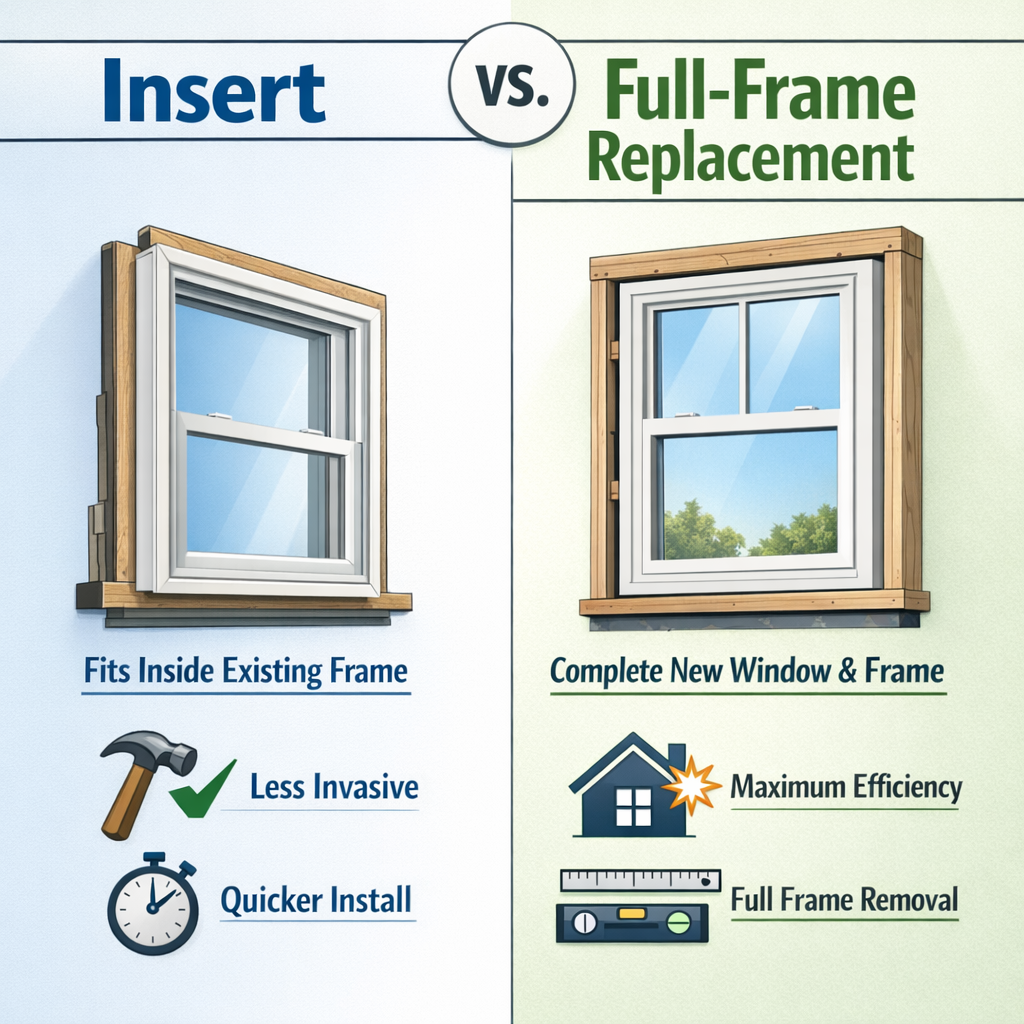
An insert replacement (sometimes called a pocket replacement) drops a new window unit into your existing frame, leaving the exterior trim, interior casing, and surrounding structure in place. It’s faster, less disruptive, and less expensive. But it’s only the right choice when the existing frame is sound.
A full-frame replacement removes everything — the existing window unit, the frame, the interior and exterior casing, and often the exterior trim and flashing system — down to the rough opening in the wall framing. It’s more involved, but in many older homes, it’s the only installation that will actually perform.
Here’s what a thorough pre-quote inspection should assess before that call is made:
Sill Pan Condition
The sill pan sits at the base of the window rough opening, behind the interior stool. Water infiltration — from failed glazing, cracked caulk, or condensation — collects here first. Probing this area for soft or spongy wood is one of the first things an experienced installer checks. A compromised sill pan means a rotted or weakened rough opening. Dropping an insert replacement into a failed sill pan is one of the most common reasons windows fail prematurely, regardless of product quality.
Exterior Brick Mold and Casing Integrity
Cracked, separated, or bowed exterior casing (called brick mold on many older homes) isn’t just a cosmetic issue. It often indicates frame movement caused by structural settlement or header deflection — problems that originate above the window, not in it. Replacing the window without addressing the underlying cause sets up the same failure cycle with a brand-new unit.
Plumb and Square of the Rough Opening
Insert replacements are manufactured to tolerances that assume a reasonably square rough opening. When a rough opening has racked out of square — which happens in older homes as framing dries and settles — shimming can compensate to a point. Beyond that point, the shimming gaps become air infiltration pathways that undermine the performance of even a high-quality window. A thorough installer measures diagonals in the rough opening before recommending an insert.
Frame-to-Wall Junction Thermal Performance
This one matters most in colder climates, including the western Piedmont of North Carolina where temperature swings are significant. In an older home with degraded or missing frame insulation, thermal imaging will often show that the coldest point in a room isn’t the glass — it’s the junction between the window frame and the wall cavity. An insert replacement into a cold frame doesn’t fix this. The fix requires opening the frame and addressing the insulation at the rough opening.
Understanding this diagnostic framework matters because it directly determines scope — and scope determines cost. A project that looks like a simple insert replacement on the surface can reveal full-frame needs once a qualified installer takes a closer look. Going in with this knowledge helps you ask better questions and evaluate estimates with more confidence. For a deeper look at how window frame replacement costs break down by scope, that breakdown covers what homeowners typically encounter at each stage.
Most articles rank window frame materials by what they cost to buy. That’s a useful starting point, but it’s also the beginning and the end of the analysis — which means homeowners end up making long-term decisions based on short-term numbers.
The more honest framework is total cost of ownership over the window’s service life, factoring in maintenance requirements, thermal performance, and warranted longevity. Here’s how the main frame materials actually compare across these dimensions:
| Frame Material | Typical Service Life | Maintenance Requirements | Thermal Performance Notes | Climate Considerations |
|---|---|---|---|---|
| Vinyl (standard) | 20–30 years | Minimal — clean periodically, no painting | Moderate insulating value; hollow chambers can be foam-filled for improvement | Expands and contracts with temperature; can warp in extreme sustained heat or cold at low grades |
| Cellular PVC | 30–40 years | Minimal to none | Better than standard vinyl due to denser material composition | More dimensionally stable than hollow vinyl in wide temperature swings |
| Fiberglass | 30–50 years | Low — can be painted | Excellent; closest thermal expansion to glass, minimizing seal stress | Performs reliably across wide climate ranges; strong choice for mixed-climate regions like the NC Piedmont |
| Wood | 20–40+ years (with maintenance) | High — requires regular painting or staining; susceptible to moisture | Naturally good insulating value | Demands climate-appropriate finishing; highly vulnerable in humid or wet climates without proper maintenance |
| Aluminum | 20–30 years | Low for the frame itself | Poor — conducts heat and cold readily; thermal break designs partially address this | Not recommended in heating-dominated climates without thermally broken frame design |
| Wood-Clad (exterior aluminum or fiberglass) | 30–40+ years | Moderate — interior wood still requires attention | Strong overall performance; combines wood insulating properties with weather-resistant exterior | Good fit for climates with both heat and cold exposure |
The practical takeaway: the cheapest frame at purchase is frequently the most expensive frame across a 20-year ownership horizon, particularly when you account for paint cycles, seal degradation, and early replacement in climates that stress lower-grade materials.
For homeowners in the NC Triad specifically — a mixed-humid climate that combines hot, humid summers with cold snaps that push into the single digits — cellular PVC and fiberglass frames consistently outperform standard vinyl over time, and the gap between them and wood in terms of maintenance requirements is significant.
ENERGY STAR is the certification most homeowners know, and it does matter. But treating it as the finish line for performance evaluation leaves a lot of important information on the table. ENERGY STAR represents a minimum qualification threshold — the floor of acceptable performance, not a ceiling.
Here are the specifications that go beyond the label and what each one is actually telling you:
The U-factor measures how readily a window assembly conducts heat — the lower the number, the better the insulating performance. The critical distinction most homeowners miss: many manufacturers report center-of-glass U-factor, which measures only the glass panel and excludes the thermally inferior frame and edge-of-glass zones.
The NFRC whole-unit U-factor — which is the metric certified by the National Fenestration Rating Council — accounts for the entire window assembly and is the only legitimate comparison metric when evaluating products across brands. If a salesperson quotes you a U-factor without specifying that it’s the NFRC whole-unit figure, it’s worth asking directly.
Solar Heat Gain Coefficient (SHGC) measures how much solar heat energy passes through a window. It’s expressed as a number between 0 and 1 — a lower number means less solar heat enters the home.
Most consumer content presents SHGC as a simple “lower is better” equation. That framing is only correct in cooling-dominated climates where blocking solar heat gain is the primary performance goal. In heating-dominated climates — or for south-facing windows in mixed climates — a moderate to higher SHGC can meaningfully contribute to passive solar heating, which reduces heating loads and energy bills. Specifying a low-SHGC window across all exposures in a mixed climate like the NC Piedmont can actually work against you energetically on your north and south elevations.
The correct approach is to spec SHGC by window orientation, not uniformly across the whole house. This is a conversation worth having with any installer you’re seriously considering. Our guide on energy-efficient window upgrades goes deeper on how to match glass specifications to your home’s specific orientation and climate zone.
Air leakage (AL) is the rate at which air passes through the window assembly under standardized test conditions. It’s rated in cubic feet per minute per square foot of window area — lower is better, with ENERGY STAR requiring AL ≤ 0.3.
This rating matters more than most homeowners realize. A window with excellent glass performance but a poor air leakage rating can effectively cancel out its own energy efficiency benefits, particularly in multi-story homes where stack pressure increases infiltration at upper floors, and in any location exposed to sustained wind. Ask for AL ratings before finalizing a product selection.
Condensation Resistance (CR) is scored 1–100, with higher numbers indicating better resistance to interior surface condensation. In high-humidity climates — which includes most of the NC Piedmont and Triad during summer months and in shoulder seasons — low CR ratings lead to chronic window condensation, which drives mold growth in window frames and sills and accelerates frame degradation regardless of material quality.
This specification is rarely mentioned in consumer-facing content, but in a climate like ours, it should be part of every serious product conversation.

Understanding how contractors price window replacement projects helps you evaluate quotes more accurately and structure the contracting process to your advantage. This part of the process is almost entirely absent from standard consumer content, but it has a direct impact on what you pay.
In the window replacement trade, the majority of a contractor’s margin typically comes from the product, not the labor. Labor is frequently priced at or near cost to appear competitive. This means a quote with low labor rates and premium-brand windows at retail pricing can easily end up more expensive overall than a higher labor quote with a transparent, competitive product price.
Knowing this, the question to ask isn’t “what do you charge per window for installation?” It’s “what is the product cost, and what is the installation cost, broken out as separate line items?” A contractor who can’t or won’t provide that breakdown is worth approaching carefully.
Several major window brands — including some of the most heavily advertised names in the market — operate through exclusive dealer or franchise agreements. This means a single authorized installer handles both the product sale and the installation in a given territory. The practical effect: you cannot get a competitive quote on the same product from a different installer. The comparison shopping process has a structural ceiling built into it.
This isn’t inherently a problem if the product and service are excellent, but it’s useful context. If you’re evaluating a quote from an exclusive dealer alongside quotes from independent installers carrying different brands, you’re comparing product and service bundles that aren’t directly interchangeable.
On whole-house or multi-window projects, manufacturers often offer volume discounts to distributors, who may pass some portion of that discount to installers. Whether any of that discount reaches you as the homeowner depends entirely on how the installer structures their pricing — it isn’t automatic.
On larger projects, it’s entirely reasonable to ask whether volume pricing applies and how it’s reflected in the quote. Experienced contractors who are confident in their product quality and their service relationship with distributors will be able to speak to this directly.
Many contractors require a signed contract and deposit before taking final rough opening measurements — which means you’re committing to a price before the full scope is confirmed. If the measurements reveal a rough opening that requires custom sizing, or if the inspection uncovers full-frame needs that weren’t visible during the initial walkthrough, the final scope may shift after you’ve already signed.
Understanding this sequence helps you ask for clarity upfront: specifically, whether the quote is contingent on inspection findings and what the process is if the scope changes after measurement.
Window installation has genuine seasonality. Installer capacity is tightest in spring and early fall — the periods when homeowners feel most urgency — and that capacity pressure shows up in pricing and scheduling lead times. In moderate climates like the NC Triad, late fall and early winter projects often carry more scheduling flexibility and, in some cases, more pricing flexibility as well.
This doesn’t mean waiting until January to start a window replacement conversation if you have a failing unit heading into cold weather. But if you’re planning a whole-house replacement and have flexibility on timing, it’s worth factoring calendar timing into your planning. Our article on why fall and winter are the perfect time for window replacements covers this seasonal advantage in more detail.
Whole-house replacement isn’t always the right starting point, and sequencing matters more than most homeowners realize. If budget or project scope requires a phased approach, here’s how to think about prioritization:
By Condition Severity
Any window showing active water infiltration, visible frame rot, or failed glazing seals (the fogging between panes that indicates seal failure) should be prioritized regardless of orientation or location. These windows are actively allowing moisture into your wall assembly — every season you wait compounds the damage.
By Heat Loss Exposure
In heating-dominated seasons, north-facing windows are the highest heat loss priority because they receive no direct solar gain to offset conductive losses. East and west-facing windows carry secondary heat loss concerns, and south-facing windows, if they’re reasonably intact, can continue contributing passive solar gain even at reduced efficiency compared to new units.
By Operational Integrity
Windows that don’t open, close, or lock properly are a safety issue and a code concern, not just a comfort issue. Single-hung and double-hung units on bedrooms must be openable as egress in many jurisdictions. This moves operability failures into the priority column regardless of their thermal performance.
By Impact on Bulk Pricing
If your plan includes replacing a significant number of windows — say, ten or more — it may make financial sense to coordinate that work in a single contract rather than phasing it across multiple seasons, even if some of the later-priority windows could wait. The volume pricing conversation becomes more meaningful at higher unit counts, and mobilization costs (setup, cleanup, waste disposal) are spread across the full project rather than duplicated across phases.
Getting multiple quotes is sound advice. Knowing how to evaluate those quotes structurally is the part that actually protects you.
A well-structured window replacement proposal should include:
On the certification side, look for installers who can speak knowledgeably about NFRC ratings and climate zone performance specifications. That conversational fluency is a reasonable proxy for product and installation knowledge that goes beyond what a sales brochure can tell you.
At Smithrock Roofing, our window replacement services are backed by the same standards we apply to every exterior project — licensed and fully insured, with more than 60 combined years of experience serving homeowners across the NC Triad. We’ll assess your existing frames honestly before we recommend an installation approach, and we’ll walk you through the product specifications in plain language so you understand exactly what you’re getting and why.
Before you request a single quote, position yourself to evaluate the process — not just the price. Three actions that will serve you well heading into a window replacement project this year:
1. Pull Your Home’s Climate Zone Classification First
The U.S. Department of Energy’s Energy Saver tool and the IECC climate zone map are both publicly accessible and free. Knowing your climate zone before you speak to a contractor gives you a concrete filter for evaluating product specifications. If a contractor recommends a window without referencing U-factor or SHGC targets appropriate for your zone, that gap in their presentation tells you something important.
2. Use NFRC’s Certified Products Directory to Verify Window Ratings Independently
Once a contractor provides a specific model and series — which any proposal worth accepting should include — cross-reference those ratings at nfrc.org before you sign. This takes under five minutes and confirms that the product performs as represented. Discrepancies between what a contractor states verbally and what the certified label shows are rare, but the verification habit protects you when they’re not.
3. Request a Pre-Installation Frame Condition Assessment in Writing
Before any contract is executed, ask the contractor to document the current condition of your existing frames, sills, and rough openings. This written baseline accomplishes two things: it protects you against scope-change disputes mid-project, and it signals to the contractor that you’re an informed buyer — which consistently correlates with more careful work and more transparent communication throughout the project.
An insert replacement installs a new window unit into the existing frame, leaving the original frame, sill, and exterior casing in place. This approach is less invasive, faster to complete, and appropriate when the existing frame is structurally sound with no rot, moisture damage, or significant air infiltration. A full-frame replacement removes everything down to the rough opening — frame, sill, casing, and all — and rebuilds from scratch. Full-frame is required when the existing frame is compromised, when you’re changing window size or configuration, or when you need to address underlying moisture or structural issues. Choosing the wrong approach can mean either overpaying for scope you didn’t need or underinvesting and leaving a deteriorated frame sealed behind a new unit.
Three is the practical minimum for a residential project. Two quotes give you a comparison but no tiebreaker when the proposals differ meaningfully. Three quotes establish enough of a reference range to identify outliers in either direction — an unusually low quote that may reflect product or labor shortcuts, or an inflated quote that doesn’t reflect actual market scope. More important than the number of quotes is the structure of each proposal. An itemized proposal specifying product model, installation type, flashing approach, and warranty terms gives you the information to compare contractors on substance, not just the bottom line.
North Carolina spans climate zones 3 and 4, which means the dominant performance priorities are solar heat gain control in the warmer months and adequate thermal resistance in winter. The two NFRC ratings most relevant to this balance are U-factor, which measures how well the window resists heat flow (lower is better), and Solar Heat Gain Coefficient (SHGC), which measures how much solar radiation passes through the glass (lower limits unwanted heat gain). Low-E glass coatings tuned to mixed climates address both metrics. Double-pane units with argon or krypton gas fill between the panes improve U-factor performance meaningfully over standard air-filled units. Frame material also matters: fiberglass and composite frames outperform vinyl thermally and dimensionally over time, while wood frames require more maintenance but perform well when properly maintained.
The physical installation of most residential window replacements — assuming standard insert work on a single-family home — runs one to three days for a full-house project and a few hours for individual unit replacements. The more relevant timeline variable is manufacturing lead time. Windows are built to order from specified measurements, and lead times from major manufacturers currently run several weeks to a few months depending on product line, configuration complexity, and current production schedules. Your total project timeline runs from the date measurements are confirmed to the date installation is complete. A contractor who can’t give you a realistic lead time estimate at the proposal stage is working without confirmed supplier relationships, which carries its own risk.
Window warranties operate on two separate tracks that homeowners frequently conflate. The manufacturer’s product warranty covers defects in the window unit itself — glass seal failures, hardware defects, frame material failures, and coating delamination — and these warranties vary significantly in duration and transferability by brand and product line. The installer’s labor warranty covers the quality of the installation work: flashing integrity, weatherization, air sealing, and anything that results from how the window was placed and secured rather than what the window is made of. Water infiltration, for example, is often an installation issue rather than a product defect, which means it falls under the labor warranty. Always request both warranties in writing before signing a contract, and confirm whether the labor warranty survives a home sale.
The answer depends on the current condition of your windows and how that condition affects your sale position. Windows that are visibly deteriorated, operationally failed, or flagged in a pre-listing inspection create a negotiating liability that typically exceeds the replacement investment. Buyers and their inspectors will discount for known deferred maintenance, and the line item they assign is rarely favorable to the seller. On the other hand, replacing functional windows that are showing cosmetic age primarily for resale appeal rarely returns full value. The practical framework is condition-driven: replace what would otherwise become an inspection issue or a buyer objection; preserve budget where the existing windows are performing adequately and the cosmetic concern is minor.
Window replacement sits at the intersection of home performance, structural integrity, and long-term value — which means the decisions you make during contractor selection and product specification carry consequences that outlast the installation date by decades. The homeowners who navigate this process well aren’t the ones who found the lowest number on a quote sheet. They’re the ones who understood what they were buying, verified what they were told, and chose a contractor whose knowledge and track record matched the scale of the commitment.
If you’re at the point of planning a window replacement project in the NC Triad, we’d welcome the opportunity to put that standard to work for you. Contact Us to schedule an assessment and receive a fully itemized proposal — no bundled numbers, no unanswered questions about what you’re getting and why.
Smithrock Roofing © Copyright 2026 • All Rights Reserved • Privacy Policy • Maintained by Mongoose Digital Marketing