Replacing windows is one of those home improvement decisions that looks straightforward from the outside — pick a style, get a quote, sign a contract — until you’re three weeks into the project and discovering rot behind the old frame that nobody mentioned during the estimate. Homeowners across the NC Triad ask us about window replacement regularly, and the questions they come in with are almost always shaped by the same generic information circulating online: a price table, a list of frame materials, and a reminder to “get three quotes.”
That advice isn’t wrong. It’s just incomplete. And incomplete information before a window project can cost you far more than any upfront savings you thought you were protecting.
This guide is built around the questions that actually matter — the ones an experienced contractor is quietly working through before they ever hand you a number. We’ll cover how to read window performance ratings before you shop, what a professional should be inspecting inside your wall before any quote is final, and why two windows with identical price tags and identical-sounding warranties can deliver completely different outcomes five years down the road.
If you want to make a confident, well-informed decision about window replacement, this is where that process starts.
Every window replacement article mentions retrofit and full-frame installation as two separate options. Almost none of them explain how a professional actually decides which one your home needs — and that omission matters, because the wrong choice in either direction creates real problems.
A retrofit installation (also called an insert replacement) leaves the existing window frame in place and fits the new window unit inside it. It’s faster, less disruptive, and typically involves less labor. A full-frame replacement removes everything — the window unit, the frame, the trim, and sometimes the surrounding finish work — down to the rough opening in the wall framing.
The decision between these two approaches should be driven by a systematic inspection, not by which option is easier to quote. Here’s what that inspection actually looks for:
Conditions that typically support retrofit installation:
– The existing frame is structurally sound with no visible rot, soft spots, or compression damage
– The rough opening dimensions are square and plumb within acceptable tolerance
– Exterior casing and sill are in good condition and properly integrated with the drainage plane
– The existing flashing is intact and correctly lapped over the water-resistive barrier
– Interior trim can be preserved without compromising the air seal at the new window perimeter
Conditions that require full-frame replacement:
– Any softness, discoloration, or visible decay in the sill plate, jack studs, or king studs
– Evidence of past water infiltration, including staining on the rough framing or compressed/missing insulation in the cavity
– Flashing that is absent, incorrectly installed, or not integrated with the drainage plane
– An existing frame that is out of square to the point that a retrofit unit cannot be properly shimmed and sealed
– Planned exterior work (siding replacement, foam insulation addition) that will require the opening to be fully exposed anyway
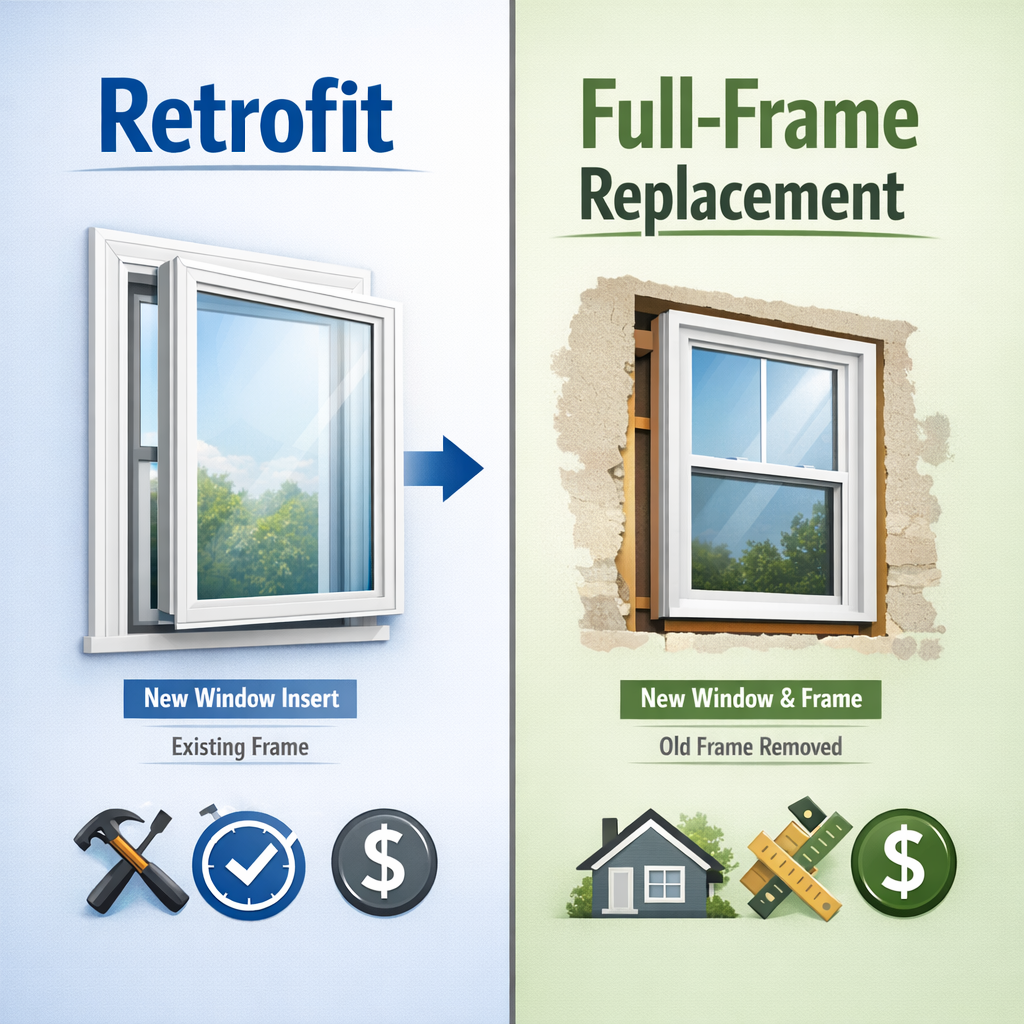
The reason this matters for your decision: a retrofit installation into a compromised frame is not a cost-saving choice — it’s a problem deferral. The new window will perform correctly for a year or two, then begin showing signs of air and water infiltration that trace back to conditions that were present before the installation. By that point, the conversation about warranty responsibility gets complicated quickly.
Ask any contractor you’re considering this direct question: What will you inspect at the rough opening before you finalize the scope of work, and when in the process does that inspection happen? A contractor who can’t give you a specific answer to that question is planning to skip it.
Most homeowners approach window shopping by asking contractors what they recommend. That’s a reasonable starting point, but it leaves the entire technical evaluation in the hands of the person who’s also trying to close a sale. The better approach is to establish your own performance targets before you request a single quote — and the tool that makes that possible is the NFRC label.
The NFRC is an independent organization that tests and certifies the energy performance of windows, doors, and skylights. Every window sold in the United States that carries an ENERGY STAR certification is required to display an NFRC label. That label contains four ratings, and understanding each one changes how you evaluate every window a contractor puts in front of you.
| NFRC Rating | What It Measures | Lower Is Better? | What to Know |
|---|---|---|---|
| U-Factor | Rate of heat transfer through the entire window assembly (frame + glass) | Yes — lower means less heat escapes in winter | This is the primary metric for heating-dominated climates. Do not confuse it with R-value; they are inversely related. |
| Solar Heat Gain Coefficient (SHGC) | Fraction of solar radiation that passes through the window as heat | Depends on climate and orientation | In cooling-dominated climates, lower SHGC reduces AC load. In heating-dominated climates, south-facing windows may benefit from higher SHGC for passive solar gain. |
| Visible Transmittance (VT) | Fraction of visible light that passes through the glass | No fixed preference | Higher VT means more natural light. Tinted glass and low-SHGC coatings reduce VT; understanding this tradeoff helps you avoid unexpectedly dim rooms. |
| Air Leakage (AL) | Rate of air infiltration through the window assembly | Yes — lower means less drafts and infiltration | Not required by NFRC but commonly included. Look for AL ≤ 0.30 cfm/ft² as a baseline quality indicator. |
| Condensation Resistance (CR) | Resistance to condensation forming on the interior surface | Yes — higher means better | Rated 0–100. Particularly relevant for kitchens, bathrooms, and humid climates. |
The Department of Energy’s ENERGY STAR program divides the country into four climate zones — Northern, North-Central, South-Central, and Southern — and assigns different performance thresholds to each zone. This means the “most energy-efficient” window on a showroom floor may actually be the wrong choice for your home’s location and orientation.
North Carolina sits primarily in the North-Central zone, with some western mountain areas qualifying for Northern zone requirements. For this region, ENERGY STAR requires:
Here’s where the practical insight lives: SHGC is not a single-correct-answer metric. A south-facing window in a well-insulated NC home may benefit from a moderately higher SHGC during winter months to capture passive solar heat gain, while a west-facing window in the same home should prioritize lower SHGC to reduce afternoon cooling load. Treating every window in the house as having identical performance requirements is a simplification that costs you money on your utility bill year after year.
Before you invite any contractor to quote your project, decide — or ask your contractor to help you decide based on your home’s orientation — what U-factor and SHGC targets make sense for each window location. Then ask every bidder to quote to those specifications. That is how a vague “energy-efficient replacement window” conversation becomes a technical apples-to-apples comparison. For a deeper look at how glazing technology affects real-world performance, the article The Low-Down on Low-E Glass: Your Guide to Smarter Windows walks through coating types and their climate-specific tradeoffs in detail.
Vinyl frames are often presented as the practical, cost-effective choice. Wood frames get positioned as the premium aesthetic option. Fiberglass sits somewhere in between. This material-category framing is broadly accurate as far as it goes — but it stops well short of the information you actually need to compare two competing bids.
Two vinyl windows can be made from entirely different structural and thermal constructions while carrying identical material labels. The differences that matter are:
Chamber construction in vinyl frames:
Vinyl window frames are hollow profiles, but the number of internal chambers within that profile varies significantly by manufacturer and product line. A multi-chamber frame creates more air pockets, which increases thermal resistance and reduces thermal bridging through the frame itself. Budget vinyl frames often use a two- or three-chamber construction. Premium vinyl frames may use five or more chambers, with some incorporating foam-filled cavities for additional insulation value. None of this is visible from the outside, and none of it shows up in a contractor’s general “vinyl window” line item unless you ask specifically.
Wall thickness and virgin vs. recycled vinyl content:
The vinyl used in window frames should meet minimum wall thickness standards for structural integrity. Some lower-tier manufacturers reduce material costs by using thinner profiles or incorporating a higher percentage of recycled vinyl content, which can affect long-term color stability and dimensional consistency under temperature cycling. Look for products that reference compliance with AAMA/WDMA/CSA 101/I.S.2/A440 (commonly referred to as the “North American Fenestration Standard”) as a baseline quality indicator.
Frame-to-sash seal and hardware quality:
The weather seal between the frame and the movable sash determines real-world air infiltration performance more than the NFRC AL rating alone suggests. Compression seals, brush seals, and fin seals each have different long-term durability profiles. The quality of locking hardware also affects how tightly the sash is drawn against the seal over time. These are components that degrade with use, and their quality tier is almost never mentioned in a standard quote.
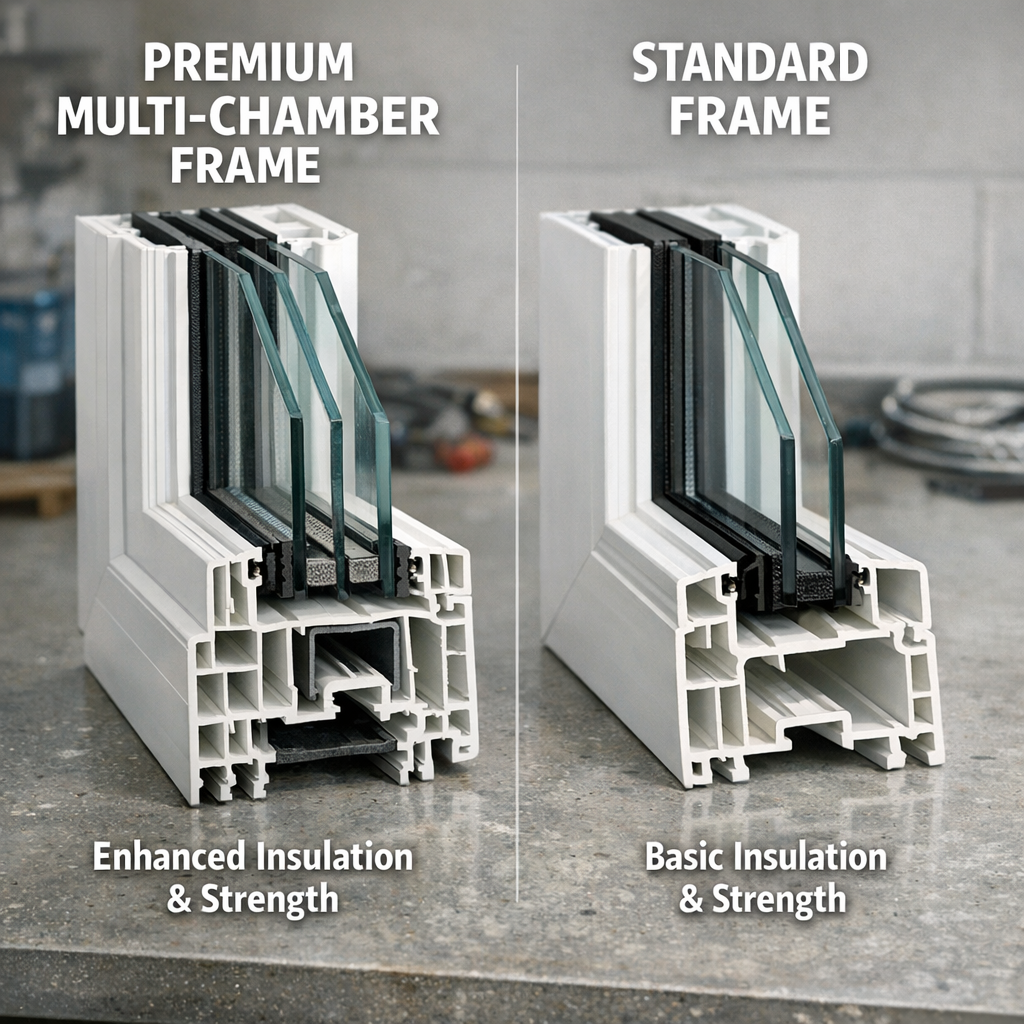
The honest takeaway here is that “vinyl windows” is a category, not a specification. When you’re reviewing quotes, ask each contractor to identify the specific window manufacturer, product line (series name), and glass package they are pricing. Then look up that product’s NFRC certification and chamber construction details on the manufacturer’s website. If a contractor can’t — or won’t — give you that level of specificity, you’re not looking at a real quote yet. Our Windows service covers the product lines and installation standards we work with, so you can see exactly what specifications we bring to every project.
“Limited lifetime warranty” is one of the most consistent selling points in the window industry, and also one of the most consistently misunderstood. Understanding how window warranties are actually structured — before you sign anything — is the difference between a warranty that protects you and one that reads well in a brochure.
A complete window warranty is actually three separate agreements with three separate issuers, covering three separate failure modes:
1. Glass package warranty (issued by the glass manufacturer)
This typically covers insulated glass unit (IGU) seal failure — the fogging or condensation that develops between the panes when the edge seal breaks down. Most quality glass packages carry a 20-year seal failure warranty. Key terms to check: Does it cover replacement of the IGU only, or the full window unit? Is it prorated after a certain number of years? What’s the claim process, and who performs the replacement?
2. Frame and hardware warranty (issued by the window manufacturer)
This covers defects in the frame material and operational hardware — cranks, locks, balance systems, and weatherstripping. Lifetime frame warranties are common on premium products, but “lifetime” typically means the lifetime of the original purchaser at the original address, not the lifetime of the home. Transferability to a subsequent buyer is often limited or requires formal registration within a defined window after the property sale.
3. Installation warranty (issued by the contractor)
This is entirely separate from both manufacturer warranties and is the one most relevant to the failure modes homeowners actually experience — air infiltration, water infiltration around the perimeter, and settling issues related to improper shimming or fastening. Installation warranties vary widely: some contractors offer one year, some offer five, some offer nothing in writing. The installation warranty should be a specific, written document, not a verbal assurance.
The most common real-world warranty dispute in window replacement involves water infiltration at the window perimeter — water getting into the wall assembly around the frame, not through the glass. This failure mode falls into the space between the product warranty (which covers the window unit itself) and the installation warranty (which covers how the window was installed).
Manufacturers will point to improper installation as the cause. Contractors will point to a failed seal or frame defect as the cause. Meanwhile, you have water damage developing inside your wall.
Before you sign any contract, ask for written answers to three specific questions:
A contractor who hesitates on any of these questions is telling you something important about how they handle problems after the job is done. You can also review our warranty to see exactly how we structure coverage and what homeowners can expect when a claim needs to be filed.
The universal advice to collect three quotes before choosing a window contractor is sound in principle. In practice, it frequently produces three numbers that cannot be meaningfully compared, because each contractor has priced a different product installed by a different method with different warranty terms.
True comparison requires a common specification. Before you invite any contractor to your home, prepare a written scope document that includes the following:
When every contractor prices against the same written specification, you’re comparing their labor quality, material sourcing, and project management — which is what you actually need to evaluate. Without that common specification, a lower quote might simply mean fewer chambers in the vinyl frame, a shorter installation warranty, or a plan to skip the rough opening inspection entirely.
Window replacement doesn’t happen in isolation. When it’s sequenced correctly relative to other exterior work, it saves money and produces better long-term results. When it’s sequenced poorly, it introduces unnecessary cost and risk.
If your home has siding that is within five to ten years of needing replacement, the timing of your window project deserves careful thought. New windows installed into existing siding require the window perimeter to be flashed and integrated with that siding as it currently exists. When the siding is later replaced, contractors will need to cut back to the window perimeter, remove and re-flash, and reinstall the exterior trim — effectively redoing a portion of the window installation. This costs additional labor, creates a second opportunity for flashing errors, and may void the original installation warranty.
The more cost-effective sequence in most cases is to coordinate window replacement with siding replacement so the rough opening flashing can be correctly integrated with the new water-resistive barrier and siding system in a single operation. At Smithrock Roofing, this is exactly the kind of sequencing conversation we have with homeowners before any exterior project begins — because getting the order right the first time is almost always less expensive than correcting it later.
Window installation can be performed year-round in most climates, including North Carolina. That said, there are practical reasons to think about timing:
The right time to replace your windows is when the combination of project readiness, product availability, contractor scheduling, and sequencing logic all align — not simply when a promotional offer appears or a neighbor mentions they just had theirs done.
Before scheduling your window replacement project, these three steps will help you move forward with greater clarity and confidence:
Many professional exterior contractors now carry infrared thermal imaging equipment that can identify air leakage, moisture infiltration, and insulation gaps around existing window frames before a single unit is removed. Requesting this kind of diagnostic assessment — rather than a simple visual quote — gives you a documented baseline of your current performance problems. This means your project scope is driven by actual building science data, not assumptions, and post-installation results can be meaningfully compared to pre-installation conditions.
The U.S. Department of Energy’s Home Energy Score program, administered through certified assessors, produces a standardized rating of your home’s energy performance that accounts for window glazing, air sealing, insulation, and mechanical systems together. Obtaining this score before your window project — and again after — gives you an objective, third-party measure of the improvement your investment delivered. This documentation can also be valuable if you plan to sell the home or apply for energy efficiency incentive programs in North Carolina.
If your home has deferred siding maintenance, aging roofing, or known water intrusion history, request a single coordinated exterior assessment from a contractor who performs all three trades — or who can credibly speak to how each trade interfaces with the others. The sequencing decisions described throughout this article (flashing integration, water-resistive barrier continuity, HVAC load recalculation) are much easier to execute correctly when one experienced party reviews the full picture before work begins. At Smithrock Roofing, this is a standard part of how we approach any multi-system exterior project.
The installation itself is often completed in a single day for most residential projects, depending on the number of openings and the replacement method used. However, the full project timeline — from initial assessment and product selection through lead time, scheduling, and final inspection — typically spans several weeks. Custom window sizes, special order glazing packages, or projects coordinated with siding or roofing work will generally require longer lead times. Planning ahead by at least four to six weeks is advisable for most homeowners.
Insert replacement windows — sometimes called pocket replacements — slide into the existing frame and are secured without removing the surrounding exterior casing or interior trim. This method is faster and less disruptive, but it relies on the existing frame being structurally sound, square, and free of rot or water damage. Full-frame replacement removes everything down to the rough opening in the wall framing, allowing the contractor to inspect and correct the rough opening, replace flashing, and integrate the new window with the water-resistive barrier behind the siding. Full-frame replacement is the more thorough option, particularly in older homes or wherever water infiltration has been an issue.
Permit requirements vary by municipality and project scope. In many North Carolina jurisdictions, direct replacement of windows in existing openings — particularly insert replacements — may fall below the permit threshold. However, full-frame replacements that alter the rough opening size, structural modifications, or projects in historic districts are more likely to require a permit and inspection. Your contractor should be familiar with the local requirements in your specific county or city and should advise you before work begins. Proceeding without a required permit can create complications during a future home sale.
Repair is often appropriate for isolated issues: a failed seal in a single insulated glass unit, a damaged hardware component, or minor frame weatherstripping that has compressed over time. Replacement becomes the more logical choice when the frame itself is structurally compromised by rot or water damage, when multiple units are failing simultaneously, when the glazing no longer meets current energy performance expectations for your climate, or when the window style is functionally limiting ventilation or egress. A qualified contractor can assess the difference during an in-person visit and help you weigh repair cost against the expected remaining service life of the existing units.
In most cases, windows and siding should be replaced together, or windows should be replaced first as part of a coordinated sequence that allows the rough opening flashing to be properly integrated with the new water-resistive barrier behind the siding. Installing new windows after new siding has already been completed typically requires disturbing the siding at each opening to integrate the flashing correctly — adding labor, creating potential flashing errors, and sometimes voiding the siding installation warranty. If replacing both systems, discuss the sequencing explicitly with your contractor before any work begins.
North Carolina spans multiple climate zones, so the right glazing specification depends on your specific location. In the warmer coastal and piedmont regions, solar heat gain coefficient (SHGC) is often the more critical metric — a lower SHGC reduces summer cooling load by limiting how much solar energy passes through the glass. In the mountains and higher elevations, U-factor becomes more important alongside SHGC, as colder winters require better insulating performance. Triple-pane glazing, low-E coatings, and inert gas fills between panes all contribute to improved performance. Your contractor should be selecting glazing packages based on your home’s climate zone designation under the North Carolina Energy Conservation Code, not simply offering a single default option.
Start with the basics: confirm that the contractor holds a valid North Carolina general contractor license, carries current general liability insurance, and maintains workers’ compensation coverage for their employees. Beyond licensing, ask whether the company installs to the manufacturer’s written installation instructions — which is required to maintain product warranties — and whether their installers have received any manufacturer-specific training or certification. Request references from completed projects of similar scope, and ask specifically about how the company handles rough opening flashing and integration with the wall assembly. A contractor who can speak fluently and specifically to those details is demonstrating real installation competence, not just sales experience.
Window replacement is one of the more consequential exterior investments a homeowner makes — not because windows are the most expensive component of the building envelope, but because they sit at the intersection of structural integrity, moisture management, energy performance, and daily livability. Getting the product selection, installation method, flashing sequence, and project coordination right the first time protects every other investment you’ve made in your home.
At Smithrock Roofing, we approach window replacement as part of a complete exterior system — because that’s what it is. If you’re evaluating a window project, considering how it fits with existing or upcoming siding and roofing work, or simply want a knowledgeable second opinion on a scope you’ve already received, we’re glad to help you think through it clearly.
Smithrock Roofing © Copyright 2026 • All Rights Reserved • Privacy Policy • Maintained by Mongoose Digital Marketing