Replacing windows is one of those home improvement decisions that feels straightforward until you’re three quotes deep and wondering why the numbers vary by thousands of dollars for what looks like the same job. The truth is, window replacement isn’t a simple product swap. It’s a building envelope intervention — and the factors that drive cost, performance, and long-term value are far more layered than any price-range chart will tell you.
Most guides on this topic hand you a table of window styles with cost ranges attached and call it a day. That’s useful for a ballpark, but it leaves out everything a seasoned contractor actually thinks about when scoping a project: what’s hiding behind that frame, how your climate should be driving your material selection, whether an insert replacement is actually appropriate for your situation, and how to tell a qualified installer from one who will cost you far more in the long run.
At Smithrock Roofing, we’ve been doing exterior work across the NC Triad long enough to know where window projects go sideways — and it’s rarely because someone chose the wrong style. It’s because the decision framework was built on incomplete information. This guide is designed to fix that.
When you read that a window replacement costs a certain amount per window, that figure assumes a lot of things that may or may not be true for your home. It assumes the rough opening is square, plumb, and sized to accept a standard unit. It assumes the existing frame is structurally sound. It assumes the flashing and sill plate beneath the window are intact. In a newer home with no history of water intrusion, those assumptions often hold. In a home built before 1980, they frequently don’t.
What contractors know — and what most guides skip over — is that window replacement projects have a well-documented tendency to expand in scope the moment the old window comes out. The first look at a raw opening often reveals the actual condition of the surrounding structure. That discovery moment is where projects either stay on budget or start climbing.
This isn’t something contractors hide from you. It’s simply the nature of working on existing structures. The honest way to approach it is to understand what signals predict scope expansion before the project starts — which we’ll cover in detail below.
Industry guides consistently frame the insert-vs.-full-frame decision as a money question: insert replacements cost less because they leave the existing frame in place; full-frame replacements cost more because they involve removing everything down to the rough opening. That framing is incomplete, and it leads homeowners to choose insert replacements for the wrong reasons.
Here’s what the cost-first framing misses: if the existing frame has any degree of moisture damage, air infiltration compromise, or dimensional distortion, an insert window placed inside that frame will underperform relative to its rated specifications — often by a measurable margin — and will likely fail well before its rated service life. You’re installing a quality product into a compromised host, and the host wins.
The right question isn’t “how much does each option cost?” It’s “what is the actual condition of my existing frame, and is it structurally appropriate to preserve it?” A qualified contractor will probe the sill, check the corners for soft wood, and assess the interior trim for staining patterns before recommending an installation method. If they don’t, that’s information worth having. For a deeper look at what full-frame versus insert projects actually cost in this market, the article Everything You Need to Know About Window Replacement Cost breaks down the variables in detail.
Understanding these signals before you request quotes puts you in a fundamentally better position. You can have an informed conversation with your contractor, ask the right questions about how they handle discovery work, and avoid being blindsided when the scope expands. Here’s what to look for:
Interior diagnostic signals:
– Drywall or plaster staining at the upper corners of window frames — this is one of the clearest indicators of past water infiltration through compromised flashing
– Paint that has lifted or bubbled along the interior trim, particularly at the sill
– A sill that feels soft or gives slightly when pressed — this is simple probe testing that any homeowner can do
– Visible gaps between the window frame and surrounding drywall that suggest the frame has shifted or settled
Exterior diagnostic signals:
– Paint failure specifically at window corners (not general peeling, but concentrated at the frame-to-siding junction)
– Caulk that has separated, cracked, or is completely missing along the window perimeter
– Siding that shows moisture staining below the window — water exiting through the wall rather than being managed at the flashing level
– Any visible gap between the brick mold or exterior casing and the adjacent siding material
A note on pre-1978 construction: Homes built before 1978 may have glazing compounds containing asbestos or lead-based paint on the window frames and surrounding trim. This isn’t a reason to avoid replacement — it’s a reason to ask your contractor directly about their handling protocols before any work begins. Qualified contractors are familiar with the applicable guidelines and can explain their approach clearly.
Every window replacement guide includes some version of the same material comparison: vinyl is affordable and low-maintenance, wood is beautiful but demanding, fiberglass is premium and durable, aluminum is strong but conducts heat. All of that is accurate as far as it goes. What it doesn’t account for is how these materials actually behave over time in your specific climate — and that gap produces a lot of windows that underperform relative to their rated specs long before they should.
Frame material selection is a climate-dependent decision. Here’s how that actually breaks down:
| Frame Material | Thermal Expansion Behavior | Best Climate Context | Durability Risk Factors | Long-Term Ownership Notes |
|---|---|---|---|---|
| Vinyl (PVC) | High expansion coefficient — frames expand and contract significantly with temperature change | Moderate climate zones with limited temperature extremes (IECC Zones 3–4) | Repeated temperature cycling causes seal degradation and joint stress over time; UV exposure affects color stability | Lower first cost, but seal failure risk increases in climates with wide temperature swings; replacement cycles may be shorter |
| Fiberglass | Expansion rate closely matches glass — minimal differential stress at frame-glass junction | Performs well across a wide range of climate zones (IECC Zones 2–7) | Highly resistant to moisture cycling; does not warp, swell, or rot; paint adhesion is strong | Higher first cost is most defensible in performance-demanding environments; long service life when properly installed |
| Wood (with cladding) | Moderate expansion; interior wood subject to humidity-driven movement | Best in moderate humidity zones; risks increase in high-humidity or high-rainfall climates | Moisture cycling frequency is the primary degradation driver — not moisture itself, but repeated wet-dry cycles | Clad exteriors significantly reduce maintenance burden; interior wood requires consistent humidity management |
| Aluminum | Very low expansion; dimensionally stable | Well-suited for coastal and high-wind environments where structural rigidity matters | Conducts heat and cold readily — thermally broken frames are necessary for any climate where energy performance matters | Typically specified for commercial or high-wind applications; residential use declining in favor of fiberglass for performance builds |
| Composite / Engineered Wood | Moderate; engineered for dimensional stability | Broad climate applicability; performs well in humid southeastern climates | Dependent on core material and cladding integrity; quality varies significantly by manufacturer | Performance varies more by brand than any other category — manufacturer track record and warranty terms matter significantly |
For homeowners in the NC Triad specifically, a few things are worth understanding. The Piedmont sits in IECC Climate Zone 4, which means you’re dealing with meaningful summer heat loads, occasional hard freezes in winter, and moderate to high humidity through much of the year. That combination has specific implications:
Vinyl windows perform reasonably well here for cost-conscious projects, but the summer temperature extremes — particularly in south- and west-facing exposures — can accelerate seal degradation in lower-grade units. Specifying a quality vinyl line with reinforced frames and multi-point locking hardware extends service life meaningfully.
Fiberglass is the most consistently defensible choice for this climate from a pure performance standpoint. The expansion stability protects seal integrity through both the summer heat cycles and winter cold snaps that characterize Piedmont winters.
Clad wood windows can perform well here provided interior humidity is managed — which is a reasonable expectation in a climate-controlled home but worth discussing with your contractor if the installation space has humidity management challenges.
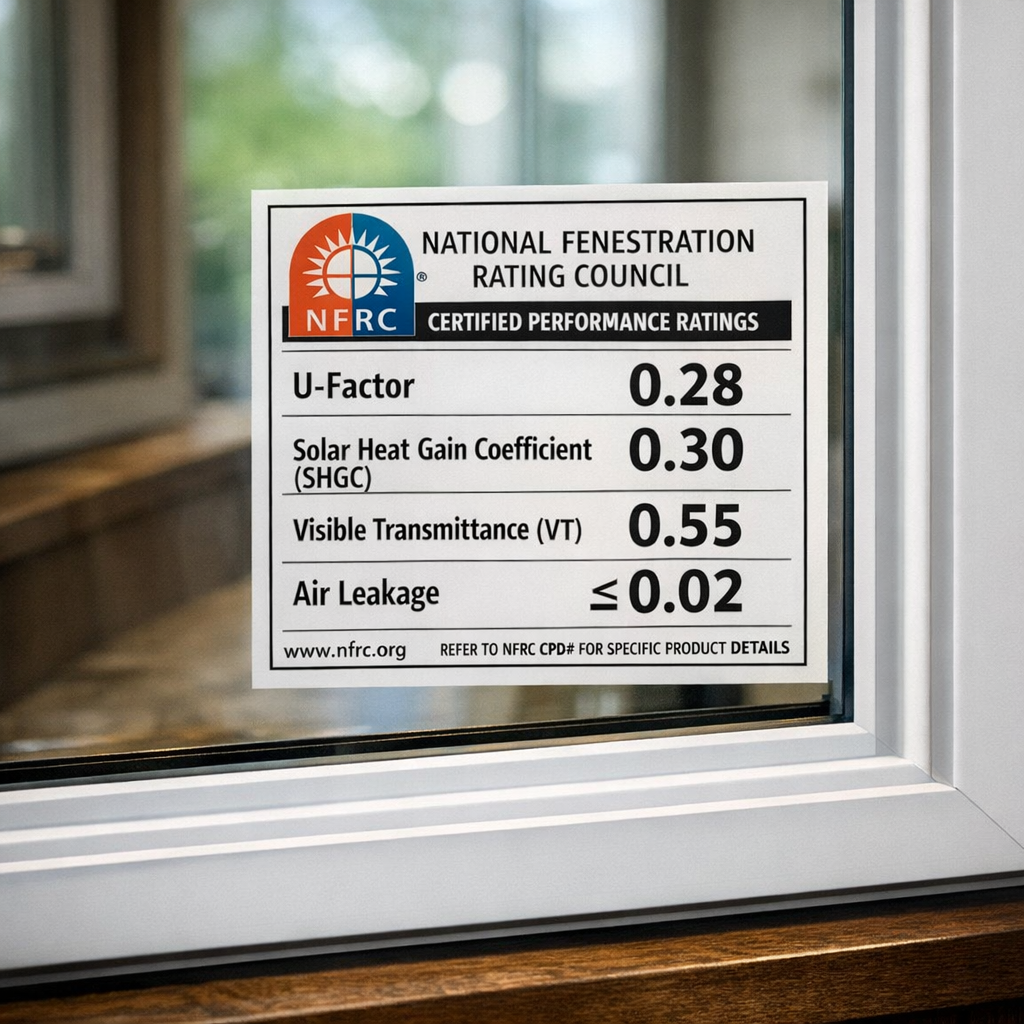
When architects and energy auditors specify windows, they’re not working from a style menu — they’re working from a performance specification built around four ratings that describe how a window manages heat, light, and air. Understanding these ratings doesn’t require an engineering background, and knowing how to apply them turns a window selection conversation from a feature comparison into a genuine performance decision.
Here’s what each rating means and why it matters:
U-Factor measures how well a window resists heat flow — in both directions. Lower numbers mean better insulating performance. In Climate Zone 4, ENERGY STAR specifies a maximum U-factor of 0.27 for northern-facing installations. This rating is most relevant for winter heating performance and year-round comfort at the glass surface.
Solar Heat Gain Coefficient (SHGC) measures how much solar radiation passes through the glass and enters the home as heat. Lower numbers block more solar heat. In a mixed climate like the NC Triad, this rating requires some strategic thinking: south-facing windows that contribute to passive solar heating in winter benefit from a higher SHGC, while west-facing windows that drive afternoon cooling loads benefit from a lower one. One number doesn’t fit all orientations.
Visible Transmittance (VT) measures how much natural light the glass allows through — a number between 0 and 1, where higher means more daylight. Low-E coatings that improve U-factor and SHGC performance can reduce VT, which affects interior daylighting. Balancing these ratings against each other is exactly what experienced window specifiers are trained to do.
Air Leakage (AL) measures how much air passes through the window assembly under a standardized pressure difference. Lower is better. ENERGY STAR requires AL ≤ 0.3 cfm/ft² for most residential products. This rating is particularly relevant in older homes where window replacement is being used to address comfort issues driven by air infiltration rather than glass performance.
The most common mistake in window selection is treating glass upgrades as optional add-ons to a frame-and-style decision that’s already been made. Professionals work the other way: they establish the performance targets for the installation — based on orientation, climate zone, and existing insulation performance — and then select a window system that meets those targets. Frame and style choices happen within that performance framework, not before it.
For most NC Triad homeowners, this means a few practical guidelines:
Low-E coatings are not optional in this climate. The combination of summer cooling loads and winter heating requirements makes dual-pane Low-E glass the minimum appropriate specification. The specific Low-E coating chemistry (there are meaningful differences between coatings optimized for solar control versus those optimized for insulating value) should be matched to the window’s orientation. If you want to go deeper on how Low-E glass actually works and what the coating variations mean in practice, The Low-Down on Low-E Glass: Your Guide to Smarter Windows covers the technical distinctions clearly.
Triple pane is not automatically better. In Climate Zone 4, the energy performance improvement from triple pane over quality dual pane is real but modest — and the added weight affects hardware longevity and sash operation over time. Triple pane is most defensible in north-facing installations where insulating value (U-factor) is the dominant performance concern.
Argon fill is a standard expectation, not a premium upgrade. Any quality dual-pane window in this market should include argon gas fill as a baseline. If it’s being presented as a notable upgrade, that’s worth examining.
Here’s something most homeowners don’t know until it’s too late: the vast majority of window manufacturer warranties explicitly exclude damage caused by improper installation. This means a 20-year warranty on a window installed by an unqualified contractor is significantly less valuable than it appears — because the most common failure modes (air infiltration, water intrusion, premature seal failure) are precisely the ones that improper installation causes, and precisely the ones the warranty won’t cover in that scenario.
This isn’t a fine-print technicality. It’s the central risk variable in any window replacement project.
AAMA (American Architectural Manufacturers Association) publishes the installation standards that define professional-grade window installation. Two standards are particularly relevant for residential work:
When reviewing contractor proposals, ask specifically whether the installation scope references AAMA standards. A contractor who can discuss these standards by name and explain which one applies to your project is demonstrating technical fluency that matters. A contract that specifies only “installation of windows” without describing the flashing methodology leaves you with no documentation of what standard of care was applied.
Most homeowners ask contractors about price, timeline, and warranty length. Sophisticated buyers ask different questions — and the answers reveal far more about what they’re actually buying:
On installation methodology:
– “What flashing system will you use at the sill, and will it integrate with my existing weather-resistive barrier?”
– “How do you handle the transition between the new window and the existing exterior cladding at the jamb and head?”
– “What happens to the project scope if you find rot or damage in the rough opening after the old window comes out?”
On qualifications and accountability:
– “Are your installers AAMA InstallationMasters certified?” (This is a specific third-party certification for window installation — not just general contractor licensing.)
– “Does your installation method preserve the manufacturer’s warranty, and can you provide that in writing?”
– “Who do I contact if I have a warranty issue — you, or the manufacturer?”
On scope documentation:
– “Does your contract specify the flashing methodology, the AAMA standard you’re installing to, and how discovery work will be handled and priced?”
A well-qualified contractor will answer these questions directly and without defensiveness. If a contractor can’t speak to installation standards or dismisses the questions as unnecessary, that’s meaningful information about the level of technical care you can expect on the job.
A window replacement contract that protects your investment should document more than product selection and total price. Look for:
At Smithrock Roofing, our window services are scoped with this level of specificity because we’ve seen what happens when it isn’t — and the cost of undocumented assumptions is always borne by the homeowner.
Window replacement guides are almost universally written around first cost — the price you pay to have the windows installed. Professionals evaluate windows on a total cost of ownership basis, and that shift in framework changes the buying decision in important ways.
Here’s what a lifecycle analysis accounts for that a first-cost comparison misses:
Service life variability by material and installation quality: A quality fiberglass window installed by a certified installer to AAMA standards in an appropriate climate application has a defensible service life of 30-plus years. A lower-grade vinyl window installed without proper flashing methodology in a problematic rough opening may begin showing performance degradation in 10 to 12 years. The first-cost comparison looks very different when annualized over those service life differences.
Energy performance degradation: Insulated glass units lose some of their performance over time as the gas fill slowly diffuses and seal integrity degrades. The rate at which this happens is directly influenced by installation quality (frames under stress from improper installation accelerate seal failure), frame material behavior in your climate, and the quality of the original glass unit. A window that performs well at installation but degrades significantly by year 10 delivers less total value than its specifications promised.
Maintenance frequency and cost: Wood windows (even clad) require periodic repainting or refinishing of interior surfaces over a 30-year period. Vinyl requires minimal maintenance but is generally not refinishable if UV degradation affects the exterior surface. Fiberglass is paintable and highly resistant to surface degradation. These maintenance differences are real costs — in both time and money — that belong in any honest comparison.
Avoided damage value: A properly installed window with appropriate flashing eliminates a water infiltration pathway into the wall assembly. An improperly installed window creates one. The cost of remediating water damage in a wall cavity — insulation replacement, sheathing repair, mold remediation — can easily exceed the cost of the original window project. Proper installation isn’t just about the window performing well. It’s about the surrounding structure continuing to perform well.
This is the framework experienced contractors and building scientists use. It produces different decisions than a first-cost comparison, and those decisions tend to hold up better over the life of the home.
The window replacement market continues to evolve, and homeowners who approach the process with the right tools and professional relationships consistently achieve better outcomes than those who rely on guesswork or single-source information. Three specific steps deserve priority attention before you commit to any project.
1. Use an ENERGY STAR Product Finder or equivalent climate-zone tool before soliciting bids.
The ENERGY STAR Most Efficient designation and its associated climate-zone mapping tool allow you to identify which performance specifications are genuinely appropriate for your geographic region. Entering a project conversation already knowing the U-factor and Solar Heat Gain Coefficient targets appropriate for your climate zone changes the nature of that conversation — you are evaluating contractors against an objective benchmark rather than accepting their recommendations without context. This tool is publicly available, free, and updated regularly to reflect current efficiency standards.
2. Request a pre-installation rough opening inspection from an independent third-party home inspector or building envelope consultant.
Before any window is ordered, having a qualified inspector assess the condition of your rough openings, existing flashing, and wall assembly moisture conditions is one of the highest-leverage steps available to homeowners in 2026. This is especially important in homes with any history of water intrusion, homes built before modern moisture barrier standards were widespread, and any project where the existing windows have been in place long enough to have concealed developing problems. The inspection findings directly inform scope, specification, and contractor selection — making every subsequent decision more grounded.
3. Engage at least one AAMA-certified or manufacturer-certified installation contractor during the bidding process.
Industry certifications from the American Architectural Manufacturers Association or equivalent manufacturer training programs signal that a contractor has been evaluated against documented installation standards. This does not guarantee perfect execution, but it establishes a meaningful baseline and creates accountability structures that benefit homeowners if disputes arise. In 2026, most reputable window manufacturers publish installer directories on their websites. Cross-referencing these directories during contractor vetting takes minimal time and adds meaningful signal to what can otherwise be a difficult evaluation process.
Installation quality is widely considered the single most consequential variable in long-term window performance. A high-specification window installed without proper flashing, air sealing, and rough opening preparation will underperform a mid-grade window installed correctly. Improper installation creates pathways for water infiltration and air leakage that can damage the surrounding wall assembly over time, producing costs that far exceed the original window investment. Evaluating a contractor’s installation methodology — not just their product offerings — deserves equal weight in the selection process.
ENERGY STAR divides the United States into four climate zones — Northern, North-Central, South-Central, and Southern — each with distinct U-factor and Solar Heat Gain Coefficient (SHGC) recommendations. U-factor governs how well the window resists heat transfer, while SHGC measures how much solar heat the window allows to pass through. In colder climates, a lower U-factor is prioritized to minimize heat loss. In warmer climates, a lower SHGC helps reduce cooling loads. The ENERGY STAR Product Finder tool allows homeowners to filter products by climate zone, providing an objective performance benchmark before contractor conversations begin.
Service life varies significantly based on frame material, installation quality, climate exposure, and maintenance practices. Well-installed fiberglass and high-quality vinyl windows in moderate climates can realistically achieve 30 or more years of reliable performance. Wood windows properly maintained and protected from sustained moisture exposure can last significantly longer. Lower-grade products installed without attention to rough opening conditions and moisture management may begin showing meaningful performance degradation in 10 to 12 years. Annualizing performance over realistic service life differences produces a more accurate comparison than first-cost alone.
Properly specified and installed replacement windows can reduce heating and cooling loads by eliminating air infiltration around degraded frame seals and by improving the thermal performance of the window assembly itself. The magnitude of the reduction depends on how inefficient the existing windows were, how well the new windows are installed, and the overall thermal performance of the rest of the building envelope. Windows are one component in a system — improvements elsewhere, such as attic insulation and air sealing, often produce larger energy impacts. That said, in homes with significantly aged single-pane or early double-pane units, the performance improvement from modern insulated glass can be substantial.
Beyond the window product itself, evaluate what each bid includes in terms of installation methodology. Specifically: how will the contractor address flashing at the sill and head? What moisture barrier or weather-resistive barrier integration is included? How will the rough opening be assessed and prepared before installation? What air sealing approach is specified at the interior? Additionally, verify that the contractor carries appropriate liability and workers’ compensation insurance, that warranty terms — both product and labor — are clearly documented in writing, and that references from comparable projects are available. A bid that omits these details is not yet a complete basis for comparison.
Yes, and the difference is significant in both scope and outcome. An insert replacement — sometimes called a pocket replacement — installs a new window unit within the existing frame, leaving the original frame, jambs, and exterior casing in place. This approach is appropriate when the existing frame is structurally sound, free of rot or water damage, and dimensionally stable. Full-frame replacement removes everything down to the rough opening, allowing inspection and remediation of any underlying damage, replacement of deteriorated flashing, and installation of the new window with complete moisture management integration. If there is any uncertainty about the condition of the existing frame and surrounding wall assembly, full-frame replacement provides a more complete solution even though it involves greater scope.
Federal tax incentives for energy-efficient home improvements, established under the Inflation Reduction Act, have included provisions for qualifying window replacements that meet specific ENERGY STAR criteria. Eligibility requirements, applicable product specifications, and annual claim limits are subject to change based on legislative updates and IRS guidance. Homeowners should verify current eligibility requirements directly with the IRS, ENERGY STAR, or a qualified tax professional before making purchasing decisions based on anticipated credits. State and utility-level rebate programs vary widely by region and are worth investigating through your state energy office or utility provider’s website.
Window replacement is one of the more consequential investments a homeowner makes — not because windows are the most expensive element of a home, but because their performance touches so many aspects of comfort, durability, and long-term operating cost simultaneously. The framework in this article is designed to move you from a first-cost mindset to a total-value mindset, which is the standard that holds up over the actual life of the project.
The decisions that matter most — contractor selection, installation methodology, specification alignment with your climate — are decisions where professional guidance adds genuine value. If you are ready to take the next step or have questions specific to your project, we encourage you to reach out directly.

Smithrock Roofing © Copyright 2026 • All Rights Reserved • Privacy Policy • Maintained by Mongoose Digital Marketing