If you need emergency roof repair high point nc services, quick action is critical. A compromised roof is a direct threat to your home’s structural integrity and interior. Roof damage escalates with every minute of water intrusion, and the difference between a manageable fix and catastrophic interior damage often comes down to how decisively you act in the first few hours.
The Piedmont Triad’s climate is a key factor. The region experiences roughly 44 inches of rainfall annually, often delivered in intense thunderstorms, the remnants of tropical systems, or prolonged rain events. When these storms track across the Triad, roof systems face rapid, high-volume water loads that exploit even the smallest vulnerabilities. A single missing shingle or a piece of lifted flashing can become a firehose aimed at your attic. A small breach can quickly saturate insulation (rendering it useless), soak drywall, warp wood framing, and create a pathway for water to travel into adjacent rooms and even down to your home’s foundation.
Safety must be your top priority. If you observe any of the following, evacuate the affected area of your home immediately and call for professional help:
Keep all people and pets away from these structurally compromised areas until they have been professionally assessed and stabilized.
To help the emergency dispatcher assess your situation quickly, have this information ready:
This guide will walk you through identifying emergencies, understanding common damage scenarios in High Point, navigating the professional repair process and insurance claims, and choosing a trustworthy contractor when every minute matters.
Knowing whether a roof problem is an urgent crisis or a routine repair can save you thousands in potential damages. An emergency roof repair high point nc situation is any scenario where the roof’s ability to protect your home is actively compromised, where occupant safety is at risk, or where any delay would permit significant and costly additional damage to occur.
If you observe any of the following, it’s time to call a 24/7 emergency roofing professional without delay:
Not all emergencies begin with a dramatic collapse. These conditions can escalate into a major crisis during the next rainstorm and warrant an urgent, though perhaps not middle-of-the-night, call:
Our team responds quickly to roof leak repair emergencies to stop water entry and prevent additional damage. The key is not waiting for a “bigger leak.” Once water breaches one layer, it travels laterally and vertically, making eventual repairs more complex and expensive. As FEMA guidelines stress, water damage compounds rapidly, making timely mitigation essential to prevent far more serious problems.
High Point’s location in the Piedmont Triad subjects local roofs to a unique and challenging mix of weather patterns. Understanding these common causes—and the cascading consequences of delaying repairs—is crucial for any homeowner deciding when to seek emergency roof repair high point nc services.
High Point roofs are constantly under assault from seasonal weather events:
Delaying mitigation allows damage to compound exponentially. What starts as a small leak can quickly spiral into a major catastrophe:
Professionally installed emergency tarps are a critical risk-control measure. They stop the cascade of damage, protect your home’s interior, and provide the necessary time to perform a thorough, permanent repair correctly.
When a roofing emergency strikes, knowing what to expect can significantly reduce stress and help you make clear-headed decisions. A professional emergency roof repair high point nc response is a multi-stage process designed to first stabilize the situation and then provide a lasting solution. Here’s how it unfolds.
While the emergency team is en route, your focus should be on safety and damage mitigation:
1. Emergency Contact and Dispatch: When you call, you’ll connect with a dispatcher or coordinator trained to assess the severity of your situation. They will ask key questions about the leak’s location, severity, and cause to determine priority. During widespread storm events, crews triage calls, prioritizing homes with active, ongoing water intrusion and structural concerns.
2. On-Site Assessment and Safety Analysis: Upon arrival, the crew’s first step is to perform a rapid but thorough assessment. This typically starts with a ground-level inspection and an interior check to see the extent of the water damage. If conditions are safe (e.g., not in the middle of a lightning storm), they will access the roof to identify the primary entry points, assess structural stability, and determine the best course of action for temporary protection.
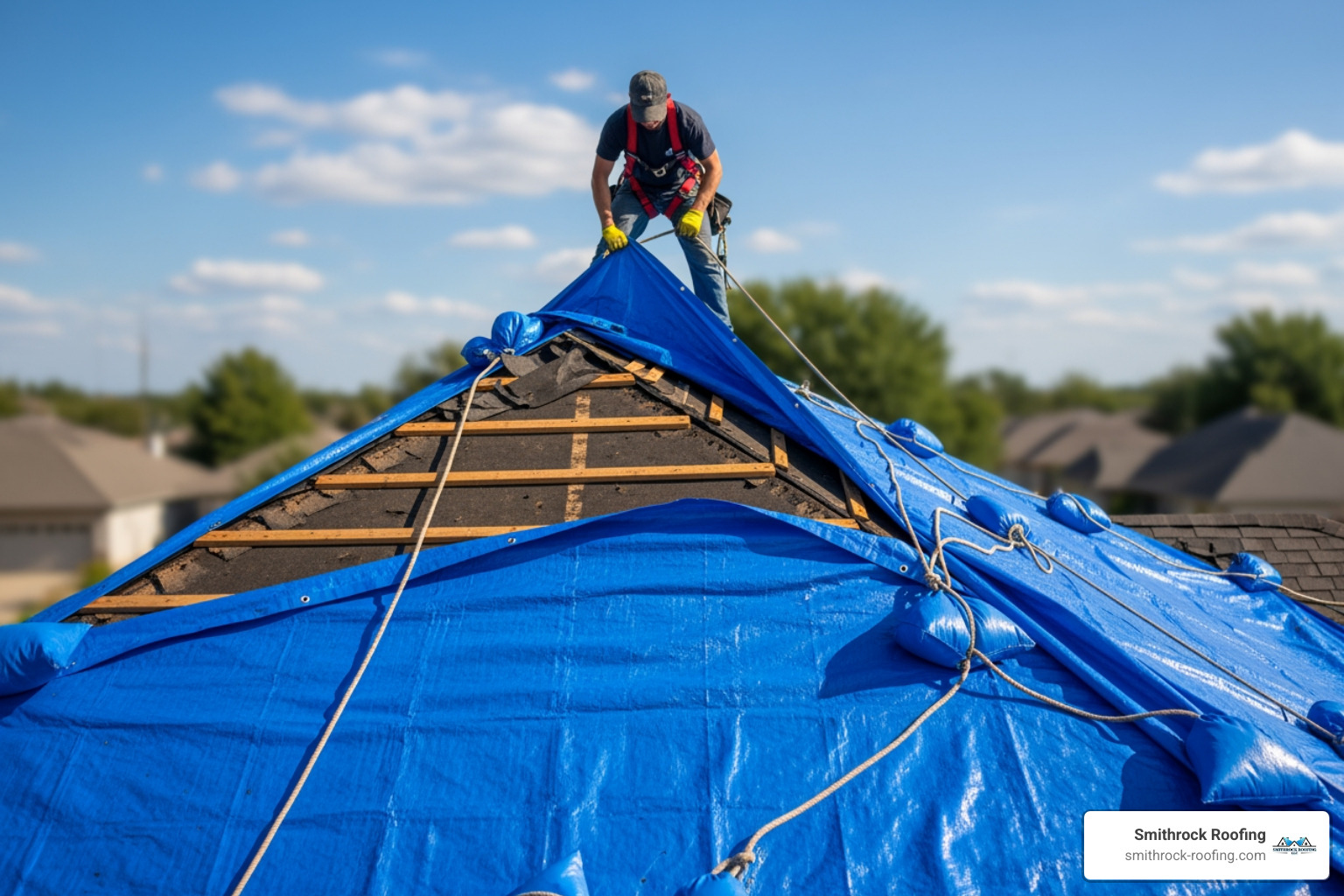
3. Temporary Protection (Tarping/Dry-In): The immediate objective is to stop more water from entering your home. This is most often achieved by installing a heavy-duty, reinforced roof tarp. Professional tarping is not just throwing a blue tarp over the hole; it involves carefully securing the tarp with wood battens and specialized fasteners to ensure it withstands wind and properly sheds water away from the damaged area. In some cases, emergency sealants may be used on smaller punctures.
4. Detailed Inspection and Repair Plan: After the roof is stabilized and the immediate threat is gone, a more detailed inspection can occur. This may involve using tools like moisture meters or thermal imaging to trace the full extent of water travel. Afterward, the contractor will provide you with a detailed, written scope of work and estimate for the permanent repair. This document should clearly outline the materials to be used, the specific areas to be repaired, the work sequence, and the total cost.
5. Permanent, Code-Compliant Repair: Once you approve the plan, the permanent repair work begins. This is not a patch; it’s a restoration of your roof’s weather barrier. The process involves removing the damaged materials (shingles, underlayment, and sometimes decking), replacing them with new components that match or exceed original specifications, and meticulously integrating the repair into the existing roof system to ensure a seamless, watertight finish. All work should meet or exceed local High Point building codes.
6. Final Inspection and Site Cleanup: After the repair is complete, a final quality check is performed to ensure all work is done correctly and the roof is watertight. Reputable crews will then conduct a thorough cleanup of the site, including using magnetic sweepers to collect any stray nails or fasteners from your yard and driveway. You should receive final documentation, including any warranties, for your records.
This systematic process is designed to turn a chaotic crisis into a controlled, secure solution as quickly and safely as possible, restoring both your home and your peace of mind.
Roof emergencies are stressful enough without the added confusion of insurance claims and contractor vetting. A clear, methodical approach to both can help you move from damage to resolution smoothly and confidently.
In most cases, yes. Standard homeowner’s insurance policies typically cover damage from sudden and accidental events, often called “perils.” This includes wind, hail, and falling objects—the most common causes of roof emergencies in High Point. However, coverage is almost always excluded for damage resulting from routine wear and tear, long-term neglect, or improper maintenance.
Key Insurance Concepts to Understand:
When Filing a Claim:
In the chaotic aftermath of a storm, it’s vital to choose a reputable local contractor, not an out-of-town “storm chaser.” Look for these signs of a trustworthy professional:
Red Flags to Avoid:
Key Questions to Ask a Potential Contractor:
When your roof is compromised, you need clear, direct answers. These are some of the most common questions High Point homeowners ask when facing a roofing emergency.
How quickly can a roofer respond to an emergency call in High Point?
For a single-home emergency with an active leak, reputable local contractors aim for same-day response to assess and tarp the roof. During a major storm event that affects the entire region, demand skyrockets. In this scenario, companies triage calls, prioritizing homes with the most severe damage (e.g., structural impact or massive water intrusion). Calling promptly is key to getting on the schedule.
What’s the difference between a temporary patch and a permanent repair?
A temporary patch, like a tarp or emergency sealant, is a damage control measure. Its only job is to stop more water from getting in right now. A permanent repair addresses the root cause of the failure. It involves removing all damaged components (shingles, underlayment, decking) and rebuilding that section of the roof to integrate seamlessly with the existing structure and provide long-term protection.
How long can a tarp safely remain on my roof?
A professionally installed, high-quality tarp can protect your home for several weeks or even a few months. However, it is not a long-term solution. UV radiation, wind, and subsequent storms will degrade the tarp material over time. It should be seen as a temporary bridge to get you to the permanent repair, which should be scheduled as soon as possible.
Can I perform a temporary repair myself?
It is strongly discouraged. Getting on a roof, especially a wet and damaged one, is extremely dangerous and a leading cause of serious injury for homeowners. Furthermore, an improperly installed tarp can fail or even trap water, potentially making the damage worse. The safest approach is to manage the water intrusion inside your home while letting trained and insured professionals handle the roof-level work.
Will the repair match my existing shingles?
Your contractor will make every effort to find a shingle that matches the brand, color, and style of your existing roof. However, the sun naturally weathers and fades shingles over time, so a brand-new shingle may not be a perfect color match for a 10-year-old roof. If an exact match is unavailable, one common strategy is to harvest existing shingles from a less visible part of your roof (like the back side) to use for the repair, and then install the new, slightly different shingles in that less conspicuous area.
What if the leak is around a chimney, skylight, or pipe?
These roof penetrations are the most common sources of leaks. A proper, durable repair involves removing the shingles around the penetration to inspect and replace the flashing—the custom metal work that seals the joint. Simply applying caulk or roof cement is a temporary, unreliable fix that will almost certainly fail.
What should I do if a tree falls on my roof?
First, ensure everyone is safe and clear of the affected area. If power lines are involved, stay far away and call 911 and your utility provider immediately. Do not attempt to climb on the roof or cut branches yourself. Call an emergency roofer who can coordinate with a tree removal service to safely remove the debris before assessing and stabilizing the roof structure.
How much does an emergency roof repair cost in High Point?
Costs vary widely based on the situation. An emergency service call and tarp installation might range from a few hundred to over a thousand dollars, depending on the roof’s size, pitch, and accessibility. The cost of the permanent repair depends entirely on the extent of the damage—from a few hundred dollars for a small shingle repair to many thousands for structural work and partial roof replacement.
What if my roof is old? Will insurance still cover storm damage?
This depends on your policy. If the damage was caused by a covered peril like wind or hail, insurance will likely cover the repair, but they may pay out on an Actual Cash Value (ACV) basis, meaning they will deduct for the roof’s age and wear. If the adjuster determines the failure was due to age and deterioration, the claim may be denied. This is why regular maintenance is so important.
What happens if the contractor finds more damage during the repair?
This is common. Once shingles are removed, hidden damage to the underlying wood decking is often discovered. A professional contractor will stop work, document the newly discovered damage with photos, and contact you immediately. They will then generate a supplement report to send to your insurance company to get the additional work approved before proceeding.
How quickly can mold develop?
In the warm, humid conditions common in High Point, mold can begin to grow on damp surfaces like drywall and wood within just 24 to 48 hours. This is a primary reason why immediate drying and mitigation are so critical.
When your roof is compromised by a High Point storm, you are protecting far more than just shingles and flashing—you are protecting your family, your most valuable possessions, and the very structural health of your home. In a climate prone to intense thunderstorms, hail, and high winds, a timely, professional, and methodical response to leaks and impact damage is not just a good idea; it is an essential defensive measure against catastrophic loss.
The path from crisis to resolution becomes clear when you act quickly and partner with experienced professionals. The key steps are always the same: prioritize the safety of everyone in the home, document what you see from the ground, call a 24/7 roofer to stabilize the roof and stop the water intrusion, and then implement a permanent, code-compliant repair that addresses the root cause of the failure. Along the way, clear communication—with your contractor and, when applicable, your insurance company—empowers you to make informed decisions focused on restoring your home’s integrity and value.
Choosing a vetted, local contractor over an opportunistic storm chaser is perhaps the most critical decision you will make. A local expert understands High Point’s specific challenges, is accountable to the community, and will be there to stand behind their work long after the storm has passed.
At Smithrock Roofing, we have built our emergency response services specifically for the needs of High Point and the surrounding Triad communities. We are committed to delivering fast stabilization, transparent communication, thorough diagnostics, and lasting repairs. From the initial emergency call to the final inspection, our entire process is centered on your safety, superior workmanship, and your complete peace of mind.
If you are facing a leak or storm damage right now, do not wait for the next downpour to escalate the problem. Contact Us today for the emergency roof repair High Point NC homeowners can rely on. We are ready 24/7 to help you protect your home.
Smithrock Roofing © Copyright 2026 • All Rights Reserved • Privacy Policy • Maintained by Mongoose Digital Marketing