When a roof starts showing its age — whether that’s a water stain on the ceiling, a handful of shingles in the yard after a storm, or a slow creep of granules collecting in the gutters — most homeowners face the same question almost immediately: do I repair this, or do I replace the whole thing?
It is a fair question, and an important one. Get it wrong in one direction and you spend money on a full replacement you did not yet need. Get it wrong in the other direction and you pour money into repairs on a roof that is already past its useful life, only to face a larger project a year or two down the road.
The honest answer is that there is no universal rule — but there is a reliable way to think through the decision. This guide walks you through the real factors that separate a repair situation from a replacement situation, including some of the less-discussed variables that most online guides skip over entirely. If you are a homeowner in the NC Triad — Winston-Salem, Greensboro, High Point, Kernersville, or anywhere in the surrounding area — the local climate context matters here too, and we will address that specifically.
Before running through specific indicators, it helps to reframe what this decision really is. You are not just deciding whether to fix shingles. You are deciding whether the roof system as a whole still has enough useful life to justify a targeted repair — or whether the system has degraded to the point where repairs will deliver diminishing returns.
A roof is not a single layer. It is a system made up of:
Every one of these components has its own lifespan, and they do not all wear at the same rate. That is where the decision gets complicated — and where the most common guidance falls short.
Need a hand with this in Winston-Salem, Greensboro and the NC Triad? Call (336) 971-0464 or request a free estimate. Honest answers, no pressure.
The most commonly repeated piece of roofing advice is this: if your roof is under 15 years old, repair it; if it is over 20 years old, replace it. It is a reasonable starting point, but it is not the full picture.
A 20-year-old roof in a mild, temperate climate with good attic ventilation and no major storm events may have shingles that are still performing adequately. That same 20-year calendar age on a roof in a climate with extreme summer heat, cold winters, and poor ventilation can translate to a roof that is functionally much older.
Here in the NC Triad, we deal with real thermal stress — hot, humid summers and cold winters with occasional ice events. That pattern of expansion and contraction, repeated thousands of times over a roof’s lifespan, has a cumulative effect on the asphalt matrix that bonds shingle granules, on the fiberglass mat that gives shingles their structural integrity, and on the adhesive seal strips that keep shingles locked down in wind.
Asphalt shingles work through a material science process that degrades under thermal cycling. As the asphalt stiffens and becomes more brittle over time, the mat beneath it develops micro-fractures that are not visible to the naked eye but that allow moisture infiltration. This happens before granule loss becomes severe. It happens before shingles start visibly curling. And it happens faster in climates with high thermal variation than in stable climates.
The practical takeaway: the standard “20–25 year lifespan” figure is calibrated for average conditions. In a region like ours — with hot summers, cold snaps, and the humidity cycles that come with the Carolina climate — your roof’s functional age may be ahead of its calendar age. A thorough inspection by someone who understands local conditions is the only way to assess where yours actually stands.
There is another version of the age problem that gets overlooked almost entirely. Shingle age and roof system age are not always the same number.
If a previous owner re-shingled the house twelve years ago, the shingles are twelve years old — but the decking, underlayment, and flashing from the original installation may be thirty years old. Conversely, if a roof was stripped to bare decking and fully replaced twenty years ago, the system age and the shingle age are synchronized.
This distinction matters because it changes which components are likely to be approaching end of life. When evaluating a repair decision, a qualified inspector should be able to tell you not just how old the shingles are, but what is known about the underlying system and when it was last fully addressed.
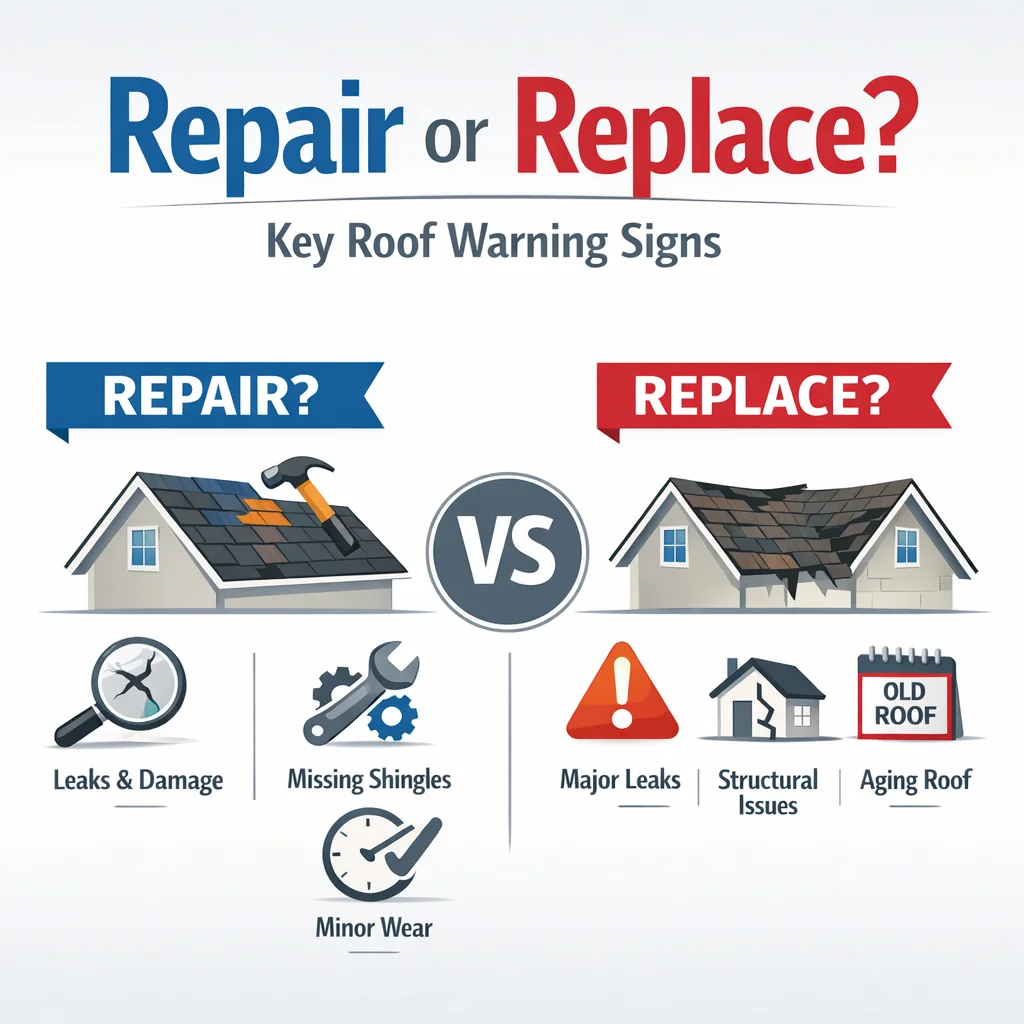
Shingle condition is the most visible indicator, but it is also the easiest to misread without context.
Granule loss is worth paying attention to in terms of pattern, not just presence. Finding some granules in gutters is normal across the life of a roof. Finding thick accumulations consistently, or seeing bald patches across a full slope, tells you the asphalt surface is breaking down and UV protection is compromised.
Curling and cupping shingles are often cited as a straightforward replacement signal — and they frequently are — but it is worth understanding why they curl. Thermal fatigue is one cause. Poor attic ventilation is another. A shingle that cups because of moisture imbalance from a ventilation problem is telling you something different than a shingle that curls because it is simply at end of life. Both may point toward replacement, but the ventilation issue needs to be addressed regardless — more on that below.
Cracking is a sign of advanced brittleness. A cracked shingle has lost its flexibility entirely and is no longer able to shed water reliably across its surface.
Soft or spongy decking is one of the clearest signals that a repair is not sufficient — but the extent of the damage matters.
OSB decking and plywood decking fail differently. OSB, which is the most common decking material in newer construction, is highly sensitive to moisture. Once it begins to swell and delaminate, it loses its fastening integrity quickly — meaning new shingles cannot be reliably anchored. Plywood tends to deteriorate more gradually, holding its structure longer even as it absorbs moisture.
Localized soft spots — say, around a chimney where flashing has failed over time — may mean that a section of decking can be replaced as part of a repair. Widespread soft decking across a slope or multiple areas of the roof is a clear indication that a full tearoff is the right path, because the structural substrate for the repair simply is not sound.
Not every leak means the roof is at end of life. Location and pattern are the useful diagnostic questions.
A single leak at a flashing transition — where the roof meets a chimney, a dormer, or a pipe boot — is often a targeted repair candidate. Flashing can fail independently of shingle condition, and replacing a failed flashing component with properly installed new material can extend the life of an otherwise healthy roof. If you are dealing with a leak originating near the chimney specifically, our article on roof repair around chimney fixes that last covers that scenario in detail.
Multiple leak points in the field of the roof — away from penetrations and transitions — are a different story. They suggest the primary water barrier (the shingles and underlayment together) has failed across a broader area. That pattern points toward system-level replacement rather than spot repair.
This is where most roofing guides — and even some inspections — fall short. Every visible assessment focuses on the shingle layer. But the underlayment beneath the shingles is a critical part of the water-shedding system, and it degrades on its own timeline, completely independent of how the shingles above it look.
Felt underlayment — the traditional paper-based material used in most roofs installed before the wide adoption of synthetic alternatives — desiccates over time. It becomes brittle, it shrinks, and it eventually loses its ability to function as a secondary water barrier. This can happen even when the shingles above still look passable to the eye.
Here is the problem: underlayment condition cannot be fully assessed without removing the shingles. A visual roof inspection from the surface tells you nothing definitive about what is happening at the underlayment layer.
This matters for the repair-vs-replacement decision because a repair that addresses damaged shingles but leaves degraded underlayment in place has not actually restored the roof’s water-shedding performance. The shingles are the primary layer, but the underlayment is the safety net. If the safety net is already compromised, a shingle repair does not give you the protection you are paying for.
A question worth asking any inspector or contractor: What is your assessment of the underlayment condition, and what information is that based on? If the answer relies entirely on visual surface observation, that is useful information in itself — it means the underlayment is an unknown variable in the decision.
One factor that rarely gets discussed in terms of its structural implications is shingle matching. Most homeowners know that finding an exact shingle match on an older roof can be difficult — they assume it is an aesthetic issue and move on. In many cases it is more than that.
Shingles manufactured in different production generations — even within the same product line — can have different thickness profiles, different granule embedment depths, and different adhesive strip formulations. When shingles with different physical characteristics are installed side by side, they can have slightly different thermal expansion rates. Over time, that difference can create a stress concentration at the seam between old and new material.
This is not a guaranteed failure point, and experienced contractors know how to manage the transition. But it is a legitimate engineering consideration, not just an aesthetic one. When a product line has been discontinued, or when the original shingles were installed more than a decade ago, the compatibility question should be part of the repair conversation — not as a reason to panic, but as a factor in honestly evaluating whether a repair will perform as well as it should.
Poor attic ventilation is one of the most common underlying causes of premature roof failure, and it is almost entirely invisible from the outside. What it does is straightforward: without adequate airflow moving through the attic, heat and moisture build up beneath the decking. That heat accelerates the breakdown of the asphalt in shingles from below. That moisture contributes to decking deterioration and can promote mold growth in the attic structure.
The reason this matters for the repair-vs-replacement decision is direct: if the underlying ventilation problem is not resolved, any repair or replacement will underperform relative to its expected lifespan. A roof replaced without addressing a ventilation deficiency will age faster than the manufacturer’s warranty assumptions account for — which, in turn, can complicate warranty claims if problems emerge early.
Signs that ventilation may be a contributing factor include:
If any of these are present, the ventilation system needs to be assessed as part of the overall inspection — not as an afterthought, but as a primary input into the repair-vs-replacement decision. Understanding roof vent installation cost and what drives the price can help you budget for this correction as part of your broader roofing project.
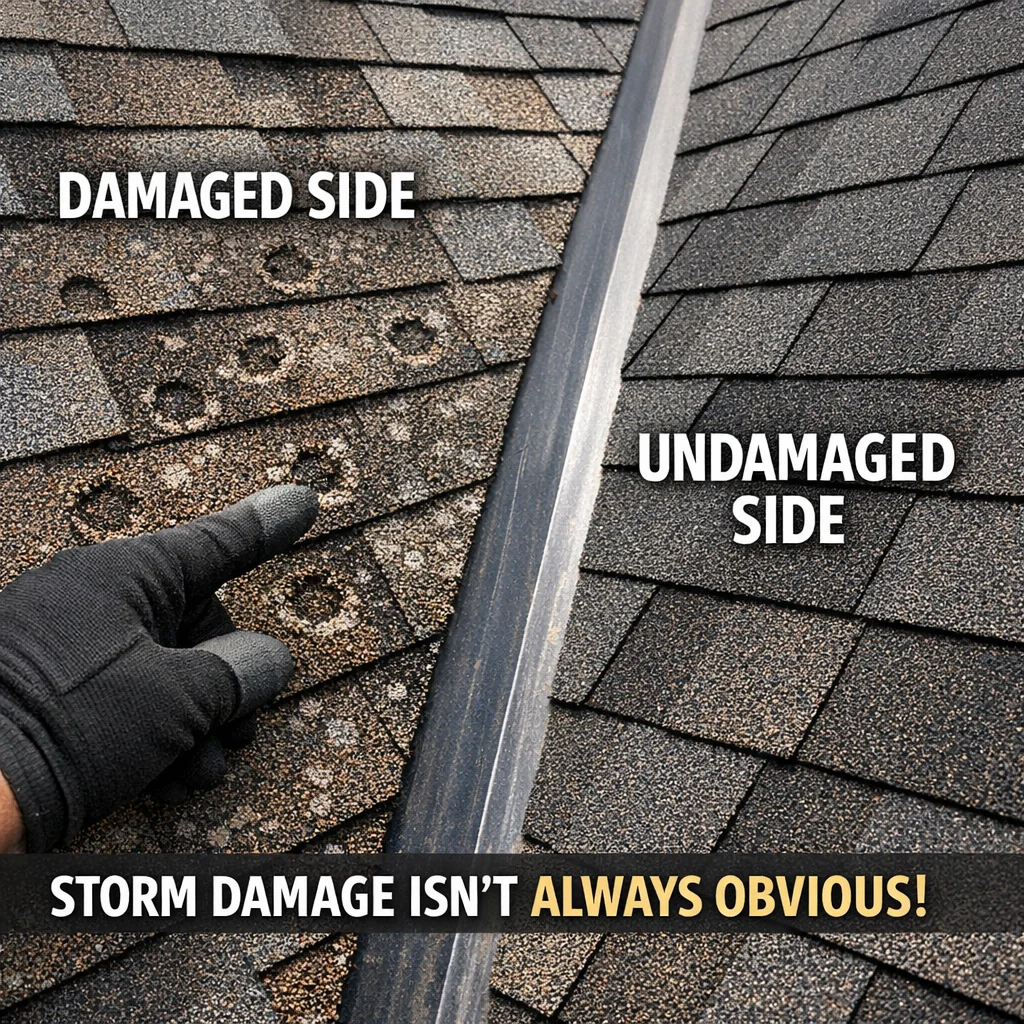
The NC Triad sees its share of significant weather — hail storms, high wind events, and the occasional severe thunderstorm complex that moves through the Piedmont region with enough force to do real damage. After any of these events, the challenge is that the damage most likely to affect long-term roof performance is often the damage you cannot see from the ground.
Hail damage is a good example. Large hailstones strike the shingle surface and leave visible dents or cracks, which are easy to identify. But moderate-size hailstones — the kind most common in Triad-area storms — often bruise the fiberglass mat beneath the granule surface without leaving a mark that is visible at ground level. That internal damage accelerates shingle aging, creates entry points for moisture, and compromises the structural integrity of the shingle without announcing itself visually. This is why a professional inspection after a significant hail event matters regardless of what you can see from the driveway. Our article on hail damage roof repair and what you can’t see goes deeper on this specific issue.
Wind damage presents a different hidden problem. High winds can break the adhesive seal strips that bond shingle tabs to the course below. A shingle with a failed seal strip looks completely normal from below, but it is no longer anchored against wind uplift — meaning it is significantly more vulnerable in the next storm. This type of damage is essentially invisible without getting on the roof and physically testing the bond.
After any significant storm, the right sequence is: get a professional inspection first, then make the repair-vs-replacement decision based on actual findings. Making the decision before the inspection — in either direction — means making it with incomplete information.
The financial logic of repair vs. replacement is not just about the immediate outlay. It is about what you are buying with each option.
A targeted repair, done correctly on a roof with adequate remaining system life, extends the functional life of the existing roof without the disruption of a full tearoff. It makes sense when:
A full replacement is a reset of the entire system — new shingles, new underlayment, new ice and water shield at vulnerable areas, and the opportunity to address any decking, flashing, or ventilation issues at the same time. It makes sense when:
| Decision Factor | Points Toward Repair | Points Toward Replacement |
|---|---|---|
| Roof age | Early half of expected lifespan | Latter half or beyond expected lifespan |
| Damage scope | Isolated, single area | Widespread across slopes or multiple zones |
| Decking condition | Sound, confirmed firm | Soft, delaminated, or moisture-compromised |
| Underlayment status | Likely sound for age and climate | Unknown, suspect, or confirmed degraded |
| Repair history | First incident in that area | Repeated repairs in the same zone |
| Shingle availability | Current matching product available | Discontinued product line or generation mismatch |
| Ventilation | Functioning adequately | Deficient — contributing to wear pattern |
| Leak pattern | Single point near a transition or penetration | Multiple points in field of roof |
| Storm damage | Isolated impact, contained scope | Broad impact pattern across roof plane |
Here is the honest way to read that table: a repair only earns its keep when every factor in the repair column is true at the same time — a young roof, one isolated problem, confirmed-sound decking and underlayment, and a matching shingle still on the market. If even two or three factors land in the replacement column, you are no longer choosing between a cheap fix and an expensive one. You are choosing between paying twice — a repair now, and the replacement anyway within a few seasons — or paying once for a full system reset with a fresh warranty behind it. That is why, for most roofs old enough to be showing the warning signs that prompted this article, replacement is the decision that actually protects the investment.
The repair-vs-replacement decision is only as good as the inspection that informs it. A surface-level look from the ground — or even a quick walk across the shingles — does not give you the full picture. A thorough inspection should address:
Any estimate or recommendation that does not account for the full system is missing variables that matter. At Smithrock Roofing, our inspections are designed to give you real information — not a quick surface assessment dressed up as a full diagnosis.
The repair-vs-replacement decision does not have to be a guess, and it should not be driven by the path of least resistance or by pressure from a contractor with a fixed agenda. What it requires is:
When those pieces are in place, the decision usually becomes clear. And when it does not — when the roof is genuinely in a gray area — the right answer is to understand exactly what the repair buys you and what risks remain unresolved, then make the call with full information.
That is the kind of conversation we have with homeowners across the NC Triad every day. If you are trying to work through this decision for your home, reach out to Smithrock Roofing. We will give you a straight answer — and the reasoning behind it.
If you are navigating the repair-vs-replacement decision heading into 2026, three steps will put you in the strongest position:
1. Schedule a Post-Winter Inspection in Early Spring
NC Triad winters — with their freeze-thaw cycles, ice, and wind events — put measurable stress on roofing systems every year. An inspection in late February or March, before the spring storm season begins, gives you a clear picture of where your roof stands before any new damage compounds existing issues. This is the single most practical step most homeowners overlook.
2. Request a Written Scope of Work Before Any Decision
Whether a contractor recommends repair or replacement, ask for a written breakdown of what is being addressed, what is being left in place, and why. A recommendation without documentation is difficult to evaluate and even harder to compare across multiple contractors. A written scope forces specificity — and specificity protects you.
3. Use NC Triad-Specific Resources When Evaluating Contractors
The North Carolina Licensing Board for General Contractors maintains a public license verification tool. Before hiring anyone to work on your roof — for repair or full replacement — verify that the contractor holds an active, valid license. Pair that with a review of their local project history, not just star ratings, and you have a much more reliable picture of who you are working with.
The honest answer is that it depends on a combination of factors — shingle age, the extent and type of damage, the condition of the underlayment and decking, and how your attic ventilation is performing. A single damaged area on a relatively young roof often points toward repair. Widespread granule loss, repeated leaks across multiple areas, or a system approaching the end of its rated lifespan typically points toward replacement. The only reliable way to know is a thorough inspection that looks at the full roof system, not just the visible shingle surface.
Yes — in specific situations. If an older roof is structurally sound, has intact underlayment, and the damage is limited to an isolated area caused by a single event (storm impact, for example), a targeted repair can be a reasonable choice. The key question is whether the repair resolves the problem fully or simply delays a replacement by a short period. A good contractor will tell you which situation you are in, and what the repair realistically buys you in terms of remaining service life.
Several indicators consistently point toward replacement over repair: shingles that are curling, cupping, or losing granules across broad sections of the roof; multiple active leaks in different locations; visible sagging or soft spots in the decking; significant moisture staining on the underside of the decking visible from the attic; and a system that has reached or exceeded its rated lifespan. Any one of these alone may not be definitive, but when two or more are present together, replacement is usually the more sound long-term decision.
It depends on the cause of the damage and your specific policy terms. Most standard homeowner’s policies in North Carolina cover sudden, accidental damage caused by covered perils — wind, hail, and storm events are the most common examples. Damage resulting from gradual wear, lack of maintenance, or age-related deterioration is generally not covered. If you have experienced a storm event and are seeing new leak activity or visible shingle damage afterward, it is worth filing a claim and having an inspection completed before any repair work begins, so the damage is documented in its original condition.
When the repair-vs-replacement question is in front of you, having a contractor who will give you a straight answer — grounded in a real inspection and local experience — makes all the difference. Smithrock Roofing works with homeowners across Winston-Salem and Greensboro every day — and in our experience, most homeowners asking this question are already seeing the signs of a roof system near the end of its serviceable life, where the repairs being weighed would only postpone the inevitable at greater total cost. We will give you honest findings either way. And if the inspection shows what it usually shows, we will walk you through exactly what a full replacement involves, what it protects you from, and how the 5-year labor warranty plus the manufacturer system warranty change the math. Schedule your free roof replacement assessment and get a clear answer this week.
Need a local pro? Learn more about our roofing services in King.
See also: Roof Repair Company | Fix Leaks Right the First Time
See also: Average Roof Replacement Cost: What You’ll Really Pay
See also: Roof Replacement Contractor: What Experts Won’t Tell You

Smithrock Roofing © Copyright 2026 • All Rights Reserved • Privacy Policy • Maintained by Mongoose Digital Marketing