Gutter downspout repair is a critical component of residential maintenance that often goes overlooked until a catastrophic failure occurs. While the gutters themselves collect rainwater from the vast surface area of your roof, the downspouts are the workhorses that transport that concentrated volume of water safely to the ground and away from your home’s structural elements. When these vertical conduits fail, the results are rarely minor. Water is the most persistent enemy of a home’s longevity, and without a functional downspout system, your foundation, basement, and landscaping are at constant risk.
Comprehensive Quick Fix Guide:
Your downspouts are sophisticated drainage components designed to manage the physics of falling water. During a standard one-inch rainstorm, a 2,000-square-foot roof sheds approximately 1,250 gallons of water. Without functional downspouts, this massive volume of water cascades directly onto the soil surrounding your foundation. This leads to a phenomenon known as the “moat effect,” where the soil becomes saturated, loses its load-bearing capacity, and begins to exert immense pressure on your basement walls.
The stakes are high. Industry research consistently demonstrates that proactive maintenance and timely repair of downspouts can extend the operational life of your entire roof drainage system by decades. More importantly, it serves as the primary defense against foundation settling, which can lead to structural cracks that are incredibly difficult and expensive to remediate. By ensuring your downspouts are in peak condition, you are protecting the equity of your home and preventing the growth of toxic mold in damp crawl spaces.
Most downspout issues manifest as subtle warnings before they become emergencies. A small drip at a joint might seem insignificant, but over a single season, that drip can erode a hole in your landscaping or rot the wooden fascia board behind the gutter. In colder climates, like those experienced in the higher elevations of North Carolina, leaking downspouts contribute to ice damming and dangerous ice patches on walkways. The good news is that with the right knowledge and a few hours of dedicated effort, most homeowners can restore their drainage system to factory-new performance.
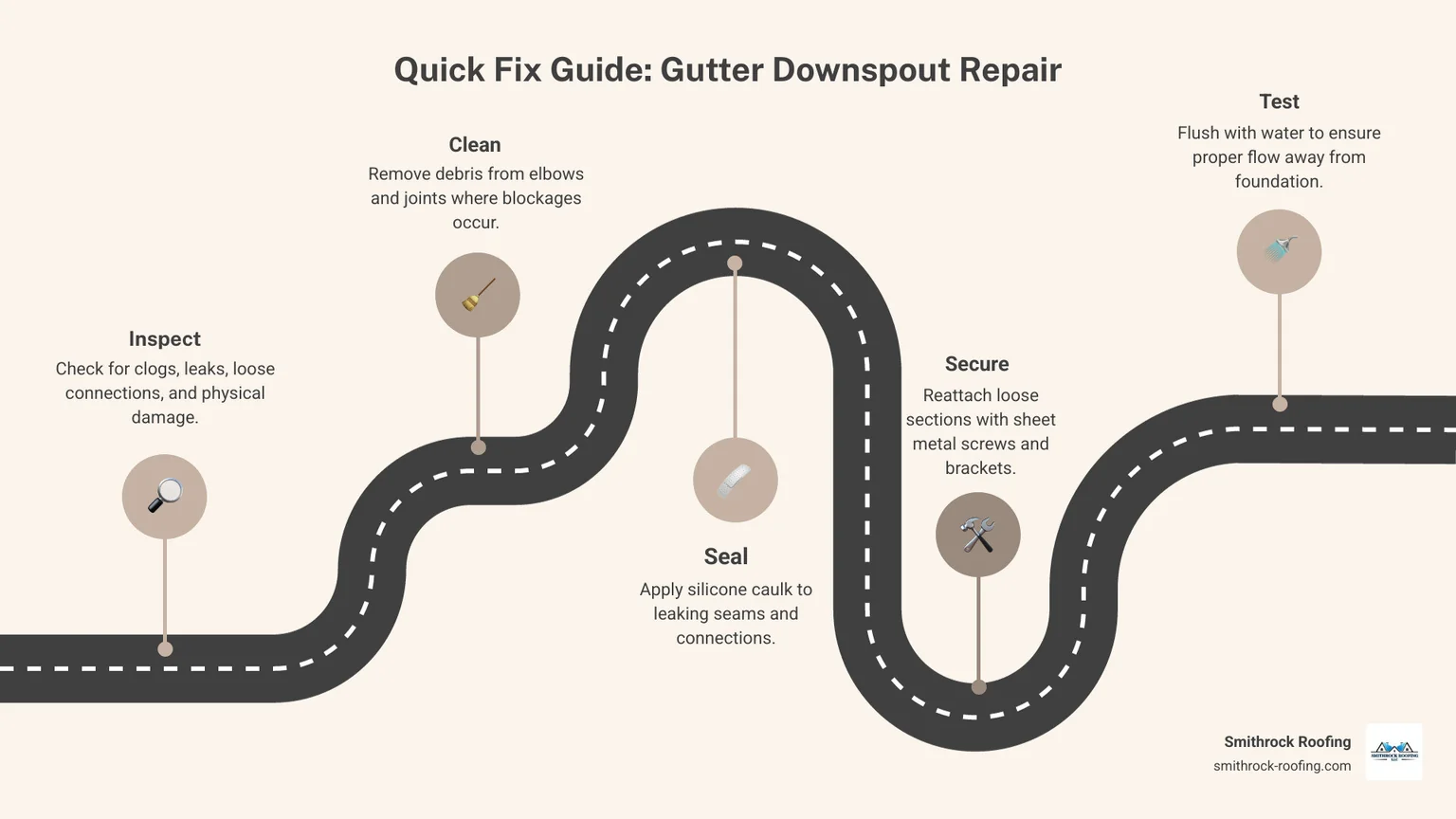
Simple guide to Gutter downspout repair terms:
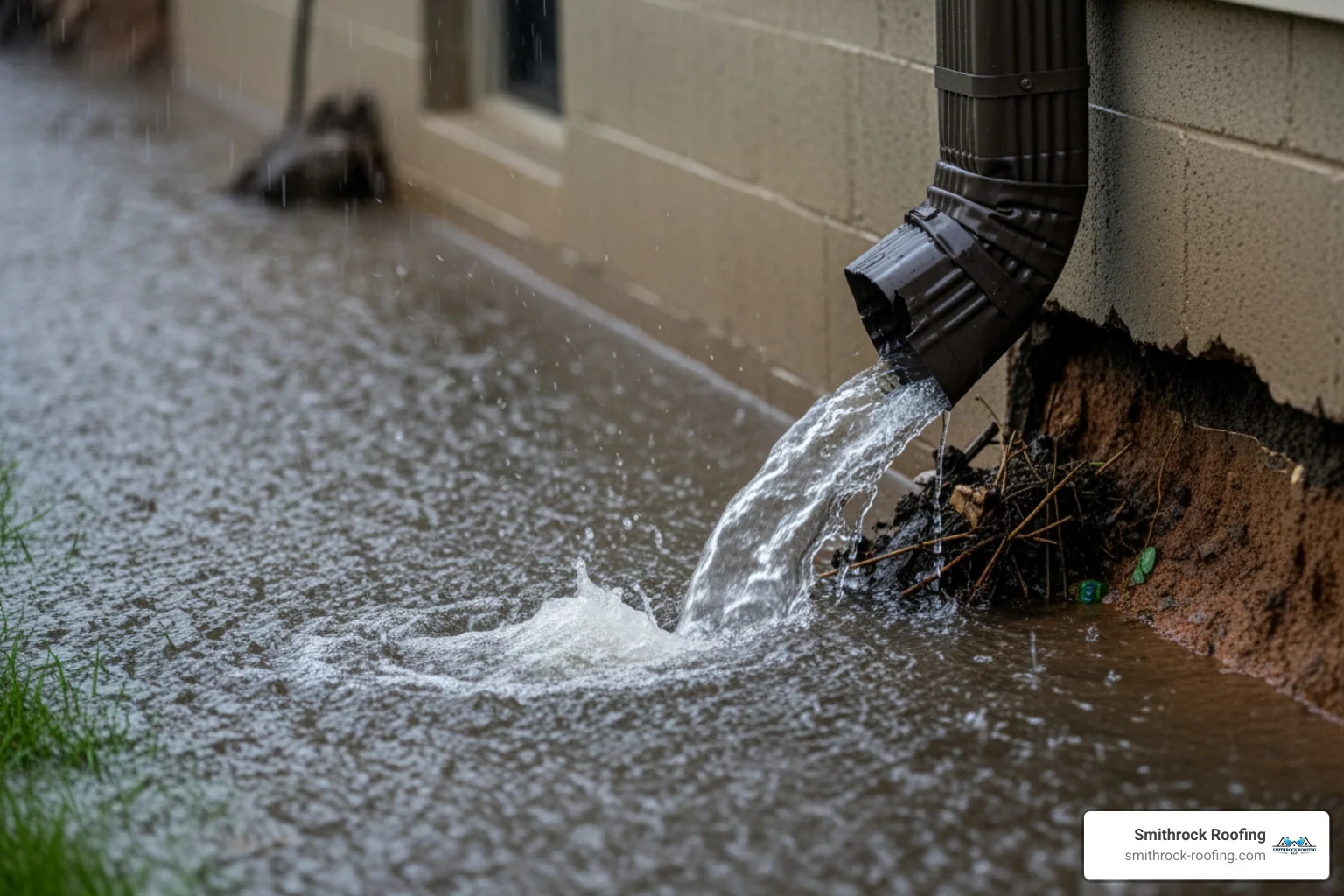
Before initiating any repair work, it is vital to perform a diagnostic assessment of the entire drainage assembly. In our extensive experience serving homeowners throughout the Triad region, from the urban centers of Winston-Salem to the rural landscapes of Mt. Airy, we have observed that downspouts are the most vulnerable part of the gutter system. Because they are positioned vertically and extend to ground level, they are subjected to unique mechanical stresses and environmental hazards that the horizontal gutters rarely face.
For a deeper dive into maintaining your system, you can refer to the General Inspection And Maintenance Of Gutters And Downspouts. If you aren’t comfortable climbing a ladder or if the damage appears to be structural, you can always find Gutter Repair Near Me through our local professional services.
To achieve a professional-grade Gutter downspout repair that will withstand the test of time and weather, you must move beyond basic household tools. Using the wrong fasteners or sealants can actually accelerate the degradation of your gutter system. Most of the specialized items listed below are readily available at hardware stores in King, Kernersville, or Greensboro, and they are essential for a safe and effective repair.
Your Professional Repair Kit Checklist:
For more technical details on the specific mechanics of these tools, check out this comprehensive guide on How to Repair Gutters.
Restoring your home’s drainage system requires a methodical approach. Rushing the process often leads to recurring leaks or improperly secured sections that will fail during the next heavy storm. Follow this detailed, step-by-step protocol to ensure your Gutter downspout repair is performed to professional standards.
Never attempt gutter work alone. Ensure a partner is present to stabilize the ladder and assist with tools. Begin by walking the perimeter of the home. Look for “tiger striping” (dark streaks) on the outside of the downspouts, which indicates water is overflowing from the top. Check the alignment of the downspout where it meets the gutter outlet; if it is skewed, the internal seal is likely broken. Inspect the wall anchors to ensure they haven’t pulled away from the siding, which can happen if the downspout becomes heavy with ice or debris.
One of the most common reasons for repair failure is applying sealant to a dirty surface. If you are fixing a leaking joint, you must remove all traces of the old, failed sealant. Use a stiff wire brush or a specialized gutter scoop to remove organic matter. Follow this by wiping the area with a rag soaked in denatured alcohol or a similar degreaser. This removes the thin film of oxidation and environmental pollutants, allowing the new silicone to create a permanent, watertight bond.
If water is backing up, the clog is likely in the elbow or the underground transition. Start by tapping the side of the downspout with a screwdriver handle; a hollow sound indicates an empty pipe, while a dull thud indicates a clog. If the clog is in the elbow, remove the screws and take the elbow down to clear it manually. For clogs deeper in the system, use a plumber’s snake or a high-pressure water jet. Avoid using chemical drain cleaners, as these can react with the metal and cause rapid corrosion.
When reassembling the system, you must strictly adhere to the “telescoping rule.” The upper section of the pipe must always slide inside the lower section. This uses gravity to keep water contained within the system. If you install them in reverse, water will constantly leak out of the seam, regardless of how much sealant you use. If the pipes are the same size and won’t fit, use your crimping tool to create small folds in the end of the upper pipe, reducing its diameter just enough for a snug fit.
Once the sections are aligned, drive two sheet metal screws into the sides of the joint. Do not place screws in the front or back of the downspout, as this is where debris is most likely to catch. After the screws are secure, apply a continuous bead of gutter sealant around the exterior of the joint. Smooth the bead with a gloved finger to ensure there are no air pockets. For more on this specific process, see How to Repair Leaking or Separated Gutter Downspouts.
When we perform a professional Gutter downspout repair, we focus on the physics of the installation. Wall straps should be placed every 6 to 8 feet, but we also recommend placing a strap within 12 inches of any elbow. This provides the necessary leverage to prevent the elbow from twisting under the weight of rushing water. Furthermore, ensure that the screws used for the wall straps are long enough to penetrate the wall sheathing and enter the structural studs of the home. This prevents the entire system from being pulled off the house during a high-wind event or a heavy ice storm. For more information on the pipes themselves, see our page on the Downspout Drain Pipe.
If your downspouts disappear into a PVC pipe in the ground, this transition point is a frequent failure zone. Ensure the downspout is not jammed too far into the PVC, which can restrict flow. Use a specialized “universal downspout-to-PVC adapter” to create a clean, debris-proof connection. If the underground line is clogged, it may require professional hydro-jetting to clear roots or compacted soil that has entered through cracks in the buried pipe.
A successful repair is only the first step in a comprehensive water management strategy. To truly protect your home, you must optimize how the water is handled once it leaves the downspout. The goal is to move the water as far away from the foundation as possible while minimizing erosion and impact on your landscaping.
1. Strategic Use of Extensions: A downspout that terminates at the corner of the house is a liability. We recommend installing permanent or fold-up extensions that carry water at least 6 to 10 feet away from the foundation. In areas with expansive clay soils, which are common in parts of North Carolina, even longer extensions may be necessary to prevent the soil from swelling and shifting.
2. High-Performance Splash Blocks: If extensions are not feasible due to walkways or aesthetic concerns, use heavy-duty splash blocks. These should be at least 24 inches long and made of concrete or high-density plastic. Their purpose is to break the velocity of the falling water and spread it out over a wider area, preventing the formation of deep gullies in your lawn or mulch beds.
3. Correcting Gutter Pitch: A downspout can only do its job if the water actually reaches it. Over time, fascia boards can warp or hangers can loosen, causing the horizontal gutters to lose their “pitch.” Use a level to ensure the gutters have a downward slope of approximately 1/4 inch for every 10 feet of run toward the downspout. If the gutter is level or sloping away from the downspout, water will pool, leading to mosquito breeding grounds and rusted metal.
4. Advanced Gutter Guard Systems: The best way to fix a clog is to prevent it from ever forming. High-quality micro-mesh gutter guards allow water to enter the system while shedding even the smallest debris like pine needles and maple seeds. This significantly reduces the maintenance burden and ensures that your downspouts remain clear during the most intense storms.
5. Underground Drainage and Dry Wells: For the ultimate in home protection and curb appeal, consider a buried downspout system. This involves connecting your downspouts to a network of 4-inch N-12 or PVC pipes buried 12 to 18 inches underground. These pipes carry the water to a “pop-up” emitter in the middle of the lawn or into a dry well—a large underground basin that allows water to slowly percolate back into the water table. This system eliminates the trip hazard of surface extensions and provides the most reliable water management possible. Learn more about Burying Gutter Downspout systems.
One of the most difficult decisions for a homeowner is determining whether a downspout can be saved or if it requires a full replacement. While we always advocate for repair when it is structurally sound and cost-effective, there are certain conditions where replacement is the only responsible choice. Continuing to repair a fundamentally flawed system is a case of diminishing returns that leaves your home at risk.
| Condition | Recommended Action | Long-Term Benefit |
|---|---|---|
| Minor joint leaks or loose fasteners | Professional Repair | Extends the system life by 5-10 years with minimal effort. |
| Single crushed or dented section | Partial Replacement | Restores full hydraulic capacity without the cost of a full system. |
| Widespread oxidation or pinhole leaks | Full Replacement | Eliminates the risk of hidden leaks damaging the home’s structure. |
| Chronic sagging or rotted fascia boards | System Re-engineering | Modern heavy-duty hangers provide vastly superior support. |
| System exceeds 20 years of age | New Installation | Modern seamless aluminum offers superior durability and aesthetics. |
The material of your system also dictates its lifespan. Traditional vinyl gutters are prone to becoming brittle and cracking after a decade of UV exposure. In contrast, high-quality aluminum gutters typically last 20 to 30 years, while copper systems can last a century if properly maintained. If you find yourself on a ladder every few months to fix the same leaks, it is likely time to transition to a modern, low-maintenance solution. Many homeowners in High Point and Greensboro are moving toward Seamless Gutter Installation. Because seamless systems are custom-fabricated on-site to the exact dimensions of your home, they eliminate the mid-run joints where most leaks and clogs originate.
We recommend a comprehensive inspection at least twice a year, ideally in the late spring after the pollen season and in the late fall after the majority of leaves have dropped. However, if your property has heavy tree cover, quarterly inspections may be necessary. In the North Carolina Triad, it is also vital to check your system after any significant weather event, such as a tropical storm remnant or a heavy ice storm, which can put immense physical stress on the mounting brackets.
Beyond the obvious overflow, look for “weeping” at the seams, which indicates that water is backing up and creating internal pressure. You might also notice that the downspout remains wet or cold to the touch long after the rain has stopped, suggesting it is full of wet debris. Another sign is the presence of birds or squirrels showing unusual interest in the gutter openings, as they may be nesting in a clog.
Yes, and the process is often faster than homeowners realize. When water is not directed away, it saturates the soil, causing it to expand. This expansion creates hydrostatic pressure that can crack concrete blocks and poured foundations. Furthermore, as the water eventually drains away, it can carry soil with it, creating voids under your foundation (subsidence). This leads to uneven settling, which manifests as sticking doors, windows that won’t open, and large cracks in your interior drywall.
While rivets provide a very clean look, we generally recommend high-quality sheet metal screws for most repairs. Screws allow for much easier disassembly if you ever need to clear a deep clog or replace a single section in the future. If you use rivets, you have to drill them out every time you want to take the system apart, which can eventually enlarge the holes and weaken the metal.
Investing time and attention into Gutter downspout repair is one of the most effective ways to safeguard your home’s structural integrity. While it may seem like a minor maintenance task, the downspout is the final, critical link in a chain that protects your roof, your walls, and your foundation from the relentless power of water. By understanding the common failure points—from clogged elbows to degraded sealants—and applying the professional techniques outlined in this guide, you can ensure your home remains dry and secure for years to come.
At Smithrock Roofing, we take pride in our deep roots within the North Carolina community. We have spent years helping our neighbors in Winston-Salem, Clemmons, Lewisville, and the surrounding Triad areas navigate the challenges of home maintenance. We understand that every home is unique, and a drainage solution that works for a ranch-style home in the suburbs might not be appropriate for a multi-story historic property. Our commitment is to provide not just repairs, but long-term peace of mind through expert craftsmanship and high-quality materials.
Don’t wait for the next heavy downpour to discover that your drainage system is compromised. A proactive approach today can save you from the stress and significant expense of foundation repairs tomorrow. Whether you are looking for a simple component fix or a complete, modern gutter system overhaul, our team is ready to provide the professional assessment you need. Ready to ensure your home is fully protected? Get an estimate for the cost of new fascia, soffit, and guttering today and let us help you keep your home’s water management system flowing perfectly.

Smithrock Roofing © Copyright 2026 • All Rights Reserved • Privacy Policy • Maintained by Mongoose Digital Marketing