
Most property owners and facilities managers start researching commercial gutter installation expecting to find the same information they’d get for a house — just bigger. That assumption leads to undersized systems, code violations, and drainage failures that cost far more to fix than they would have cost to get right the first time.
Commercial gutter installation is a different discipline. It involves hydraulic load calculations, code compliance under the International Plumbing Code and SMACNA standards, material selection that accounts for galvanic corrosion and thermal expansion, and in many cases, formal shop drawings submitted to an architect or engineer of record before a single bracket goes up. If your contractor isn’t talking about any of that, they’re bringing a residential mindset to a commercial problem.
This guide walks through what commercial gutter installation actually requires — the technical decisions, the failure modes, and the factors that separate a system built to last from one that’s already failing before the first heavy rain.
The most common shortcut in commercial gutter work — and the one that causes the most damage — is sizing gutters by feel or by visual comparison to neighboring buildings. Proper commercial sizing is a calculation, not a guess.
Licensed sheet metal contractors and engineers size commercial drainage systems using the Rational Method:
Q = C × i × A
Rainfall intensity isn’t a single national number — it varies significantly by region. The SMACNA Architectural Sheet Metal Manual and IPC Chapter 11 both reference geographic rainfall intensity data, and your local Authority Having Jurisdiction (AHJ) may specify which storm return period (typically a 100-year storm event) the system must handle. In parts of the NC Triad, that can mean designing for 4–6 inches of rainfall per hour during extreme events.
Take a 10,000 square foot warehouse roof in a Zone 4 rainfall region with a design intensity of 4 in/hr:
Running two downspouts on a building like that — which is common when gutters are installed by crews without formal load training — means every heavy rain is pushing three times the intended volume through the system. The gutters don’t just overflow. They build hydrostatic pressure at end caps and mitered joints, which forces sealant failure, splits seams, and eventually rots the fascia substrate behind the gutter. By the time you see the damage, it’s already structural.
Commercial gutter slope requirements aren’t one-size-fits-all. The standard residential guidance of ¼ inch per 10 linear feet doesn’t directly translate to wide commercial box gutter profiles. A 7-inch box gutter requires different minimum slope calculations than a 5-inch K-style, and outlet placement — not just slope — drives drainage efficiency on long commercial runs. As a general field rule, plan for one downspout outlet per 40 linear feet of gutter at minimum, but always verify against hydraulic calculations for your specific roof area and rainfall zone.
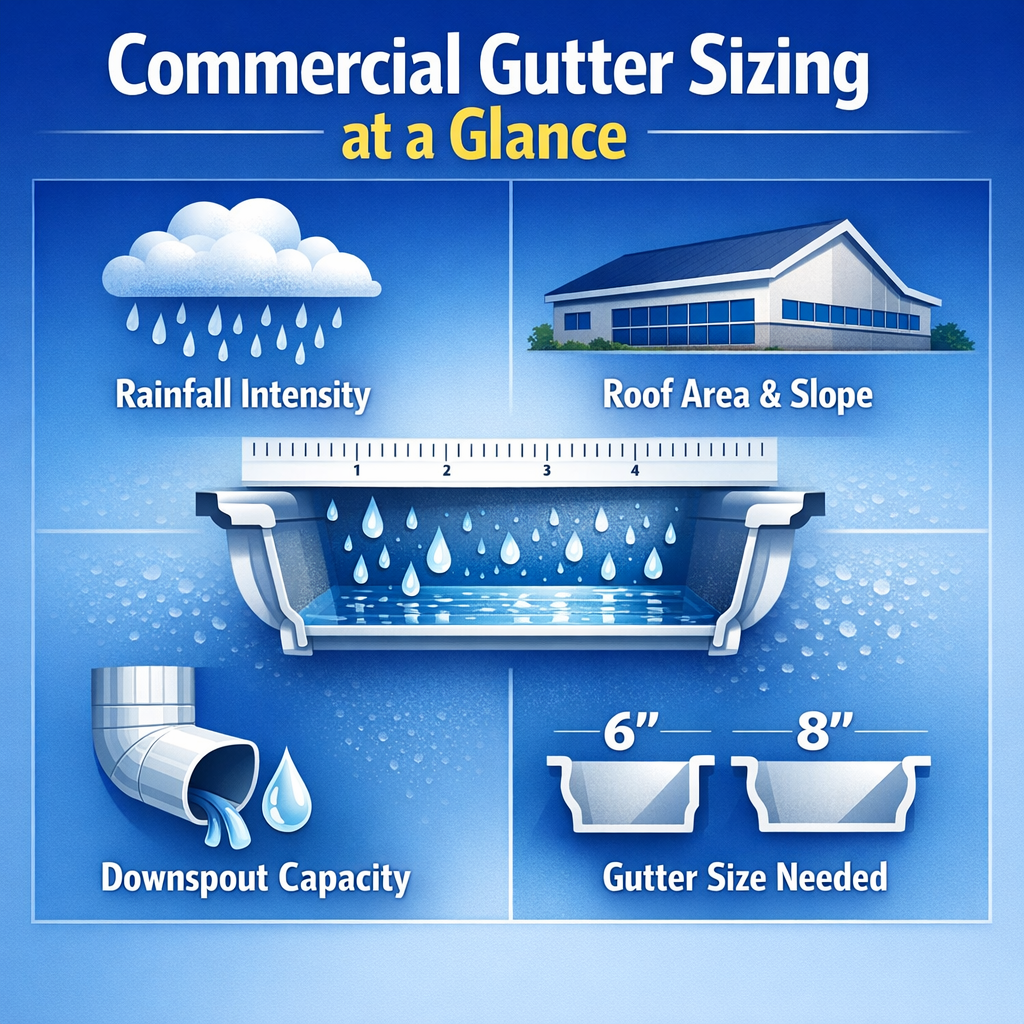
Commercial buildings don’t all drain the same way, and the right gutter profile depends on the building type, roof configuration, fascia design, and in some cases, historic district or code requirements. Here’s how experienced contractors think through that decision.
| Building Type | Recommended Profile | Key Reason |
|---|---|---|
| Metal building / warehouse | 6″–8″ box gutter | High drainage volume; integrates cleanly with eave trim systems |
| Retail strip mall / flat roof with parapet | Internal roof drains + scuppers | Parapet walls make perimeter gutters impractical or code-noncompliant |
| Historic commercial building | Half-round with cast iron outlets | Aesthetic and code compliance in historic districts |
| Industrial / manufacturing facility | Oversized box with leaf guards | Heavy debris load from HVAC exhaust, venting, and industrial particulate |
| Multi-story commercial building | Conductor heads + leader pipes | Manages cascading drainage from upper to lower roof levels |
| Food processing / chemical exposure | Stainless steel box gutter | Corrosion resistance against caustic environments |
The distinction between external and internal box gutters matters more than most non-contractors realize.
External box gutters are surface-mounted to the fascia, like an oversized version of what you’d see on a residence. They’re the more common commercial choice for new metal buildings and retrofits because they’re accessible for maintenance and don’t compromise the roof deck if they fail.
Internal box gutters are built into the roof structure itself, sitting behind the eave line. They’re common on older commercial and institutional buildings. When they work, they’re nearly invisible. When they fail — typically from sealant deterioration, improper slope, or debris accumulation — water is actively sitting inside your roof assembly. Relining or replacing an internal box gutter is a significantly more complex waterproofing project than replacing an external system.
On residential gutters, corners and mitered joints are sealed with butyl or silicone sealant and rely on that sealant staying intact. That’s acceptable for a 5-inch aluminum K-style on a house. On a commercial box gutter handling 200+ GPM, it’s not.
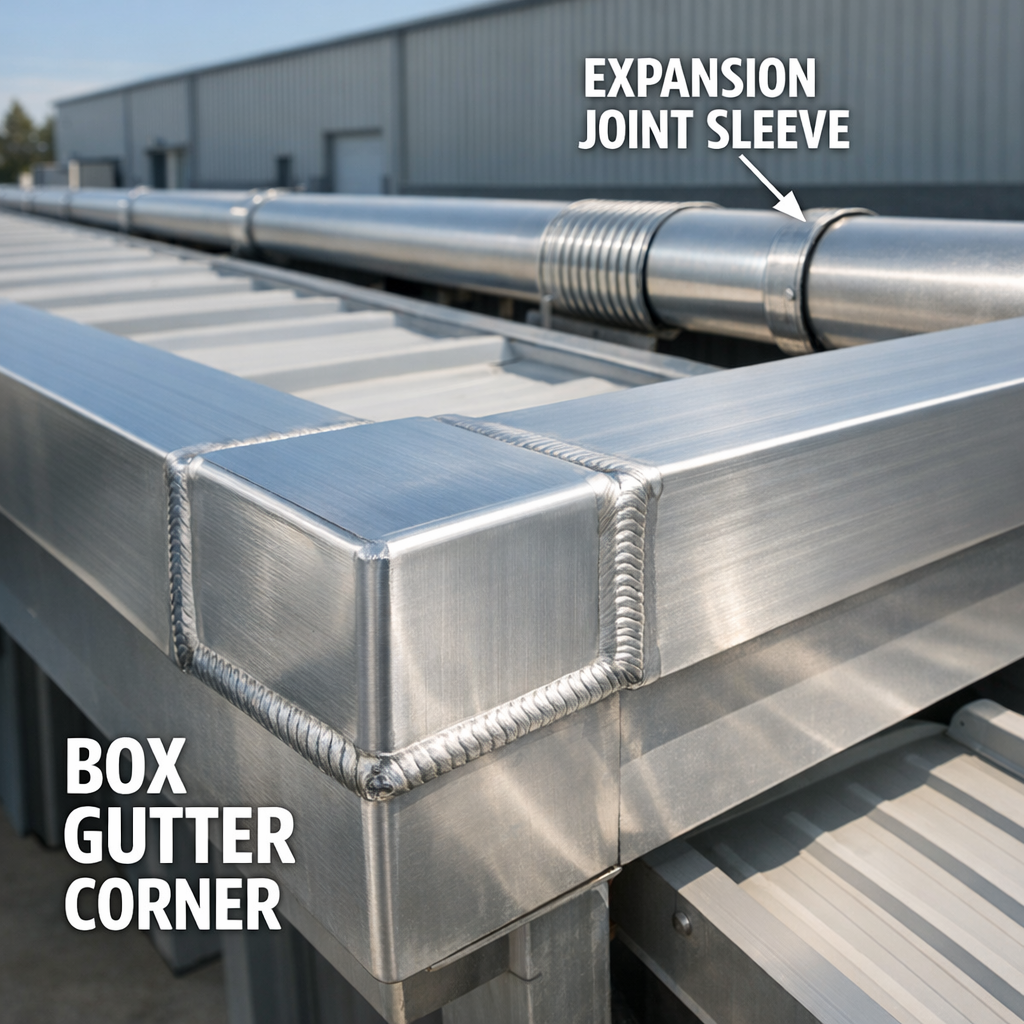
Commercial box gutter corners are welded or soldered — copper and steel systems are soldered, aluminum systems are typically welded with TIG or MIG processes, or factory-fabricated as single pieces to eliminate field joints entirely. Any commercial contractor quoting sealant-only corners on a box gutter installation is using residential practice on a commercial system. That joint will fail under load.
“High-quality materials that resist rust” is how most gutter content handles material science. That’s not enough information to make a good decision on a commercial project. Here’s what actually matters.
Residential aluminum gutters are typically .027 gauge. Commercial applications require heavier stock:
Asking for the gauge specification in a commercial bid isn’t nitpicking — it’s a reasonable question that a qualified contractor will answer without hesitation.
Galvanic corrosion happens when two dissimilar metals are in contact in the presence of moisture. On a commercial property, this risk shows up in several common ways:
The fix is straightforward: use like metals throughout the system, or install an isolation barrier (neoprene, rubber gaskets, or dielectric coatings) wherever dissimilar metals must be in contact. A contractor who doesn’t bring this up during material selection either isn’t thinking about it or doesn’t know to.
Metal expands and contracts with temperature changes. On a 20-foot residential gutter, that movement is negligible. On a 120-foot commercial run, it’s significant — aluminum expands approximately 0.0000131 inches per inch per degree Fahrenheit, meaning a 120-foot aluminum gutter can move more than ¾ inch across a seasonal temperature swing of 80°F. Without expansion joints, that movement loads the end caps and joint connections until something gives.
The industry standard is an expansion joint every 40 linear feet on commercial gutter runs. Those joints need to be designed into the system, not added as an afterthought after the first winter.
Understanding how commercial gutters fail is the fastest way to evaluate whether an existing system is worth repairing or needs replacement — and to know what questions to ask when reviewing a new installation bid.
Most common on: Long commercial runs installed without proper expansion joints
When sealant at end caps and seams is being asked to absorb seasonal metal movement it wasn’t designed to handle, it cracks. Once cracked, water infiltrates behind the gutter and begins deteriorating the fascia substrate. This failure mode is slow and easy to miss until the wood is gone.
What to look for: Hairline cracks at end caps, sealant pulling away from seams on long runs, staining on fascia below gutter joints.
Most common on: Buildings where gutters were sized by visual comparison rather than calculation
This is the single most frequent cause of commercial overflow damage. A rough field rule — 1 square inch of downspout cross-section per 100 square feet of roof — helps identify obviously undersized systems, but it’s a starting point, not a substitute for hydraulic calculation in high-rainfall zones.
What to look for: Overflow marks (efflorescence, staining, erosion) directly below gutter runs between downspouts; ponding at the building base after heavy rain.
Most common on: Re-installation bids and gutter replacement projects on older buildings
When a contractor pulls an old gutter system off a building that has been leaking for years, what’s behind it is often soft, deteriorated fascia board or even compromised rafter tails. Contractors who skip the substrate inspection and re-mount new gutters over damaged wood are starting the clock on the next failure before the job is even finished. For a closer look at what proper fascia inspection and repair should involve, the article on DIY fascia and soffit repair covers the key signs of deterioration that should be addressed before any new gutter system goes up.
What to look for: Soft spots or discoloration at the fascia line, paint peeling from below the gutter, sagging gutter sections that don’t align with the original slope.
Most common on: Buildings with mixed metal systems or those near coastal or industrial environments
As covered in the material section above, dissimilar metal contact accelerates corrosion at every contact point. In industrial environments, airborne chemicals can accelerate this further.
What to look for: White or gray oxidation streaking below fastener points on aluminum gutters; rust staining below steel components; pitting along the gutter body near copper transitions.
Most common on: Commercial buildings in the NC Piedmont and mountain regions during ice events
When ice accumulates in commercial gutters, it’s not a trivial load. Ice weighs approximately 57 pounds per cubic foot. A 6-inch box gutter filled with ice across a 40-foot run can add several hundred pounds of load to a system designed to carry only the weight of the gutter itself and moving water. Transitions from flat or low-slope roof sections to perimeter gutters concentrate this load because ice dams form where the heated building envelope meets the cold eave — exactly where the gutter is. Understanding how ice dams form and why they concentrate at eave transitions is covered in depth in the article on how to get rid of ice dams.
What to look for: Gutter sections that have pulled away from the fascia at the bracket points; deformed or kinked gutter profiles; bent downspout connections at the upper elbow.
This is an area where most commercial gutter content goes completely silent. On any commercial project of meaningful size, gutter installation isn’t just a field trade decision — it’s a code compliance exercise.
The International Plumbing Code, Chapter 11 governs storm drainage design for commercial buildings in most jurisdictions. It specifies design storm frequency, drainage area calculations, and minimum sizing for roof drains, gutters, leaders, and combined systems. The SMACNA Architectural Sheet Metal Manual provides the fabrication and installation standards that contractors and inspectors reference for gutter profiles, gauge requirements, joint construction, and expansion joint frequency.
Most local AHJs adopt IPC with local amendments, so the specific requirements in Guilford County or Forsyth County may differ slightly from the base code. A contractor working in the NC Triad should know those local amendments.
On projects that involve an architect or engineer of record — new commercial construction, significant additions, or any project requiring a building permit — gutter systems typically require shop drawings submitted for approval before fabrication begins. Those drawings show:
A contractor who has never prepared or submitted shop drawings for a commercial gutter project is almost certainly operating exclusively in residential work, regardless of what their marketing materials say. Asking whether they can provide shop drawings and material submittals is a simple qualification question that separates commercial-capable contractors from those working beyond their experience.
Not every commercial roof uses perimeter gutters. The roof configuration determines what drainage system is appropriate:
Getting this decision right at the planning stage keeps a project on schedule and out of the re-work cycle. Getting it wrong means tearing out a newly installed system to satisfy a code requirement that was always there — it just wasn’t addressed.
Commercial gutter installation is becoming more technically demanding, not less. Building codes are tightening around stormwater management, material costs continue to fluctuate, and the gap between contractors who understand commercial work and those who don’t is wider than ever. These three steps will position any building owner, facilities manager, or general contractor to make better decisions in the year ahead.
The Sheet Metal and Air Conditioning Contractors’ National Association (SMACNA) publishes the industry-standard reference for architectural sheet metal work, including gutters, flashings, and drainage systems. The 2012 edition (still current for most jurisdictions) provides sizing tables, profile details, expansion joint spacing requirements, and material gauge minimums that align directly with what commercial building codes reference. Before accepting any contractor’s proposed specifications, compare them against SMACNA tables. A contractor proposing 24-gauge steel box gutters on a large commercial building when SMACNA calls for 22-gauge is cutting corners in a way that won’t be visible until the system fails. Access the manual through SMACNA’s official publication store or request that your contractor provide the specific SMACNA table number their design references. This single step eliminates a significant category of specification disputes.
The 2024 International Plumbing Code updated several provisions affecting roof drainage design, and many jurisdictions are in active adoption cycles. More importantly, NOAA’s Atlas 14 rainfall frequency data — the source most codes require for design storm calculations — has been updated for multiple regions to reflect observed increases in storm intensity. A hydraulic calculation prepared against 2010 rainfall data for a building in a region where NOAA has since revised intensity figures upward is no longer a valid design basis. In 2026, ask any contractor or engineer preparing drainage calculations to confirm which NOAA Atlas 14 volume and which IPC edition their calculations reference. If they cannot answer that question specifically, the calculations need to be reviewed before fabrication begins.
For projects where gutter system failure carries significant consequence — loading dock canopies, covered pedestrian entries, multi-story facades — the cost of a third-party special inspector during fabrication and installation is routinely justified. Special inspectors verify that the fabricated product matches approved shop drawings, that seam methods meet specification, that expansion joints are installed at the correct intervals, and that penetration details are executed correctly before they are concealed by other trades. The International Building Code provides the framework for special inspection programs under Chapter 17, and many jurisdictions now require them for certain commercial envelope components. Even where not required, commissioning a special inspector converts a verbal quality assurance commitment from a contractor into a documented, third-party-verified record — which matters when a warranty claim is filed five years later. Smithrock Roofing’s warranty outlines the coverage terms that back our commercial work, including the documentation standards that support long-term claims.
Commercial gutter installation typically ranges from $25 to $75 or more per linear foot installed, depending on gutter profile, material, gauge, finish, and site-specific factors such as building height, access requirements, and drainage complexity. Custom-fabricated box gutters in heavy-gauge steel or copper will fall toward the higher end of that range. Obtaining itemized bids that separate material costs, fabrication, labor, and equipment is the only reliable way to make accurate cost comparisons between contractors on a commercial project.
Gutter sizing for commercial buildings is determined through hydraulic calculations that account for the roof drainage area, the local design storm rainfall intensity (typically the 100-year, one-hour storm event from NOAA Atlas 14), and the slope of the gutter. The International Plumbing Code provides the governing sizing methodology for most jurisdictions. Unlike residential work, where rule-of-thumb sizing is common, commercial gutter sizing must be calculated and documented. Gutters that are undersized relative to the drainage area and design storm are a code violation and a recurring maintenance problem.
Box gutters are rectangular or square in cross-section, custom-fabricated from sheet metal, and designed to integrate structurally into the roof system — often concealed within the roof framing or behind a parapet. They are the standard choice for larger commercial buildings because they offer greater capacity and are engineered for the specific drainage load. K-style gutters have a decorative profile that resembles crown molding and are typically used on smaller commercial buildings or structures where the aesthetic reads more residential. K-style gutters are available in commercial-grade gauges and sizes but are generally not the appropriate specification for high-volume drainage applications or buildings where the gutter is a structural or architectural element.
In most jurisdictions, yes. Commercial gutter systems are considered part of the building envelope and the storm drainage system, both of which are regulated under the International Building Code and the International Plumbing Code. Permit requirements vary by jurisdiction and project scope, but on new construction or significant renovation projects, the drainage system design is typically reviewed as part of the building permit process. Shop drawings and material submittals are usually required before fabrication is approved. Proceeding without required permits exposes building owners to stop-work orders, mandatory removal and reinstallation, and complications with property insurance and future building sales.
Properly specified and installed commercial gutters have service lives that range from 20 to 50 or more years depending on material. Galvanized steel gutters in commercial gauges typically last 20 to 30 years with routine maintenance. Aluminum gutters can match or exceed that range in non-coastal environments. Copper gutters are the longest-lasting option, with documented service lives exceeding 50 years on well-maintained buildings. In all cases, service life is heavily influenced by proper installation — particularly expansion joint placement, sealant specification, and fastener compatibility — and by a consistent maintenance program that keeps debris clear and identifies seal failures before they develop into structural damage.
An overflow scupper is a secondary drainage opening installed through a parapet wall above the elevation of the primary drainage system. Its purpose is to provide a relief pathway for stormwater if primary roof drains or gutters become blocked, preventing the accumulation of standing water that can exceed the structural load capacity of the roof. The International Plumbing Code requires emergency overflow drainage for most commercial roof configurations, and the requirement is treated as a life-safety provision. On flat or low-slope roofs with parapet walls, overflow scuppers or secondary roof drains are not optional. Buildings constructed or renovated without required overflow drainage are at risk of roof collapse under blocked-drain conditions during heavy storm events.
A minimum inspection and cleaning schedule of twice annually — typically in late spring after tree pollination and seed release, and in late fall after leaf drop — is appropriate for most commercial buildings. Buildings located near heavy tree canopy, in high-debris environments, or in regions with frequent storm events warrant quarterly inspections. Each inspection should include checking for debris accumulation, sealant condition at joints and outlets, expansion joint integrity, fastener security, and signs of standing water or overflow staining on the building facade. Gutter maintenance is most cost-effective when performed on a scheduled basis rather than reactively after a drainage failure has already caused interior damage.
*See also: [Steel Siding Installation: What NC Homeowners Must Know](https://smithrock-roofing.com/steel-siding-installation-what-nc-homeowners-must-know/)*
*See also: [Gutters Kernersville NC: What Homeowners Must Know](https://smithrock-roofing.com/gutters-kernersville-nc-what-homeowners-must-know/)*
*See also: [Chimney Flashing Repair Cost: What NC Homeowners Must Know](https://smithrock-roofing.com/chimney-flashing-repair-cost-what-nc-homeowners-must-know/)*
Commercial gutter installation is a technical discipline with real consequences when it is executed without the knowledge, materials, and process that the work requires. The decisions made at specification, contractor selection, and installation verification determine whether a building drains reliably for decades or becomes a recurring maintenance liability from the first heavy rain. Understanding the code framework, the material options, the hydraulic principles, and the qualification markers that separate capable contractors from unqualified ones puts building owners and project teams in a position to make decisions that hold up over time.
If you are planning a commercial roofing or gutter project and want to work with a team that brings the full depth of commercial expertise to the work, we are ready to help. Contact Us

Smithrock Roofing © Copyright 2026 • All Rights Reserved • Privacy Policy • Maintained by Mongoose Digital Marketing