
Every homeowner who’s climbed a ladder in October to scoop out a handful of decomposing leaves has had the same thought: there has to be a better way. Leaf guard gutter systems — and specifically the LeafGuard brand — have become one of the most talked-about answers to that problem. The marketing is compelling, the concept makes sense, and the lifetime no-clog warranty sounds reassuring. But when homeowners start researching the actual installation cost, they run into a wall of vague price ranges and comparison tables that don’t really help them make a confident decision.
That’s exactly the gap we want to close here.
Understanding what you’re paying for when you install leaf guard gutters isn’t just about knowing a per-linear-foot number. It’s about understanding how the system physically works, what makes one installation better than another, which variables in your specific home drive the final cost, and what questions you should be asking before anyone starts forming aluminum on your driveway. With over 60 combined years of exterior contracting experience serving homeowners across the NC Triad, we’ve seen every version of this project — the well-executed ones and the ones that left homeowners with questions their original installer couldn’t answer.
Let’s give you the complete picture.
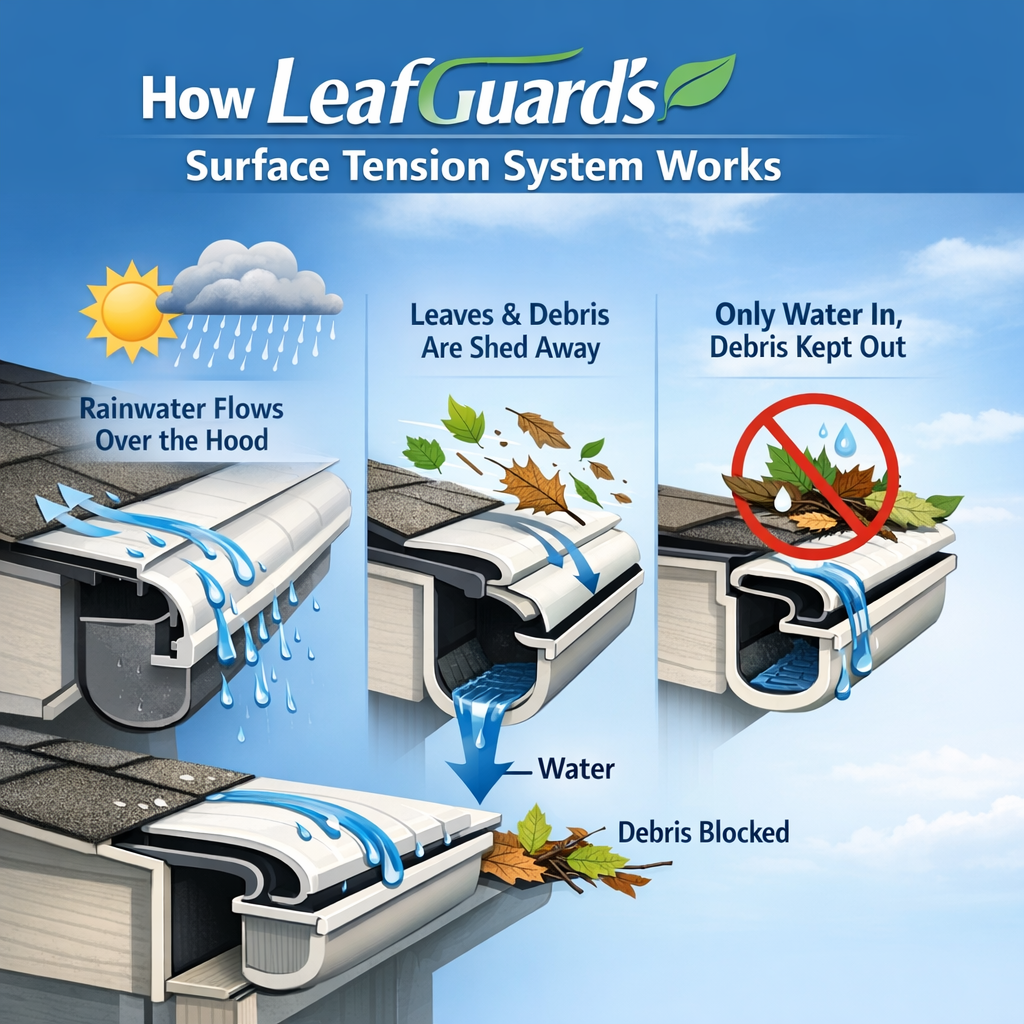
Before you can evaluate whether this system is right for your home, you need to understand what separates it from a standard gutter with a screen snapped over the top. LeafGuard is not a gutter cover. It’s a one-piece, seamless gutter system built around a specific physical principle.
LeafGuard’s core technology relies on what engineers call the Coanda effect — the tendency of a fluid to cling to a curved surface and follow its contour rather than break away. You’ve seen this principle at work anytime water runs down the side of a glass instead of dripping straight off the rim.
In a LeafGuard system, the gutter’s hooded top is curved in a way that guides rainwater around the bend and into the channel below, while debris — leaves, twigs, pine needles — lacks the weight and surface tension to follow that curve and simply falls off the front edge. The result, when the system is properly installed and performing correctly, is a gutter that sheds debris passively without any screens or filters to maintain.
This is genuinely clever engineering. But it has specific conditions under which it works well, and specific conditions under which it struggles. Any honest discussion of this product has to address both.
Most marketing materials present the Coanda effect as a guaranteed solution. The real-world picture is more nuanced:
Conditions that support strong performance:
– Moderate to heavy rainfall at typical intensity levels
– Moderate deciduous leaf coverage (the classic autumn scenario the system was designed for)
– Proper hood pitch calibrated to your specific roof angle during installation
– Adequately sized downspouts that allow water to exit without backpressure
Conditions that challenge the system:
– Extreme rainfall intensity — During very high-volume rain events (measured in inches per hour), water volume can overwhelm the surface tension mechanism. Water sheets over the hood rather than following the curve — a phenomenon known as “overshooting.” This is worth understanding if you live in a region prone to intense summer thunderstorms.
– Fine debris accumulation — Pollen, shingle grit, and particles from rooftop moss or algae create a film on the hood surface over time. This film disrupts the water’s adhesion path and can cause the same overshooting issue without any large debris present.
– Ice damming in freeze-thaw climates — Repeated freeze-thaw cycles can deform the hood profile, altering the carefully calibrated pitch and permanently degrading the Coanda mechanism’s effectiveness.
– Undersized downspouts — If the downspouts can’t handle peak flow, backpressure builds in the gutter channel and defeats the system’s drainage capacity regardless of how well the hood is functioning.
Understanding these failure conditions isn’t a reason to dismiss the product. It’s a reason to have an honest conversation with your installer about your specific roof environment before you commit.
One phrase appears in nearly every LeafGuard article: “custom-formed on-site by certified professionals.” It sounds reassuring. But most homeowners have no idea what that actually means — and that gap in understanding makes it harder to evaluate whether the crew showing up at your house is doing the job right.
Here’s what’s actually happening.
LeafGuard installers arrive with a truck-mounted roll-forming machine. This piece of equipment feeds a coil of aluminum stock — typically flat sheet metal — through a series of precision rollers that progressively bend and shape it into the finished gutter profile. The gutter is extruded continuously at whatever length your home requires, which is why LeafGuard gutters have no seams. The machine makes one long, continuous piece.
This process is meaningfully different from what a traditional gutter crew does. It’s closer to light manufacturing than it is to standard installation work. That distinction matters for a few reasons:
Before any forming happens, a proper installation begins with a thorough site assessment. This visit should evaluate:
A crew that skips a thorough site assessment and relies on a satellite measurement and a quick walkthrough is a crew that will produce a less accurate quote and potentially a less accurate installation.
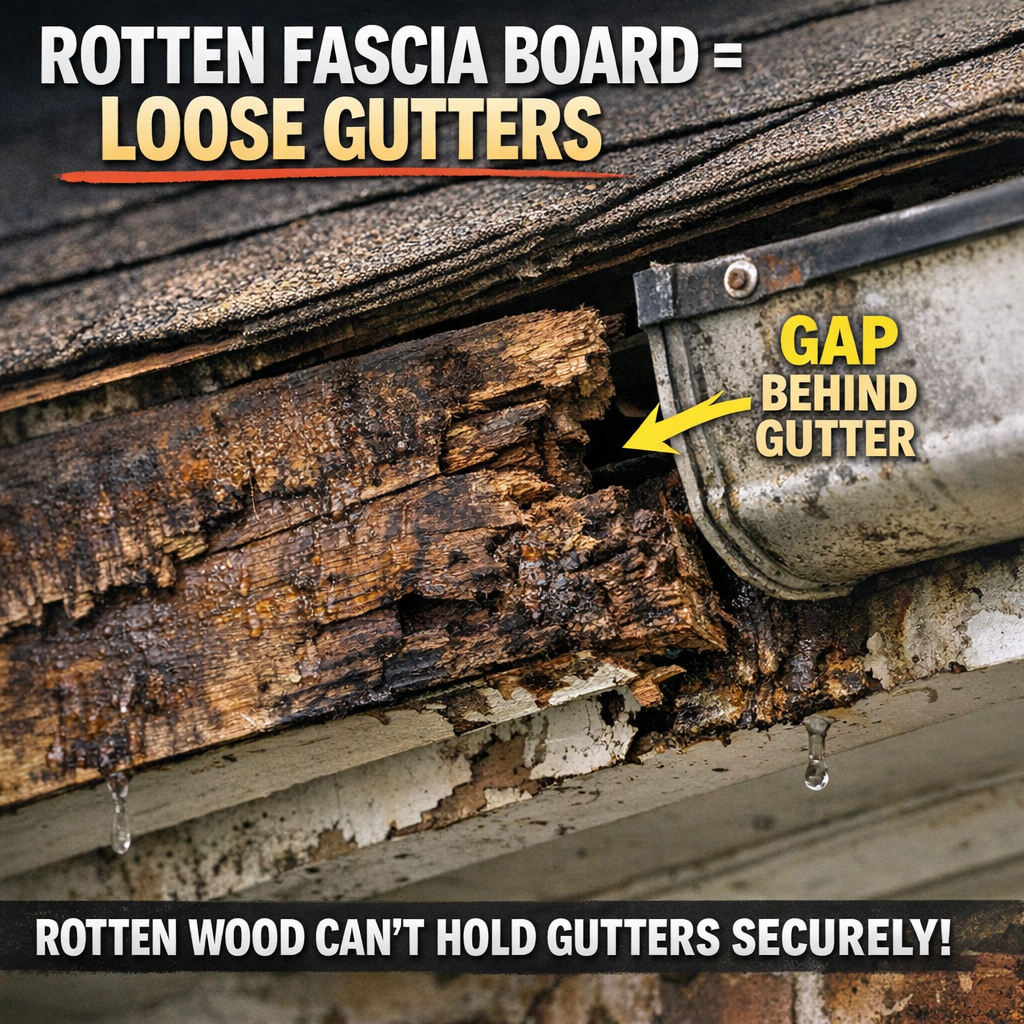
If there’s one cost factor that consistently surprises homeowners during the LeafGuard installation process, it’s the condition of the fascia — the horizontal board that runs along the edge of your roofline and serves as the attachment point for any gutter system.
LeafGuard attaches directly to your fascia. If that fascia is rotted, soft, or compromised — which is extremely common on homes that have had clogged gutters running over for years, or older homes where wood fascia has simply degraded over time — it must be repaired or replaced before the new gutter system can be properly secured. For a full breakdown of what that remediation work involves and what it typically costs, the article on DIY fascia and soffit repair provides useful context on what the scope of that work actually looks like.
This matters for a few reasons:
A reputable installer will identify fascia concerns during the site assessment and include them transparently in the project scope. If a quote doesn’t address your fascia condition at all, that’s a question worth raising directly.
With the mechanical and installation context established, the factors that influence your final project cost start to make more intuitive sense. Here’s a straightforward breakdown of the primary variables:
| Cost Factor | What It Affects | What to Ask Your Installer |
|---|---|---|
| Linear Footage | The single largest driver — total length of all gutter runs on the home | Ask for the measured total, not an estimate based on square footage |
| Home Height & Stories | Multi-story homes require additional staging and safety equipment | Confirm whether height-related costs are included in the per-foot quote |
| Roof Complexity | More corners, valleys, and angles mean more cuts, end caps, and transitions | Ask how they handle mitered corners and tight transitions |
| Downspout Count & Placement | More downspouts add material and labor; relocated downspouts add complexity | Discuss whether your current downspout layout is adequate for the new system |
| Fascia Board Condition | Damaged fascia must be repaired or replaced before installation | Ask specifically: “Will you inspect and report on my fascia before finalizing the quote?” |
| Aluminum Gauge | Heavier gauge costs more but performs better under load | Ask what gauge is standard in their installation |
| Regional Dealer Pricing | LeafGuard operates through licensed regional dealers with independent pricing authority | Understand that quotes from different dealers reflect regional margin decisions, not just material differences |
| Existing Gutter Removal | Old gutters must be removed and disposed of | Confirm whether removal and disposal are included or itemized separately |
One of the most common sources of homeowner confusion with LeafGuard specifically is receiving very different quotes from what appear to be similar installers for what appears to be the same project. This isn’t arbitrary — it reflects something real about how the product is sold.
LeafGuard Brand Inc. operates through a licensed dealer network, not as a single company with uniform national pricing. Individual dealers set their own pricing within brand guidelines, which means two dealers operating in the same metro area can legitimately quote the same home at meaningfully different numbers based entirely on their individual margin structures. “Certified installer” in this context means the individual completed LeafGuard’s proprietary training — but the training depth and the business practices of the dealer vary by region.
This also has implications beyond the initial sale:
None of this is a reason to avoid the product. It is a reason to understand who you’re actually buying from and what happens if you need service five years from now.
A fair evaluation of any product has to include the options that don’t get much airtime in product-sponsored content. Here’s an honest comparison of the main approaches:
| System Type | How It Works | Strengths | Limitations | Best Fit |
|---|---|---|---|---|
| LeafGuard (one-piece seamless) | Coanda effect guides water in; debris falls off curved hood | No seams, passive debris shedding, no mesh to clog | Higher upfront cost; overshooting in heavy rain; hood pitch must be precisely calibrated | Homes with heavy deciduous leaf coverage and moderate rainfall intensity |
| Micro-Mesh Guards (e.g., LeafFilter) | Fine mesh filters water; debris sits on top and dries/blows off | Handles very fine debris (pine needles, shingle grit); fits over existing gutters | Mesh can clog with fine material over time; requires periodic maintenance; seams at joints | Homes with heavy pine coverage or fine debris environments |
| Reverse-Curve/Surface Tension Covers | Similar Coanda principle; separate hood added to existing gutter | Lower cost than full system replacement | Relies on existing gutter condition; fit and pitch calibration critical; seams at joints | Budget-conscious homeowners with sound existing gutters |
| Foam/Brush Inserts | Porous material inside gutter allows water through; debris sits on top | Very low cost; DIY-friendly | Debris and organic matter grow inside the foam; frequent cleaning or replacement required | Low-debris environments only; not recommended for heavy tree coverage |
| No Guard — Regular Cleaning | Conventional gutters cleaned 2–4 times per year | Lowest upfront cost; no performance limitations | Ongoing maintenance cost and effort; safety risk of ladder use; relies on consistent scheduling | Homes with minimal tree coverage and accessible rooflines |
The “no guard” option is rarely presented in articles about gutter guard products, for obvious reasons. But for a home with light tree coverage, a single-story roofline, and a homeowner who schedules maintenance diligently, a well-installed seamless gutter system without any guard may be the most rational choice. Honest advice acknowledges that.
LeafGuard’s lifetime no-clog warranty is one of its primary selling points, and it’s mentioned in virtually every piece of content about the product. What’s rarely explained is what the warranty actually covers, what voids it, and what its practical limitations are.
Here’s what homeowners should understand before treating the warranty as a guaranteed benefit:
None of this makes the warranty worthless. It makes it a real-world document with real-world terms — and any homeowner spending a premium on this system deserves to read those terms before, not after, installation day.
Before you request a single quote or let a sales representative into your home, three tools and steps will put you in a materially stronger position.
Platforms that allow you to submit a single project request and receive structured, comparable bids from multiple licensed contractors — such as those available through your state’s contractor licensing board portal or established home services marketplaces — are worth using before any in-home consultation. The goal is not to find the cheapest bid. The goal is to have a credible comparison point in hand before a salesperson presents a single-option quote under time pressure. Walk into every LeafGuard consultation knowing what three competing systems cost in your market.
Before any gutter installer assesses your home, gather your roof installation date, any records of fascia board repairs, and your home’s drainage history. This matters for two reasons: first, installing a premium gutter system on failing fascia or an aging roof undermines the investment immediately; second, dealers who see an informed homeowner with documented property history tend to deliver more accurate assessments rather than one-size-fits-all upgrade pitches. Your HOA covenants, if applicable, should also be reviewed at this stage — hood-style systems have profile dimensions that occasionally conflict with architectural guidelines.
In 2026, this is non-negotiable. Ask for the current warranty document in writing — not a summary brochure, the actual terms — before the consultation concludes. Specifically, identify: the definition of a qualifying clog event, the non-transferability clause, the labor warranty duration and administrator, and the process for filing a claim if the installing dealer is no longer in business. If a contractor cannot produce this document on the day of consultation, that itself is information worth weighing. You can also review Smithrock’s own warranty standards to understand what a transparent, clearly documented workmanship commitment looks like before you compare it against what a dealer is offering.
The primary cost drivers are linear footage of gutter run, the pitch and height of your roofline (which affects labor complexity and safety requirements), the number of corners and downspout drops, and your geographic market. Regional dealer pricing structures vary significantly, and areas with higher labor costs or limited dealer competition typically see higher installed prices. Fascia condition also matters — if boards require repair or replacement before installation, that adds to the total project scope.
It depends on your specific situation. LeafGuard’s one-piece seamless design eliminates the joint failure points common in sectional systems, and its surface tension hood performs well with standard leaf debris. For homeowners with heavy tree canopy, particularly pine needles or helicopter seeds, the performance advantage narrows. The premium is most justified when you have a complex roofline, high labor costs for gutter cleaning, and plan to remain in the home long enough to recoup the installation investment through eliminated maintenance costs.
In most cases, no. LeafGuard’s lifetime no-clog warranty is typically tied to the original purchaser and is non-transferable. This means if you sell your home, the warranty does not convey to the buyer. Homeowners who anticipate selling within a relatively short time horizon should weigh this carefully, as the warranty — one of the system’s primary value propositions — may provide little practical benefit in that scenario. Always confirm the specific transferability terms in the written warranty document provided by your dealer.
The most frequently reported issues include overshooting during heavy rainfall events — where water velocity causes sheeting water to arc over the hood rather than following the surface tension curve into the channel — and fine debris accumulation on the hood surface that creates a slow-draining film over time. Some homeowners also report dissatisfaction with the sales process, particularly high-pressure in-home consultations and difficulty comparing the system to alternatives when only one quote is presented. Downspout sizing and placement decisions made at installation also generate post-installation complaints when drainage backing up is misattributed to the hood system.
Start by measuring or estimating your home’s total linear gutter footage before any contractor arrives — this prevents you from relying solely on the installer’s measurement and gives you a baseline for comparison. Request itemized quotes that separate material costs, labor, downspout work, and any fascia repair scope. Obtain at least two or three competing bids, including from contractors offering alternative gutter guard systems, so you have a genuine market comparison rather than a single-option framing. Finally, ask each contractor to provide the warranty document in full before you sign anything.
LeafGuard is compatible with most residential rooflines, but certain conditions limit its suitability. Very low-pitch roofs can affect the drainage dynamics the hood relies on. Homes with cedar shake, tile, or certain metal roofing profiles may present installation challenges at the roof-to-gutter interface. HOA architectural guidelines sometimes restrict the visible profile of hood-style systems. Additionally, fascia boards must be in structurally sound condition to support the system properly — deteriorated wood needs to be addressed before installation proceeds, which adds to the overall project scope and timeline.
Seven questions worth asking before signing: Is the quote itemized by material, labor, and additional scope? What is the labor warranty duration, and who administers it separately from the product warranty? What is the specific legal definition of a clog that qualifies for a warranty claim? What happens to my warranty claim process if this dealership closes? Is the warranty transferable to a future buyer? What is the cancellation policy and window? And — critically — can you provide the full warranty document in writing today, before I make any decision?
*See also: [Roof Replacement Cost in Greensboro NC: Full Guide](https://smithrock-roofing.com/roof-replacement-cost-in-greensboro-nc-full-guide/)*
Gutter protection is a long-term structural decision, not a commodity purchase — and the premium systems that dominate this category are priced accordingly. The homeowners who get the most value from installations like LeafGuard are those who enter the process informed: they know their home’s specifications, they’ve compared competing options on equal terms, and they’ve read the warranty before the salesperson leaves the driveway.
No product is right for every home, and no sales consultation can replace independent due diligence. Use the framework in this article as your baseline, ask the questions that don’t appear in brochures, and make the decision that fits your home’s actual conditions — not a generalized pitch.
If you’d like guidance specific to your project, we’re here to help. Contact Us

Smithrock Roofing © Copyright 2026 • All Rights Reserved • Privacy Policy • Maintained by Mongoose Digital Marketing