If your home was built before 1980 and still has its original siding, there’s a real possibility you’re looking at asbestos-cement shingles every time you pull into the driveway. For a lot of homeowners, that word — asbestos — triggers immediate alarm. And honestly, that reaction is understandable. But the reality is more nuanced than the internet usually lets on, and making a smart decision about your siding starts with understanding what you’re actually dealing with.
This guide goes deeper than the standard “don’t disturb it and call a professional” advice you’ll find on most sites. We’re going to walk you through what asbestos siding actually is, how to identify it, what the real risk factors look like over time, and what your options are — including the building science details that most contractors won’t bother explaining. Because at Smithrock Roofing, we believe an informed homeowner makes better decisions, and better decisions lead to homes that hold up for generations.
Asbestos siding shingles — formally called asbestos-cement shingles — are a composite material made from Portland cement reinforced with asbestos fibers. The asbestos wasn’t added carelessly. It served a real engineering purpose: the fibers dramatically improved the shingle’s tensile strength, fire resistance, and dimensional stability. Manufacturers used this combination widely from roughly 1910 through the early 1970s, when the EPA began restricting asbestos use following mounting evidence of serious health consequences.
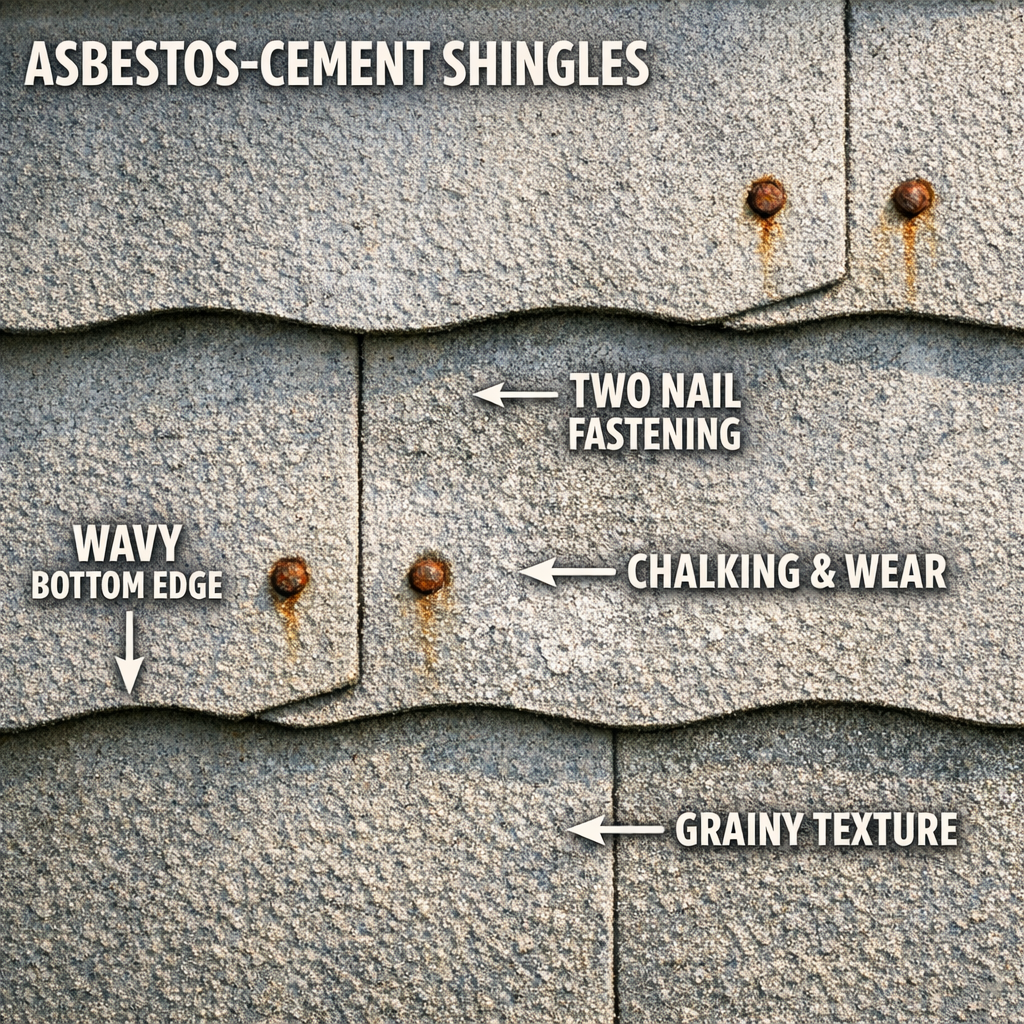
The most common profile is a rectangular shingle approximately 12 inches tall by 24 inches wide, with a distinctive wavy or scalloped bottom edge. They were installed in overlapping horizontal courses, much like wood shingles, and nailed directly to wall sheathing. On a well-maintained home, they can look deceptively similar to modern fiber-cement products — which is part of why so many homeowners don’t realize what they have.
Visual identification alone can strongly suggest asbestos-cement siding, but it cannot confirm it. Confirmation requires laboratory analysis of a physical sample. That said, here’s what to look for:
If you’re seeing most of these characteristics on a pre-1978 home, treat the material as presumed asbestos-containing until tested.
Every article on this subject repeats some version of the same sentence: asbestos siding is only dangerous when disturbed. That statement is not wrong — but it is incomplete in a way that matters.
Asbestos-containing materials exist on a spectrum defined by their friability — essentially, how easily the material can be crumbled, pulverized, or reduced to powder by hand pressure. Non-friable asbestos is encapsulated within a stable binder matrix. The cement in asbestos siding is that binder, and when it’s intact, it holds the fibers in place effectively. Friable asbestos is different: the fibers are loose or easily released, and that’s when airborne exposure becomes a genuine concern.
The critical point that almost nobody discusses: asbestos-cement siding does not stay permanently non-friable. It transitions along a weathering curve over decades, and that curve accelerates under certain conditions.
Here’s how the degradation process works:
The practical implication: a home in Greensboro, North Carolina with 1955 asbestos siding in good condition, minimal cracking, and no significant chalking presents a very different risk profile than the same vintage siding on a home in a region with harsh freeze-thaw cycles and visible surface pitting. Condition matters as much as age.
You’ll see lists of asbestos types on most competitor sites, but what those lists almost never explain is that the health risk profile varies significantly across them. This isn’t a minor footnote — it’s directly relevant to how you think about your specific situation.
| Asbestos Type | Classification | Primary Use in Building Products | Relative Fiber Persistence in Lung Tissue | Carcinogenic Risk Level |
|---|---|---|---|---|
| Chrysotile | Serpentine | Roofing, siding, floor tiles, pipe insulation | Lower (fibers dissolve more readily) | Real but lower than amphiboles |
| Amosite | Amphibole | Pipe insulation, ceiling tiles, some cement products | High (fibers are rigid, bio-persistent) | High |
| Crocidolite | Amphibole | Spray-on insulation, pipe lagging | Very high (needle-like, most bio-persistent) | Highest (WHO classification) |
| Tremolite | Amphibole | Contaminant in talc and vermiculite products | High | High |
| Anthophyllite | Amphibole | Contaminant in some cement products | High | High |
| Actinolite | Amphibole | Contaminant in various building materials | High | High |
The asbestos used in the vast majority of asbestos-cement siding was chrysotile — the serpentine type. This does not mean it’s harmless. Chrysotile is still classified as a Group 1 human carcinogen by the International Agency for Research on Cancer. But its fiber geometry (curved, less biopersistent) means it clears from lung tissue more readily than the needle-like amphibole fibers, which lodge permanently and accumulate with repeated exposure. For a homeowner doing a risk assessment, knowing you’re dealing with chrysotile rather than amosite or crocidolite is meaningful context — even if the correct response to either is careful management.
Every guide on asbestos siding tells you to collect a sample and send it to a certified lab. Almost none of them explain that doing this improperly is exactly the kind of disturbance they’ve spent the whole article warning you about.
Proper bulk sampling for suspected asbestos-containing material follows a specific protocol designed to minimize fiber release during the collection process:
Samples should go to an NVLAP-accredited laboratory (National Voluntary Laboratory Accreditation Program) for polarized light microscopy (PLM) analysis. Results typically identify both the presence and type of asbestos fibers.
If this process feels like more than you want to take on — or if your siding is already showing significant deterioration — the more sensible call is to have a certified asbestos inspector collect the sample. That’s a separate credential from an abatement contractor, and it’s worth understanding the difference.
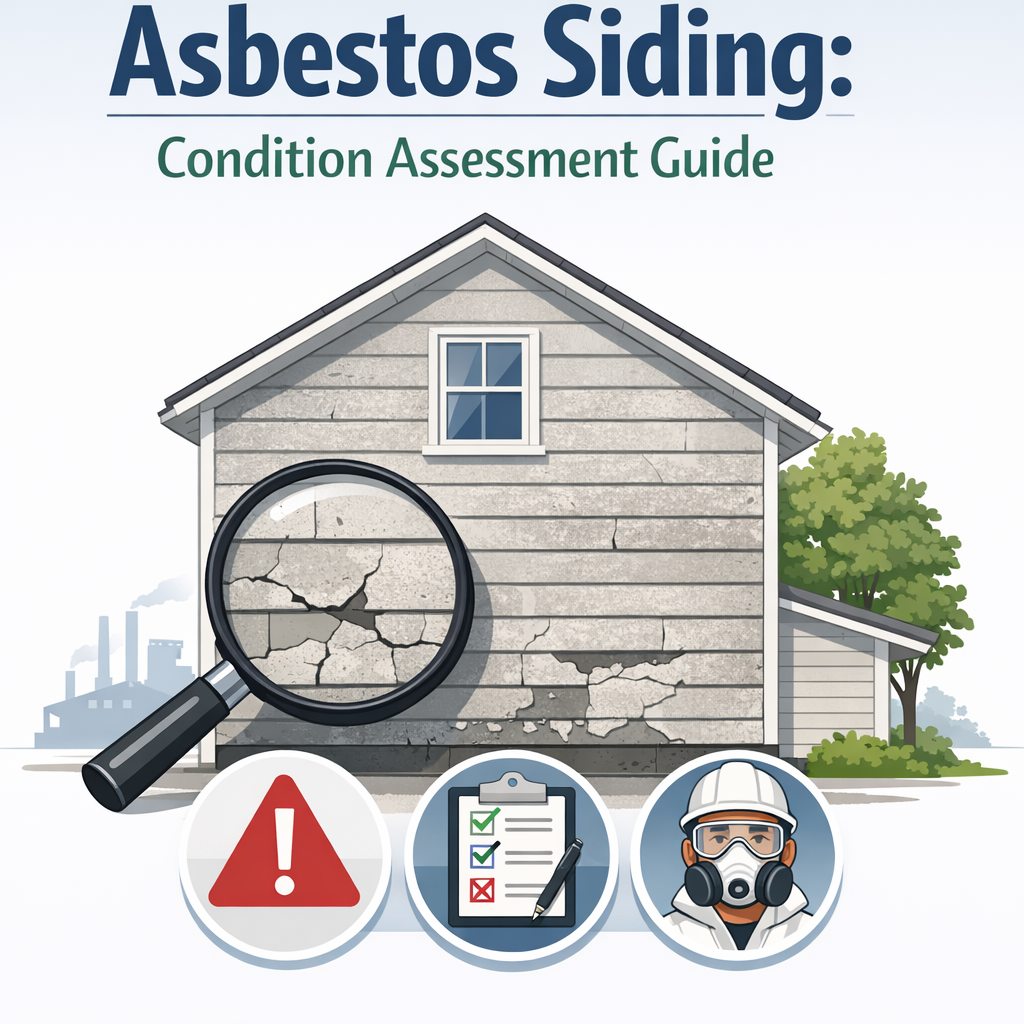
One of the most consistent oversimplifications in this space is the blanket advice to “hire a certified professional.” That’s correct — but there are three distinct professional roles in asbestos work, and conflating them leads to homeowners either overpaying for services they don’t need yet or under-protecting themselves during actual abatement.
An asbestos inspector’s job is assessment and documentation. They collect bulk samples, evaluate material condition, estimate friability, and produce a written report that tells you what you have and what condition it’s in. They do not remove anything. Hiring an inspector before you’ve decided on a course of action is often the smartest first move — it gives you a documented baseline and protects you legally if you sell the home.
This is the licensed contractor who physically removes or encapsulates asbestos-containing materials. In North Carolina, abatement contractors must be licensed through the NC Department of Labor’s Asbestos Hazard Management Program. When you hire one, you should ask for:
This is a third-party industrial hygienist or certified project monitor who performs air sampling after abatement work is complete to verify the area is clear for re-occupancy. On larger projects, this role is legally required. On residential work, it’s not always mandated but is worth serious consideration — especially if the work involved significant disturbance.
You’ll frequently see references to the EPA banning asbestos. The actual regulatory history is more specific, and understanding it helps you know your rights and responsibilities as a homeowner.
The Toxic Substances Control Act (TSCA) of 1976 gave the EPA authority to regulate asbestos. A more comprehensive ban attempted in 1989 was largely overturned by a federal court in 1991. The EPA’s NESHAP regulations (40 CFR Part 61, Subpart M) govern asbestos removal from buildings — but with a significant and widely misunderstood provision: single-family residential dwellings are explicitly exempt from many NESHAP requirements.
This exemption is why the regulatory landscape varies so dramatically from state to state:
The practical takeaway: before you assume you can legally handle your own asbestos siding removal, verify the specific requirements for your state and county. And regardless of what’s technically legal, understand that “legal to do yourself” and “safe to do yourself” are two different evaluations.
The two primary options for asbestos siding are encapsulation (covering it with new siding) or full removal. Most sources endorse covering as the simpler, lower-risk approach without explaining the genuine building science trade-offs involved. Here’s the full picture.
Installing new siding over existing asbestos-cement shingles avoids disturbing the material — which is a legitimate advantage. But the cover-over approach introduces its own set of considerations that deserve honest discussion.
Structural loading: Asbestos-cement shingles are dense. Adding a new siding layer on top increases the dead load on your wall assembly. On most homes with sound framing, this isn’t a structural concern. On older homes with deteriorated sheathing, compromised framing members, or existing window and door trim under stress, a structural assessment is warranted before proceeding.
The substrate problem: Asbestos shingles are lapped and profiled — they are not a flat surface. Installing new siding directly over them creates an uneven substrate with air gaps and irregular contact points. This matters because:
The moisture disclosure problem: Home inspectors often note asbestos siding as an informational item during a sale, which creates an impression that covered asbestos is “handled.” What the inspection report won’t tell the buyer is whether the drainage plane behind the new siding was properly constructed — and moisture damage developing between layers may not be detectable for years. By the time it is discovered, remediation now involves disturbing the asbestos layer you covered.
Removal makes more sense in certain situations:
Full removal must be performed by a licensed abatement contractor in most practical scenarios, and it generates regulated waste that requires proper disposal documentation. The result, however, is a clean substrate and a fresh start for your new exterior — with no buried complication waiting to be discovered by a future owner or inspector. If you’re evaluating what comes next after removal, our article on fixing asbestos siding covers repair and replacement considerations in detail.
Making a well-informed decision about asbestos siding shingles requires current information, qualified professionals, and a clear understanding of your property-specific conditions. Before committing to any path — encapsulation, cover-over, or full removal — consider these three concrete next steps.
1. Commission a Professional Asbestos Survey with Bulk Sampling
General visual inspections are not sufficient for making abatement or remediation decisions. In 2026, the standard of care is a formal asbestos survey conducted by a certified industrial hygienist or licensed asbestos inspector who collects bulk material samples and submits them to an accredited laboratory (NVLAP-accredited labs are the benchmark in the United States). The resulting report gives you defensible documentation of fiber type, concentration, and material condition — the foundation every downstream decision should rest on. This document also has direct value at resale.
2. Use a State-Licensed Abatement Contractor for Any Disturbance Work
Licensing requirements for asbestos abatement vary by state, but the baseline expectation in 2026 is state licensure, EPA RRP certification where applicable, and documented worker protection protocols under OSHA 29 CFR 1926.1101. Before engaging any contractor for removal, encapsulation, or cover-over work, verify their license status through your state environmental or labor agency’s public lookup tool. Ask for a copy of their waste disposal manifest from a previous project — a contractor who handles disposal correctly will produce this without hesitation. For a broader look at what separates reliable contractors from the rest, the article on choosing the best roofing contractor in Winston-Salem walks through the credentials that actually matter.
3. Document Everything Before Any Work Begins
Regardless of which remediation path you choose, create a thorough pre-work photographic record of your siding’s current condition, establish a written scope of work with your contractor that specifies disposal documentation requirements, and retain all laboratory reports and contractor certifications in a permanent file associated with the property. In an era where disclosure obligations at sale are increasingly scrutinized, this documentation is not administrative overhead — it is a material asset that protects you, your contractor, and every future owner of the property. When you’re ready to discuss what a proper siding replacement looks like after abatement, Smithrock Roofing can walk you through the options suited to your home.
Not automatically. Asbestos-cement siding shingles in sound, undisturbed condition are generally considered non-friable, meaning the fibers are bound within the cement matrix and are not readily released into the air under normal conditions. The risk increases significantly when the material is deteriorated, cracked, crumbling, or physically disturbed — through drilling, cutting, sanding, or pressure washing. A professional assessment of your siding’s current condition is the appropriate starting point before drawing any conclusions about immediate risk.
In many jurisdictions, covering intact asbestos siding with new siding material is legally permissible and does not trigger the same regulatory requirements as removal. However, local building codes, HOA rules, and disclosure obligations at sale vary considerably. Some municipalities require a permit for re-siding work that involves an asbestos substrate, and the permit application may trigger an inspection. Always verify the specific requirements with your local building department before beginning work, and be aware that covering does not eliminate your disclosure obligations to future buyers in most states.
In the vast majority of U.S. states, sellers are required to disclose known material defects and known hazardous materials, which includes asbestos if you are aware of its presence. This obligation typically survives a cover-over installation — if you know asbestos siding exists beneath your new vinyl siding, that knowledge is generally a disclosable fact. Failure to disclose can expose sellers to post-sale legal liability. Consulting a real estate attorney familiar with your state’s specific disclosure statutes is strongly advisable before listing a property with known or suspected asbestos-containing materials.
Visual identification alone is not reliable. While certain physical characteristics — the size, texture, and installation pattern of older shingles on homes built before approximately 1980 — are strongly suggestive, the only definitive answer comes from laboratory analysis of a bulk material sample. Samples should be collected by a certified asbestos inspector using proper containment and handling procedures, then submitted to an NVLAP-accredited laboratory for polarized light microscopy (PLM) analysis. Do not attempt to collect samples yourself without proper training and personal protective equipment.
Asbestos-containing waste materials are classified as regulated waste under federal and state environmental law. After removal, the material must be wetted to suppress fiber release, double-bagged or wrapped in heavy-duty polyethylene, clearly labeled with required hazard warnings, and transported to a licensed disposal facility approved to accept asbestos waste. Your abatement contractor is required to maintain a waste shipment record or disposal manifest documenting the chain of custody from your property to the disposal site. Request a copy of this manifest for your permanent property records — it is documentation you may need at a future sale or in the event of an inspection.
In most practical and regulatory terms, asbestos siding removal requires a licensed abatement contractor. While a small number of states technically permit homeowners to handle limited quantities of asbestos-containing material on their own primary residence, the worker protection requirements, disposal regulations, and liability exposure make unlicensed removal by a general contractor or handyman highly inadvisable — and in many states, illegal. General contractors who remove asbestos without proper licensure can face significant regulatory penalties, and homeowners who hire them share that exposure. Always verify licensure through your state’s official regulatory database.
See also: Tin Roofing Contractors: What NC Homeowners Must Know
See also: Roofing Winston-Salem NC | What Homeowners Must Know
See also: Siding Greensboro NC: Expert Guide for Local Homeowners
See also: High Point NC Roofing: What Homeowners Must Know
See also: Commercial Roofing Repair Cost: What You Must Know
See also: Durable Exterior Cladding: What Homeowners Must Know
See also: Chimney Caps Greensboro NC | What Homeowners Must Know
See also: Gutter Replacement Winston-Salem | What You Must Know
See also: Steel Siding Installation: What NC Homeowners Must Know
See also: Asbestos Siding Replacement Cost | NC Triad Guide
See also: Gutters Kernersville NC: What Homeowners Must Know
See also: Chimney Flashing Repair Cost: What NC Homeowners Must Know
Asbestos siding shingles represent one of the more nuanced challenges in residential property management — a material that requires neither panic nor dismissal, but careful, informed decision-making grounded in current condition, regulatory context, and long-term property strategy. The homeowners and property managers who navigate this issue best are those who invest in proper documentation, engage qualified professionals, and resist the temptation to treat a cover-over as a permanent solution without understanding its long-term implications.
If you have specific questions about your property, the condition of your existing siding, or the remediation options that make sense for your situation, we encourage you to reach out directly. Contact Us

Smithrock Roofing © Copyright 2026 • All Rights Reserved • Privacy Policy • Maintained by Mongoose Digital Marketing