Asbestos shingle siding repair goes wrong in predictable ways. Homeowners either disturb far more material than necessary because they chose the wrong removal technique, or they stop a safe and manageable job prematurely because they misread a broken shingle as a crumbling one. Both mistakes have real consequences. This article walks through the full repair process with enough detail to help you make the right call at every step, whether you complete the work yourself or decide to hand it off.
Asbestos cement shingles were a common siding product installed on homes across the United States from roughly the 1920s through the late 1970s. The shingles are a composite of Portland cement and chrysotile asbestos fibers. In their original cured, undisturbed state, those fibers are locked inside the cement matrix and pose no airborne risk. The danger comes when the matrix is broken in ways that release fibers, specifically sanding, cutting with power tools, pressure washing, or allowing shingles to crumble apart.
Most aged asbestos siding on homes in the Winston-Salem, Greensboro, High Point, Kernersville, Clemmons, Rural Hall, King, and Mount Airy areas falls into the non-friable category, meaning the cement binder is still intact and the material does not release fibers under normal handling. Friable material, by contrast, crumbles under moderate hand pressure and signals that the binder has degraded significantly. This distinction matters because it determines whether careful DIY repair is reasonable or whether you need a licensed abatement contractor.
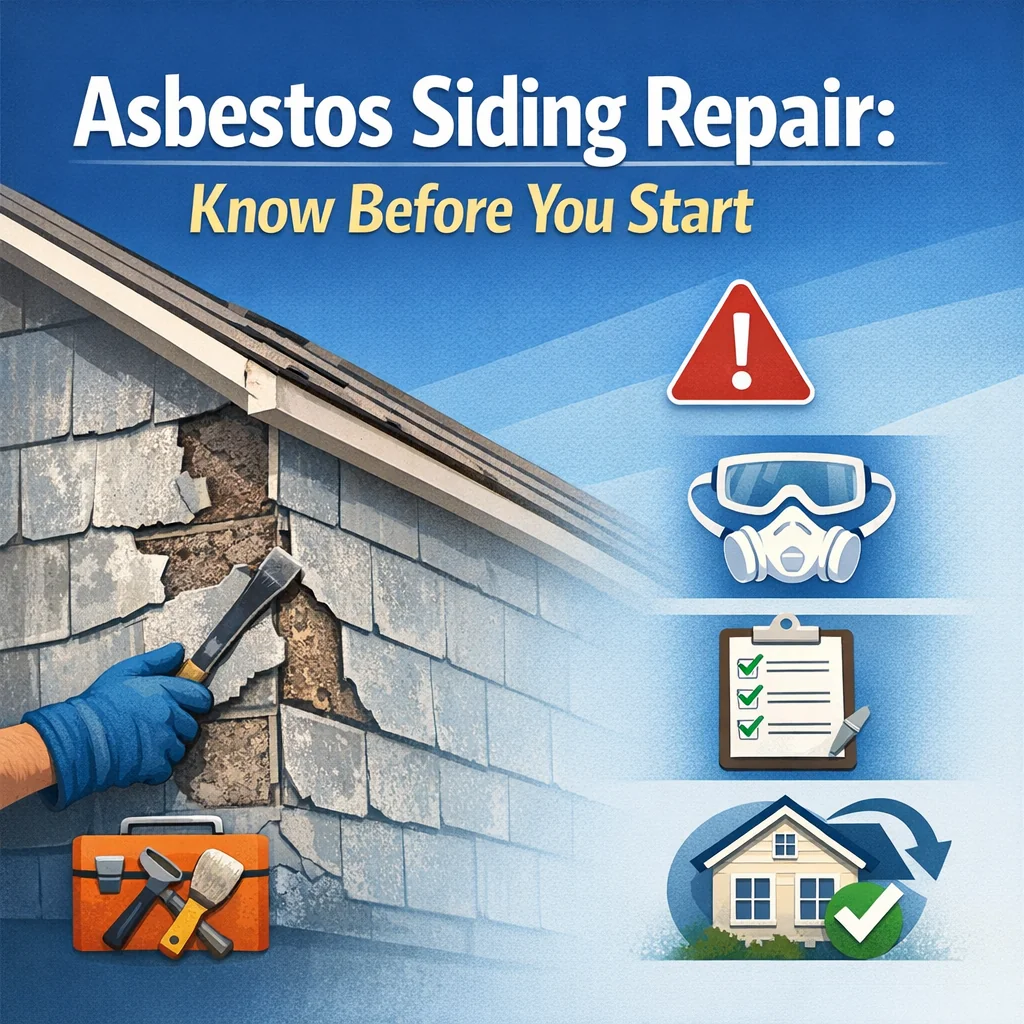
Before touching anything, assemble your protective equipment. The minimum standard is a P100 or N100 half-face respirator, not a paper dust mask. You also need nitrile gloves and disposable Tyvek coveralls. Seal your coveralls at the wrists and ankles with tape. When the job is done, wet the outside of the coveralls before removing them, fold them inward, bag them, and dispose of them with the shingle material as regulated waste. Wash your hands and face before eating, drinking, or leaving the work area.
Need a hand with this in Winston-Salem, Greensboro and the Triad? Call (336) 971-0464 or request a free estimate. Honest answers, no pressure.
This step gets skipped constantly, and it is the reason repair jobs that should take an afternoon turn into emergency calls. Asbestos cement shingles were installed in overlapping courses, similar to fish scales. The nails holding the lower edge of one course also pass through the upper portion of the shingle below it. That geometry means the nails you can see are not always the ones holding the damaged shingle.
Three installation patterns existed, and regional practices varied:
| Pattern | How It Looks | Correct Removal Tool |
|---|---|---|
| Face-nailed through the shingle body | Nails visible through the face of each shingle | Flat pry bar, worked gently to loosen |
| Top-nailed under the overlapping course above | Nails hidden under the lap of the course above | Pliers or pry bar angled upward under the lap |
| Wire nail at bottom plus roofing nail through body | Two nail types, often spotted in older installations | Shingle ripper tool to hook and cut hidden nails |
Take five minutes to examine the shingles adjacent to the damaged one before committing to a tool. If you begin prying and meet resistance you did not expect, stop and reassess rather than applying more force. Cracking neighboring shingles means more asbestos material to manage, more area to wet and contain, and a repair that has grown beyond what DIY can reasonably handle.
Every guide tells you to wet the shingle before removal. Fewer explain why amended water works better than plain water. The dish soap reduces surface tension, allowing water to penetrate micro-cracks in the shingle surface instead of beading off. This is what suppresses fiber release at the source rather than just at the surface.
What most guides miss is when to reapply. You should mist the work area with amended water:
Keep your spray bottle within arm’s reach throughout the job. Treating moisture as a single pre-step rather than a continuous practice is one of the most common errors in DIY asbestos siding repair. For a broader look at how moisture and damage interact across your home’s exterior, the article Roof & Siding Repair: Stop Leaks Before They Spread offers useful context on managing water intrusion before it compounds existing problems.
Here is a scenario no guide explains clearly enough. You begin removing a shingle, and it breaks partway through. Most homeowners either panic and stop the job entirely, or they continue without reconsidering the situation. The right response depends entirely on how the shingle is failing.
A shingle breaking into two or three large, clean-edged pieces is a mechanical fracture along a stress line. The cement binder is still intact in those fragments, meaning fibers are not freely releasing from the matrix. Re-wet the pieces immediately, collect them carefully, double-bag them, and continue. This is not the same situation as a friable failure.
A shingle that begins to powder, crumble at the edges, or produce visible dust even when wet is a different matter. This indicates binder degradation, and the material is now behaving as friable asbestos. At that point, stop work, re-wet the entire area generously, contain what you can in heavy poly bags, and call a licensed abatement contractor to take over.
The decision point is the difference between a clean fracture and a crumbling failure. Those two things look and feel different, and knowing which one you are dealing with keeps you from making the wrong call in either direction.
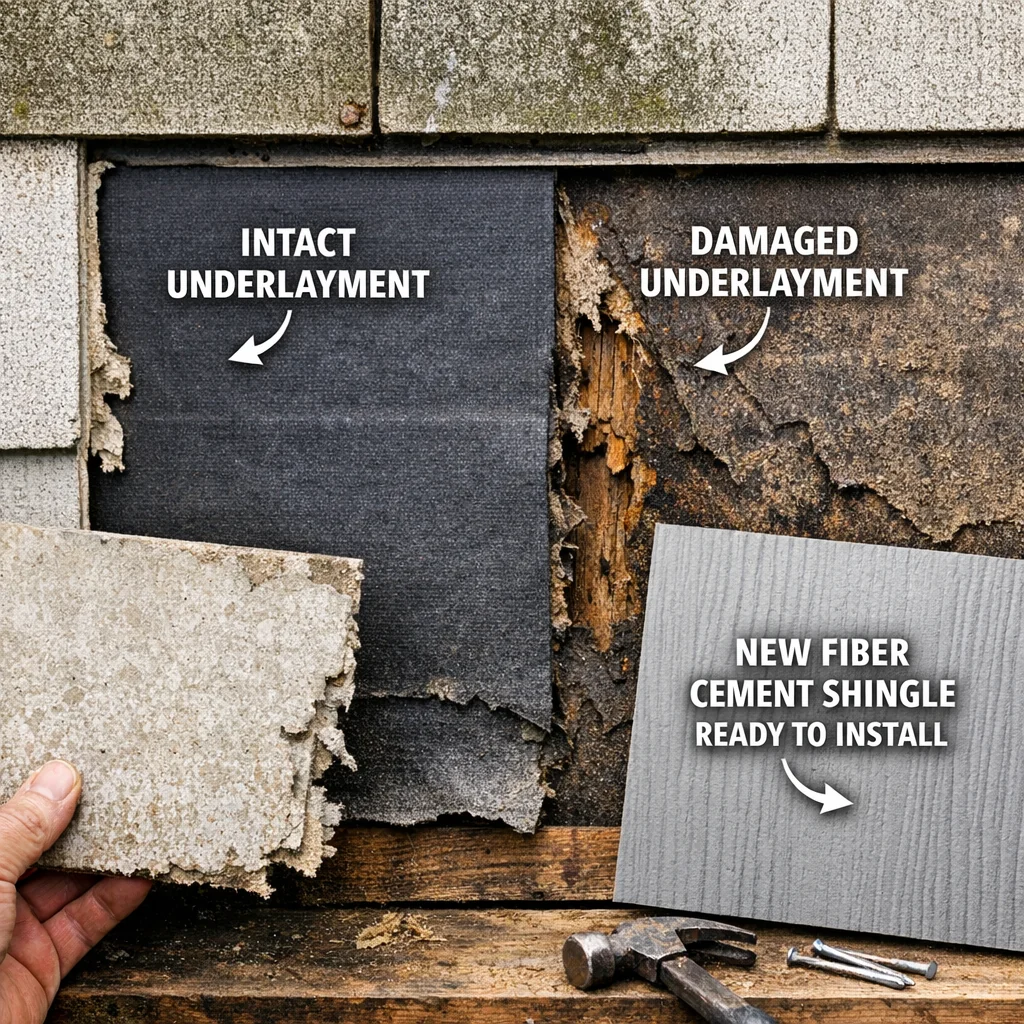
When the damaged shingle is out, look at the underlayment before sliding in the replacement. This is a step that rarely gets mentioned. Homes old enough to have original asbestos siding often have aged building paper or felt behind the shingles. If that underlayment is torn, wet, or missing in the exposed area, installing a new shingle over it introduces a moisture management problem that has nothing to do with asbestos and everything to do with long-term wall integrity. Patch any damaged underlayment with a compatible material before proceeding.
For the replacement shingle itself, fiber-cement panels in a 12-by-24-inch profile are the standard substitute and are widely available from building supply retailers. Slide the panel into position so it aligns with the course on either side. Nail it per the manufacturer’s specification, and re-wet surrounding shingles before driving each nail.
Painting the new shingle to match requires a bonding primer on the replacement panel before any topcoat, even if the panel comes labeled as pre-primed. The surface texture and porosity of a new fiber-cement panel differ enough from weathered, painted neighbors that skipping primer produces a visible sheen mismatch even after the topcoat dries. Prime first, allow it to cure fully, then apply a quality exterior latex in a color matched to your existing siding.
Asbestos-containing material is regulated waste, and the rules for disposal vary by county. Before the job begins, contact your county’s solid waste or environmental health department to confirm the approved disposal method and drop-off location for your area. In most cases, removed shingles must be double-bagged in 6-mil poly bags, sealed with duct tape, and labeled before transport. Standard construction dumpsters and curbside household trash pickup are not legal disposal options.
Keep records of how and where you disposed of the material. This matters if you ever need to document the work for a home sale or insurance review.
Minor repairs involving one to three shingles, where the material is clearly non-friable and conditions are calm and dry, are within reach for a careful DIYer who follows the process above. Call a licensed contractor if any of the following apply: the damaged area spans more than a few shingles, the material is crumbling or powdering, the underlying wall shows moisture damage or rot, or you are simply not comfortable managing regulated materials. There is no shame in that call. The stakes are real, and a qualified exterior contractor handles the work, the disposal, and the documentation without putting your household at risk.
At Smithrock Roofing, we bring more than 60 combined years of exterior experience to jobs across the NC Triad. Our roofing service covers the full range of exterior needs, and if you are looking at asbestos siding damage and want an honest assessment of what the repair involves, we will give you a straight answer, not a sales pitch.
In many cases, yes. Asbestos-containing shingles that are intact and firmly attached pose minimal risk because the fibers are bound within the material and not being released into the air. The danger rises when shingles are crumbling, cracking, or being disturbed. If the damage is limited and the material is non-friable, a careful repair that encapsulates or replaces the affected shingles is often the safest short-term path. A professional assessment can help you decide whether repair or full encapsulation makes more sense for your specific situation.
Permit requirements vary by municipality and by the scope of work involved. Replacing a handful of shingles may not trigger a permit in your jurisdiction, but any project that disturbs asbestos-containing material is subject to state and federal notification and disposal regulations regardless of permit status. Contact your local building department before you begin, and always check with your county’s environmental health office for disposal requirements. When in doubt, a licensed contractor can handle the regulatory side on your behalf.
Visual inspection alone cannot confirm asbestos content. Siding installed between the 1920s and the mid-1980s has a reasonable likelihood of containing asbestos, but the only reliable way to know is laboratory testing. A certified asbestos inspector can collect a small sample following proper containment procedures and send it to an accredited lab. Do not attempt to collect a sample yourself by breaking or scraping the material, as that is exactly the kind of disturbance that releases fibers. For a detailed overview of what the full replacement process involves and what to expect from contractors, the article Asbestos Siding Replacement: What Homeowners Must Know is a useful reference.
Painting over intact asbestos shingles is a widely accepted method of encapsulation and is generally permissible when the shingles are in sound condition. A quality exterior elastomeric or latex paint applied to a properly primed surface can seal minor surface porosity and extend the life of the siding. This approach does not address shingles that are already cracked, broken, or loose. Those pieces need to be handled and replaced first before any painting begins, following the same protective protocols described throughout this article.
Asbestos shingle siding repair is manageable when it is approached with the right information and a respect for the material involved, but there is a meaningful difference between a straightforward patch job and a situation that calls for professional hands. Smithrock Roofing has spent more than 60 combined years serving homeowners across the NC Triad, including Winston-Salem and Greensboro, and we understand both the technical side of exterior repair and the regulatory realities that come with older siding materials. If you have questions about what you are looking at or simply want an honest second opinion, give us a call at (336) 971-0464 or Contact Smithrock Roofing to schedule your free estimate.

Smithrock Roofing © Copyright 2026 • All Rights Reserved • Privacy Policy • Maintained by Mongoose Digital Marketing