If you’ve ever watched rain pour straight down your chimney flue during a storm, or discovered a family of raccoons had made themselves at home in your fireplace, you already understand the basic argument for chimney caps. But here’s the truth most cap installers in Greensboro aren’t sharing: the decision is more complicated than picking a style you like from a product sheet, and the consequences of getting it wrong extend well beyond a wet firebox.
At Smithrock Roofing, we’ve spent decades working on the rooftops and chimneys of homes across the NC Triad — Greensboro, Winston-Salem, High Point, Kernersville, Clemmons, Rural Hall, King, and surrounding communities. That experience has taught us something the generic contractor pages miss entirely: Greensboro’s specific climate, its local wildlife, and the engineering standards that govern proper chimney cap sizing all create a uniquely important case for getting this right the first time.
This guide covers what a chimney cap actually does, how Greensboro’s weather turns an uncapped chimney into a structural liability, which cap is right for which chimney, and why there’s a specific date on the calendar that every local homeowner should pay attention to.
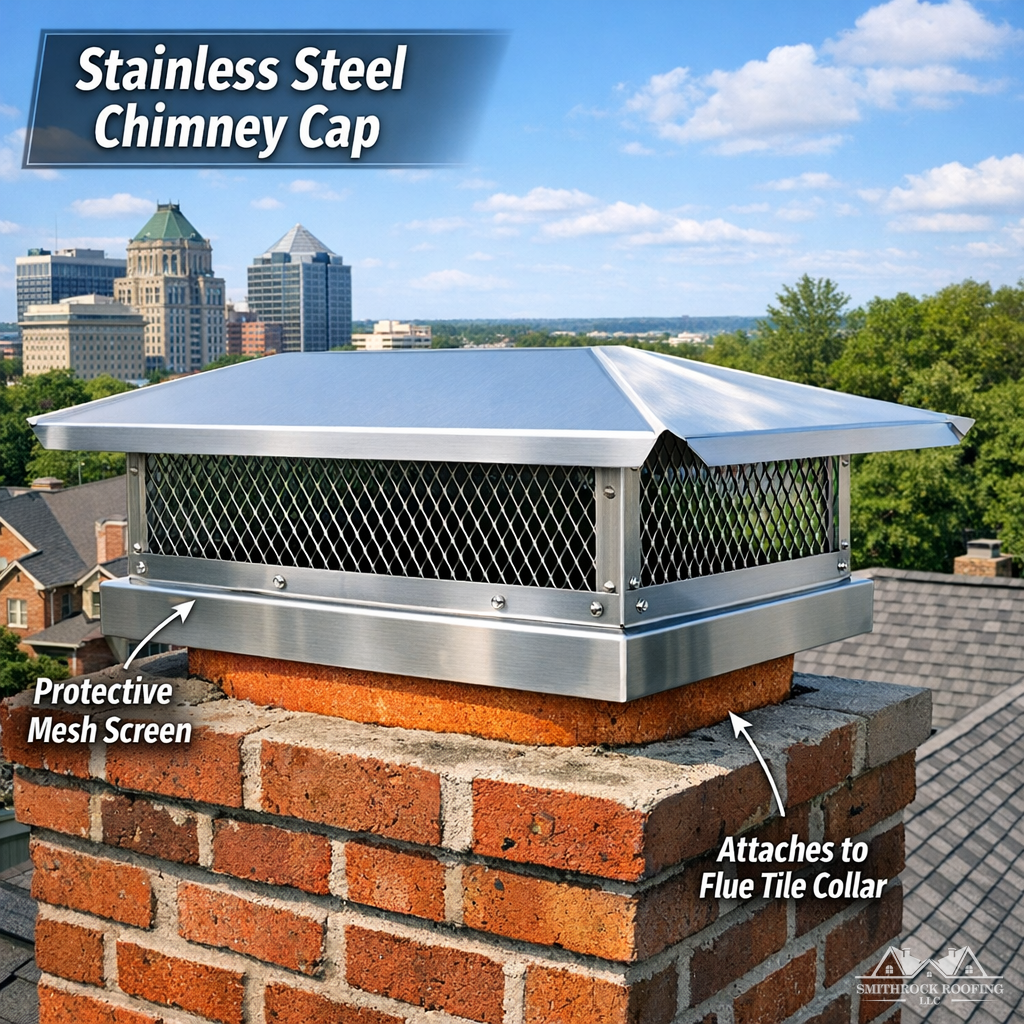
A chimney cap is a protective cover installed at the top of a chimney flue or over a chimney chase. It typically includes a solid top to shed water, a mesh skirt to block animals and debris, and a mounting collar that fits over or inside the flue opening.
That’s the basic definition. Here’s what’s worth understanding beneath it.
1. Water Exclusion
A cap prevents rain and snow from falling directly into the flue. This sounds simple until you consider what water actually does once it’s inside an uncapped chimney — a subject we’ll cover in detail in the next section.
2. Animal and Debris Blocking
Mesh skirting keeps birds, squirrels, raccoons, and leaves out of the flue channel. This matters for airflow as much as it does for animal exclusion — a partially blocked flue doesn’t draft properly.
3. Spark Arrest
On wood-burning fireplaces, caps with appropriate mesh serve as spark arrestors, containing burning embers that might otherwise land on the roof surface or nearby landscaping. This is a fire-safety function, not just a cleanliness one.
4. Draft Stability
A properly sized and positioned cap reduces the effect of crosswinds at the flue opening. Without a cap, certain wind conditions create a downdraft — pushing air down the flue and back into the living space. A cap breaks that wind pattern and helps maintain consistent upward draft.
A chimney cap is not a repair tool. It cannot fix a cracked flue liner, a deteriorated crown, or a spalled brick structure. Installing a cap over a compromised chimney delays the detection of underlying damage without stopping it. This is why any reputable chimney professional will inspect the crown and flue condition before cap installation — and why you should be skeptical of any installer who doesn’t mention this step.
This is the section that most chimney cap pages skip entirely, and it’s the most important thing a Greensboro homeowner can understand.
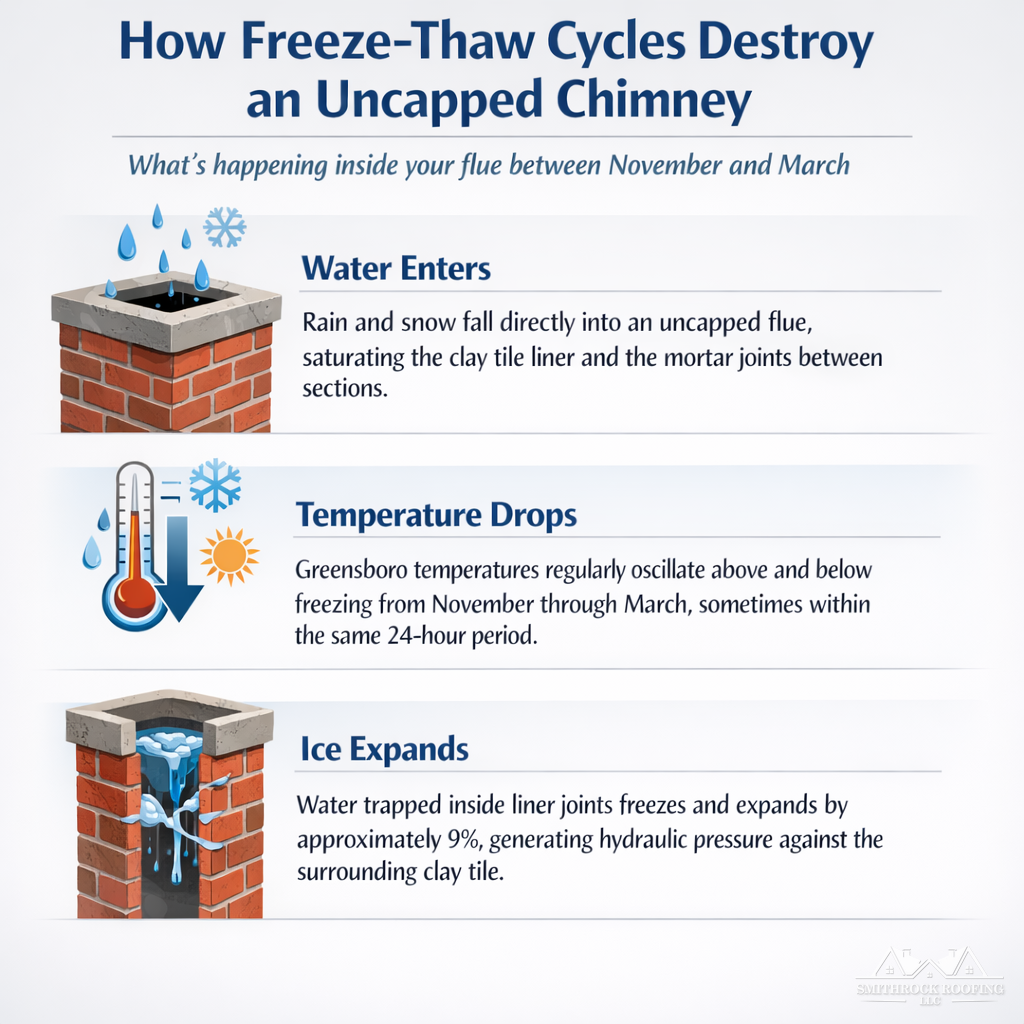
(https://www.buildingscience.com)s crack and spall the clay liner from the inside out — damage that is invisible without a camera inspection.”; item5_title=”Gases Escape”; item5_body=”A cracked liner allows combustion gases, including carbon monoxide, to migrate into the home through gaps in the masonry structure.”; footer=”Smithrock Roofing | Greensboro, NC”]
Greensboro sits in a humid subtropical climate zone with a specific characteristic that distinguishes it from both the warmer Piedmont flatlands to the south and the colder mountain regions to the west: its winters are unpredictable. Temperatures swing above and below freezing repeatedly throughout November, December, January, February, and into March — sometimes within a single day.
This creates what engineers call a freeze-thaw cycle, and for an uncapped chimney, it’s a slow-motion structural event.
When rain or snow enters an uncapped flue, it saturates the clay tile liner — the cylindrical sections that line the interior of a masonry chimney — and the mortar joints between those sections. When temperatures drop below freezing, that water doesn’t just sit there. It expands by approximately 9% as it turns to ice.
That expansion exerts hydraulic pressure against the surrounding clay tile. A single freeze-thaw event may not cause visible damage. But across a Greensboro winter, that cycle can repeat dozens of times. Each cycle widens existing micro-cracks. Each spring, the thawing water carries dissolved mortar out of the joint. Over a few seasons, the liner begins to spall — fragments of clay tile break free from the inside, collapsing into the flue channel.
The dangerous part isn’t the mess. It’s what a compromised liner means for your family’s safety.
The clay tile liner in a masonry chimney exists to contain combustion byproducts — carbon monoxide, particulates, and heat — and direct them safely out of the home. When the liner cracks, those gases find new paths. They migrate through the mortar joints and gaps in the surrounding masonry, potentially entering the home through areas adjacent to the chimney structure.
Carbon monoxide is odorless and colorless. You won’t detect its presence until you’re already experiencing symptoms — and by then, you have a medical emergency, not a maintenance question.
This is the damage pathway that nobody’s talking about on the generic chimney cap pages: uncapped flue → water infiltration → freeze-thaw spalling → cracked liner → carbon monoxide migration pathway. In Greensboro’s climate, this isn’t a worst-case scenario. It’s a predictable sequence for any masonry chimney that goes without a cap through multiple winter seasons.
A Level 2 chimney inspection with camera equipment is the only way to assess liner condition if you suspect freeze-thaw damage has already occurred. If you’re not sure whether your chimney has a cap or when it was last inspected, that inspection should happen before the next heating season. For a deeper look at what chimney liner installation and replacement typically involves and costs, that resource walks through what to expect from the process.
Most chimney cap pages present a style menu and leave you to figure out the rest. That’s not particularly helpful when you’re standing in your living room trying to understand what your chimney actually requires.
The right cap depends on four variables: your chimney’s construction type, your flue configuration, your fuel type, and the condition of your chimney crown. Here’s how those factors interact.
Masonry chimneys are built from brick and mortar, with clay tile or cast flue liner sections. They have exposed flue tile at the top that requires a cap sized to fit over or inside that tile opening. The cap mounts to the flue tile itself, often with a tension-mount or screw-down collar.
Factory-built (prefabricated) chimneys use a metal chase — a framed enclosure that surrounds the metal flue pipe. The top of that chase is exposed to weather and requires a chase cover, not a traditional chimney cap. A chase cover is a flat or pitched metal panel that spans the entire chase opening, with a collar for the flue pipe and a lip that overhangs the chase walls to shed water.
This is one of the most common sources of confusion for homeowners, and it’s worth being direct about: if you have a metal fireplace insert or a wood-burning stove with a metal chase, a traditional chimney cap won’t solve your problem. You need a chase cover. Installing the wrong product leaves gaps at the chase perimeter that allow water infiltration at the framing level — often causing damage that isn’t visible from the outside until it’s significant.
Homes with multiple fireplaces or a fireplace and a gas appliance vent sharing the same chimney structure may have multiple flue tiles extending from a single chimney crown. A multi-flue cap spans the entire crown area, covering all flues with a single unit. Single-flue caps cover one opening.
Multi-flue caps are heavier and require secure mounting — wind loads on a cap that spans a full chimney crown are significant. The crown condition (more on that below) matters more with a multi-flue installation than with a single-flue cap.
This distinction matters more than most homeowners realize, and it’s one of the gaps that even experienced contractors sometimes gloss over.
Wood-burning applications produce creosote — a combustion byproduct that accumulates on flue surfaces and cap mesh screens. Caps for wood-burning fireplaces need to be inspected annually for mesh clogging because a restricted mesh opening creates back-pressure in the flue, reducing draft and increasing smoke spillage. Certain cap geometries that work well on gas applications are not appropriate for wood-burning use because they trap creosote particulates at the cap level, creating a localized fire risk.
Gas appliance vents produce condensation rather than creosote, requiring caps with good drainage design and corrosion-resistant materials. Gas vents also operate at lower temperatures than wood-burning flues, which affects the material requirements for the cap itself.
Before any cap installation makes sense, the chimney crown needs to be evaluated. The crown is the concrete or mortar cap that surrounds the flue tile at the top of the chimney structure, sealing the space between the flue tile and the chimney casing. A cracked or deteriorated crown allows water to enter the chimney structure below the cap level — meaning the cap you just installed is solving the wrong problem while water continues to get in through the crown.
Any contractor who recommends a cap installation without mentioning crown condition is leaving a step out of the process.
Here’s the technical detail that no competitor in this market is explaining, and it’s genuinely important for understanding why professional cap selection matters.
The National Fire Protection Association’s NFPA 211 standard, which governs chimneys, fireplaces, and venting systems in the United States, establishes a specific requirement for chimney cap mesh openings: the net free area of the mesh must be at least equal to the cross-sectional area of the flue it covers.
In plain terms: the holes in the cap mesh, taken together, must allow at least as much airflow as the flue pipe itself.
A chimney works by creating a column of warm air that rises through the flue and exits at the top, pulling combustion gases with it. This is called draft. The cap sits directly at the point where that column of air exits.
If the cap mesh opening is too small — whether because the cap is undersized for the flue diameter, or because mesh has become clogged with debris and creosote — it creates back-pressure at the exit point. That back-pressure reduces draft throughout the entire flue column. The result is a fireplace that smokes into the room, a stove that doesn’t draw properly, or a gas appliance that produces combustion byproducts that linger in the flue longer than they should.
Homeowners often attribute poor draft to a design problem with the fireplace itself. In many cases, the actual cause is a cap that isn’t performing to the NFPA 211 net free area standard — either because it was installed without proper measurement, or because it hasn’t been maintained and the mesh is partially blocked.
| Flue Inside Dimension | Minimum Net Free Mesh Area Required | Common Cap Size Range |
|---|---|---|
| 8″ × 8″ round or square | ≥ 50 sq. inches | Single-flue cap, small |
| 8″ × 12″ rectangular | ≥ 76 sq. inches | Single-flue cap, medium |
| 12″ × 12″ square | ≥ 113 sq. inches | Single-flue cap, standard |
| 13″ × 13″ square | ≥ 132 sq. inches | Single-flue cap, large |
| 13″ × 18″ rectangular | ≥ 182 sq. inches | Single-flue cap, oversized |
| Multiple flues | Sum of all flue cross-sections | Multi-flue or full-width cap |
Net free area requirements are consistent with NFPA 211 guidance. Exact flue dimensions should be measured by a qualified technician before cap selection.
Professional cap installation begins with measuring the flue opening — not eyeballing a standard size. A cap that sits loose on the flue tile, or one that was pulled from a general inventory without matching flue dimensions, may pass the visual test and still fail the airflow standard that protects your draft performance.
This is the piece of information that is completely absent from every competing page in this market, and it’s the most urgently time-sensitive fact a Greensboro homeowner can know.
Chimney swifts (Chaetura pelagica) are small migratory birds that have adapted to using masonry chimneys as nesting habitat in place of the hollow trees that were their original nesting sites. They are a federally protected species under the Migratory Bird Treaty Act of 1918, which makes it illegal to disturb, destroy, or remove an active chimney swift nest — including the eggs and young birds inside it.
Chimney swifts return to the Piedmont Triad region typically in late April and remain through September before migrating south. If a chimney swift colony establishes a nest in your uncapped chimney before you’ve had a cap installed, you are legally required to leave that nest undisturbed until the birds have completed their nesting cycle and migrated.
That means if you wait until May to schedule a cap installation and swifts have already moved in, you may be looking at a September completion date — an entire summer of an open, unprotected flue.
The practical solution is straightforward: schedule chimney cap installation before April. For Greensboro homeowners who haven’t yet capped their chimney, the calendar matters as much as the product selection.
There is a secondary consideration worth noting: chimney swifts are beneficial birds that consume large quantities of flying insects. They are not a nuisance species. Many homeowners who learn about this situation choose to welcome swifts for one final season while scheduling their cap installation for the following fall migration — which is also a responsible approach.
What’s not responsible is learning about this situation in June after you’ve already tried to schedule a cap installation and are confused about why it can’t happen immediately.
Because this distinction causes so much confusion, it’s worth setting out the differences clearly before you pick up the phone.
| Feature | Traditional Chimney Cap | Chase Cover |
|---|---|---|
| Chimney type | Masonry chimneys with exposed flue tile | Factory-built chimneys with metal chase enclosures |
| What it covers | Individual flue tile opening(s) | Entire top of the chase enclosure |
| Mounting method | Collar fits over or inside flue tile; secured with tension mount or screws | Flat/pitched panel rests on chase top; collar around flue pipe; drip edge overhangs chase walls |
| Material options | Stainless steel, galvanized steel, copper | Stainless steel, aluminum, galvanized steel, painted steel |
| Common failure mode | Loose collar fit allows water infiltration at flue tile; mesh clogging restricts draft | Improper overhang allows water to wick under edge; inadequate slope pools water at center |
| Crown condition relevance | Crown must be sound for cap to seal properly | Chase cover replaces crown function; crown inspection still recommended |
| Fuel type consideration | Cap geometry and mesh size must match fuel type | Cover design must accommodate flue pipe type (single-wall vs. double-wall metal) |
| Typical lifespan | 15–25 years (stainless steel, properly maintained) | 15–30 years (stainless steel or aluminum, depending on coating quality) |
If you’re not certain which type of chimney you have, look at the exterior structure above the roofline. A brick chimney with clay tile visible at the top is a masonry chimney requiring a traditional cap. A framed enclosure finished in siding, stucco, or wood that terminates at the roofline with a flat metal panel (or no panel) is a chase — and it needs a chase cover.
Smithrock Roofing fabricates custom chimney chase covers for homes across the Triad, including Winston-Salem, Greensboro, High Point, Kernersville, Clemmons, Rural Hall, and King. Because chase dimensions vary, custom fabrication typically produces a better fit and a longer-lasting seal than a stock replacement panel. If you’re weighing whether a prefabricated option might work for your situation, the article Is a Prefab Chimney Chase Cover Right for You? walks through where stock covers succeed and where they fall short.
Material selection is one area where budget decisions and long-term outcomes diverge significantly.
The professional standard for chimney caps in most residential applications. Stainless steel resists corrosion, handles the acidic condensation produced by gas appliances, and holds up through freeze-thaw cycling without developing the rust bleed that mars masonry surfaces. Most quality stainless caps carry manufacturer warranties. For wood-burning applications, 18-gauge stainless is the minimum to specify.
Less expensive than stainless, and adequate in some applications. Galvanized coatings can break down over time in the acidic environment of a flue exhaust column, leading to rust. On wood-burning chimneys with moderate to heavy use, galvanized caps often show corrosion within five to ten years.
A premium option that develops a protective patina and is essentially maintenance-free in terms of corrosion resistance. Copper caps are often chosen for homes where the chimney cap is visible from the street and the homeowner wants a material that improves with age rather than degrading. Higher upfront investment, indefinite functional lifespan.
Common for chase covers because it’s lightweight and doesn’t rust. Not typically used for traditional chimney caps on wood-burning applications due to lower heat tolerance.
One honest note on warranty language: manufacturer warranties on chimney caps — including lifetime warranties on stainless steel products — typically cover the cap itself against defect and corrosion perforation. They do not cover labor for replacement, and they are typically conditional on professional installation. Understanding what a warranty covers before you buy matters more than the headline warranty length.
The chimney cap market has a significant DIY segment. Home improvement stores carry standard-size caps, and the installation process for a simple single-flue cap looks straightforward from the ground.
Here’s what experienced installers see consistently when they follow a DIY installation:
For a straightforward single-flue cap on a masonry chimney with a sound crown and accessible roofline, a skilled homeowner can potentially handle this. For anything involving a multi-flue chimney, a chase cover, a wood-burning application, or a chimney with any visible crown deterioration, professional installation is worth the protection it provides — both for the work itself and for the documentation it creates if you ever have an insurance question about chimney-related damage.
A professional chimney cap installation from a qualified exterior contractor covers more ground than simply attaching hardware at the flue opening.
The process should include:
At Smithrock Roofing, our chimney cap work is part of our full exterior expertise — the same team that handles your roofing, gutters, siding, and windows can assess and address the entire roofline in a single visit. We serve homeowners across the NC Triad with the same commitment to thorough, honest work that has earned us 312+ five-star reviews and our A+ BBB rating.
If you have an uncapped chimney in Greensboro, Winston-Salem, High Point, or anywhere else in the Triad, the time to act is before chimney swifts return in late April. Once an active nest is established, your options change considerably.
Whether you need a traditional cap for a masonry chimney, a custom chase cover for a factory-built fireplace, or a full assessment of your chimney crown and liner condition before winter, Smithrock Roofing is ready to help.
Contact Smithrock Roofing today to schedule a chimney cap assessment for your home. Our team brings the same certified craftsmanship and straightforward communication to chimney work that we bring to every exterior project — no pressure, no guesswork, and no shortcuts.
For additional guidance on chimney maintenance standards, the Chimney Safety Institute of America (CSIA) and the National Fire Protection Association NFPA 211 standard are reliable reference resources for homeowners who want to go deeper on the technical side.
As you plan your chimney and exterior maintenance for the coming year, these three steps will help you stay ahead of the most common and costly issues Triad homeowners face:
Yes — and in some ways an unused fireplace makes a chimney cap even more important. An active fire produces heat and draft that can deter some moisture and pests from settling in. A dormant flue that stays cold and still is actually more inviting to birds, raccoons, and standing water. A properly installed cap protects the flue whether the fireplace sees weekly use or none at all.
A chimney cap sits on top of an individual flue tile and is typically used on masonry chimneys with exposed clay tile liners. A chase cover is a flat or pitched metal panel that covers the entire top of a prefabricated chimney chase — the box-framed enclosure common on factory-built fireplaces. Chase covers are custom-fitted to the chase dimensions and are a separate product from the cap that mounts over the flue opening within that chase. Many homes with factory-built fireplaces need both.
The most reliable indicator is audible — a distinctive chattering or churring sound coming from inside the flue, particularly in the evening as birds return to roost. You may also observe swifts circling tightly above the chimney at dusk. If you notice these signs between late April and late August, the nest is likely active and federally protected under the Migratory Bird Treaty Act, which means removal must wait until after the birds have naturally departed and the nest is no longer in use.
In most cases, yes, though the right product and installation method depend on your specific chimney type. Round single-flue caps, multi-flue caps, top-mount damper caps, and custom chase covers each address different configurations. Factors like flue diameter, crown condition, and whether the chimney is masonry or factory-built all determine which cap is appropriate. A proper site assessment before ordering hardware ensures the cap fits correctly and performs as intended rather than creating new problems down the line.
Greensboro homeowners deal with a specific combination of humid summers, variable winters, and active wildlife migration that makes chimney cap installation less of an optional upgrade and more of a practical necessity. Smithrock Roofing has been serving the NC Triad — including High Point and the surrounding Piedmont communities — with the kind of thorough, honest exterior work that holds up season after season. If your chimney is uncapped, improperly capped, or simply overdue for a look, our team is ready to help you get it right.
Smithrock Roofing © Copyright 2026 • All Rights Reserved • Privacy Policy • Maintained by Mongoose Digital Marketing