If you’ve started researching chimney caps for your Kernersville home, you’ve probably already read a few pages that tell you the same thing: caps keep out rain, animals, and debris. That’s true — but it’s about as helpful as being told a seatbelt “helps in accidents.” The real questions — which cap material holds up in Piedmont humidity, what mesh size the fire code actually requires, whether your chimney crown needs attention before any cap goes on — those questions rarely get answered.
This guide exists to fill that gap. Whether you’re replacing a rusted cap that’s seen better days or installing one for the first time, the decisions you make here have real consequences for your chimney’s long-term health, your home’s fire safety, and how many times you’ll be back on the phone with a contractor over the next decade.
This is the conversation most cap installers skip entirely, and it’s the most important one.
A chimney cap sits on top of your chimney. A chimney crown is the concrete or mortar surface that seals the top of the chimney stack — the sloped, wide ledge that directs water away from the flue opening and prevents moisture from entering the masonry below. These two components work as a system. If the crown is compromised, even the best cap on the market won’t protect your chimney.
Chimney crowns develop hairline cracks over time. In Kernersville and across the NC Triad, January and February bring the freeze-thaw cycles that stress masonry hardest — water seeps into small cracks, freezes, expands, and forces those cracks wider. Once water is entering through the crown, it saturates the masonry from the inside out. The cap above it is essentially decorative at that point.
The visible damage that follows — spalling brick faces, white efflorescence staining, mortar joint deterioration — is expensive to repair and completely preventable. Before any chimney cap installation is meaningful, the crown should be inspected and, if necessary, repaired or rebuilt.
This is why a credible chimney contractor evaluates your crown condition before recommending a cap. Anything less is managing a symptom while ignoring the underlying problem.
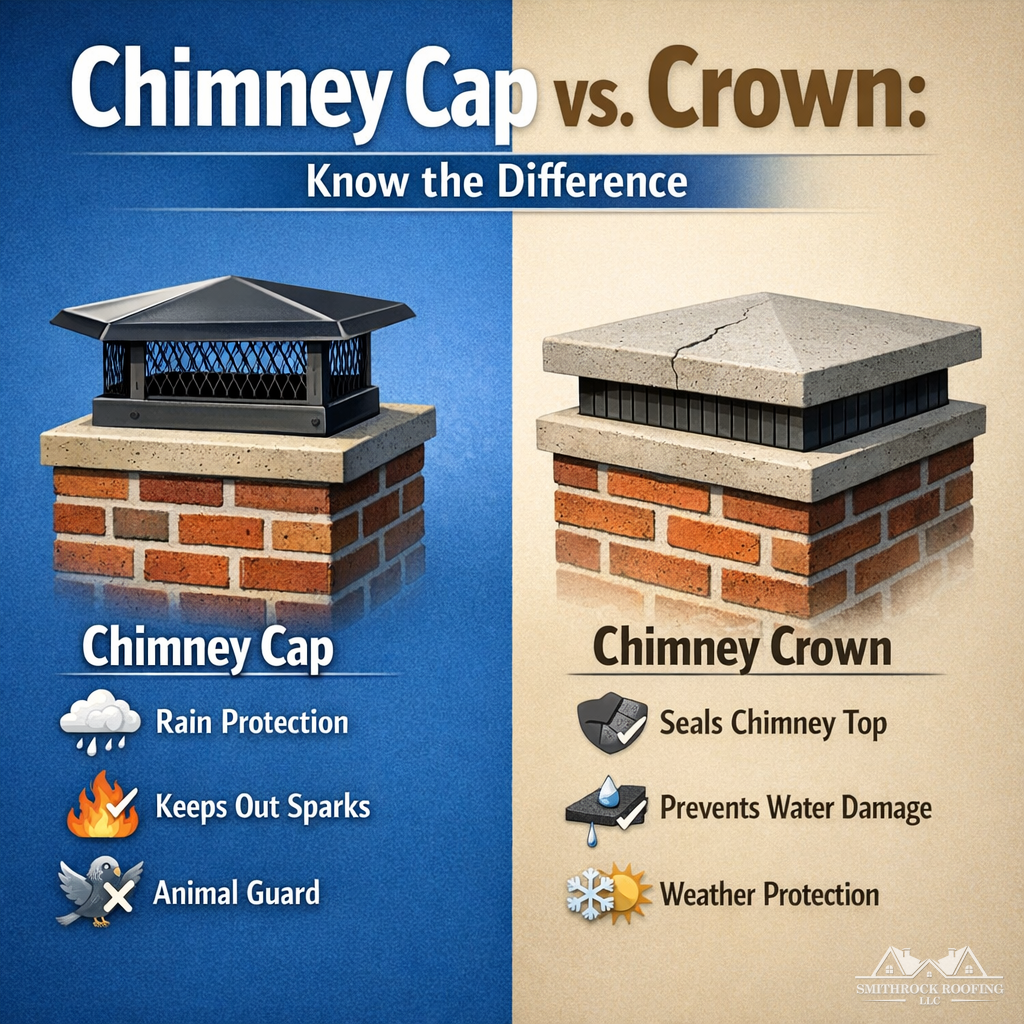
Once the crown is confirmed to be in good condition, cap selection becomes the real conversation. There are several distinct types, and the right one depends on your flue configuration, chimney structure, and specific site conditions.
These cover one flue opening and are the most common residential cap. They’re available in a range of sizes and materials, and they work well for straightforward masonry chimneys with a single fireplace flue. Proper sizing matters here — a cap that’s too large creates a gap where wind-driven rain can still enter; one that’s too small won’t mount securely.
Some chimneys serve multiple appliances — a fireplace, a furnace, and a water heater, for example — each with its own flue. Rather than capping each flue individually, a large outside-mount cap covers the entire chimney top. This approach provides uniform coverage but requires precise measurement of the full chimney crown perimeter.
The distinction matters practically:
This is a category that every competitor in Kernersville overlooks entirely, and the omission has real consequences.
Factory-built, or prefabricated, chimneys are not masonry chimneys. They’re manufactured systems — metal fireboxes and insulated flue pipes — and they require manufacturer-specified caps to maintain their UL listing. Installing a generic cap on a factory-built chimney can void the manufacturer’s warranty and, in some cases, affect your homeowner’s insurance coverage, since the chimney is no longer operating as a listed, tested system.
If your home was built in the 1980s or later and has a metal chase (the exterior box surrounding the chimney pipe) rather than a brick chimney, you almost certainly have a factory-built system. The cap replacement process is different, and the stakes of getting it wrong are higher. For a deeper look at how these systems differ, the article The Definitive Guide to Prefabricated Chimney Caps covers the key distinctions worth understanding before you buy.
Competitors mention stainless steel and copper in passing. Here’s what those mentions leave out.
Galvanized caps are the most common and least expensive option. In drier climates, they hold up reasonably well. In the Piedmont Triad — where summer humidity regularly runs high and heavy oak and pine canopy over many Kernersville lots keeps moisture from evaporating quickly — galvanized steel corrodes faster than the regional average. A galvanized cap that might last fifteen years in a dry environment may show significant rust at seven or eight years in this climate. It’s not a bad material, but homeowners should go in with realistic expectations about inspection intervals.
Type 304 stainless steel is the professional standard for most residential applications. It resists corrosion in humid conditions, holds up well under the acidic condensation that wood-burning chimneys produce, and doesn’t require repainting or refinishing. It costs more than galvanized, but the longevity gap in a high-humidity environment like Kernersville’s makes it the better long-term value in most cases.
Type 316 stainless — sometimes called marine-grade — offers even higher corrosion resistance and is typically reserved for chimneys venting gas appliances, where condensate acidity is more aggressive.
Copper caps are chosen for aesthetic reasons as much as performance. They develop a distinctive patina over time, making them a popular choice on older homes in Kernersville’s historic and established neighborhoods. Copper is extremely durable and corrosion-resistant, but there’s an important installation consideration: copper and steel must never be in direct contact on a chimney. When dissimilar metals contact each other in the presence of moisture, galvanic corrosion occurs — the less noble metal degrades rapidly. A copper cap installed with steel fasteners against a steel flashing system will cause accelerated corrosion at every contact point. If you’re considering this option, the article Decoding Copper Chimney Cap Prices: A Comprehensive Guide walks through what to budget and what to watch for during installation.
| Material | Corrosion Resistance (Triad Humidity) | Typical Lifespan | Aesthetic Option | Notes |
|---|---|---|---|---|
| Galvanized Steel | Moderate | 7–12 years | No | Adequate for budget installations; inspect frequently |
| Type 304 Stainless Steel | High | 20+ years | No | Professional standard for most residential installs |
| Type 316 Stainless Steel | Very High | 20+ years | No | Preferred for gas appliance chimneys |
| Copper | Very High | 30+ years | Yes | Requires non-steel fasteners; check for galvanic compatibility |
| Aluminum | Low-Moderate | 5–10 years | No | Not recommended for wood-burning chimneys; degrades under creosote exposure |
Every competitor says chimney caps “prevent sparks from escaping.” None of them explain the actual standard that governs mesh size — which means homeowners have no way to evaluate whether the cap they’re buying actually meets code.
NFPA 211 is the National Fire Protection Association’s standard for chimneys, fireplaces, and venting systems. It is the foundational code reference for residential chimney installations in North Carolina and most of the country. On the subject of spark arrestor mesh, it is specific:
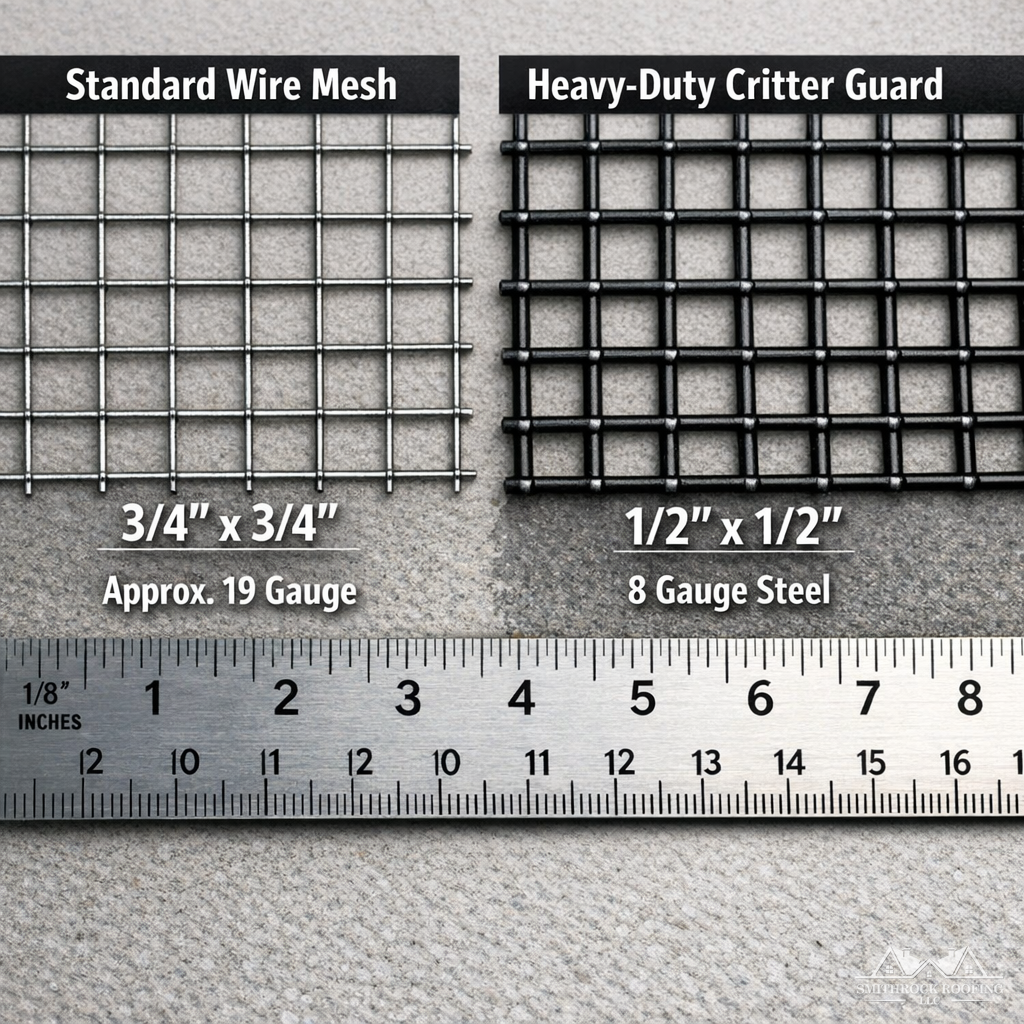
Mesh openings must be no larger than ½ inch and no smaller than ¼ inch.
This isn’t arbitrary. It reflects an engineering constraint in both directions:
When evaluating a chimney cap — whether purchasing one independently or having one installed — confirming that the mesh conforms to this standard is not optional. It is a code compliance issue.
Standard ½-inch mesh will block birds, squirrels entering as juveniles, and most small animals. It will not reliably stop a determined adult raccoon. Raccoons can — and do — bend standard wire mesh to gain entry, particularly when they’ve identified a chimney as a denning site in late spring.
For homes in Kernersville neighborhoods adjacent to wooded areas — and many subdivisions in town border significant tree cover — reinforced mesh or purpose-built critter guard caps with heavier gauge wire are the appropriate specification. This is a product distinction that matters, and it’s one worth asking about specifically when discussing cap options with a contractor.
This is the most technical section of this guide, but it has direct practical implications for homeowners in specific Kernersville neighborhoods, so it’s worth understanding at a functional level.
A chimney draws air upward because warm air rises. The draft — the upward pull that keeps smoke moving out of the firebox and up through the flue — depends on the temperature differential between the air inside the flue and the air outside, the height of the chimney, and the flue’s cross-sectional area. Anything that disrupts that pressure differential can cause downdrafts: cold, smoky air pushing back down into the living space.
Homes situated within or adjacent to tree canopies experience a wind dynamic that open-lot homes do not. As wind passes over and around a tree canopy, it creates turbulence — irregular, swirling air movement rather than a clean laminar flow. This turbulence, sometimes called eddy current flow, can push air downward at the roofline and directly into an open or standard-capped flue.
Many established Kernersville neighborhoods — particularly older subdivisions near downtown and areas where mature oak and pine tree coverage is dense — see this effect regularly. Homeowners often describe it as a chimney that “smokes” into the house on windy days even when there’s no fire burning, or a fireplace that struggles to draw on gusty afternoons.
A basic rain cap provides a cover over the flue opening. It does nothing to actively improve draft or counteract negative pressure from wind turbulence.
Two cap designs address this problem directly:
Neither of these is the right solution for every chimney. But for a home where downdraft is a recurring complaint and the chimney structure itself is sound, the problem is almost never “the fireplace is broken.” It’s usually a mismatch between cap type and site conditions. A professional evaluation of the specific wind exposure, roof geometry, and neighboring vegetation is what determines the right answer — not a default recommendation.
A chimney cap installation should never happen in isolation from a basic assessment of the flue liner condition. This is another point that every competitor in Kernersville’s market omits, and it matters.
A cracked or deteriorated flue liner creates gaps in the pathway between the firebox and the open air. Combustion gases — including carbon monoxide — can escape through those gaps into the wall cavities or living spaces of the home. A cap installation on top of a compromised liner doesn’t address that risk. It just adds a new component to a system that has a more serious underlying problem.
This doesn’t mean every cap replacement requires a full liner inspection — but it does mean that if you haven’t had a chimney inspection recently, combining that evaluation with cap work is the sensible approach. It’s one visit, one ladder climb, one opportunity to know the complete state of the system rather than the state of one component.
Chimney caps are not permanent, maintenance-free components. A few specifics worth knowing:
Annual chimney inspection should include a direct look at the cap: mesh condition, mounting security, visible corrosion, and any deformation from impact (falling branches are more common than most homeowners expect in Kernersville’s wooded neighborhoods). Catching a failing cap early is straightforward. Catching the water damage it allowed after two seasons of neglect is not.
Given everything covered here, a few questions separate contractors who are genuinely knowledgeable from those who are simply ready to install whatever they’ve brought on the truck:
A contractor who can walk through these questions clearly, without frustration or vagueness, is one who understands that chimney cap work is a professional judgment call — not a commodity installation.
At Smithrock Roofing, we’ve served homeowners across Kernersville, Winston-Salem, Greensboro, High Point, Clemmons, Rural Hall, and King with over 60 combined years of exterior expertise. Our approach to chimney caps starts with an honest evaluation of the full chimney system — crown condition, liner integrity, flue configuration, and site-specific draft factors — before any recommendation is made. Because the right cap for your home isn’t just any cap. It’s the one that fits your chimney, your environment, and your long-term goals for the system.
If you’re ready to have that conversation, we’re ready to make it straightforward.
As chimney cap standards, materials, and installation expectations continue to evolve, here are three specific steps Kernersville homeowners should prioritize heading into 2026:
1. Schedule a Full Chimney System Inspection Before Winter
Rather than waiting until a visible problem develops, book a comprehensive inspection that includes the cap, crown, flashing, and flue liner together. Many issues that become expensive repairs in January are preventable when caught in September or October. A combined inspection gives you an accurate picture of the whole system — not just the component that’s easiest to see from the ground.
2. Request a Draft Performance Assessment if You Use Your Fireplace Regularly
If your fireplace smokes back into the living space, your fire is difficult to start, or you notice odors when the fireplace isn’t in use, these are draft symptoms that a cap change alone won’t resolve. In 2026, more contractors are offering draft diagnostics as a standalone service — take advantage of that when evaluating any chimney contractor.
3. Evaluate Your Current Cap Material Against What Your Flue Is Actually Venting
If your chimney system has changed — a new gas insert, a wood stove replacement, or a conversion from one fuel source to another — the cap that was appropriate before may not be the right fit now. Different flue gases create different corrosion conditions. An honest material review before problems surface is far less disruptive than a reactive replacement after deterioration has set in.
The most common signs are visible rust or corrosion on the cap itself, mesh that has collapsed or developed gaps large enough for birds or large debris to enter, and water staining inside the firebox or on the ceiling near the chimney. If you’ve noticed animal activity in your chimney, a missing or damaged cap is frequently the reason. A contractor who inspects the full chimney system — not just the cap in isolation — can give you the most accurate assessment of whether repair or replacement is warranted.
Yes, significantly. A factory-built prefabricated fireplace requires a cap that is either manufacturer-specified for that system or UL-listed as compatible with it. Installing a universal masonry cap on a prefabricated system can void the manufacturer’s warranty and may create safety concerns related to draft and clearances. A masonry chimney with a traditional flue offers more flexibility in cap selection, but the right choice still depends on what the flue is venting, the flue dimensions, and local weather conditions.
It can, in both directions. A well-matched cap installed correctly will have minimal effect on draft under normal conditions. However, an oversized cap, an undersized cap, or a cap placed at the wrong height above the flue can restrict airflow or create turbulence that worsens draft performance. If your fireplace already has draft challenges before cap installation, those issues should be diagnosed separately — a new cap alone is unlikely to resolve them, and the wrong cap selection could make them worse.
The National Fire Protection Association recommends that chimneys be inspected at least once per year. The cap should be included in that inspection as a matter of course. In the Triad region specifically, the combination of seasonal ice events, summer humidity, and significant wind exposure from storm systems means that annual inspection is a practical minimum — not a conservative recommendation. Caps that look intact from the roofline can have mesh failures, lifting seams, or fastener corrosion that only a close inspection will reveal.
A chimney cap is a small component with an outsized impact on the long-term condition of your chimney system, and getting it right requires someone who understands the full picture — not just what fits the flue opening. Smithrock Roofing has spent over 60 combined years helping homeowners across Kernersville and the broader Triad region make confident, well-informed decisions about their exterior systems, from the crown down. If you’re ready to have a straightforward conversation about what your chimney actually needs, Contact Smithrock Roofing and we’ll start with an honest evaluation.
Smithrock Roofing © Copyright 2026 • All Rights Reserved • Privacy Policy • Maintained by Mongoose Digital Marketing