There’s a conversation we have with Winston-Salem homeowners more often than we’d like. A roof that was replaced ten or twelve years ago — by a seemingly reputable contractor, with name-brand materials — is already showing signs of premature failure. Granule loss, moisture intrusion, sagging decking. The homeowner is frustrated, and rightfully so.
In most of these cases, the materials weren’t the problem. The climate was ignored, the attic was overlooked, and the installation cut corners that weren’t obvious until years later.
This guide exists to change that conversation before it happens to you. Whether you’re dealing with storm damage, planning a replacement, or simply trying to evaluate a roofing contractor before you commit to anything, understanding what actually separates a long-lasting roof from a short-lived one in the Piedmont Triad is the most useful thing we can offer you.
Most homeowners think about roofing in terms of obvious events — a major storm, visible leaks, or shingles blowing into the yard. What they don’t think about is the slow, cumulative damage caused by where they live.
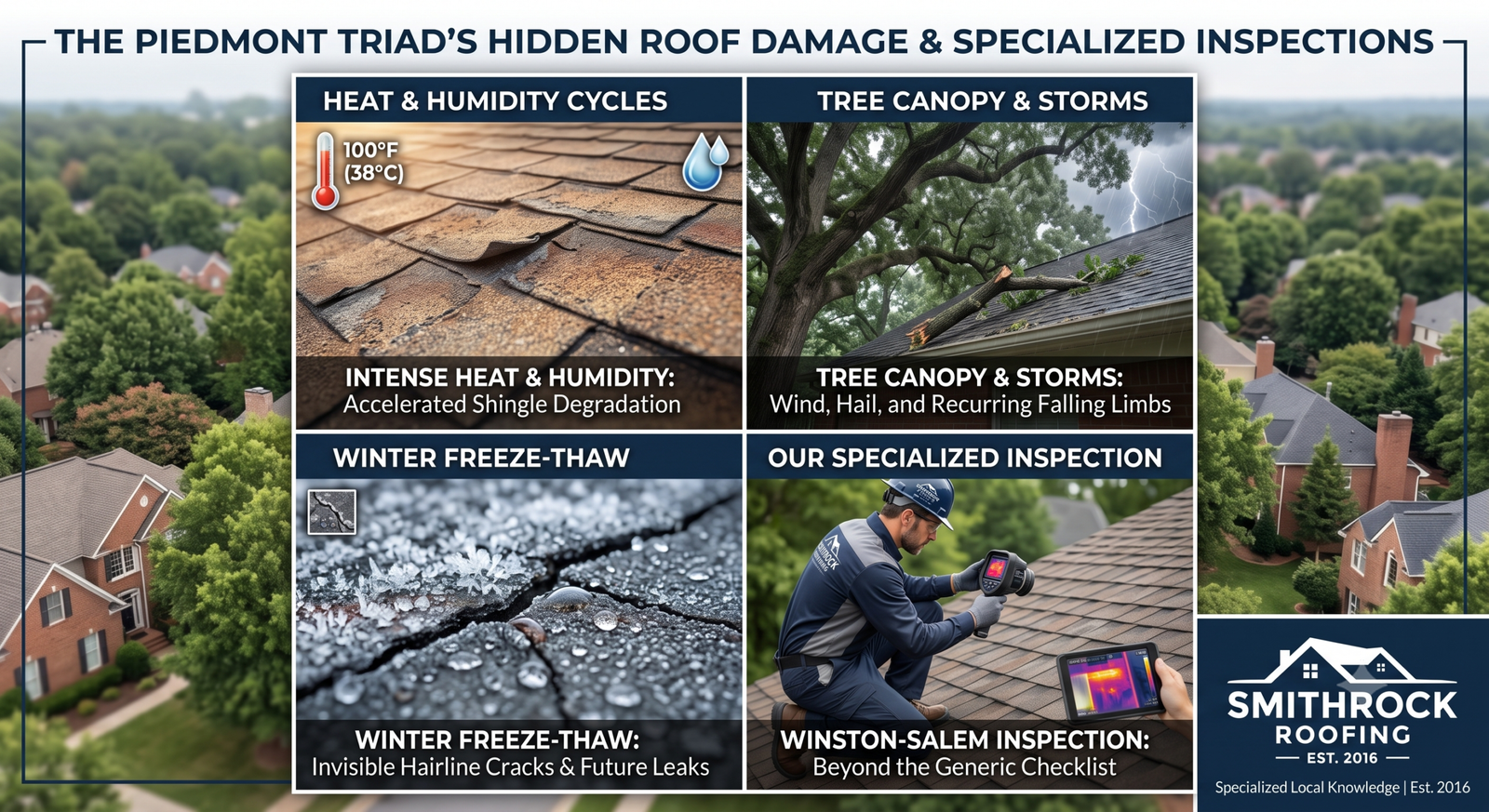
Winston-Salem sits in a humid subtropical climate zone (Köppen classification Cfa), which places it in a genuinely difficult position for residential roofing. It’s not the mountains, so it doesn’t get the brutal snowloads that mountain communities manage. It’s not the coast, so it doesn’t face salt air and hurricane-force winds year-round. But it gets meaningful portions of all of those stressors — and the housing stock here largely wasn’t built to account for that combination.
The Blue Ridge foothills to the west of Winston-Salem create a specific wind shear dynamic and temperature fluctuation pattern that coastal NC cities simply don’t experience. During winter months, the Triad regularly cycles through freezing temperatures at night followed by above-freezing daytime temperatures — sometimes within the same 24-hour period.
For your roof, this means:
This is why a contractor who installs roofs in coastal Wilmington or Asheville isn’t automatically the right person for your Winston-Salem home. The failure patterns here are specific.
Winston-Salem summers are long, humid, and hot. A poorly ventilated attic on a south- or west-facing roof slope can reach internal temperatures well above 150°F during peak summer months. At those temperatures, the asphalt binder in standard architectural shingles softens, and granule adhesion degrades.
The result is accelerated granule loss — the protective mineral surface that deflects UV radiation and weathering. A properly ventilated attic system keeps roof deck temperatures meaningfully lower. In an under-ventilated system, you’re looking at a shingle lifespan shortened by three to seven years compared to a correctly ventilated installation of the same product.
This isn’t a scare tactic. It’s building science, and it’s the kind of thing a knowledgeable roofing contractor should be discussing with you on day one.
If there’s one technical issue that comes up repeatedly in our inspections across Winston-Salem, Kernersville, Clemmons, Greensboro, and High Point, it’s under-ventilated attic systems.
Homes built between roughly 1940 and 1985 — which represents a substantial portion of the housing stock in neighborhoods like Ardmore, Reynolda Manor, and Sherwood Forest — were designed before modern ventilation science became standard practice in residential construction. Many have soffit venting that’s been blocked by insulation added in the 1970s energy crisis era, or ridge ventilation that was simply never installed.

Ventilation isn’t just about having some vents somewhere on the roof. A functional system requires balanced intake and exhaust — typically soffit vents at the eave line for intake and ridge vents at the peak for exhaust. The ratio matters. A system that’s all exhaust and no intake will create negative pressure that draws conditioned air from the living space into the attic, compounding both energy and moisture problems.
Before any reputable contractor installs a new roof on a Winston-Salem home, a thorough attic assessment should be part of the process. If ventilation deficiencies exist and aren’t corrected at the time of installation, the new roof is already operating under a disadvantage before the first storm arrives. Our article Don’t Hit the Ceiling Understanding Your Roof and Attic Inspection walks through exactly what that assessment should cover.
This is where the gap between a thorough contractor and a surface-level one becomes most apparent. Every roofing company in Winston-Salem will tell you they do quality work. Far fewer explain what that actually means in practice.
A roof replacement begins at the deck, not at the shingles. Once the old material is stripped, every square foot of the underlying decking should be walked and inspected. Here’s what a thorough inspection identifies:
Skipping this step doesn’t save time. It guarantees callbacks.
The roofing industry has moved substantially away from traditional #15 felt underlayment over the past decade. In Winston-Salem’s humid climate, this matters. Modern synthetic underlayments offer:
| Feature | Traditional #15 Felt | Synthetic Underlayment |
|---|---|---|
| Moisture resistance | Absorbs moisture; can wrinkle and buckle | Highly moisture-resistant; stays flat |
| Tear strength | Prone to tearing in high-wind installation | Significantly higher tear resistance |
| UV exposure tolerance | Degrades quickly if left exposed | Can tolerate extended UV exposure during install |
| Weight | Heavier per square | Lighter; easier to handle on steep slopes |
| Slip resistance | Low | Higher traction for installers on wet decks |
| Performance in humid climates | Moderate | Superior moisture management |
In a climate with Winston-Salem’s humidity profile and summer storm frequency, synthetic underlayment isn’t an upgrade — it’s the appropriate baseline specification.
This is a genuine technical debate in the roofing industry, and it’s worth understanding. Pneumatic nail guns allow faster installation, but they introduce the risk of over-driving fasteners — which penetrates the shingle’s fiberglass mat and reduces its wind uplift resistance — or under-driving, which leaves fasteners raised and prone to working loose over time.
Hand-nailing gives an experienced installer direct tactile feedback on fastener depth. CertainTeed’s installation specifications for products like the Landmark series are precise about fastener placement and depth, and those specifications exist for a reason: they’re directly tied to both wind warranty performance and the shingle’s ability to resist uplift in storm conditions.
This is the kind of installation detail that matters particularly in the Piedmont Triad, where convective storm activity — including brief but intense straight-line wind events — is common during spring and summer.
This is one of the most anxiety-producing situations a homeowner can face, and it’s almost entirely absent from competitor content in this market. So let’s be direct about how this process actually works.
Before you call your insurance company or a roofing contractor, document what you can safely observe from the ground:
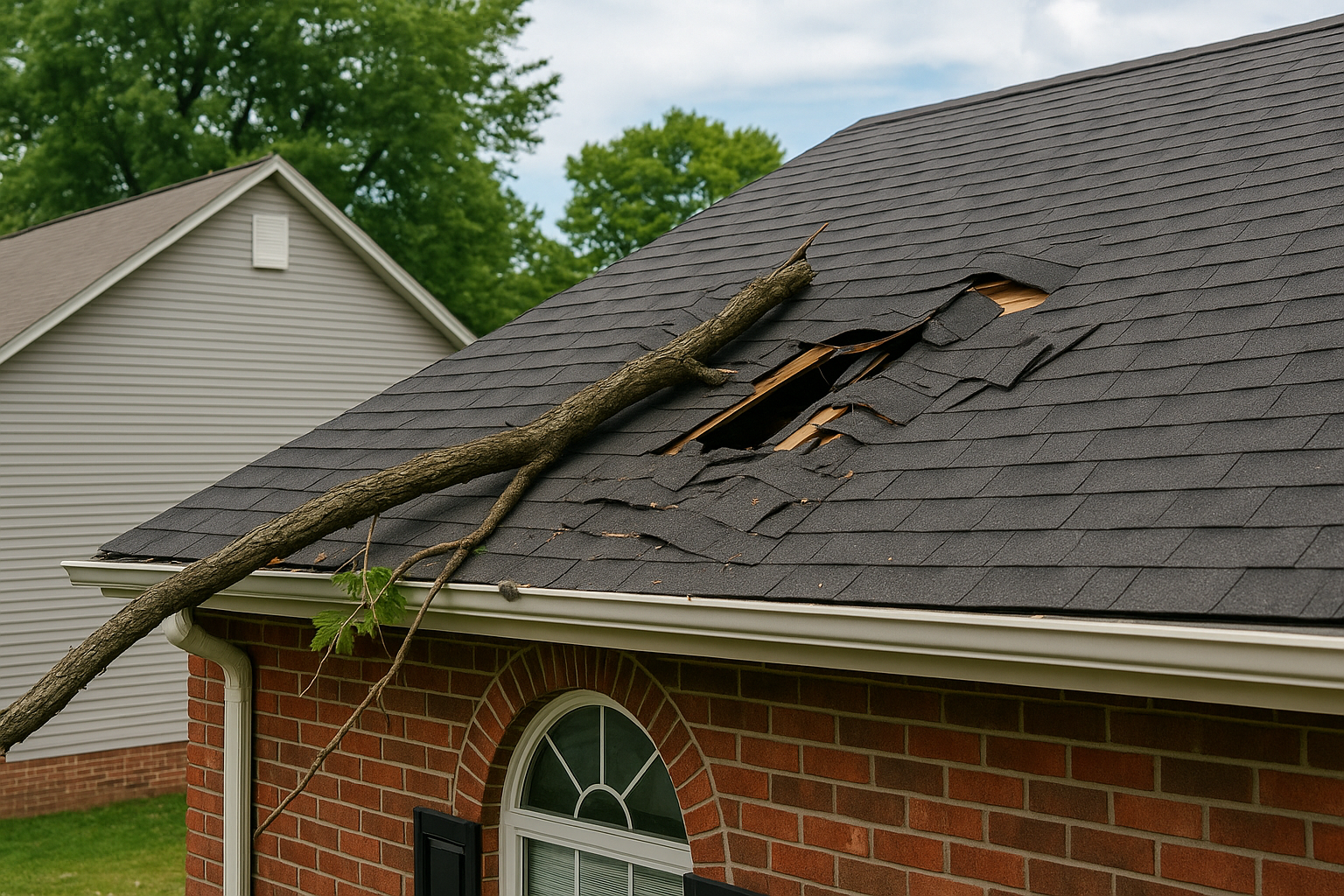
This distinction is important in North Carolina insurance claims and is frequently misunderstood. Functional damage compromises the roof’s ability to perform its primary job — keeping water out. This includes cracked shingles, displaced tabs, and impact damage that has breached the shingle surface. Cosmetic damage affects appearance but not performance — surface scuffing, minor granule displacement, or denting to metal components that remain watertight.
North Carolina Department of Insurance guidelines recognize this distinction, and insurers will apply it during the adjuster’s evaluation. A knowledgeable roofing contractor can help you understand which category your damage falls into before the adjuster arrives — which affects how you frame your claim documentation.
A reputable roofing contractor can walk your property with your insurance adjuster to ensure that all documented damage is accounted for in the scope of loss. This isn’t adversarial — it’s practical. Adjusters cover many properties after a major storm event, and having a contractor present who can point to specific damage indicators prevents line items from being missed.
What a contractor should never do is offer to waive your insurance deductible. This practice is illegal in North Carolina and is a red flag about how that contractor approaches their business overall. For a detailed walkthrough of how to navigate this process, the article Don’t Get Ripped Off: The Essential Steps for Your Roof Insurance Claim covers the documentation and adjuster process in full.
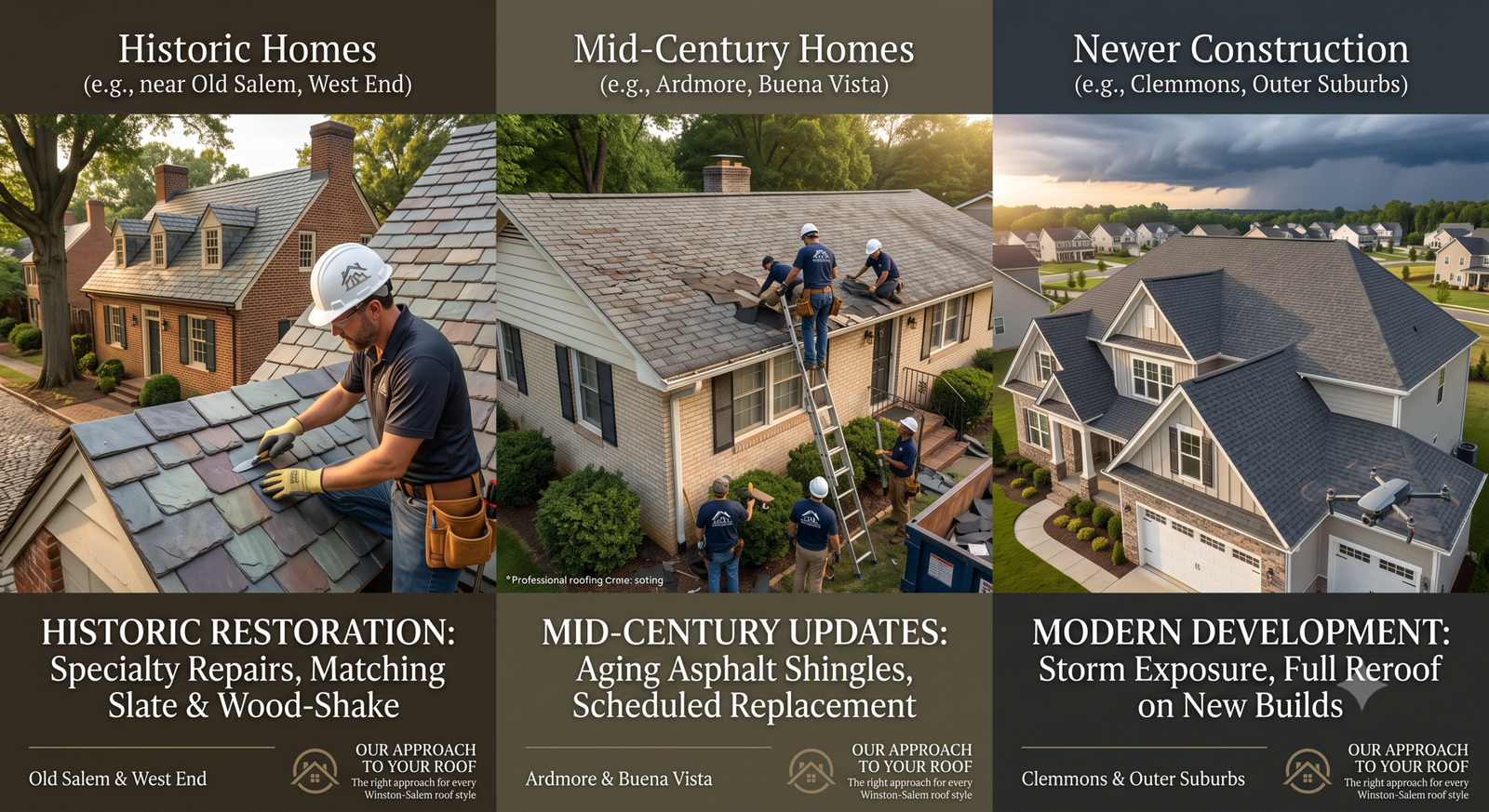
Winston-Salem has significant historic neighborhoods — West End, Ardmore, and the Old Salem area among them — and homeowners in these districts face an additional layer of consideration before any roofing work begins.

The City-County Planning Board’s Historic Resources Commission oversees exterior alterations in Winston-Salem’s locally designated historic districts. Before installing a new roof in a covered area, homeowners may need to obtain a Certificate of Appropriateness (COA) — a review process that evaluates whether the proposed material, color, and installation method is consistent with the historic character of the property and district.
This isn’t a rubber stamp. The commission evaluates:
The Old Salem district carries additional standards aligned with its Moravian architectural heritage. This is a nationally recognized historic area, and exterior work here is evaluated against preservation standards that go beyond the city’s general historic district guidelines. Homeowners in or adjacent to Old Salem should consult with both the Historic Resources Commission and Old Salem Museums & Gardens’ preservation staff before finalizing any material specifications.
A roofing contractor familiar with this process — who has navigated COA applications before — can save you weeks of delay and the cost of having to revise a specification that didn’t meet review standards.
Choosing a roofing contractor in Winston-Salem should involve more than checking for a license and reading a few reviews. Here’s what to actually look for:
A contractor who answers these questions specifically and without hesitation is demonstrating real field experience. A contractor who deflects, generalizes, or pivots immediately to price is showing you something important about how they operate.
“Lifetime warranty” is one of the most misused phrases in the roofing industry. What homeowners should understand:
A five-year labor warranty backed by a limited lifetime manufacturer warranty, from a certified installer, represents a meaningfully different level of protection than a vague “satisfaction guarantee” with no documented terms. You can review Smithrock’s specific warranty coverage to understand exactly what’s included before you commit to any project.
Not every shingle product performs equally in Winston-Salem’s climate. Material selection should be driven by the specific demands of the environment, not just brand recognition or appearance.
Dimensional or architectural shingles — products like the CertainTeed Landmark series — represent the current standard for residential roofing in this market. They offer:
Higher-tier shingle products — CertainTeed’s Landmark Pro or Presidential series, for example — offer heavier construction, enhanced wind ratings, and improved hail impact resistance. For homes with particularly complex roof geometry, steep pitches, or exposure to prevailing storm tracks, these specifications make practical sense beyond the cosmetic difference.
The decision should be driven by your roof’s specific geometry, exposure, and the ventilation conditions underneath — not by a sales pitch for the most expensive option.
Standing seam metal roofing has gained meaningful adoption in the Winston-Salem market, particularly in higher-end residential applications and in historic neighborhoods where synthetic alternatives may not pass COA review. Metal roofing performs well in the Piedmont’s thermal cycling environment because it expands and contracts as a system rather than at individual panel seams. It’s also significantly lighter than tile or concrete alternatives, which matters for aging roof structures.
Smithrock Roofing has served homeowners across Winston-Salem, Greensboro, High Point, Kernersville, Clemmons, Rural Hall, King, and the surrounding NC Triad for years — and what we’ve seen in that time is that most roofing problems aren’t material failures. They’re process failures.
The climate we work in is specific. The housing stock here has its own history and its own vulnerabilities. And the homeowners we work with deserve a contractor who walks in already knowing those things — not one who’s learning them on the job at your home’s expense.
With 60+ combined years of field experience, CertainTeed PREMIER ShingleMaster certification, an A+ BBB rating, and more than 312 five-star reviews from homeowners across the Triad, we’ve built our reputation one honest conversation and one well-installed roof at a time.
If you’re ready to talk about your roof — whether it’s storm damage, a long-overdue replacement, or just a question about what’s going on up there — reach out to Smithrock Roofing. We’ll give you a straight answer.
If you’re a homeowner in the Winston-Salem area thinking about your roof in the coming year, three steps are worth prioritizing before problems escalate:
1. Schedule a Post-Winter Inspection Before Storm Season Opens
The freeze-thaw cycles of a Piedmont winter do quiet damage — to flashing joints, to sealant around penetrations, and to shingles already working through their service life. A professional inspection in late winter or early spring gives you a clear picture of where things stand before hail season and summer storm activity begins. Catching a failing drip edge or compromised valley before a hard rain is substantially less disruptive than addressing water intrusion after the fact.
2. Document Your Roof’s Condition and Warranty Status
Most homeowners don’t know the installation date of their current roof, what manufacturer warranty applies, or whether the installation was completed in a way that actually activates that warranty. In 2026, take the time to track this down. If you can’t locate records, a qualified contractor can often date a roof by material type and visible wear, and identify whether workmanship standards were met. This documentation matters when storm damage occurs and you’re navigating an insurance claim.
3. Evaluate Your Attic Ventilation Before Replacing Shingles
If a roofing contractor quotes you a full replacement without discussing attic ventilation, that’s worth pausing on. Poor ventilation is one of the most common reasons roofs in Forsyth and Guilford County underperform relative to their rated lifespan. Before committing to new material, confirm your intake and exhaust capacity is appropriate for your attic volume. Correcting ventilation at the time of replacement adds very little to the overall scope and can meaningfully extend the life of the new system.
The honest answer depends on several factors: the age of the roof, the extent and location of the damage, and whether the underlying decking has been compromised. Isolated damage to a small number of shingles on a roof that’s still within its service life is often a legitimate repair candidate. But if a roof is nearing the end of its expected lifespan, has experienced widespread granule loss, or has flashing and underlayment that are no longer performing, repairs become a short-term patch on a system that’s fundamentally due for replacement. A reputable contractor should be willing to show you what they’re finding and explain the reasoning, not just default to the option that generates more revenue.
Most standard homeowner’s insurance policies cover storm-related damage — wind, hail, falling debris — but the specifics depend heavily on your individual policy, your deductible structure, and how your insurer categorizes the damage. Age and condition of the roof at the time of loss also affects how claims are settled. What’s important is working with a roofing contractor who understands the documentation an adjuster needs and who can provide an accurate, itemized scope of damage. Contractors who promise to “handle everything” and discourage you from reading your own policy are worth approaching with caution.
The Piedmont Triad sits in a climate zone that combines meaningful summer heat with genuine winter freeze-thaw cycling — a combination that accelerates wear on roofing materials differently than the coast or the mountains. The region also sees significant hail and wind events, particularly in spring and early summer. Beyond climate, the housing stock in Winston-Salem includes a significant number of older homes in historic neighborhoods with specific material and aesthetic standards that not every contractor is prepared to navigate. Local experience with Forsyth County permitting, COA requirements in historic districts, and the specific ventilation challenges in older attic structures matters more than most homeowners realize until they’re already in the middle of a project.
For most residential replacements in the Winston-Salem area, a single-day completion is typical on straightforward projects — a standard-sized home with accessible roof geometry and no significant decking damage. More complex roofs, multi-family structures, or projects where decking issues are discovered during tear-off may extend to two days. What you should expect from a well-run crew: a clear pre-job walkthrough, protection for landscaping and exterior surfaces during tear-off, daily cleanup throughout the project, and a final inspection before the crew leaves. If a contractor can’t tell you what their cleanup process looks like or won’t commit to a timeline, that’s useful information before you sign anything.
Smithrock Roofing has spent years working alongside homeowners in Winston-Salem and Kernersville who needed a contractor they could trust to give them the truth — about what their roof actually needs, what the installation process looks like, and what to expect when the job is done. That kind of straightforward, local expertise is what we show up with every time. If your roof is giving you reason to worry, or you simply want to know where things stand before the next storm season, we’re glad to take a look. Get a Free Estimate

Smithrock Roofing © Copyright 2026 • All Rights Reserved • Privacy Policy • Maintained by Mongoose Digital Marketing