If you live in Clemmons, your chimney is working against more natural forces than you might expect. The Yadkin River valley corridor that runs through southwestern Forsyth County creates a distinct microclimate — one with elevated humidity, persistent valley fog, and the kind of freeze-thaw cycling that quietly chips away at masonry structures season after season. A properly fitted chimney cap is one of the most straightforward ways to protect against that damage, yet it’s also one of the most misunderstood components of the entire roofing system.
At Smithrock Roofing, we’ve spent decades serving homeowners across the NC Triad — Clemmons, Winston-Salem, Kernersville, High Point, Greensboro, and the surrounding communities. We’ve seen firsthand what happens when a chimney cap is the wrong size, the wrong material, installed at the wrong time of year, or placed over a chimney structure that needed attention first. This guide exists to give you the honest picture — the kind of detail that helps you make a smart decision rather than an expensive mistake.
Most homeowners know chimney caps keep rain out and animals away. That’s true, but it’s also the beginning of the story, not the whole thing. A chimney cap, when correctly specified and installed, performs five distinct functions simultaneously — and failing at any one of them creates real consequences for your home.
Rain and moisture exclusion is the most visible function. Water entering an open flue saturates the flue liner, the surrounding masonry, and eventually the mortar joints and brick below the roofline. In Clemmons’ climate, that moisture doesn’t just sit there — it cycles through freezing and thawing, expanding inside the masonry pores and fracturing mortar from the inside out. A cap eliminates that entry point.
Spark arrest is a safety function that matters for wood-burning fireplaces. Live embers can exit the flue and travel significant distances on a breeze before landing on dry roofing material, a neighbor’s deck, or surrounding landscaping. A properly meshed cap intercepts those embers before they leave the chimney.
Animal and pest exclusion prevents nesting material, animal remains, and associated debris from blocking the flue or degrading air quality. Raccoons, squirrels, and certain bird species will readily use an uncapped chimney as shelter.
Downdraft prevention addresses a building-science issue that many homeowners notice but can’t identify: smoke puffing back into the living room when the wind is blowing from certain directions. Some cap designs are specifically engineered to redirect wind flow and prevent negative pressure from pushing air back down the flue.
Negative pressure management deserves its own mention because it’s become more relevant as homes get tighter. Modern construction — and even older homes that have been weatherized — creates sealed building envelopes that develop negative indoor air pressure. That pressure differential can actively pull air downward through the flue. Cap geometry affects how well a chimney handles this condition, which is why cap selection isn’t simply about matching the flue size.
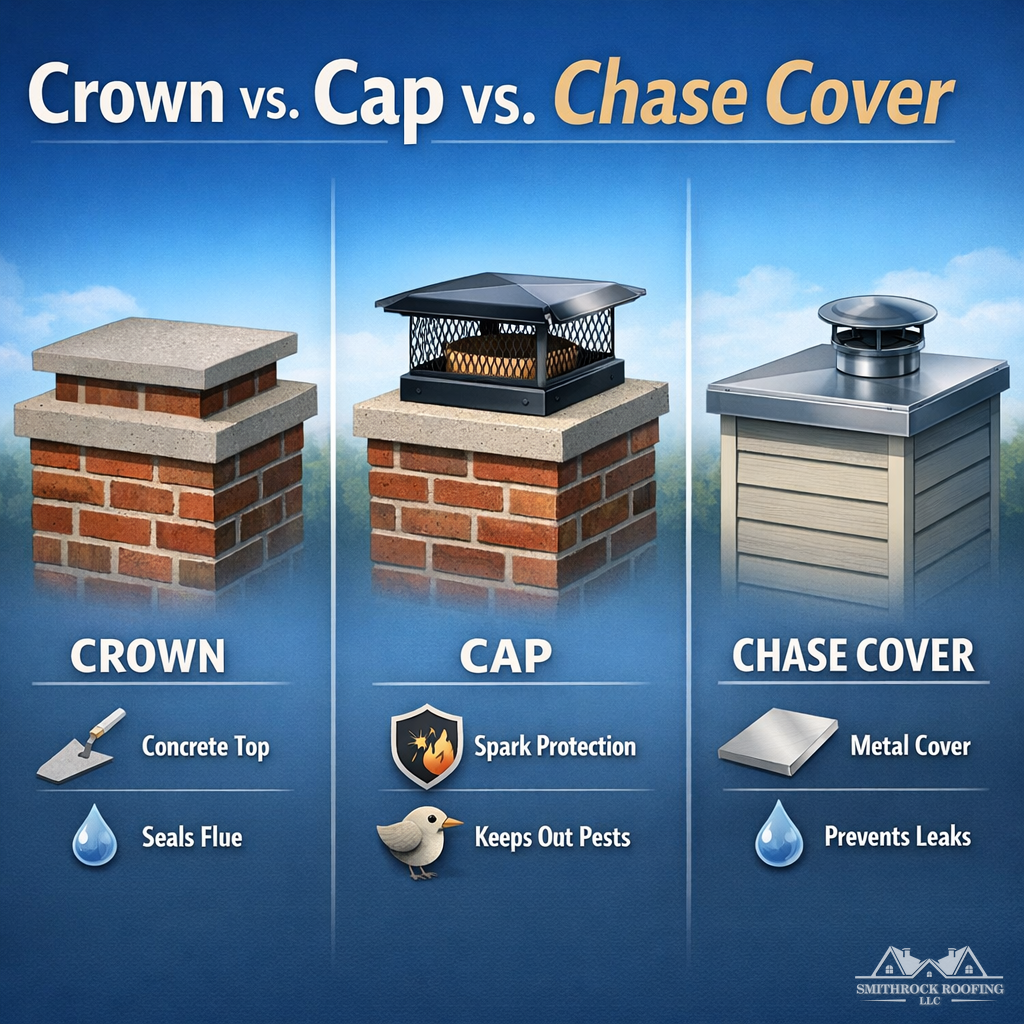
This is where a lot of homeowners — and, frankly, some contractors — get confused. The terms “cap,” “crown,” and “chase cover” are sometimes used loosely, but they describe three entirely different components. Understanding the difference protects you from spending money in the wrong place.
The chimney crown is the concrete or mortar slab that seals the top surface of the masonry chimney structure. It sits flat across the top of the chimney, sloping outward from the flue tile to direct water away from the brick below. The crown is separate from the cap — the cap sits on top of the crown, covering the flue opening itself.
Here’s the critical issue: a cracked chimney crown allows water to infiltrate the masonry structure regardless of whether a cap is present. The most common crown failure pattern is horizontal cracking caused by differential thermal expansion between the crown material and the surrounding brick. When that cracking occurs, water wicks directly into the masonry below the cap — which means a new cap does nothing to solve the actual water problem.
The Crown Check: During any roof-level inspection, look at how water sheds off the crown surface. If water pools toward the flue opening rather than shedding outward toward the edges, the crown has likely settled or cracked and is directing water exactly where you don’t want it. Crown inspection should be a prerequisite to cap installation, not an optional add-on.
The cap sits above the crown, covering the flue opening while allowing combustion gases to exit freely through the sides. It typically consists of a flat or arched top with mesh or louvered sides.
This is where the masonry vs. factory-built distinction becomes important — and it’s relevant to a significant portion of Clemmons housing stock. Many homes built during the suburban expansion of the 1980s through early 2000s have factory-built fireplaces with metal chases rather than traditional masonry chimneys. The exterior looks similar, but the internal structure is fundamentally different. Factory-built systems use a chase cover — a flat metal cover that seals the entire top of the framed chase enclosure — rather than a masonry crown and flue cap.
Installing a masonry chimney cap on a metal chase system, or vice versa, doesn’t just look wrong — it leaves gaps that allow water infiltration at the framing level, where the damage is far more extensive and expensive to repair. Knowing which system you have before any cap work begins is not optional. For a deeper look at how these systems differ and what replacement involves, the article on chimney chase cover replacement covers the full process in detail.
Chimney caps are not all meshed equally, and the difference matters more than most people realize. The Chimney Safety Institute of America (CSIA) and NFPA 211 — the governing standard for solid fuel burning appliances — reference 5/8-inch mesh as the functional standard for chimney cap screens. That specific measurement isn’t arbitrary.
Mesh that is too fine clogs with creosote particulate on wood-burning systems. As the mesh surface area becomes restricted, flue resistance increases, draft velocity drops, and you get incomplete combustion, faster creosote accumulation, and smoke spillage into the living space. That’s not a minor inconvenience — elevated creosote accumulation is a direct chimney fire risk.
Mesh that is too coarse fails as a spark arrestor. Embers that are smaller than the mesh opening exit the flue freely, eliminating one of the cap’s core safety functions.
The 5/8-inch standard balances these competing concerns. When evaluating cap options, verify mesh size before purchase. Decorative caps that prioritize appearance over specification can fall outside this range.
Here’s a detail that separates an informed installation from a guesswork installation: the open mesh area of a chimney cap should be at minimum three to four times the cross-sectional area of the flue opening. This ratio, referenced in Hearth, Patio & Barbecue Association (HPBA) technical guidelines, accounts for the fact that mesh restricts airflow — and that restriction compounds as the mesh ages and accumulates deposits.
A cap sized solely by matching the exterior flue tile dimensions — without accounting for this ratio — will reduce effective draft, particularly on wood-burning systems operating at lower temperatures. Reduced draft means the system can’t pull combustion air efficiently, which cascades into all the same problems described above: creosote buildup, smoke spillage, and reduced combustion efficiency.
This is why “one size fits most” cap purchases from a home improvement store can underperform even when installed correctly. The physical dimensions match, but the functional specification doesn’t.
This is information that virtually no local contractor discusses — and it’s the kind of thing that could save you from a serious legal problem.
Chimney swifts (Chaetura pelagica) are small migratory birds that nest and roost inside unlined or uncapped chimneys. They are common throughout the NC Piedmont, including Forsyth County and the Clemmons area. They are also federally protected under the Migratory Bird Treaty Act (16 U.S.C. §703).
What that means practically: disturbing an active chimney swift nest — including installing a cap over one — carries federal penalties. This is not a technicality. It is a law with enforcement teeth, and “I didn’t know” is not a defense.
Chimney swifts are active in the NC Piedmont from approximately April through October, returning from South American wintering grounds each spring. They migrate south again by October. The safe installation window for Clemmons homeowners who want to cap a chimney without risk of disturbing an active nest is November through March.
How to check before scheduling: Listen at the firebox opening with the damper open. Chimney swifts produce a distinctive, rapid chittering sound — sometimes described as chattering or twittering — that carries clearly through the flue. If you hear it between April and September, the chimney is actively occupied and capping must wait. For additional guidance on local wildlife compliance, the NC Wildlife Resources Commission is the relevant state authority.
A contractor who installs a cap in July without confirming the flue is clear has created a federal liability problem for the homeowner. We check. It matters.
The standard material options for chimney caps are galvanized steel, stainless steel, and copper. Each has a genuine use case, and each has a tradeoff that rarely comes up in a quick sales conversation.
Galvanized caps are the entry-level option. The zinc coating provides corrosion resistance, but it degrades over time — particularly in high-humidity environments like the Clemmons area, where valley moisture and seasonal condensation accelerate surface oxidation. Expect a shorter service life compared to stainless or copper.
Stainless steel is the practical premium choice for most applications. It resists corrosion reliably, handles thermal cycling without the expansion issues that plague galvanized coatings, and holds up well in the NC Piedmont climate. For most Clemmons homeowners, a properly gauged stainless steel cap is the right answer — it combines longevity with compatibility across chimney types.
Copper caps are visually distinctive and exceptionally durable, but there’s a compatibility issue worth knowing: copper runoff on masonry chimneys creates a documented deterioration pathway called galvanic corrosion. As copper oxidizes and rain washes that oxidation product — cupric compounds — down the brick surface, it can accelerate the breakdown of mortar joints over time. On a masonry chimney, copper caps should be paired with proper flashing and standoff design that minimizes direct runoff contact with the brick below. On metal chase systems, this concern is significantly reduced. If copper appeals to you aesthetically, the material is not a problem — the installation detail matters. For a full breakdown of what copper caps cost and how to evaluate whether the investment is right for your home, the article on copper chimney cap pricing provides a detailed cost guide.
| Cap Type | Best For | Key Advantage | Watch Out For |
|---|---|---|---|
| Single-Flue Cap | Masonry chimneys with one flue opening | Simple installation, widely available | Must be sized with correct cap-to-flue area ratio |
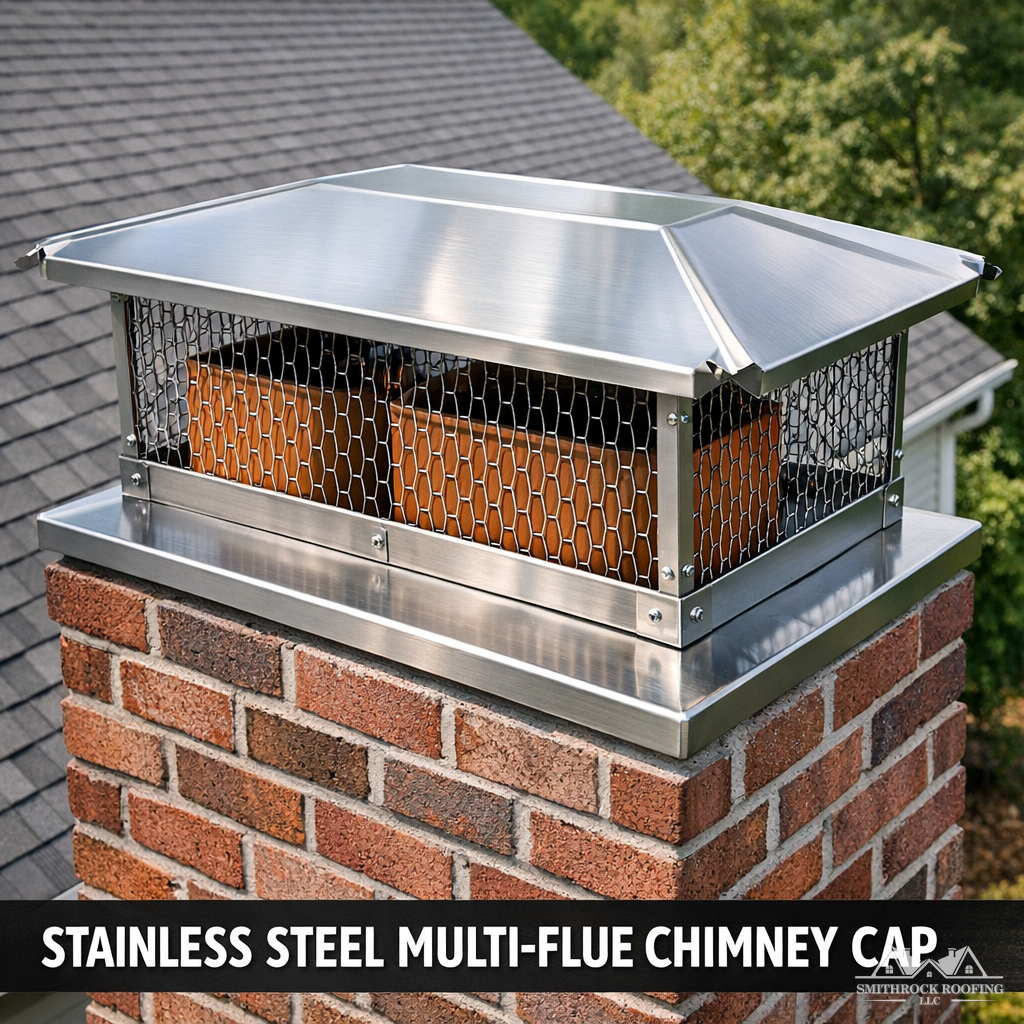
| Multi-Flue Cap | Masonry chimneys with two or more flues | One unit covers the full chimney crown | Custom sizing often required; verify crown condition first |
| Chase Cover | Factory-built fireplaces with metal chases | Seals entire chase top; prevents framing moisture damage | Stainless steel preferred; galvanized deteriorates faster |
| Copper Cap | Masonry or metal chase, decorative applications | Exceptional longevity, premium appearance | Manage runoff on masonry to prevent galvanic corrosion |
| Draft-Increasing Cap | Chimneys with persistent downdraft problems | Wind-directional design reduces negative pressure events | Not a substitute for diagnosing underlying draft issues |
| Custom Fabricated Cap | Non-standard flue sizes or historic chimneys | Exact fit; no compromise on mesh ratio or coverage | Requires experienced fabrication; not a DIY solution |
A chimney cap installation done correctly starts with assessment, not a product recommendation. Here is the inspection sequence that protects your investment:
Skipping steps in this sequence doesn’t speed up the project — it just moves the problem downstream to a place where it’s more expensive to fix.
Smithrock Roofing has been part of this community long enough to know that the homes in Clemmons aren’t generic — the housing stock, the local climate conditions, and the specific geography of southwestern Forsyth County all shape what good chimney cap work looks like here. We hold a CertainTeed PREMIER ShingleMaster certification, carry full licensing and insurance, and back our work with a 5-year labor warranty. Our 312+ five-star reviews reflect a straightforward operating principle: treat every home like it belongs to someone we’re going to run into at the hardware store next week.
If you’re not sure whether your chimney needs a new cap, a crown repair, or something else entirely, the honest answer is to get an inspection from someone who will tell you what’s actually there — not what generates the largest ticket. That’s how we’ve earned an A+ BBB rating, and it’s how we plan to keep it.
If you’re planning chimney cap work or a broader roofing inspection in the coming year, here are three specific steps worth prioritizing:
1. Schedule a combined chimney and roof inspection before winter. The shoulder season — late summer through early fall — is the ideal window in Clemmons. Crews are accessible, materials are available, and any issues identified can be addressed before cold weather arrives and small problems compound. A single inspection that covers cap condition, crown integrity, and the surrounding roof plane is more efficient than booking separate trades.
2. Ask about stainless steel chase covers if you have a prefabricated or factory-built fireplace system. Galvanized covers that were installed more than a decade ago are likely showing rust and scale degradation by now. Upgrading to a stainless or copper cover in 2026 is a maintenance step that pays forward — it eliminates a recurring cost category rather than pushing it to the next homeowner.
3. Document your chimney’s current condition with photos. Whether you schedule professional service or not, having a timestamped photographic baseline of your flue tile condition, crown surface, and cap fit is genuinely useful for insurance purposes and for tracking deterioration rate over time. Any reputable contractor should provide you with before-and-after documentation as a standard part of the job.
If the cap shows visible rust scaling, bent or collapsed mesh, missing sections, or has shifted out of position on the flue tile, replacement is typically the better path. Repairs to compromised mesh or corroded metal rarely hold long-term, and the labor cost of a second service call often exceeds the difference between patching and replacing. A direct inspection will tell you which condition you’re actually dealing with.
Yes. Smithrock Roofing serves communities throughout the NC Triad, including Winston-Salem, Greensboro, High Point, and Kernersville, as well as the broader Forsyth County area. If you’re unsure whether your location falls within the service area, reaching out directly is the quickest way to confirm.
Yes — and in some ways an infrequently used fireplace is more vulnerable, not less. A capped, open flue on a fireplace that sits unused for months is an accessible entry point for moisture, nesting wildlife, and debris accumulation. Because the system isn’t being inspected through regular use, deterioration can go unnoticed for longer. Capping an unused flue is one of the most cost-effective protective measures available.
These two components are often confused but serve distinct functions. The crown is the mortar or concrete surface that seals the top of the masonry chimney structure around the flue tile — it slopes outward to direct water away from the flue opening. The cap is the metal cover that sits on top of the flue tile itself, with mesh sides that allow smoke to exit while blocking rain, animals, and debris from entering. Both need to be in sound condition; one failing doesn’t excuse neglecting the other.
Chimney cap work is one of those maintenance categories where getting it right the first time is worth the effort of choosing carefully — and for homeowners in Clemmons and across the Winston-Salem area, Smithrock Roofing brings the licensing, local knowledge, and documented track record to do exactly that. Whether you’re in Kernersville or closer to the heart of the Triad, our team approaches every job with the same standard: honest assessment, quality materials, and work we’d stand behind in any conversation. If you’re ready to find out what your chimney actually needs, Contact Smithrock Roofing and we’ll schedule a straightforward inspection from there.
Smithrock Roofing © Copyright 2026 • All Rights Reserved • Privacy Policy • Maintained by Mongoose Digital Marketing