If you’ve started searching for a roofing company in Winston-Salem, NC, you’ve probably already noticed that most contractor websites look and sound identical. Same service lists. Same stock photos. Same promises about quality craftsmanship and free estimates. Swap the logo and phone number, and you’d never know the difference.
That sameness isn’t just a marketing problem — it’s a symptom of something more important. Most roofing content written for this area treats Winston-Salem like a generic American city with a generic American climate. It isn’t. The Piedmont Triad sits in a specific climate classification with specific failure patterns that affect your roof in ways most homeowners — and frankly, many contractors — never discuss.
This guide exists to fix that. Whether you’re replacing an aging roof in Ardmore, repairing storm damage in Kernersville, or simply doing your homework before calling anyone in Winston-Salem, Greensboro, High Point, Clemmons, King, or Rural Hall, what follows is the honest, thorough information you deserve.
(https://www.certainteed.com) a near-universal issue on north-facing slopes within 7–10 years.”; item4_title=”Ice Dam Risk”; item4_body=”Occasional Piedmont ice storms combined with under-ventilated attic spaces can produce localized ice damming — often surprising homeowners who don’t associate it with NC winters.”; item5_title=”UV Intensity”; item5_body=”Long, hot summers in the Triad accelerate granule loss and sealant degradation on standard shingles not rated for high UV exposure.”; footer=”Smithrock Roofing | Winston-Salem, NC”]
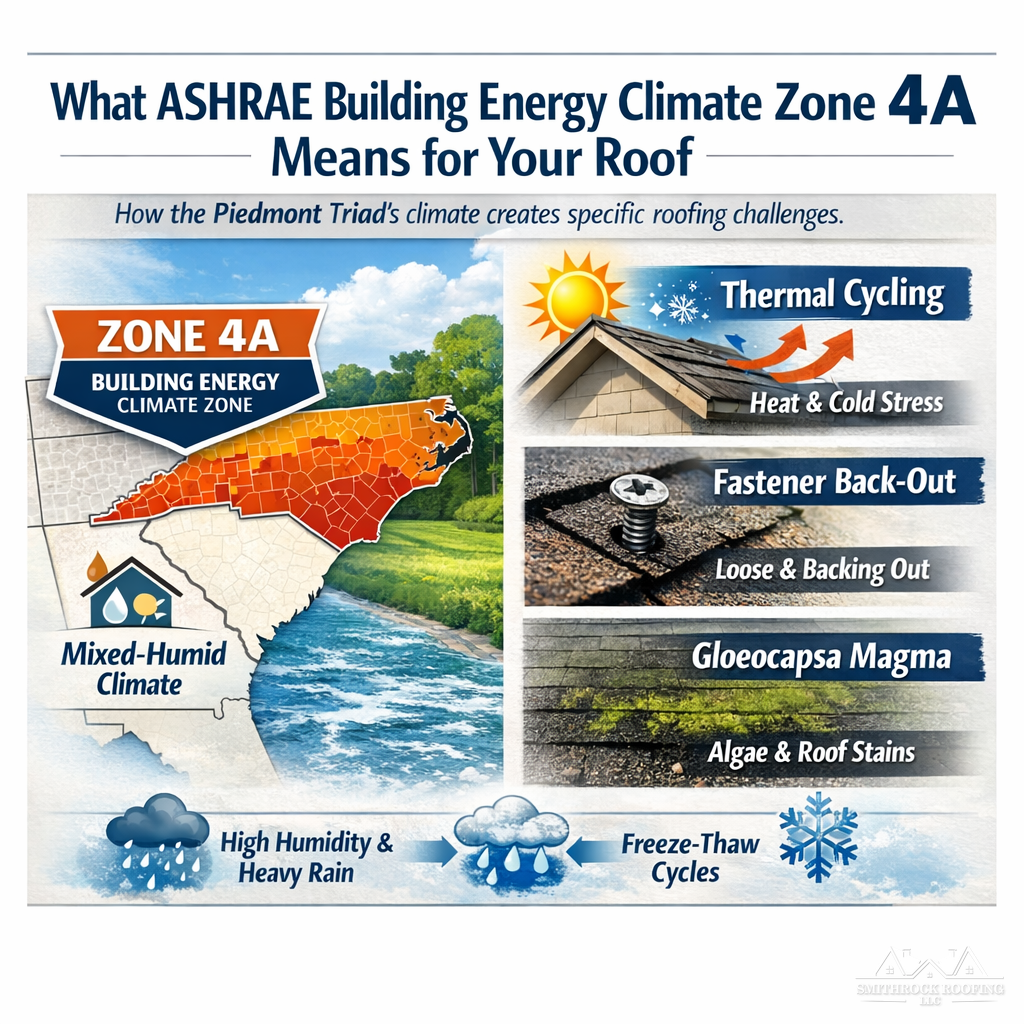
Winston-Salem falls within ASHRAE Climate Zone 4A — a designation that means “mixed-humid.” That single label carries significant consequences for every roofing decision you make.
Zone 4A climates sit at a frustrating intersection: hot and humid summers, cold and occasionally icy winters, and rapid transitions between the two. For roofing materials, that combination is genuinely punishing in ways a northern or southern climate isn’t.
Roofing materials expand when they heat up and contract when they cool down. In a stable climate, that movement is manageable. In the Piedmont Triad, where a January ice storm can be followed by a 60-degree afternoon within 48 hours, those cycles happen faster and more frequently than most material specs anticipate.
The practical result? Fasteners — the roofing nails holding your shingles in place — gradually back out over time. Sealant strips between shingles crack earlier than their rated lifespan suggests. Flashing joints around chimneys, skylights, and pipe penetrations open up incrementally with each cycle, creating pathways for water that don’t announce themselves until the damage is already done inside your attic.
A knowledgeable roofing contractor serving Winston-Salem accounts for this during installation — selecting fasteners with appropriate shank designs, ensuring sealant is applied in the correct conditions, and using flashing techniques that accommodate movement rather than resist it.
If you’ve noticed dark streaks running down the north- or west-facing slopes of older roofs in neighborhoods like Buena Vista, West End, or along the rural stretches near King and Rural Hall, you’re looking at Gloeocapsa magma — a cyanobacteria that thrives in the Triad’s humidity.
This isn’t purely cosmetic. The algae feeds on the limestone filler in standard asphalt shingles, gradually degrading the granule layer that protects the asphalt underneath from UV exposure. Left unchecked, it shortens shingle lifespan meaningfully.
The fix isn’t a pressure washer — that strips granules and voids warranties. The proper solution is selecting shingles with copper or zinc granule infusion (like CertainTeed’s Landmark shingles with StreakFighter technology) that inhibit biological growth at the material level. This is a region-specific decision that a contractor with real local experience will raise with you unprompted. If they don’t mention it, that tells you something.
Winston-Salem isn’t Vermont. But the Piedmont does get ice storms, and when an under-ventilated attic space allows warm air to migrate toward the roof deck, snow and ice melt unevenly. Water runs toward the cold eaves, refreezes, and builds up a dam that forces water back under the shingles.
This pattern causes water intrusion at the very spots where you’d least expect it — several feet from the edge of the roof, above the exterior wall, right where it can damage insulation, ceiling drywall, and wall framing without being immediately visible.
Proper ventilation and a correctly installed ice-and-water shield at the eaves are the defense against this. For a deeper look at how ice dams form and what you can do about them, our article on how to get rid of ice dams walks through the mechanics and solutions in detail. We’ll cover ventilation shortly, because it connects to something even more important than weather: your warranty.
This is the section most roofing websites skip entirely. It’s also one of the most financially consequential things you can understand before any contractor puts shingles on your home.
Attic ventilation directly determines whether your roofing warranty is valid.
Most major shingle manufacturers — including CertainTeed, GAF, and Owens Corning — specify ventilation requirements as a condition of their warranty coverage. The standard requirement is a 1:150 net free area ventilation ratio (1 square foot of ventilation for every 150 square feet of attic floor space). With a balanced ridge-and-soffit system, that ratio improves to 1:300.
If your attic doesn’t meet these thresholds at the time of installation, the manufacturer’s warranty may be voided — even if the shingles themselves are flawless.
This matters acutely in the Triad because a significant portion of the residential housing stock here was built between the 1950s and 1980s — decades when attic ventilation wasn’t a priority in residential construction. In neighborhoods throughout Winston-Salem, Greensboro, and High Point, soffit vents in these homes are frequently:
A roofing contractor who doesn’t assess your current ventilation before tearing off your old roof is doing you a disservice. At Smithrock Roofing, our process includes evaluating your existing ventilation system before we ever propose a solution — because installing premium shingles on a poorly ventilated attic wastes the investment and undermines the warranty you’re paying for.
In Zone 4A’s mixed-humid environment, a trapped attic space becomes a slow-motion damage machine:
Getting ventilation right isn’t an upsell. It’s the baseline.
Every roofing company website in Winston-Salem says the same thing: “We’re licensed and insured.” Almost none of them explain what that means — or how to verify it.
That gap matters, because not all licensing claims are equal, and the difference has real consequences for homeowners.
North Carolina routes roofing contractor licensing through the NC Licensing Board for General Contractors (NCLBGC). Contractors must hold either a Limited License or a General Contractor License depending on the scope and value of the work they perform.
You can — and should — verify any contractor’s license status before signing anything. The NCLBGC maintains a public verification database at nclbgc.org. It takes about 90 seconds to confirm whether a contractor’s license is active, what classification it covers, and whether any disciplinary actions are on record.
If a contractor can’t give you their license number, or discourages you from checking, that’s a meaningful red flag.
These are not the same thing, and the distinction matters on a project where workers are on your roof and equipment is in your yard.
A professional contractor carries two types of coverage:
When you request proof of insurance, ask for a Certificate of Insurance that names you as an additional insured for the duration of the project. This is standard practice for professional contractors and costs them nothing to provide. Many homeowners in Winston-Salem never think to ask for it — which leaves them exposed if a subcontractor gets injured on their roof and the contractor’s coverage lapses or is disputed.
After significant hail or wind events — and the Piedmont corridor sees enough of these from spring and summer storm systems to warrant concern — out-of-state contractors descend on affected neighborhoods offering fast estimates and low prices. These are commonly called “storm chasers.”
The risk isn’t just quality of work. It’s continuity. A contractor based in another state with no local business presence cannot honor a labor warranty. They cannot come back to address a flashing failure two years from now. Their license may not be active in North Carolina at all.
Working with an established local company — one with genuine roots in Winston-Salem, Greensboro, Kernersville, Clemmons, or the surrounding communities — means someone is here to stand behind the work when it matters.
Most roofing websites describe what they do in the vaguest possible terms. Here’s what the actual process should look like on a Winston-Salem home — the kind of transparent, step-by-step reality that lets you hold any contractor accountable.
A legitimate inspection isn’t a salesperson walking the perimeter and pointing at your gutters. It includes:
At Smithrock Roofing, we document what we find and walk you through it honestly — including being straightforward when a repair is genuinely sufficient and a full replacement isn’t warranted yet.
This is a step many homeowners don’t know to ask about. Roof replacement projects in Forsyth County (which governs most of Winston-Salem) typically require a building permit, depending on the scope of work. Pulling a permit means the completed job is subject to inspection by the county building department — which is a layer of protection for you, not just paperwork for the contractor.
A contractor who suggests skipping the permit to save time or money is removing a quality checkpoint that exists specifically to protect homeowners. It can also affect your home’s resale value and insurance coverage if undisclosed unpermitted work is discovered later.
Once the old roofing material is removed, the decking — typically OSB or plywood in Triad-area homes — needs a thorough evaluation before anything new goes down. Not all decking issues are visible from a pre-install inspection.
The assessment looks for:
Any decking that fails the threshold gets replaced before the new roofing system goes down. This isn’t optional — it’s the foundation your new roof will sit on for the next 25–30 years.
A properly installed roofing system on a Winston-Salem home is layered — each component serving a specific function:
Job-site cleanliness is a professional standard, not a bonus feature. Magnetic nail sweeps across the yard, dumpster placement that protects landscaping, and a final walkthrough with the homeowner before the crew leaves should be the expectation — not something you have to ask for.
Generic roofing content lists material types. Here’s what the performance specifications mean in the context of Winston-Salem’s environment.
| Material | Wind Uplift Rating | Impact Resistance Class | Algae Resistance | Typical Lifespan (Zone 4A) | NC Insurance Benefit Potential |
|---|---|---|---|---|---|
| Architectural Asphalt (standard) | 110–130 mph | Class 3 | Low–Medium (without granule treatment) | 20–28 years | Standard |
| Architectural Asphalt (algae-resistant, e.g., CertainTeed Landmark) | 110–130 mph | Class 3 | High (StreakFighter technology) | 25–30 years | Standard |
| Impact-Resistant Asphalt (Class 4) | 130 mph+ | Class 4 | Varies by product | 25–35 years | Potential premium reduction — verify with your NC insurer |
| Standing Seam Metal | 140–170 mph | N/A (no granules) | Excellent | 40–70 years | Varies |
| Concrete/Clay Tile | 125–150 mph | Class 3–4 | Excellent | 40–50+ years | Varies |
| Cedar Shake (synthetic) | 110–130 mph | Class 4 | Excellent | 30–50 years | Potential premium reduction |
Notes for Triad homeowners:
For a full breakdown of how these materials compare on cost and performance for NC homes, the article on best roofing materials for Winston-Salem homes covers the trade-offs in detail.
Storm damage claims are a common reason homeowners in the Triad contact a roofing company. The process has more nuance than most people realize.
Your homeowner’s insurance policy is either an Actual Cash Value (ACV) policy or a Replacement Cost Value (RCV) policy. The difference is significant:
Knowing which type of policy you have before a storm season — not after the hail hits — puts you in a far better position to make informed decisions.
The sequence of events between damage and repair matters. When a storm affects your home:
Smithrock Roofing isn’t a franchise. We’re not headquartered somewhere else with a regional office here. We have 60-plus combined years of experience working specifically in the NC Triad — Winston-Salem, Greensboro, High Point, Kernersville, Clemmons, King, Rural Hall, and the surrounding communities. We know the housing stock in West End. We know the ice storm patterns. We know what happens to roofs in Forsyth County when ventilation gets overlooked.
That local knowledge isn’t a marketing point — it’s a practical advantage. Our A+ BBB rating and 312-plus five-star reviews reflect the relationships we’ve built here over years of honest work, not a single transaction model. We’re CertainTeed PREMIER ShingleMark Master Certified — a credential that reflects both technical training and a demonstrated commitment to installation quality that protects your warranty from day one.
Our 5-year labor warranty backs every installation we perform, alongside the limited lifetime manufacturer warranty on CertainTeed products. We pull permits. We assess ventilation before we propose anything. We document decking condition during tear-off. We clean up after ourselves.
That’s not a value proposition. That’s what professional roofing looks like when a company plans to be here long after your roof is installed.
Before you sign anything with any roofing contractor in the Triad, use this framework:
Verification steps:
– Confirm license status at nclbgc.org using the contractor’s license number
– Request a Certificate of Insurance naming you as an additional insured
– Check BBB rating and read actual reviews — not just star count, but response patterns to negative feedback
– Ask whether the company is locally based with a verifiable physical presence in the Triad
Proposal review:
– Does the proposal specify the exact materials being used — manufacturer, product line, and shingle class?
– Is the ventilation assessment included, or are they proposing to install without evaluating it?
– Are permits addressed in the proposal?
– What does the labor warranty cover, for how long, and is it in writing?
Project process questions:
– Who performs the work — direct employees or subcontractors?
– What is the decking replacement protocol if damage is found during tear-off?
– How is the job site cleaned at completion?
– Who is the point of contact if you have questions or concerns after the job is done?
A contractor who can answer all of these questions clearly, without hesitation, is a contractor who’s done this properly enough times to have thought through every step.
Smithrock Roofing serves homeowners throughout Winston-Salem, Greensboro, High Point, Kernersville, Clemmons, King, Rural Hall, and the surrounding NC Triad communities. Contact us for an honest, no-pressure consultation and roof assessment.
If you’re a homeowner in the Winston-Salem area planning a roofing project in the next year, here are three steps worth taking before you’re standing under a leak:
1. Schedule a proactive roof assessment before storm season.
Most roofing failures that become emergencies started as slow, detectable problems — failed flashing, compromised ridge caps, early-stage decking softness. A documented inspection in early spring, before severe weather arrives, gives you an honest baseline and time to plan rather than react. Ask any contractor you’re considering whether they provide written inspection reports, not just verbal opinions.
2. Evaluate your attic ventilation independently of any roof replacement quote.
In 2026, building science around attic ventilation is well-established — improper airflow is one of the leading causes of premature shingle failure and ice damage in the Piedmont region. Before your next roof replacement, request a ventilation audit as a standalone evaluation. If a contractor won’t assess ventilation before proposing materials, that’s a gap in their process worth questioning.
3. Use the NC Licensing Board for General Contractors verification tool before any contractor sets foot on your property.
The tool at nclbgc.org is free, takes two minutes, and tells you whether a contractor is licensed, what category of work they’re licensed for, and whether any complaints or disciplinary actions are on record. Make this a non-negotiable first step — not an afterthought after you’ve already received a proposal you like.
You can verify any roofing contractor’s license status directly through the North Carolina Licensing Board for General Contractors at nclbgc.org. Enter the contractor’s license number to confirm it is active, that the license category covers the type of work being proposed, and whether any complaints have been filed. A legitimate roofing company will provide their license number upfront without being asked.
A thorough roofing proposal should specify the exact materials being installed — including manufacturer, product line, and shingle class — along with a ventilation assessment, permit handling details, decking replacement protocol, cleanup procedures, and a written labor warranty. Proposals that list only a total and a start date are missing information you’ll need if anything goes wrong during or after the project.
Yes. Smithrock Roofing pulls the required permits for roofing projects in Winston-Salem and throughout the Triad. Permits exist to protect homeowners — they trigger inspections that verify the work meets local code, and they create a documented record that matters when you sell your home. Any contractor who suggests skipping permits is transferring risk directly onto you.
Smithrock Roofing installs CertainTeed shingles and roofing systems, which carry a limited lifetime manufacturer warranty on qualifying products. Every project also comes with a workmanship warranty covering the installation itself. Before any materials are specified, we assess ventilation and decking condition so that the warranty has a reasonable chance of performing as designed over the long term.
Homeowners in Winston-Salem and Greensboro deserve a roofing contractor who treats a roof replacement as a building science project — not a materials delivery with some labor attached. Smithrock Roofing brings licensed, insured, locally-rooted expertise to every job in the Triad, with transparent proposals, documented processes, and workmanship we’re willing to put in writing. When you’re ready to get an honest assessment from a team that plans to be here long after your roof is installed, Contact Smithrock Roofing.
Smithrock Roofing © Copyright 2026 • All Rights Reserved • Privacy Policy • Maintained by Mongoose Digital Marketing