If you’ve started researching replacement windows in Greensboro, NC, you’ve probably already encountered a wall of look-alike web pages — brand logos, star ratings, and promises of “lifetime warranties” and “energy savings.” What you haven’t found, in all likelihood, is a straight answer to the questions that actually matter: Which window performance specs are right for Greensboro’s specific climate? Does your older home need a full-frame replacement or an insert? And how do you verify that the contractor you hire is properly licensed to do the work?
Those are the questions we’re going to answer here.
At Smithrock Roofing, we’ve been serving homeowners across the NC Triad — Greensboro, Winston-Salem, High Point, Kernersville, Clemmons, Rural Hall, and King — for decades. Window replacement is one of the most consequential exterior upgrades a homeowner can make, and it’s also one of the most misunderstood. This guide exists to change that.
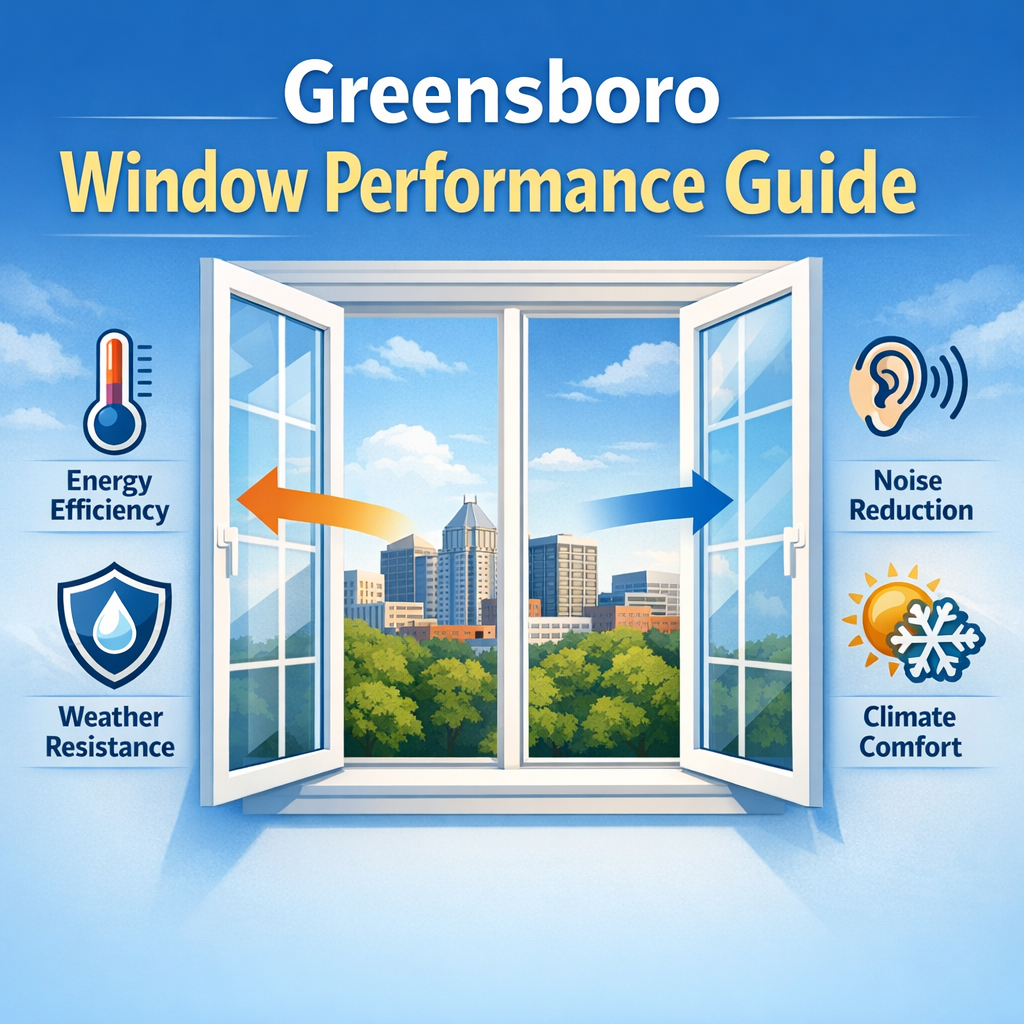
Here’s something that almost no window company in the Triad will tell you: Greensboro sits in IECC Climate Zone 4A, a mixed-humid zone. That classification isn’t just bureaucratic shorthand. It directly shapes which window specifications will actually perform well on your home — and which ones will underperform despite looking good on paper.
Zone 4A means Greensboro homeowners face a genuine two-front challenge. Summers here are hot and humid, placing significant solar heat load on west- and east-facing windows. Winters are cold enough that poorly insulated windows create real heat loss, drafts, and condensation problems. A window optimized exclusively for one season can actively work against you in the other.
Most window marketing ignores this tension entirely. Here’s what a building science-informed approach actually looks like for Greensboro.
U-factor measures how much heat a window allows to escape. The lower the number, the better the insulation. For Greensboro’s winters, a U-factor of 0.30 or below is the appropriate performance target — not the looser national Energy Star baseline, which is set to accommodate a broad range of climates and isn’t calibrated specifically for Zone 4A’s demands.
Many windows that carry an Energy Star label for our climate zone still fall well short of that 0.30 threshold. Energy Star certification is a minimum floor of acceptability, not a mark of high performance. When you’re evaluating window quotes, ask specifically for the NFRC-rated U-factor for the unit being proposed.
Solar Heat Gain Coefficient (SHGC) measures how much of the sun’s energy a window allows into your home. A lower SHGC blocks more solar heat — which sounds like what you’d always want in a warm climate. But Greensboro’s winters complicate that assumption significantly.
South-facing windows in a Greensboro home can actually benefit from a moderately higher SHGC. During winter months, passive solar gain through south-facing glass helps reduce heating loads — a meaningful energy benefit that a very low-SHGC window eliminates entirely. Specifying the same ultra-low SHGC on every window in your home, regardless of orientation, is a common mistake driven by marketing simplification rather than building science.
West-facing windows are a different story. Afternoon sun in Greensboro’s summers creates aggressive heat loading through west exposures. Lower SHGC values on west-facing glass meaningfully reduce cooling loads and interior discomfort during peak summer months.
The practical takeaway: a good window contractor should discuss orientation with you before specifying products, not after.
Greensboro’s summer humidity also creates a durability issue that rarely gets mentioned in window marketing. Aluminum-clad frames conduct heat and cold readily — a property called thermal bridging — which means the frame itself can become a condensation point in humid conditions. Over time, that condensation cycle contributes to moisture intrusion in the wall assembly around the window.
Vinyl and fiberglass frames inherently resist thermal bridging and hold up better in the Triad’s humidity extremes. This isn’t just an energy efficiency conversation — it’s a long-term structural durability question that affects the wall framing around every window you install.
Walk through almost any window company’s website and you’ll see “replacement windows” treated as a single, uniform product category. It isn’t. The installation method matters as much as the window itself — and for Greensboro’s older housing stock, this decision carries real consequences.
Insert (pocket) replacement involves removing the existing sash and hardware while leaving the existing window frame in place. The new window unit is fitted into the opening the old frame creates. This approach is faster, less disruptive, and requires minimal interior or exterior finishing work.
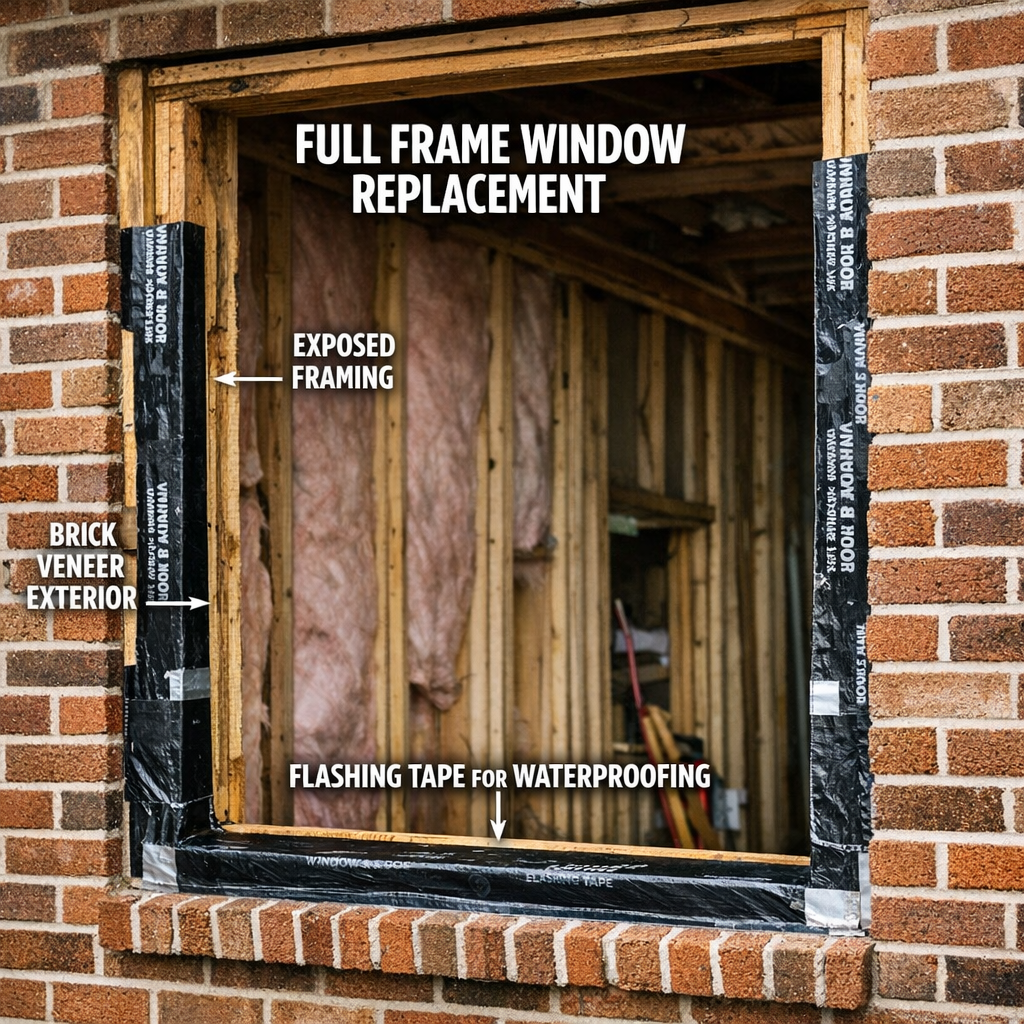
Full-frame replacement removes everything down to the rough opening in the wall framing — old frame, sill, casing, and all. The new window is installed directly into the structural opening, then flashed, sealed, and finished on both the interior and exterior.
Neither approach is universally superior. The right choice depends on the condition of your existing frames and the construction type of your home.
Greensboro has a substantial percentage of homes built between the 1940s and 1980s — a period when brick veneer ranch construction and aluminum single-pane windows were the dominant building approach in the Triad. These homes are attractive, they’re solidly built, and they present some non-obvious challenges for window replacement.
The wood frame rot problem. Insert replacements leave the existing wood frame in place. In a home where those frames have been exposed to 40 or 50 years of Greensboro’s humid summers, there’s a meaningful probability of moisture damage — soft spots, rot, or compromised wood that simply can’t provide a stable substrate for a new window. Installing a new insert window into a rotted frame is a short path to air infiltration, water intrusion, and warranty complications that no manufacturer will cover.
Before recommending an insert replacement, a responsible contractor should inspect the existing frames closely — and be willing to tell you honestly if what they find warrants a full-frame approach instead.
The brick ranch opening challenge. For homes with masonry construction, full-frame replacement introduces a layer of complexity that separates experienced local installers from contractors who’ve imported generic practices from other markets. Masonry openings require different flashing methodology, different sealant systems, and careful attention to how the window integrates with the brick veneer to prevent water infiltration behind the cladding.
Done correctly, a full-frame replacement in a Greensboro brick ranch delivers superior air sealing, a clean installation, and decades of reliable performance. Done incorrectly — or with flashing details borrowed from wood-frame construction — it creates water intrusion problems that can be expensive to diagnose and repair.
Rough opening irregularities. Homes from this era were built before window sizes were fully standardized. Rough openings in 1960s Greensboro construction may not match any standard window size on the market today. A full-frame replacement allows the contractor to properly size, shim, and flash the opening to accept a modern window correctly. An insert replacement in an irregular opening can result in air gaps, improper weight distribution, and operational problems.
The replacement window market has a three-tier structure that most contractors are reluctant to discuss openly. Understanding it gives you a genuine decision-making framework instead of just accepting whatever a salesperson recommends.
These are the entry-level products that move volume. They meet minimum code requirements, often carry Energy Star certification for the appropriate zone, and represent a meaningful upgrade over original single-pane aluminum windows. Their limitations show up in thinner vinyl profiles that are more susceptible to warping over time, simpler hardware, and warranties that tend to be more narrowly written than marketing language suggests.
For a home you’re preparing to sell in the near term, or for secondary spaces like a garage or workshop, builder-grade windows serve a purpose. For a home you intend to live in for another decade or more, the performance gap relative to mid-range and premium products is real and worth understanding.
This is where most informed Greensboro homeowners land after doing their research. Mid-range products offer meaningfully improved frame construction, better glass packages (dual-pane Low-E with argon fill is standard here), stronger hardware, and warranty terms that are more substantive — though still worth reading carefully.
The step up from builder-grade to mid-range typically delivers the most significant performance improvement per dollar spent, particularly in terms of U-factor, operational smoothness, and long-term durability in the Triad’s humidity.
Premium products bring fiberglass or composite frame construction, triple-pane glass options, spectrally selective Low-E coatings tuned for specific climate zone requirements, and the most comprehensive warranty coverage in the market. They’re the right choice for homeowners focused on long-term energy performance, comfort, and maximum product longevity. If you want to understand how energy efficient window upgrades translate to real-world savings in a Zone 4A climate, the performance differences between tiers become especially clear.
For south-facing great rooms, master bedrooms with significant glass area, or any application where comfort and energy performance are primary concerns, the premium tier warrants serious consideration.
“Lifetime warranty” appears in nearly every window company’s marketing. The phrase deserves scrutiny, not automatic trust. Here are the questions that reveal what a warranty actually covers:
| Warranty Question | Why It Matters |
|---|---|
| Is the warranty transferable to a new owner? | Non-transferable warranties provide zero resale value protection — a meaningful factor for home equity |
| Does the warranty cover installation labor after year one? | Most manufacturer warranties exclude labor after the initial period, leaving you to cover reinstallation costs |
| Is the warranty prorated after a set period? | Many “lifetime” warranties reduce coverage significantly after 10–20 years |
| Who honors the warranty if the installer goes out of business? | Brand-affiliated franchise locations are often separate legal entities — the franchisor’s warranty may not cover a local franchisee’s closure |
| What specifically is excluded? | Seal failure from improper installation, damage from settling or structural movement, and “Acts of God” are common exclusions |
Read the actual warranty document before signing a contract, not the summary brochure.
Every window company in Greensboro will tell you they’re reputable. Trust signals on competitor pages are all self-reported: their own star ratings, their own warranty language, their own brand affiliations. What’s absent from all of them is a discussion of the independent regulatory framework that actually governs window installation quality in North Carolina — and how to use it to protect yourself.
North Carolina requires that construction projects meeting certain scope thresholds be performed by or under the supervision of a licensed contractor. Window replacement, particularly full-frame projects involving structural rough openings, framing work, or significant weatherproofing scope, falls within this framework.
The relevant licensing authority is the NC Licensing Board for General Contractors, and their license lookup tool is publicly searchable online. Before signing any window replacement contract, verify the license number of the contracting entity — not the salesperson’s business card, not the brand logo, but the actual legal entity that will be performing work on your home.
This is worth understanding clearly. A number of national window brands operate through regional franchise locations. The corporate brand may carry strong reviews and national recognition. The actual licensed entity performing work in Greensboro is often a separate legal business — with its own license status, its own liability profile, and its own insurance coverage. These are not the same thing.
Verify the local operating entity’s license independently. It takes under two minutes and is one of the highest-value due diligence steps available to any homeowner.
North Carolina maintains a Homeowner Recovery Fund administered through the Licensing Board, which provides a layer of financial protection for consumers harmed by licensed contractors. This protection only applies when the contractor performing the work was properly licensed for the scope of work completed. If you hire an unlicensed contractor, or a contractor performing work outside their licensed scope, you forfeit this protection entirely.
One additional question worth asking any window contractor: are the people installing your windows W-2 employees of the licensed contractor, or independent subcontractors? This distinction affects warranty service responsiveness, workmanship liability, and who is accountable if an installation problem surfaces two years from now. A contractor whose installation crews are direct employees carries different accountability than one who coordinates subcontractors on a project-by-project basis.
There’s no national window brand that understands Greensboro’s older brick ranch housing stock, the specific moisture dynamics of the Triad’s climate, or the licensing landscape in North Carolina better than a contractor who has worked here for decades.
At Smithrock Roofing, we bring 60-plus years of combined experience to every exterior project we take on — roofing, siding, gutters, and windows. Our approach to window replacement begins with an honest assessment of what your home actually needs: the condition of your existing frames, the construction type of your home, the orientation of your windows, and the performance specifications that will genuinely serve you in Zone 4A’s mixed-humid climate. We don’t sell windows by leading with a product catalog. We lead with an inspection and an honest conversation.
Our team is fully licensed and insured, and we’re happy to provide our license number for your independent verification — because we believe that’s exactly the kind of question a well-informed homeowner should be asking.
If you’re ready to talk through your window replacement project, we’re here. No pressure, no scripts — just straight answers from people who know this area and take their work seriously.
As you plan your window replacement project in Greensboro, three practical steps will help you move forward with confidence and avoid the most common missteps homeowners encounter.
1. Use the North Carolina Licensing Board for General Contractors Verification Tool
Before signing anything, visit the NCLBGC’s public license lookup portal and verify every contractor you’re considering. Search by business name and license number, confirm the license is active, and check that the license category covers window installation in your home’s construction type. This takes less than five minutes and eliminates a significant category of risk.
2. Request an Energy Audit or Window Assessment Before Selecting a Product
In 2026, several utility programs and local contractors — including Smithrock Roofing — offer pre-project assessments that evaluate your current windows’ thermal performance, frame conditions, and air infiltration before any product conversation begins. Starting with an assessment rather than a product catalog means you’re selecting windows based on your home’s actual needs in Greensboro’s Zone 4A climate, not a showroom presentation.
3. Document Your Installation for Future Warranty Claims
Ask your contractor to photograph rough openings, flashing details, insulation placement, and finished frames before and after installation. Store these with your product warranty paperwork. If a warranty claim arises — whether related to the window unit, the installation, or moisture intrusion — this documentation is often the difference between a straightforward resolution and a dispute.
Greensboro falls in ENERGY STAR climate Zone 4A, which the program classifies as mixed-humid. For this zone, double-pane windows with low-emissivity coatings and a U-factor of 0.27 or lower are generally recommended. These specifications balance winter heat retention and summer solar control, which is important given the Triad’s genuine seasonal swings. Frame material matters too — vinyl and fiberglass both perform well in the humidity levels common to this region, while wood frames require more maintenance discipline to avoid moisture-related deterioration over time.
North Carolina requires contractors performing window replacement on residential structures to hold a license through the North Carolina Licensing Board for General Contractors. You can verify any contractor’s license status, category, and standing directly through the NCLBGC’s public online search tool. Ask the contractor for their license number before your first meeting — a reputable company will provide it without hesitation and actually encourages you to verify it independently.
A full-frame replacement removes the existing window down to the rough framing, allowing the installer to inspect and address any rot, moisture damage, or insulation gaps before the new window is installed. An insert replacement — sometimes called a pocket installation — fits a new window unit into the existing frame, preserving the surrounding trim and finish work. Insert installations are faster and less disruptive, but they’re only appropriate when the existing frame is structurally sound and free of moisture damage. A proper on-site assessment should determine which approach is right for your home.
Most single-family home window replacements in the Greensboro area are completed within one to two days once materials are on-site, though the timeline depends on the number of windows, the installation method, and whether any frame repairs are needed. The longer portion of the project timeline is typically the window manufacturing lead time — custom-sized windows for older Greensboro homes can take several weeks from order to delivery. A contractor who sets realistic timeline expectations upfront, including lead times and scheduling windows, is worth noting positively during your selection process.
Homeowners across Greensboro and High Point deserve a window contractor who combines genuine local knowledge with the credentials and accountability to back up their work — and that’s exactly what Smithrock Roofing has built over more than six decades of combined experience serving the Triad. Whether you’re replacing a handful of aging single-panes in a brick ranch or addressing whole-home energy performance, our team starts with an honest assessment, not a sales pitch. For more on what to expect from a full window replacement project, the Window Replacement Winston-Salem NC: Buyer’s Guide covers many of the same principles that apply across the broader Triad region. Ready to get started? Get a Free Estimate and let’s talk through what your home actually needs.

Smithrock Roofing © Copyright 2026 • All Rights Reserved • Privacy Policy • Maintained by Mongoose Digital Marketing