Most homeowners start their siding search the same way — browsing a few websites, scanning reviews, and comparing product names like James Hardie and CertainTeed vinyl. That is a reasonable starting point. But here is what those product pages and contractor websites rarely tell you: the siding material is only part of the equation. What happens beneath the surface, how the installation is executed, and whether your contractor truly understands the conditions specific to Winston-Salem and the NC Triad — those factors determine whether your new siding performs beautifully for decades or becomes an expensive problem in just a few years.
This guide is written for homeowners in Winston-Salem, Greensboro, High Point, Kernersville, Clemmons, Rural Hall, and King who want honest, detailed answers before making one of the larger exterior investments they will make in their home. We will walk you through the climate realities your siding has to survive, how to actually choose between material types based on your specific home, the tear-off versus overlay decision no one talks about, and how to vet a contractor with confidence. No vague promises. No pressure. Just the kind of conversation you would have with a contractor who has been doing this for decades and is more interested in giving you a good outcome than a quick signature.
Before you pick a material, understand what that material has to withstand. The NC Piedmont has a climate that genuinely tests exterior cladding in ways that generic “weather resistant” marketing language never captures.
Forsyth County receives approximately 46 inches of rainfall annually — meaningfully above the national average of around 38 inches. Summer humidity in Winston-Salem regularly exceeds 80 percent, and the region experiences a freeze-thaw cycle through winter months that, while moderate by northern standards, is enough to drive moisture into any gap or unsealed penetration and then expand it. On top of that, south and west elevations absorb intense UV radiation through long NC summers, which accelerates thermal expansion in certain materials and degrades surface finishes faster than homeowners typically expect.
What this adds up to is a punishing expansion-contraction cycle year-round. Materials expand in summer heat and humidity, contract in cooler and drier stretches, and face moisture pressure from every direction. A siding system — and it is a system, not just panels — needs to be specified and installed with all of this in mind.
Here is where the real expertise gap between contractors shows up. Many homes in established Winston-Salem neighborhoods — West End, Ardmore, Buena Vista, Sherwood Forest, and similar areas built from the 1920s through the 1960s — were originally constructed with wood plank sheathing beneath the original exterior cladding. Over decades, that sheathing has absorbed moisture, experienced organic growth, and in many cases suffered varying degrees of rot or softness that is not visible from the outside.
When a contractor installs new siding over compromised sheathing without evaluating it first, the new panels simply seal that damage in place. The aesthetic problem disappears. The structural problem keeps developing underneath where you cannot see it. This is one of the most avoidable failures in residential exterior work, and it happens consistently when homeowners choose a contractor based on price alone or when the contractor’s process does not include a substrate assessment before the job begins.
A thorough pre-installation inspection should evaluate:
If rot or damage is found, it must be addressed before new siding goes on. A contractor who skips this conversation — or who never raises it at all — is not giving you the full picture.
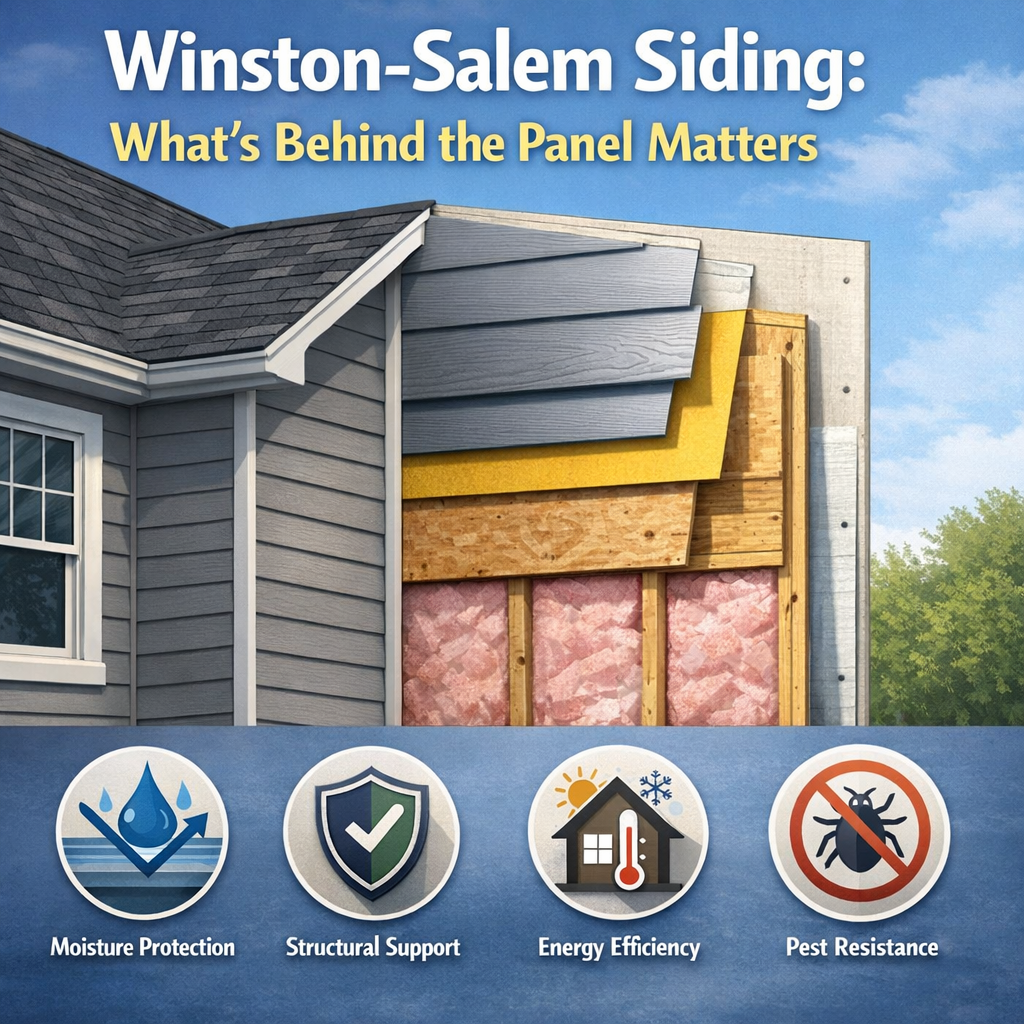
Behind every siding system is a house wrap or moisture barrier layer. Most contractors mention it briefly, if at all. But in Winston-Salem’s high-humidity climate, the vapor permeability of that layer — its ability to allow moisture vapor to pass through and dry outward — is a critical performance specification.
A house wrap that is too vapor-tight in a hot, humid climate can trap moisture between the barrier and the sheathing, creating exactly the conditions that accelerate rot and mold growth. Conversely, a barrier with improper lapping at seams or unsealed around penetrations provides almost no meaningful protection regardless of its material spec. The installation details at this layer — how seams overlap, how the wrap integrates with window flanges, how penetrations are taped — are invisible once the siding goes on and are almost never discussed in competitor content. They matter enormously.
Most contractor websites present siding materials as a menu with equal options. The honest answer is that different materials are genuinely better suited to different homes, and the right choice depends on factors specific to your property.
Fiber cement — James Hardie is the most recognized brand — is composed of cement, sand, and cellulose fiber. It does not rot, it resists impact well, and it holds paint for significantly longer than wood. For many Winston-Salem homes, it is the superior long-term choice.
Where fiber cement makes the most sense:
What to understand about fiber cement installation: It is heavier than vinyl and requires specific fastening, cutting techniques, and moisture management at end joints. Improper end-joint sealing is one of the most common fiber cement failure points. Every cut edge must be sealed before installation. This is an execution detail that separates experienced crews from those who learned on the product last season. For a deeper look at what goes into this process, our article on Siding Savvy: Repairing Fiber Cement Like a Pro walks through the material’s specific demands in practical detail.
Modern vinyl siding has improved substantially over older generations and remains a widely used, cost-effective cladding option across the NC Triad.
Where vinyl makes the most sense:
What to understand about vinyl installation: Vinyl expands and contracts with temperature significantly more than fiber cement. This is not a defect — it is a property of the material that must be accounted for in installation. Panels must be fastened with appropriate nail slot clearance, never face-nailed tight. J-channel, starter strip alignment, and the way trim integrates at windows and doors directly determines how the system performs through Winston-Salem’s temperature range. An improperly fastened vinyl installation buckles, gaps, and allows water infiltration at intersections.
A variation worth understanding separately: insulated vinyl features a rigid foam backing laminated to the panel. This adds dimensional stability — reducing the thermal movement that standard vinyl experiences — and provides some improvement in wall thermal performance. The mechanism here is modest reduction in air infiltration and minor thermal resistance added at the wall plane. It is not a replacement for proper wall insulation, and any contractor claiming dramatic energy savings from siding alone is overstating what the product delivers. The honest value of insulated vinyl is improved panel rigidity and a reduction in the hollow sound common to standard vinyl.
| Factor | Fiber Cement | Standard Vinyl | Insulated Vinyl |
|---|---|---|---|
| Thermal expansion | Low | High | Moderate |
| Impact resistance | Excellent | Moderate | Moderate-Good |
| Moisture resistance | Excellent (when properly sealed) | Excellent | Excellent |
| Paint required | Yes (factory or field) | No | No |
| Historic district suitability | High — profiles available | Low — reads as modern | Low — reads as modern |
| Ideal for complex geometry | Yes, with experienced crew | Requires careful execution | Requires careful execution |
| Sun/heat performance | Superior on south/west exposures | Expansion management required | Better than standard vinyl |
| Long-term maintenance | Repainting every 10–15 years | Minimal | Minimal |
| Weight / installation complexity | Heavier, specialized handling | Lightweight, faster install | Moderate weight |
| HOA / covenant compatibility | Frequently approved | Varies by HOA guidelines | Varies by HOA guidelines |
A meaningful number of homes across Winston-Salem and the broader NC Triad have existing siding layers — sometimes two or even three — from previous renovation cycles. One of the most important decisions in a siding project is whether to install new material over the existing cladding (an overlay) or perform a full tear-off down to the sheathing. Almost no contractor website raises this question directly. Here is what you need to know.
Installing new siding directly over old material reduces labor and disposal costs and can be completed more quickly. In certain limited circumstances, overlay is a legitimate approach:
Even when these conditions are met, overlay permanently conceals the substrate beneath. If there is any doubt about underlying conditions, tear-off is the responsible choice.
Full tear-off exposes the sheathing, allowing a complete substrate assessment and any necessary repairs before the new siding system goes on. This is where problems that would otherwise be hidden for years — sometimes until they become structural — are found and corrected. Tear-off also allows for:
Here is a practical vetting signal: ask any contractor you are evaluating how they decide between tear-off and overlay. A contractor who immediately defaults to overlay without discussing substrate assessment is prioritizing efficiency over your home’s long-term health. A contractor who explains the evaluation process — what they look for, what triggers a tear-off recommendation, and how they handle unexpected substrate damage found during tear-off — is demonstrating the kind of transparency that protects you.
Every contractor on your list will claim skilled craftsmanship. Here is what that actually means in practice, so you can evaluate the claim.
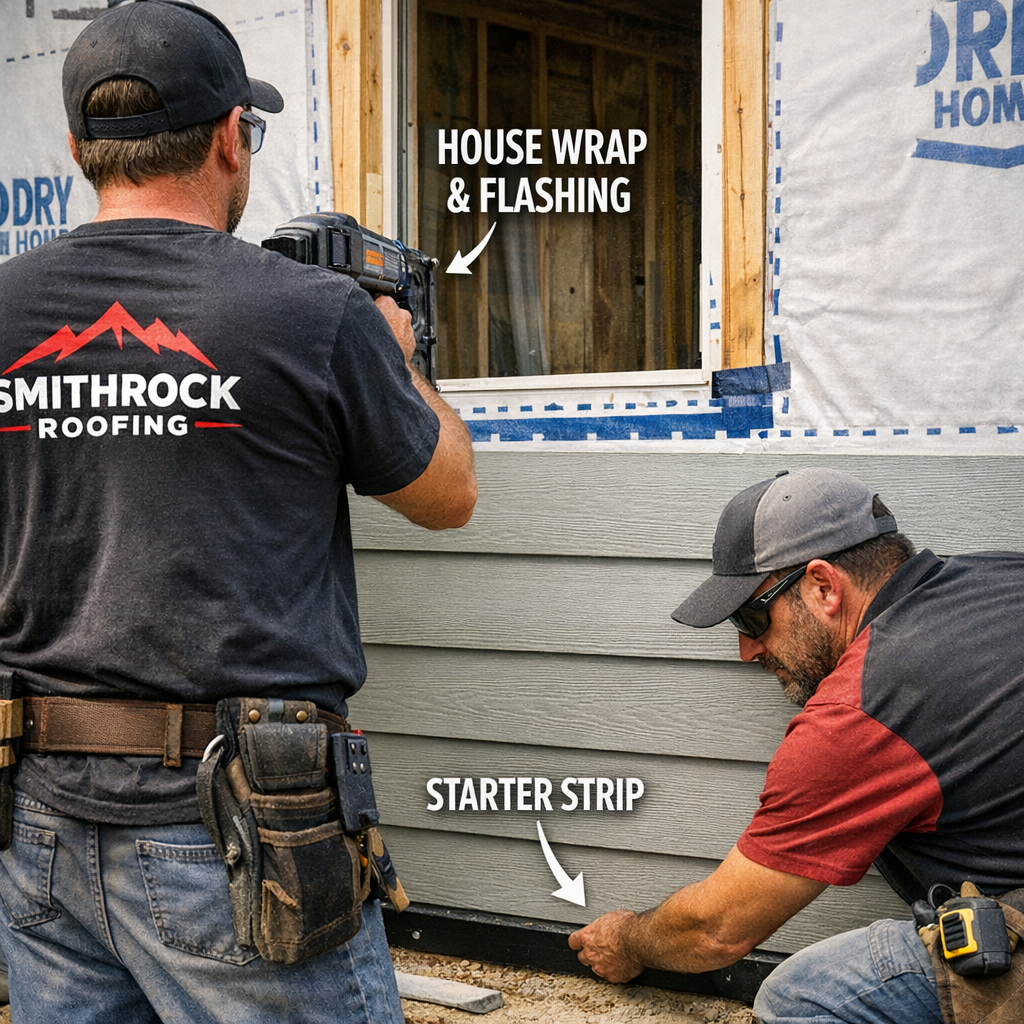
The house wrap must be installed before any siding panels go up, with horizontal seams lapped upper over lower (like shingles) so water cannot migrate behind the seam. At window and door openings, the wrap integrates with self-adhesive flashing tape applied to the rough opening sill first, then the side jambs, then the head — in that sequence. Reversing this sequence defeats the flashing entirely. This is a detail that experienced installers execute correctly automatically and that rushed crews get wrong consistently.
Vinyl panels are not face-nailed tight. Each fastener passes through a slot, not a pre-punched hole, and is driven to leave a slight gap so the panel floats as it expands and contracts. Over-driven fasteners — a common mistake — bind the panel and cause buckling during summer heat. Under-driven fasteners allow panels to rattle, shift, and eventually disengage. The correct nail placement also maintains consistent coursing alignment across the entire elevation.
The starter strip at the base of the wall determines the alignment of every course above it. A starter strip that is not level, not secured correctly, or not installed at the proper height above grade creates problems that compound with every successive course. By the time the error is visible at eye level, the root cause is ten feet below, already under the siding.
Every window, door, outlet, fixture, and utility penetration is a potential water entry point. J-channel and trim profiles around these openings must be cut, fit, and caulked correctly. Gaps at corners, open miter cuts at trim intersections, and caulk applied over painted trim rather than to bare substrate are the most common installation shortcuts that lead to moisture intrusion claims within a few years. These details are rarely visible from the ground at project completion, which is why they are also rarely caught by homeowners at the time. For a closer look at how moisture damage behind siding can escalate into a larger structural problem, the article Roof & Siding Repair: Stop Leaks Before They Spread covers the warning signs homeowners most often miss.
If your home sits within an HOA community or in one of Winston-Salem’s designated historic districts, your siding material, color, and profile choices may require pre-approval from an architectural review board before work begins. This is not a minor administrative detail — starting a project without required approvals can result in required removal and reinstallation.
Winston-Salem’s Historic Preservation Commission oversees designated historic districts, and the city’s Historic Preservation Office maintains guidelines on what exterior changes require a Certificate of Appropriateness. For homes in applicable areas, fiber cement siding is typically more likely to satisfy material authenticity requirements than vinyl, and color choices are often restricted to historically appropriate palettes.
If your neighborhood has an active HOA, request the architectural guidelines before selecting any product. Bring those guidelines to your contractor consultation. A contractor with experience in established Winston-Salem neighborhoods will be familiar with this process and can help you identify compliant options before the project begins.
For additional information on Forsyth County building permits and exterior work requirements, the City of Winston-Salem Inspections Division is the direct resource for permit requirements applicable to your project.
Beyond confirming a contractor is licensed and insured — which is the floor, not the ceiling — here are the questions that reveal whether you are dealing with someone who will protect your home or someone who will simply put panels on the wall and move to the next job.
Ask to see completed projects in your area. Look specifically at:
Smithrock Roofing brings more than 60 combined years of exterior experience to siding projects across the NC Triad. We serve homeowners in Winston-Salem, Greensboro, High Point, Kernersville, Clemmons, Rural Hall, King, and the surrounding communities — and we understand the specific conditions these homes face because we work in them every day.
Our process begins with an honest substrate assessment before we recommend any material. If we find damage behind old siding during tear-off, we address it transparently and completely before new panels go on. We do not take shortcuts on moisture barrier integration, fastening patterns, or trim execution — because those are the details that determine whether your investment holds up over decades or starts failing in a few years.
We are fully licensed and insured, carry an A+ rating with the Better Business Bureau, and have earned more than 312 five-star reviews from homeowners across the Triad who wanted the work done right the first time. Our 5-year labor warranty backs our installation, and we use premium materials backed by manufacturer warranties that protect your home long-term.
If you are evaluating siding options for your Winston-Salem home, we welcome the conversation — no pressure, no rush. We would rather help you understand your options fully than have you make a decision you regret.
If you are planning a siding project in the coming year, three steps will help you move forward with confidence and avoid the missteps that lead to costly do-overs:
1. Schedule a Substrate Assessment Before Committing to Any Material
Before selecting a product, have a qualified contractor inspect what is behind your current siding. In older Winston-Salem neighborhoods — particularly homes built before 1990 — moisture infiltration and wood rot are frequently discovered only after tear-off begins. Knowing the condition of your sheathing and framing in advance allows you to plan accurately and eliminates surprise scope changes mid-project.
2. Request a Written Manufacturer Warranty Comparison
As product lines evolve heading into 2026, warranty terms across vinyl, fiber cement, and engineered wood categories continue to shift. Ask any contractor you are considering to walk you through the specific warranty documents for the products they plan to install — not just the marketing summary. Pay attention to what voids the warranty, whether labor is included, and how claims are filed.
3. Verify Insurance and Licensing Before Signing Anything
The NC Licensing Board for General Contractors maintains a public verification tool. Use it. Also request a certificate of insurance directly from the contractor’s insurer — not a copy they provide — so you can confirm coverage dates and limits are current. This single step eliminates the largest category of homeowner risk in exterior renovation projects.
The key indicators are scope and pattern. Isolated damage from a single impact or localized moisture event can often be addressed with targeted repairs. However, if you are seeing widespread warping, chronic moisture infiltration in multiple areas, fading and chalking across entire elevations, or siding that has reached the end of its rated service life, replacement is typically the more sound long-term investment. A thorough substrate inspection during the assessment process will clarify which path makes sense for your specific home.
The NC Piedmont climate presents a combination of hot, humid summers, moderate freeze-thaw cycles in winter, and seasonal storm exposure that puts real demands on exterior materials. Fiber cement and high-quality engineered wood both perform well in these conditions because they resist moisture absorption and hold finish effectively. Premium vinyl with reinforced panels is also a practical option for homeowners prioritizing low maintenance. The right choice ultimately depends on your home’s architecture, existing substrate condition, and long-term goals — which is why material selection should follow, not precede, a proper assessment.
Most full siding replacements on a standard single-family home in the Winston-Salem area are completed within one to two weeks under normal working conditions. Variables that affect timeline include total square footage, architectural complexity such as multiple roofline transitions or dormers, substrate repair requirements discovered during tear-off, and weather. A reputable contractor will give you a realistic project schedule in writing before work begins and communicate proactively if conditions change.
At minimum, ask for proof of NC licensure and a current certificate of insurance, references from completed local projects you can contact directly, a written scope of work that specifies materials by product name and gauge, how they handle substrate damage discovered during tear-off, and the terms of their labor warranty. How a contractor answers these questions — and whether they provide documentation without hesitation — tells you as much as the answers themselves.
Choosing the right siding contractor in Winston-Salem comes down to experience, transparency, and a demonstrated commitment to getting the details right — and that is exactly what Smithrock Roofing delivers to homeowners across the Triad, including the communities of Kernersville and Clemmons where we work regularly. Our team brings honesty to every assessment, craftsmanship to every installation, and accountability to every project we put our name on. When you are ready to move forward, we are here to help — Get a Free Estimate and let’s start with a conversation about what your home actually needs.

Smithrock Roofing © Copyright 2026 • All Rights Reserved • Privacy Policy • Maintained by Mongoose Digital Marketing