Replacing the windows in your home is one of those projects that looks straightforward from the outside but reveals real complexity once you start asking the right questions. A window is not just a product you select from a catalog and drop into a wall. It is a building system — one that has to manage heat, moisture, air pressure, and light in ways that are specific to your home’s construction and your local climate.
For homeowners in Winston-Salem and across the NC Triad — Greensboro, High Point, Kernersville, Clemmons, Rural Hall, King — that local context matters more than most contractors will tell you. The Piedmont Triad’s climate creates demands on window systems that generic, national-brand content simply does not address. And a significant portion of the housing stock here involves older homes with their own distinct set of replacement considerations.
This guide is built around what you actually need to know before making a window replacement decision in this market. We will cover climate-specific performance specifications, the realities of older home replacement, what separates a quality installation from a problematic one, and the questions worth asking any contractor before work begins.
Most homeowners shopping for replacement windows hear a lot about energy efficiency. What they rarely hear is what energy efficiency actually means for their specific location.
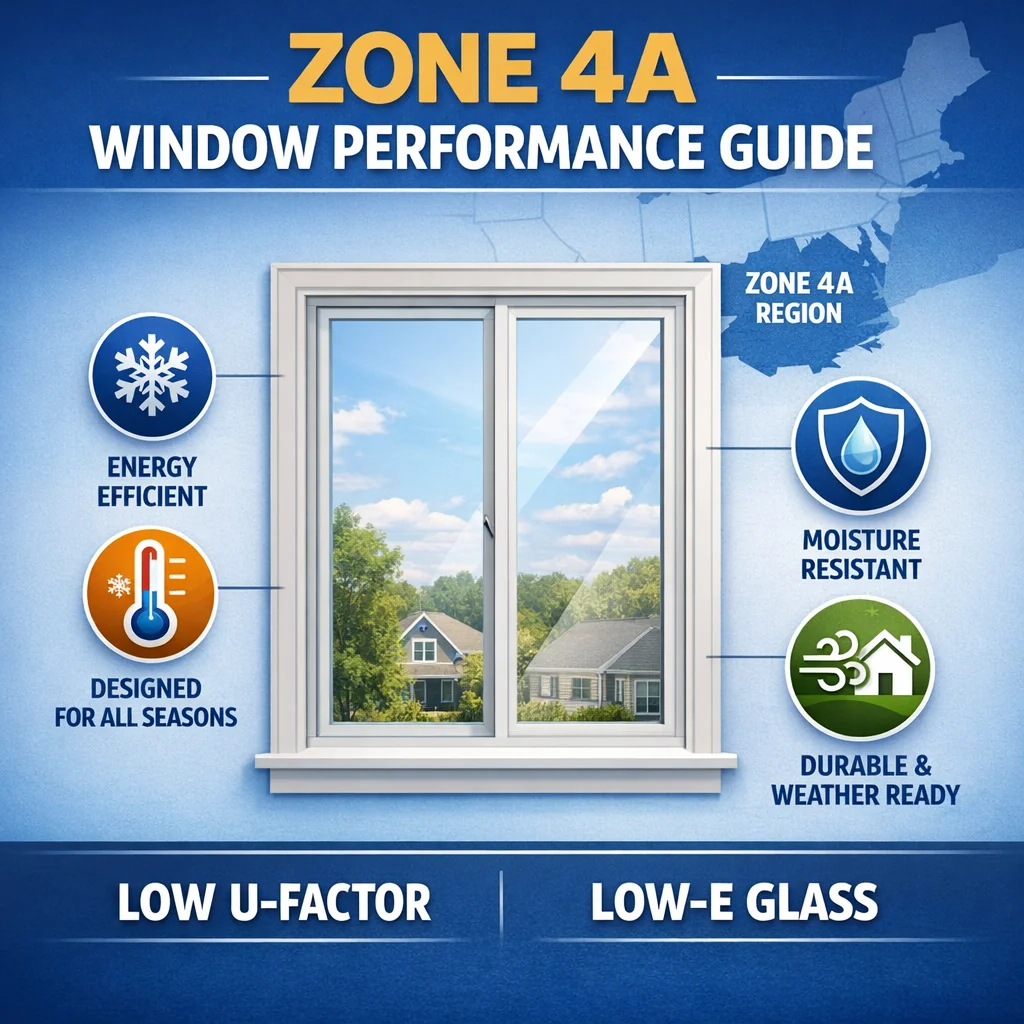
The United States Department of Energy and the International Energy Conservation Code divide the country into climate zones based on temperature, humidity, and precipitation patterns. Winston-Salem falls in Climate Zone 4A — a designation that covers much of the Mid-Atlantic and upper Southeast and is defined as a mixed-humid climate. Understanding what that label means in practical terms is the starting point for any well-matched window selection.
Zone 4A is demanding because it asks your windows to do two opposing jobs well.
During a Winston-Salem summer, outdoor temperatures regularly climb into the upper 80s and 90s with high humidity. Solar heat gain through glass — the radiant energy the sun pushes through your windows — becomes a primary driver of cooling load. Windows that allow too much of that solar energy inside force your HVAC system to work harder to compensate.
Then winter arrives. Temperatures in the Triad regularly drop into the 20s and 30s, sometimes lower. Now the concern flips: windows that conduct heat too readily from the warm interior to the cold exterior bleed your heating energy and create uncomfortable drafts near glass surfaces.
A window optimized for only one of those conditions will underperform in the other. That is why the window specifications appropriate for coastal Wilmington or the Blue Ridge mountains are not necessarily right for Winston-Salem.
Two performance ratings determine how well a window handles this dual challenge:
U-Factor measures how quickly a window conducts heat. Lower numbers mean the window loses less heat in winter. For Zone 4A, the Department of Energy recommends a U-factor of 0.30 or lower for maximum efficiency. Many standard double-pane windows exceed this threshold without upgraded glass packages.
Solar Heat Gain Coefficient (SHGC) measures how much solar radiation passes through the glass into your home. Lower numbers mean less solar heat gain. For Zone 4A, the DOE recommends an SHGC of 0.25 or lower. This is where low-emissivity (Low-E) glass coatings do their most important work.
ENERGY STAR certifies windows for specific climate zones, not as a single blanket rating. A window that earns ENERGY STAR certification for the Southern zone has a very different SHGC specification than one certified for the Northern zone. When you see “ENERGY STAR certified” in a product listing without zone clarification, it is worth asking which zone that certification applies to and whether the performance numbers align with Zone 4A requirements.
Low-E glass has become standard in replacement windows, but the coating type matters significantly in a mixed climate like Winston-Salem’s.
There are two primary Low-E coating approaches:
For Zone 4A, a soft-coat Low-E with moderate to high visible light transmittance (so you retain natural daylight) and a low SHGC coating on the outer pane is the configuration that manages summer solar gain while preserving winter heat retention. When reviewing window options, ask specifically about the Low-E coating type and the glass unit’s actual tested U-factor and SHGC values — not just whether a Low-E coating is present. Our article on the magic of dual pane Low-E glass goes deeper on how these coatings work in practice.
Triple-pane windows add a third layer of glass and a second insulating gas-filled cavity. They deliver meaningfully lower U-factors and can reduce condensation on interior glass surfaces. In very cold climates — Climate Zones 6 and 7 — triple pane makes strong sense.
In Zone 4A, the calculus is less clear-cut. The performance improvement over a well-specified double-pane unit is real but incremental, and the added weight affects frame stress and hardware longevity over time. For most Winston-Salem homes, a quality double-pane window with a proper Low-E glass package and inert gas fill (argon or krypton) will meet DOE Zone 4A recommendations without the structural trade-offs of triple pane. Triple pane becomes worth the conversation in homes with particularly large window openings, north-facing elevations with significant heat loss exposure, or owners who prioritize maximum noise reduction — a relevant benefit near busier corridors in Greensboro or High Point.
Window frame material is a decision that affects thermal performance, maintenance demands, longevity, and visual compatibility with your home’s architecture. In the Triad’s climate — with hot, humid summers and fluctuating winter temperatures — each material behaves differently in ways worth understanding before you commit.
Vinyl is the most widely installed replacement window frame material in the residential market, and for practical reasons. It does not rot, it does not require painting, and it insulates reasonably well with multi-chamber construction that limits thermal bridging.
The performance consideration specific to the Triad: vinyl expands and contracts with temperature changes. In a climate that swings from summer highs well above 90°F to winter lows below freezing, that thermal movement is real. Lower-quality vinyl formulations can warp, bow, or cause hardware to bind over years of repeated cycling. Premium vinyl with stabilized formulations and reinforced sash corners handles this better. Asking about the vinyl grade and whether metal reinforcement is used in the sash is a reasonable quality check.
Fiberglass is dimensionally stable — it expands and contracts at nearly the same rate as glass, which reduces stress on seals and glazing compounds over time. In a mixed-humid climate, this stability is a genuine performance advantage. Fiberglass frames are also paintable, which gives older home owners more flexibility to match historical trim profiles.
The trade-off is that fiberglass is typically priced higher than vinyl. For homeowners prioritizing long-term performance over initial outlay, particularly on large or custom openings, fiberglass earns consideration.
Wood frames offer excellent insulation values and remain the right answer for certain historic district applications where wood profiles and sight lines are preservation requirements. The maintenance reality in the Triad’s humid summers is significant: exterior wood exposure demands regular finishing, caulking, and inspection to prevent moisture intrusion and rot.
Wood-clad windows — wood interior, aluminum or fiberglass cladding on the exterior — reduce that maintenance burden substantially while preserving the interior wood aesthetics that many older Triad homes call for. For historic district properties where interior wood appearance is valued but exterior maintenance concerns are real, wood-clad is often the most practical resolution.
| Frame Material | Thermal Performance | Humidity/Moisture Resistance | Dimensional Stability (NC Climate) | Maintenance Demand | Historic District Compatibility |
|---|---|---|---|---|---|
| Vinyl (standard) | Good | Excellent | Moderate (thermal expansion) | Very Low | Limited (profile restrictions) |
| Vinyl (premium reinforced) | Good–Very Good | Excellent | Good | Very Low | Limited |
| Fiberglass | Very Good | Excellent | Excellent | Low | Moderate (paintable) |
| Wood | Excellent | Poor (untreated) | Moderate | High | Excellent |
| Wood-Clad | Very Good | Good | Good | Low–Moderate | Good–Excellent |
| Aluminum | Poor (without thermal break) | Excellent | Excellent | Very Low | Case-dependent |
Winston-Salem has a rich inventory of pre-1980 housing. Craftsman bungalows in Ardmore, colonial revivals in West End, mid-century ranches in Sherwood Forest and Washington Park — these homes define the character of the city’s residential neighborhoods. They also present window replacement challenges that catalog-driven contractors are not always equipped to handle.
Several Winston-Salem neighborhoods carry historic overlay district designation, which means exterior alterations — including window replacement — may require review and approval from the Winston-Salem Historic Preservation Commission. This applies to properties within designated historic districts, not just individually landmarked structures.
The approval process typically involves submitting a Certificate of Appropriateness (COA) application that documents the proposed replacement product’s appearance, profile, and materials. The commission evaluates whether the proposed change maintains the historic character of the structure and the district.
What this means practically:
If your home is in or near a historic district, confirming COA requirements before selecting a product is not optional — it is the first step. Working with a contractor familiar with local preservation guidelines prevents the costly scenario of purchasing and installing windows that require removal.
Older homes frequently present a choice between two replacement approaches, and the right answer depends on the condition of the existing frame and surrounding structure.
Insert (pocket) replacement involves removing only the sashes and installing a new window unit within the existing frame, blind stops, and exterior casing. This approach:
Full-frame replacement removes the entire window assembly down to the rough opening and installs a complete new unit. This approach:
In homes built before 1978, full-frame replacement also raises lead paint considerations. Disturbing painted surfaces on pre-1978 construction triggers EPA RRP (Renovation, Repair, and Painting) rule requirements for lead-safe work practices. Any contractor performing full-frame replacement on older Triad homes should hold EPA RRP certification.
Pre-1980 homes were not built to the standardized rough opening dimensions that modern replacement windows assume. Window openings in older Triad construction are often irregular — a quarter-inch off in one direction, a half-inch out of square in another. This is not unusual; it is the nature of older construction that has settled and shifted over decades.
The practical consequence: standard replacement window units often require custom sizing or careful shimming and adaptation to fit correctly. A window forced into a rough opening that is not properly prepared will not operate correctly, will not seal correctly, and will show those problems within a few years of installation. Experienced local installers who regularly work with older Triad housing stock understand this. Contractors who primarily install in new construction or who work from a standardized process without field assessment of individual openings are more likely to create fit problems.
This is the part of the conversation that most window vendors avoid because it shifts attention away from the product and toward the installation. For a homeowner in Winston-Salem spending significant money on a whole-home window replacement, understanding installation quality factors is just as important as understanding the product.
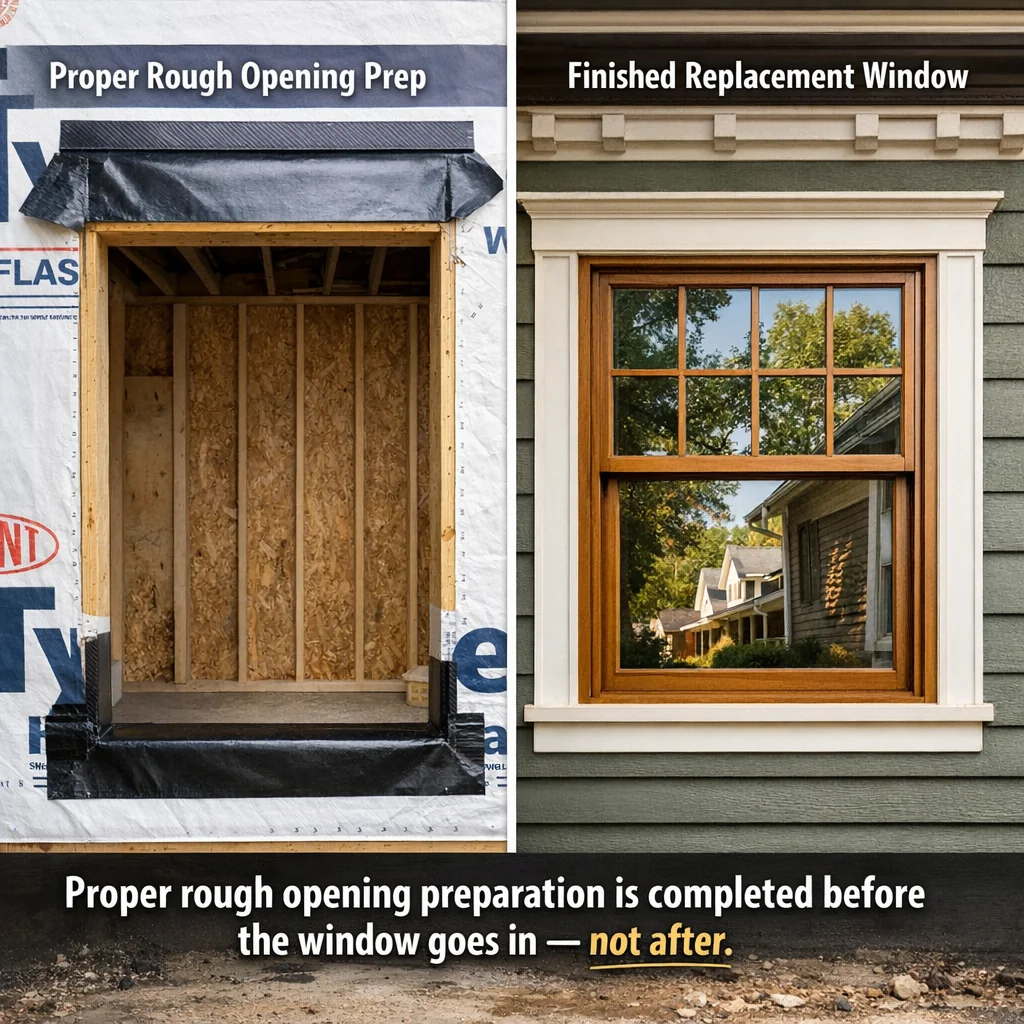
The glass unit gets most of the attention, but the rough opening preparation determines whether that glass unit performs as designed for decades or begins failing within a few years.
In North Carolina’s humid climate, the primary long-term risk for replacement windows is water intrusion — not through the glass, not through failed seals, but through the interface between the window frame and the surrounding wall assembly. This happens when:
Asking a contractor specifically how they handle sill pan flashing and head flashing integration is a legitimate and important pre-hire question. A contractor who can walk you through their water management approach clearly is demonstrating real installation knowledge.
Window replacement does not always require a building permit — but it sometimes does, and the cases where it does matter significantly.
In Forsyth County, building permits are required for window replacements that:
Contractors who work exclusively in volume without pulling permits when required are exposing homeowners to code compliance issues that surface at resale. Asking upfront whether the scope of your replacement requires a permit — and verifying that the contractor will pull it if so — is a straightforward question that separates compliant contractors from those cutting corners.
Before any installer begins work on your home, these are the questions worth asking. They are not adversarial — a competent, experienced contractor will answer all of them comfortably.
About Climate Performance:
– What are the U-factor and SHGC ratings of the specific glass package being proposed?
– Is this window ENERGY STAR certified for the Northern or North-Central climate zone (Zone 4A)?
– What type of Low-E coating is used, and is it a soft-coat sealed between panes?
About Installation Practice:
– How do you prepare the sill pan at the rough opening, and what material do you use?
– How do you integrate head flashing with the existing weather-resistant barrier?
– Is insert replacement or full-frame replacement appropriate for my specific openings, and why?
– If my home was built before 1978, are you EPA RRP certified for lead-safe work practices?
About Permits and Compliance:
– Does this scope of work require a building permit in Forsyth County?
– Are you licensed with the NC Licensing Board for General Contractors for this scope of work?
– If my property is in or near a historic district, are you familiar with COA requirements from the Winston-Salem Historic Preservation Commission?
About Warranty:
– What does the manufacturer’s warranty cover, and what are the specific exclusions — particularly for seal failure?
– Is the warranty transferable to a subsequent owner?
– What does the installation warranty cover, and who administers it — the manufacturer or the contractor?
– Are labor costs for future service calls covered under any warranty provision?
Window replacement is not a commodity service, and the NC Triad market is specific enough that local experience carries real value. A contractor who has worked across Winston-Salem, Greensboro, High Point, Kernersville, Clemmons, Rural Hall, and King understands the housing stock, the local building department processes, the historic district requirements, and the climate realities in ways that a national chain or out-of-market operator simply does not.
At Smithrock Roofing, we have been serving homeowners across the NC Triad long enough to know that older homes in Ardmore need a different approach than newer construction in Clemmons, that Forsyth County’s permit office has specific documentation requirements, and that a window installation in a Zone 4A climate demands water management practices that are non-negotiable — not optional upgrades.
Our approach to windows is the same as our approach to every part of a home’s exterior: we start with an honest assessment, we recommend what actually fits your home and your climate, and we back our work with a warranty that means something. With over 60 combined years of exterior contracting experience, A+ BBB-rated service, and 312+ five-star reviews from Triad homeowners, we have earned the trust that lets us have straight conversations about what your home actually needs.
If you are ready to talk about replacement windows for your Winston-Salem home, reach out for a consultation. We will assess your openings, explain what we find, and give you a clear recommendation — no pressure, no rush.
As you move forward with window replacement planning, three steps will help you make the most informed decision in the current market.
1. Schedule an In-Person Assessment Before Requesting Quotes
Online quote tools and general estimates based on square footage do not account for the specific conditions of your openings — rough framing condition, existing flashing, interior trim depth, or signs of historic moisture intrusion. Before comparing contractor bids, have at least one qualified contractor walk your home and document what they find. A written assessment gives you a baseline for evaluating every subsequent quote on equal terms.
2. Request an Energy Audit Through Duke Energy or Piedmont Natural Gas
Both utilities offer home energy assessment programs for North Carolina customers. An independent energy audit will identify where your current windows rank among your home’s total efficiency losses, which helps you prioritize window replacement relative to insulation, air sealing, and HVAC improvements. In many Triad homes, this context changes the conversation significantly.
3. Verify Contractor Credentials Through the NC Licensing Board for General Contractors
Before signing any agreement, confirm your contractor holds a valid North Carolina General Contractor license appropriate to the scope of work. You can search active licenses directly through the NCLBGC online database. This single verification step filters out a significant number of operators who work without proper standing in the state.
The most reliable indicators of necessary replacement are seal failure between panes, visible rot or structural deterioration in the frame, and windows that no longer operate correctly despite hardware adjustments. Condensation forming between double-pane glass is a definitive sign that the insulating seal has failed and cannot be restored — that unit requires replacement. Minor weatherstripping issues, paint failure, or sticky operation can often be addressed with targeted repairs. A qualified contractor can assess each opening individually and give you an honest breakdown of which units warrant repair versus full replacement. For a detailed look at what seal failure costs to address, the article on window seal repair cost covers what Winston-Salem homeowners typically encounter.
Most like-for-like window replacements in Winston-Salem require a permit through the Forsyth County Inspections Division. This applies even when you are replacing an existing window with the same size unit. Permit requirements exist to ensure the installation meets current energy code and water management standards. Contractors who suggest skipping the permit process are creating liability for the homeowner and often cutting corners on the installation itself. A reputable contractor will pull the appropriate permits as a standard part of the project.
For the Zone 4A mixed-humid climate that defines Winston-Salem and the broader Triad, vinyl and fiberglass frames are the most consistently reliable choices for most residential applications. Both materials resist moisture absorption, do not require repainting, and maintain their dimensional stability through the region’s seasonal temperature swings. Wood and wood-clad frames can perform well in the right circumstances — particularly in historic homes where matching period aesthetics is a priority — but they require a higher level of maintenance and a more careful installation approach to manage moisture at the frame perimeter.
For an average single-family home with eight to twelve windows, a professional crew typically completes the installation in one to two days once the windows have been manufactured and delivered to the job site. The longer timeline in most projects is the period between contract signing and installation — custom-ordered windows generally require several weeks of lead time through the manufacturer. Your contractor should give you a clear projected lead time at the point of contract so you can plan accordingly, particularly if the project falls around winter months when weather windows for exterior work become more limited.
When it comes to replacement windows in Winston-Salem and the surrounding Triad communities, the difference between a good outcome and a frustrating one almost always comes down to the contractor’s local knowledge and installation discipline — not just the window brand on the box. Smithrock Roofing has spent years earning the trust of homeowners across Winston-Salem and Kernersville by doing the work correctly the first time, communicating honestly about what each home actually needs, and standing behind every installation with a warranty that holds up. If you are ready to get a straight answer about your windows, we are ready to give you one. Get a Free Estimate

Smithrock Roofing © Copyright 2026 • All Rights Reserved • Privacy Policy • Maintained by Mongoose Digital Marketing