
If you’ve noticed a foggy film between your window panes that won’t wipe away, or you’ve felt a cold draft creeping in along a frame that used to feel solid, you’ve already discovered what most NC Triad homeowners find out the hard way: window seal failure doesn’t announce itself with a dramatic crack or a sudden flood. It shows up quietly, costs you money on your energy bills, and gets worse the longer it sits.
The natural next question is, “What’s this going to cost me to fix?” That’s a fair question, and we’ll help you understand every factor that shapes the answer. But here’s what most window repair articles skip entirely: the cost of your repair depends almost entirely on where you are in the failure cycle when you catch it. Two houses on the same street, same window brand, same symptoms, and the correct repair for one might be a straightforward insulating glass unit swap while the other legitimately requires full window replacement. The difference comes down to diagnostics most homeowners never get explained to them.
That’s what this guide is for. We’re going to give you the real framework, the one a fenestration professional actually uses, so that when you call a contractor, you already understand what they’re looking at and why their recommendation makes sense (or doesn’t).
Most window seal articles describe failure as if it’s a single event: the seal breaks, moisture gets in, the window fogs up. That oversimplification causes homeowners to either panic too early or wait too long, and both errors cost money.
Here’s what’s actually happening inside your window unit.
A double-pane window (technically called an insulating glass unit, or IGU) consists of two panes of glass separated by a spacer bar and sealed at the perimeter. That airspace between the panes is what provides insulation, and in most modern windows, it’s filled with argon or krypton gas rather than plain air, because these inert gases transfer heat less efficiently.
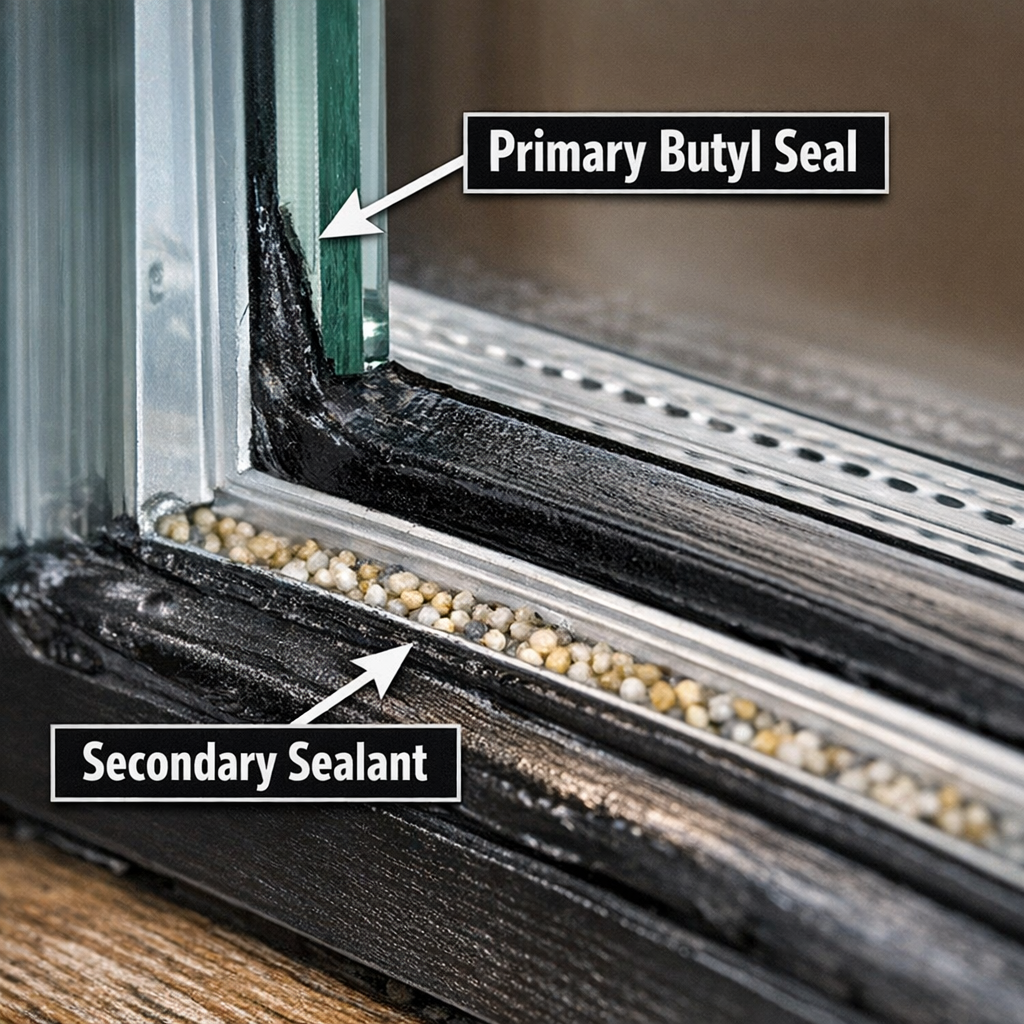
What holds the whole assembly together is a two-part seal system:
Inside the spacer bar itself, whether it’s a traditional aluminum channel or a modern warm-edge polymer design, sits a bed of desiccant beads. These beads are hygroscopic, meaning they’re engineered to absorb any moisture that sneaks past the seals during normal thermal cycling.
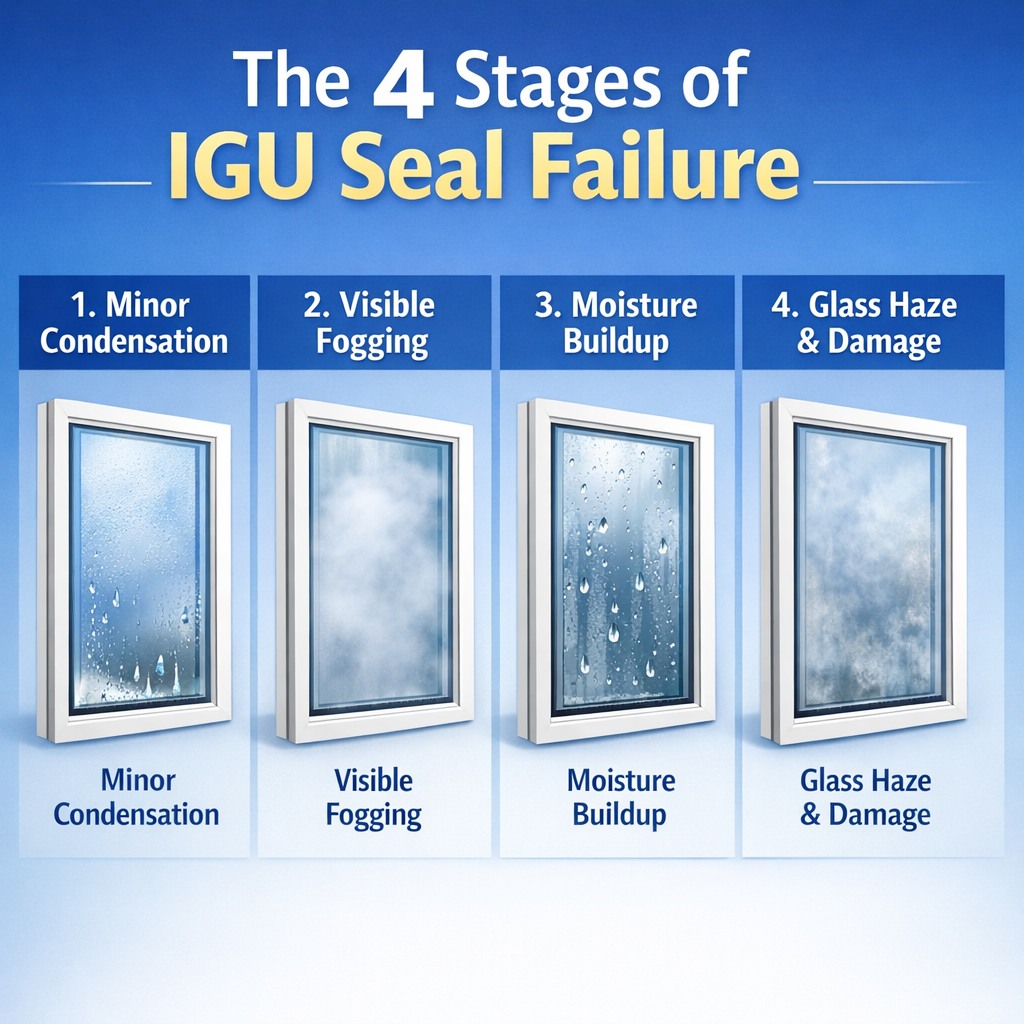
Here’s the expert insight that changes the entire repair conversation: your window’s fogging problem isn’t actually caused by the seal failing. It’s caused by the desiccant running out of capacity to compensate for the seal failing.
Think of the desiccant beads as a buffer. Even after the primary seal develops micro-cracks, which happens in virtually all IGUs over time through normal thermal expansion and contraction, the desiccant continues to absorb the small amounts of moisture that infiltrate. During this period, the window may look and perform perfectly fine. This buffer period can last months or years depending on your local humidity levels and how severe the seal damage is.
Once the desiccant reaches full saturation, it can no longer absorb incoming moisture. That moisture now condenses on the interior glass surfaces, which is the fogging you see. At this point, the desiccant has crossed a threshold it cannot come back from. No amount of drying, sealing, or surface treatment reverses saturation.
Why this matters for cost: If a contractor catches your window at Stage 1 or Stage 2, before saturation, the intervention is simpler and the options are broader. Once you’re at Stage 3 or Stage 4, IGU replacement is the minimum defensible repair. And in certain window configurations we’ll discuss shortly, it may not be the right option at all.
Need a hand with this in Winston-Salem, Greensboro and the NC Triad? Call (336) 971-0464 or request a free estimate. Honest answers, no pressure.
Here’s an honest breakdown of the available repair paths, including the limitations that most articles gloss over.
Before spending a dollar out of pocket, locate your window documentation. Many IGU failures in the first ten to fifteen years of a window’s life fall within manufacturer warranty coverage.
But here’s where homeowners consistently get tripped up: window warranties are not all the same document.
| Warranty Type | What It Typically Covers | What It Often Excludes |
|---|---|---|
| Product Warranty | Defective materials, seal failure, glass defects | Labor, installation-related causes of failure |
| Installation Warranty | Workmanship errors that led to premature failure | Material defects (those fall to manufacturer) |
| Full System Warranty | Both product and labor, usually from certified installers | Third-party repairs or modifications |
| Lifetime Limited Warranty | IGU fogging for original purchaser | Transferability to new owners, acts of nature |
The critical detail most articles skip: many premium window manufacturers void warranty coverage the moment a third-party IGU or sealant product is used in a repaireven if the repair itself is structurally sound. A general glazier who installs a cheaper, uncertified replacement unit may solve your immediate fogging problem while silently invalidating any remaining warranty protection on the other sealed units in the same window assembly.
The correct sequence before authorizing any repair work is:
1. Obtain the actual warranty document (not a summary card)
2. Identify whether you have a product warranty, an installation warranty, or both
3. Determine whether your repair contractor is an authorized service provider for that manufacturer
4. Confirm whether labor is covered in addition to materials
Defogging (sometimes called “window restoration”) involves drilling small holes in the outer pane, introducing a cleaning solution into the airspace, allowing it to evaporate, and then sealing the holes. It’s frequently marketed as a budget-friendly alternative to full IGU replacement.
Here’s what deserves more honest treatment than most articles provide:
Defogging does not restore the insulating gas. Once argon or krypton has escaped through a failed seal, it cannot be reintroduced through the defogging process. The airspace is refilled with ambient air, which is significantly less insulating, meaning your window’s thermal performance remains degraded even after the visible fogging clears.
Defogging typically voids remaining manufacturer warranties. The drilling process constitutes a modification to the sealed unit that most manufacturers explicitly exclude from continued coverage.
Micro-drilling introduces stress points in tempered glass. While reputable operators take precautions, the drilling process creates small stress concentrations in glass that was engineered as a sealed unit.
In our area’s climate, re-fogging recurrence rates are meaningful. Our region sits in a humid subtropical climate with significant seasonal humidity swings. In these conditions, the moisture load on a defogged-but-not-replaced IGU is substantial, and recurrence timelines are shorter than in drier climates. Defogging has a stronger case in mild, lower-humidity coastal environments, not inland piedmont areas.
For most homeowners in our service area, defogging is a short-term cosmetic fix rather than a durable repair. It’s worth discussing with your contractor, but go in with realistic expectations about its lifespan.
Replacing the insulating glass unit, not the entire window frame, is the most common professional repair for a failed seal where the frame itself is structurally sound. The damaged IGU is removed, a new sealed unit is manufactured to match the opening dimensions, and it’s set and glazed into the existing frame.
This is where several quality variables exist that no competing article bothers to flag.
Spacer bar type matters, and substitution degrades performance.
Modern IGUs increasingly use warm-edge spacer systems rather than traditional aluminum. Common designs include foam spacers, thermoplastic materials, and stainless steel hybrids (trade names like Swisspacer and TGI spacers are common in the industry). Warm-edge spacers reduce heat transfer at the glass edge, which improves overall window U-value and reduces interior condensation risk at the perimeter.
If a replacement IGU is installed with a conventional aluminum spacer in a frame that originally held a warm-edge unit, the window’s rated thermal performance is degraded, even with a perfect new seal. This is something to ask your contractor explicitly: Will the replacement IGU use a spacer system that matches the original specification?
Insulating gas refill: standard practice or optional upgrade?
Every competitor article mentions that gas escapes when seals fail. Not one addresses the question homeowners should actually be asking: Is argon or krypton gas included in my IGU replacement, and how would I verify it was filled correctly after installation?
The honest answer is that gas fill should be a standard specification in any quality IGU replacement, not an upgrade you have to request. A replacement IGU manufactured without gas fill, or with insufficient fill, will underperform thermally compared to the original window specification. IGMA-certified IGUs (certified by the Insulating Glass Manufacturers Alliance) undergo standardized fog resistance and climate cycling tests that provide a meaningful quality baseline. Ask whether the replacement unit your contractor is sourcing carries IGMA certification.
The sightline depth variable, why frame condition matters as much as glass condition.
The sightline depth of your window frame, essentially, how deep the channel is that holds the IGU, and the glazing bead material (rubber gasket, silicone, foam tape, or aluminum stops) both affect how the new IGU seats and seals. A frame with compressed, brittle, or incompatible glazing bead material will compromise the longevity of an otherwise quality replacement IGU. This is a dimension inspection that a thorough contractor performs during assessment, not an afterthought.
The repair-to-replacement progression most articles describe as a simple ladder, try repair first, replace if needed, breaks down entirely for certain window configurations. In these situations, jumping straight to full replacement is the only professionally sound recommendation:
If you’re weighing whether repair or full replacement makes more sense for your situation, our Window Replacement Winston-Salem NC: Buyer’s Guide walks through the decision framework in detail.
Here’s a detail that even experienced homeowners rarely hear from contractors, but that directly affects which windows in your home you should prioritize, and why windows on the same house can fail at dramatically different rates.
IGU seal failure is driven significantly by thermal cycling: the daily heating and cooling of the glass as sun exposure changes. What most articles describe as “temperature changes cause expansion and contraction” is an oversimplification that misses a critical nuance.
South-facing and west-facing windows experience asymmetric thermal stress. The pane facing the sun heats dramatically faster and to higher temperatures than the interior-facing pane. This differential expansion creates uneven mechanical stress across the seal, the primary butyl seal on the sun-exposed side degrades measurably faster than on the shaded side of the same unit.
In practical terms for NC Triad homeowners: your south and west-facing windows are working significantly harder than your north-facing windows, even if they were all installed on the same day. A comprehensive window assessment should note orientation, not just condition, because a window that looks fine today on the west side of your house may be at Stage 2 of failure and worth addressing proactively while repair options are still broad.
Since the right repair varies significantly by situation, so does the investment required. Here’s an honest breakdown of the variables your contractor will be weighing, none of which involve arbitrary markup, and all of which affect the quality and durability of the outcome.
Vinyl frames are generally forgiving and easy to work with for IGU replacement. Wood frames require more careful evaluation for rot or warping. Aluminum frames, particularly older thermally-broken commercial-grade units, can present complications that affect labor time and approach.
A standard rectangular IGU in a common size can often be sourced quickly. Arched, trapezoidal, or unusually large units require custom fabrication, which affects both cost and lead time.
The gap between a budget uncertified replacement IGU and an IGMA-certified unit with proper warm-edge spacers and verified gas fill is meaningful, both in upfront investment and in expected service life. This is a conversation worth having explicitly with your contractor rather than assuming the specifications are equivalent.
Addressing one foggy window in isolation is straightforward. But if a professional assessment reveals that three additional south-facing windows are at Stage 2 of failure, before visible fogging, addressing them proactively in the same visit is a meaningfully different project scope that affects total cost while potentially avoiding more expensive emergency repairs later.
Whether you call Smithrock Roofing or any qualified exterior contractor, these questions separate a thorough professional assessment from a surface-level quote:
These aren’t trick questions, they’re the natural questions a thorough contractor asks themselves during any professional window assessment. If you get clear, direct answers, you’re talking to someone who knows what they’re doing.
At Smithrock Roofing, window work is part of our full exterior scope, the same team that handles roofing, siding, and gutters for homeowners across Winston-Salem, Greensboro, High Point, Kernersville, Clemmons, Rural Hall, and King. We’ve seen enough window failures across enough home styles in our area to know that cookie-cutter repair recommendations don’t serve our customers well.
Our approach starts with a genuine assessment, not a quote for the job we assumed before we looked. We identify which stage of failure the unit is in, evaluate frame condition, check orientation and thermal stress history, and give you a plain-language explanation of what we found and what we recommend. If a warranty claim is your best first step, we’ll tell you that. If a full replacement is the only professionally defensible answer, we’ll explain exactly why rather than pushing you toward a repair that won’t hold.
With 60-plus combined years of experience and a reputation built on honest assessments and premium materials, we’re not in the business of selling work that won’t last. If you’re seeing fogging, feeling drafts, or just noticing that your energy bills have crept up without explanation, a window assessment is a smart starting point, and it costs you nothing to have the conversation.
Learn more about insulating glass standards from the Insulating Glass Manufacturers Alliance (IGMA), and explore ASHRAE’s climate zone guidance through the U.S. Department of Energy’s Building Energy Codes Program to understand how your local conditions affect window performance and repair decisions.
It depends on the stage of failure and the condition of the overall unit. If the insulating glass unit has failed but the frame, sash, and hardware are structurally sound, an IGU replacement can be a legitimate long-term solution. However, if the frame is warped, the seals on adjacent windows are also showing signs of stress, or the unit is significantly aged, full replacement is often the more defensible investment. A professional assessment, not a general rule, is what separates a good decision from a costly one.
Location is the key indicator. Condensation on the interior surface of the glass typically means indoor humidity is too high relative to the glass temperature, a ventilation or humidity control issue, not a window failure. Condensation or fogging that appears between the two panes of glass, in the sealed airspace, confirms that the insulating seal has been compromised and outside air or moisture has infiltrated the unit. That middle-pane fogging won’t clear on its own and requires either IGU replacement or full window replacement.
Yes, significantly. South- and west-facing windows in North Carolina experience the highest thermal cycling stress, they heat and cool repeatedly through daily and seasonal cycles, which causes the sealant materials to expand and contract at a rate that accelerates fatigue. This is one reason homeowners in the Triad often see failures cluster on specific sides of the house rather than evenly across all windows. Orientation is one of several factors a thorough assessment should document before any repair or replacement recommendation is made.
Possibly, on both counts, but the path to coverage differs. Many window manufacturers offer limited warranties that cover insulating glass unit failure within a defined period, though transferability to subsequent owners and exclusions vary widely by brand and product line. Homeowner’s insurance rarely covers seal failure as a standalone issue unless it resulted directly from a covered event such as storm damage. Identifying your window brand, locating original documentation, and confirming transfer status are all steps worth taking before paying out of pocket for work that may already be covered.
When it comes to window seal failures in our area’s demanding climate, the difference between a repair that holds and one that fails again within a season often comes down to who assessed the problem in the first place. Smithrock Roofing’s team brings the same commitment to honest, thorough evaluation to window work that homeowners across our service area have come to expect from our roofing and exterior services, no overselling, no cookie-cutter recommendations, just a clear explanation of what we found and what we’d actually recommend for your specific situation. If your windows are fogging, drafty, or quietly costing you more on energy bills than they should, Contact Smithrock Roofing to schedule your free assessment and get answers you can act on with confidence.

Smithrock Roofing © Copyright 2026 • All Rights Reserved • Privacy Policy • Maintained by Mongoose Digital Marketing