When a homeowner in Winston-Salem or Greensboro starts shopping for a new roof, the word “affordable” is almost always top of mind. That makes complete sense. A roof replacement is one of the largest home investments you’ll ever make, and wanting fair value for your money is entirely reasonable.
The problem is how most people define “affordable” when they’re staring at three different estimates on their kitchen table. Almost universally, the assumption is that the lowest number equals the best deal. In roofing, that logic breaks down fast, and it breaks down in ways that don’t become obvious until two or three years after installation, when repairs start stacking up or a warranty claim gets denied.
This guide is designed to change how you read an estimate. Not to steer you toward spending more than you need to, but to give you the tools to recognize genuine value when you see it, and to spot the gaps in a bid that looks attractive on paper but leaves you exposed in practice.
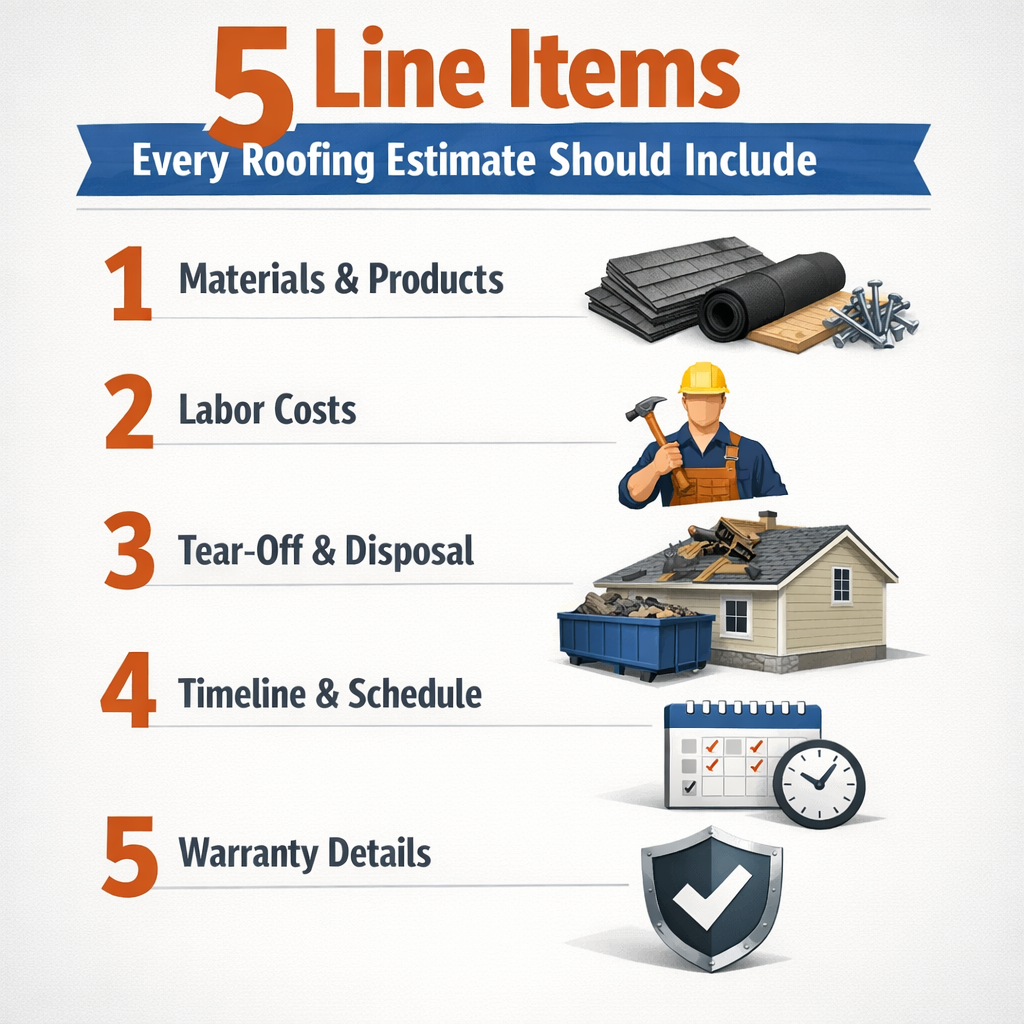
An accurate roofing estimate should read like a complete scope of work, not a single lump sum. When a quote arrives stripped of detail, something has almost certainly been stripped from the job itself. Here are the components that every legitimate estimate for an NC Triad home should address explicitly.
Underlayment is the water-resistant barrier installed directly over your roof decking, beneath your shingles. It is your second line of defense if a shingle is ever lifted, cracked, or blown off by wind.
There are two primary categories: felt underlayment and synthetic underlayment. Synthetic underlayment is significantly more durable, tear-resistant, and moisture-stable, especially in the heat and humidity that define North Carolina summers. A bid that doesn’t specify underlayment type, or defaults to a minimum-grade felt product to shave costs, is giving you a weaker system than the shingles themselves might suggest.
Many homeowners hear “ice and water shield” and assume it’s irrelevant in their area. We do get ice events here, and more importantly, we get freeze-thaw cycles that create conditions very similar to what this product is engineered to address. Beyond cold-weather performance, ice and water shield is the standard for any vulnerable roof penetration: valleys, around chimneys, around skylights, and at eave lines where wind-driven rain can force water upward under shingles.
A thorough estimate identifies exactly where this product is being applied. A thin estimate skips it entirely to look more competitive on paper.
Drip edge is a metal flashing installed along the roof’s edges that directs water away from the fascia and into the gutters rather than behind them. It is required by most modern building codes in our area. Its absence causes accelerated rot to fascia boards, soffit damage, and the kind of slow moisture infiltration that becomes a structural repair several years down the road.
If a bid doesn’t mention drip edge, ask directly. The answer will tell you a great deal about how that contractor approaches every other detail on the job.
Roof decking, the plywood or OSB sheathing beneath your underlayment, is the structural platform that everything else depends on. Soft spots, rot, or delaminated panels need to be replaced before any new material goes down. A complete estimate will include a clear policy: how the contractor assesses decking condition, how replacement material is specified, and how any necessary decking work will be handled once the existing shingles are removed.
When this is absent from an estimate, you’ve lost the ability to compare bids accurately. One contractor may be pricing for a job that addresses decking; another may be assuming they’ll leave compromised boards in place.
Need a hand with this in Winston-Salem, Greensboro and the NC Triad? Call (336) 971-0464 or request a free estimate. Honest answers, no pressure.
This is the single biggest expertise gap in the roofing industry, and if you read nothing else in this guide, read this section.
Proper attic ventilation is what allows your roofing system to function as an actual system rather than a collection of independent materials. Without it, heat and moisture accumulate in your attic space. That trapped heat degrades shingles from underneath, baking the adhesive strips, warping the decking, and accelerating granule loss. The moisture accelerates rot and mold in decking and framing.
The standard that governs this is the 1:150 ratiofor every 150 square feet of attic floor space, you need one square foot of net free ventilation area, split between intake (typically at soffits) and exhaust (typically at the ridge). Many existing homes in the Triad, particularly those built before ventilation standards were tightened, fall short of this ratio.
Here is why this matters directly for affordability:
A premium shingle installed over an under-ventilated attic will fail years ahead of its rated service life. The heat stress alone shortens shingle longevity significantly. More critically, most manufacturer warranties explicitly void coverage when inadequate ventilation is documented as a contributing factor to premature failure. That “lifetime warranty” you were sold becomes worthless precisely when you need it most.
Conversely, a mid-grade shingle installed over a properly ventilated attic, with correct underlayment and quality flashing work, will consistently outlast an expensive shingle installed by a contractor who never looked at the attic. The system determines the outcome, not the shingle grade alone.
A contractor who evaluates ventilation as part of the initial assessment is demonstrating field-level expertise. One who never mentions it is treating your roof as a surface replacement rather than a building science problem. Those two approaches produce very different roofs, and very different long-term costs. To understand what drives ventilation upgrade pricing, the article on roof vent installation cost breaks down the key variables homeowners should expect to see in any scope of work.
“Lifetime warranty” is one of the most misunderstood phrases in home improvement. Here is what that term actually represents, and what it quietly omits.
These are two separate protections that cover two separate things.
The manufacturer’s material warranty covers defects in the shingle itself, manufacturing flaws, premature granule loss beyond specified tolerances, structural failures in the shingle body. It does not cover installation errors. It does not cover damage caused by ventilation failure, improper flashing, or a storm event.
The contractor’s workmanship warranty covers how the shingles were installed. This is where the real practical protection lives for the first several years of your roof’s life, because installation errors, missed nail patterns, improper shingle offsets, inadequate flashing seals, manifest early. A workmanship warranty is only as strong as the contractor standing behind it. If that contractor is out of business in three years, the warranty is meaningless regardless of its stated terms.
At Smithrock Roofing, we back our installations with a 5-year labor warranty, and we use CertainTeed Landmark shingles that come with a limited lifetime manufacturer warranty. We’re also CertainTeed PREMIER ShingleMaster Certified, which matters for the third warranty type.
Manufacturer contractor programs, including CertainTeed’s ShingleMaster program, are tiered, and each tier unlocks different warranty coverage for the homeowner. At the highest certification levels, homeowners become eligible for a system warranty that covers both materials and labor under a single umbrella. This is meaningfully stronger protection than a standalone material warranty.
Two things most contractors never tell you:
“Licensed and insured” is the legal floor. It is not a differentiator. Every legitimate contractor in North Carolina is required to carry licensing through the NC Licensing Board for General Contractors, and any crew working on your home should carry both general liability and workers’ compensation insurance. The question is how you verify those claims rather than simply accepting them.
Here is a practical checklist for vetting any contractor you’re considering:
| What to Check | How to Verify | Why It Matters |
|---|---|---|
| NC General Contractor License | Search the NC Licensing Board database | Confirms legal authorization to perform work in the state |
| General Liability Insurance | Request a Certificate of Insurance naming you as additionally insured | Protects your property if damage occurs during the job |
| Workers’ Compensation Coverage | Confirm on the Certificate of Insurance | Protects you from liability if a worker is injured on your property |
| BBB Accreditation & Rating | Check bbb.org directly | Reveals complaint history, resolution patterns, and time in business |
| Manufacturer Certification Level | Ask which tier the contractor holds and what warranty it unlocks for you | Determines your actual warranty coverage, not just the shingle grade |
| Warranty Registration Process | Ask who registers the warranty and when | Confirms you’ll receive documented proof of coverage in your name |
| Local Physical Address | Verify a real business address, not a P.O. box | Storm-chasing crews often have no local accountability |
| Workmanship Warranty Terms | Get it in writing with specific coverage scope | Defines your recourse if installation issues surface in year two |
Three questions that quickly reveal whether a contractor genuinely knows what they’re doing:
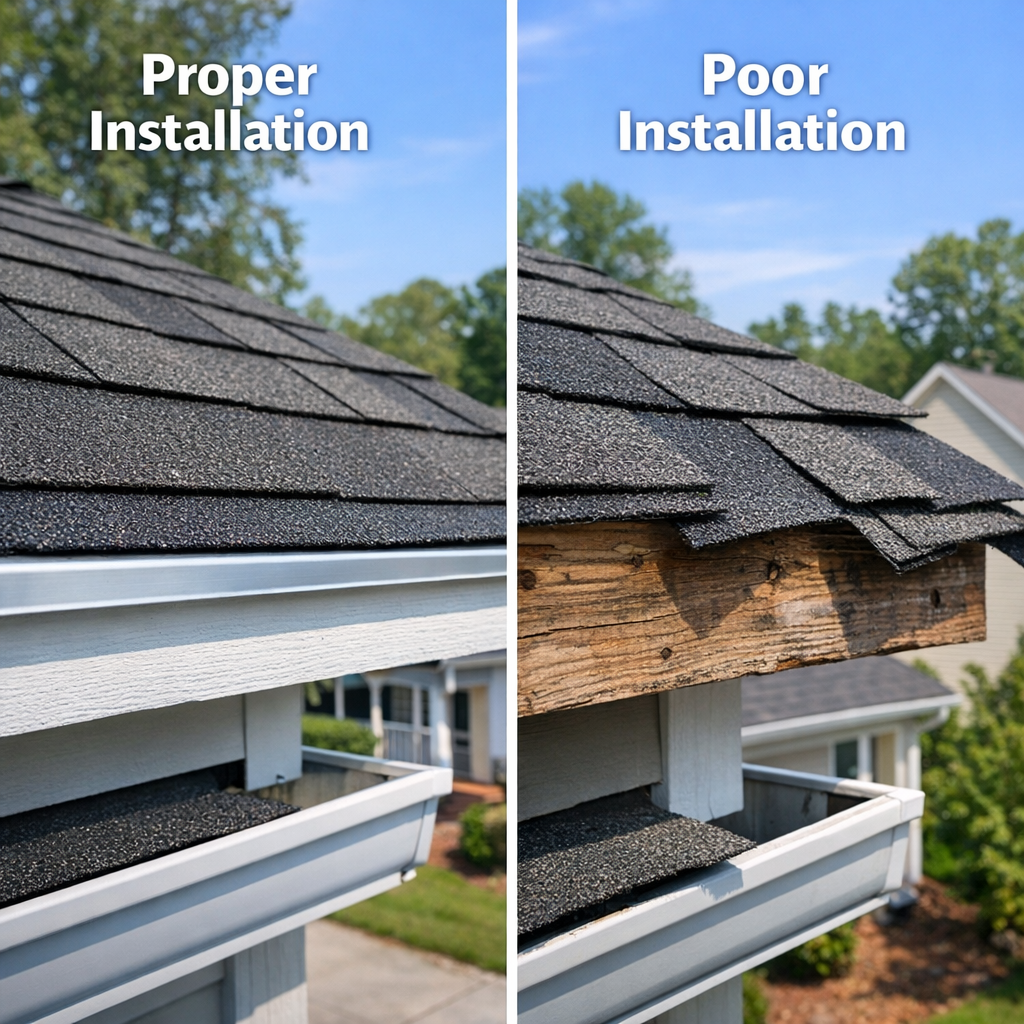
Homeowners often focus exclusively on the shingle product when comparing bids, treating shingle grade as the primary variable in roof longevity. It is an important variable, but it is not the controlling one.
Here are the factors that interact with shingle quality to determine how long your actual roof lasts:
An under-ventilated attic creates a heat environment that no shingle manufacturer designs their product to tolerate over a full service life. Ventilation assessment is non-negotiable in any thorough installation.
Flashing is the metal work that seals every point where your roof surface meets a vertical surface, chimneys, dormers, walls, skylights, and pipe penetrations. These are the highest-probability failure points on any roof. Step flashing, counter flashing, and chimney saddle installation require experience and care that cannot be rushed without creating pathways for water intrusion.
A roof with premium shingles and poor flashing will leak. A roof with mid-grade shingles and expert flashing work will stay dry for decades. This is where experienced craftsmanship has a direct, measurable impact on performance.
Starter strips along the eave and rake edges seal the bottom edge of your first shingle course, preventing wind infiltration and blowoff. Ridge cap shingles at the peak seal the highest vulnerability point on the roof. Both are frequently handled as afterthoughts by contractors trying to move fast. Both are specific points of failure in high-wind events, and our area sees its share of severe weather, from thunderstorm wind events to the occasional tropical remnant moving through.
Shingle manufacturers specify precise nailing zones, a narrow band within each shingle where fasteners must be placed to achieve rated wind resistance and maintain warranty coverage. Nailing above that zone (called “high nailing”) dramatically reduces the shingle’s ability to resist uplift in wind. It is a common shortcut taken on rushed jobs, and it is invisible to the homeowner after installation. It shows up later when shingles lift in the first significant storm.
After significant hail or wind events in our area, many homeowners find themselves navigating an insurance claim for the first time. Every roofing contractor seems to offer to “help with insurance.” Very few explain what that actually means in practice.
When your insurance carrier sends an adjuster, that inspection produces a scope of loss document and an initial estimate of repair costs. Most homeowners treat this as the definitive settlement figure. It is not. It is a starting point.
Adjusters work from a software platform called Xactimate, which prices every line item in a roofing repair or replacement scope. An experienced contractor who understands how Xactimate scopes work can review that initial estimate and identify items that were missed, undervalued, or documented at the wrong grade of material.
Common gaps in initial adjuster estimates include:
A contractor who can advocate through this process, pointing to specific Xactimate line items that warrant supplementation, is genuinely helping you. One who simply submits the adjuster’s scope without review is potentially leaving significant coverage on the table. For a detailed walkthrough of how to navigate this process, the article on roof insurance claims covers exactly what homeowners need to know before the adjuster arrives.
Insurance adjusters categorize storm damage into two buckets: functional damage and cosmetic damage. This distinction determines whether your claim gets approved for replacement or denied.
Functional damage compromises the roof’s ability to perform its primary purpose, keeping water out. Cracked shingles, dislodged granules exposing the substrate, lifted or displaced shingles, and damaged flashing fall into this category.
Cosmetic damage affects appearance without compromising weather resistance. Many hail events produce surface scarring that technically classifies as cosmetic under policy language, which means the claim is denied even though the roof looks visibly impacted.
An experienced contractor understands this distinction and can assess whether visible damage meets the functional threshold, and document it appropriately for the adjuster’s review. This is not advocacy for inflated claims. It is making sure legitimate functional damage is accurately recognized and covered under a policy you’ve been paying premiums on for years.
Real affordability in roofing is not the lowest number on an estimate. It is the best ratio of long-term performance to investment, a roof that doesn’t need emergency repairs in year three, doesn’t void its warranty due to installation shortcuts, and doesn’t create water damage that costs far more than the original project.
That kind of value comes from a combination of:
Smithrock Roofing has built its reputation across Winston-SalemGreensboro, High Point, Kernersville, Clemmons, Rural Hall, and King on exactly this approach. With 60+ combined years of field experience, an A+ BBB rating, 312+ five-star reviews, and CertainTeed PREMIER ShingleMaster Certification, we treat every job as a system, not just a surface.
If you’re ready to understand exactly what your roof needs and what a proper scope of work looks like for your home, reach out for a no-pressure consultation. We’ll walk you through every detail, from ventilation assessment to warranty registration, so you can make a fully informed decision.
A roofing estimate is a number. A scope of work is a detailed breakdown of every component being replaced or repaired, the materials specified by brand and grade, the installation method, and what warranties will apply to each element. Homeowners comparing roofing projects should always ask for a full scope of work rather than a summary figure. Without it, you cannot accurately compare one contractor’s proposal against another’s, because the underlying work may be completely different even when the surface numbers look similar.
Functional damage means the roof’s ability to perform its protective role has been compromised, not simply that it looks different than it did before. Dented metal flashing, cracked or missing shingles, granule loss that exposes the asphalt mat, and compromised seals around penetrations can all qualify as functional damage depending on severity and pattern. An experienced roofing contractor can document findings in the specific language adjusters are trained to evaluate, which makes a significant difference in whether legitimate damage is recognized during the claims process.
Ventilation directly affects shingle lifespan, decking condition, and energy performance inside the home. Poor attic ventilation traps heat and moisture, which accelerates shingle degradation from below and can void manufacturer warranties even when installation was otherwise correct. Replacing shingles without addressing an underlying ventilation problem means the new roof is aging faster than it should from the moment the project is complete. Any contractor quoting a shingle replacement should include a ventilation assessment as a standard part of the evaluation.
Manufacturer warranties cover materials under defined conditions. What they do not cover is the quality of the installation itself. A workmanship warranty, offered separately by the contractor, is what protects you if a leak or failure is caused by how the roof was installed rather than a defect in the product. When evaluating contractors, ask specifically about the duration of their workmanship warranty, whether it is transferable if you sell the home, and what their documented process is for handling warranty service calls. A contractor who has been operating locally for years with verifiable reviews is far more likely to honor a long-term workmanship commitment than one with no established local presence.
Homeowners across Winston-Salem and Greensboro deserve roofing partners who explain the full picture honestly, not just what it costs today, but what a properly installed, fully warranted roof system means for the years ahead. Smithrock Roofing brings 60+ combined years of field experience, CertainTeed PREMIER ShingleMaster Certification, and a straightforward approach to every consultation, so you always know exactly what you’re getting and why. When you’re ready to take the next step, Contact Smithrock Roofing and let’s talk through what your home actually needs.

Smithrock Roofing © Copyright 2026 • All Rights Reserved • Privacy Policy • Maintained by Mongoose Digital Marketing