Walk through the chimney cap aisle at Lowe’s, or scroll through their website, and you’ll find plenty of options: galvanized steel, stainless steel, round, square, rectangular, single-flue, multi-flue. Brands like Shelter, Forever Cap, and SuperVent line the shelves. Filters let you sort by size and material. It looks straightforward enough.
But here’s the honest truth most homeowners discover too late: picking the wrong chimney cap is one of the most common and costly mistakes in home maintenance. Not because the caps themselves are bad products, many of them are perfectly serviceable. The problem is that the product listings tell you almost nothing about which cap is actually right for your chimneywhat the material differences mean in the real world, or how the wrong choice can quietly damage your flue, your crown, and your fireplace’s performance over time.
At Smithrock Roofing, we’ve worked on chimneys across Winston-Salem, Greensboro, High Point, Kernersville, Clemmons, and throughout the NC Triad for decades. We see the aftermath of mismatched caps regularly, rusted-out galvanized steel, caps that sit loose over the flue opening, and homeowners dealing with smoke rollback because the cap’s clearance is too tight. This guide is designed to give you the advisory depth that no product listing page provides, so you can make a genuinely informed decision before you buy.
A chimney cap is not a purely cosmetic addition. It is a functional component of your chimney system, and when it’s working correctly, it does several things at once:
None of these functions work correctly if the cap doesn’t fit the flue properly, is made from the wrong material for your climate, or has a design that creates back-pressure. Let’s work through each of those factors.
Need a hand with this in Winston-Salem, Greensboro and the NC Triad? Call (336) 971-0464 or request a free estimate. Honest answers, no pressure.
This is where most homeowners go wrong before they even reach the store. The most common mistake is measuring the outside of the chimney crown or the exterior of the flue tile instead of the interior of the flue liner opening. These are different measurements, and confusing them leads directly to a cap that either slips down into the flue or leaves a gap large enough for rain and wildlife to enter.
If your chimney has a traditional masonry construction, which describes the vast majority of homes in our area, you almost certainly have a clay tile flue liner. Here’s how to measure it correctly:
When you look at chimney caps at Lowe’s, the listed dimensions typically refer to the size of the opening the cap is designed to fit overnot the cap’s outer footprint. Read the product specification carefully and confirm which dimension is referenced.
Round chimney caps are designed exclusively for round metal flue systems, specifically, Class A double-wall or triple-wall insulated chimney pipe and flexible stainless steel liner systems. If you have a traditional masonry chimney with clay tile liner and you’re looking at a round cap, stop. Round caps are not designed for that application, and forcing the fit creates a dangerous gap around the flue opening that invites moisture intrusion and animal entry.
Round liner diameter is measured across the inside of the metal liner, again, interior measurement, not exterior pipe diameter.
This is the section the product listing pages skip entirely. The material you choose determines how long your cap will actually perform, and in the NC Triad’s climate, that calculation matters more than it might seem.
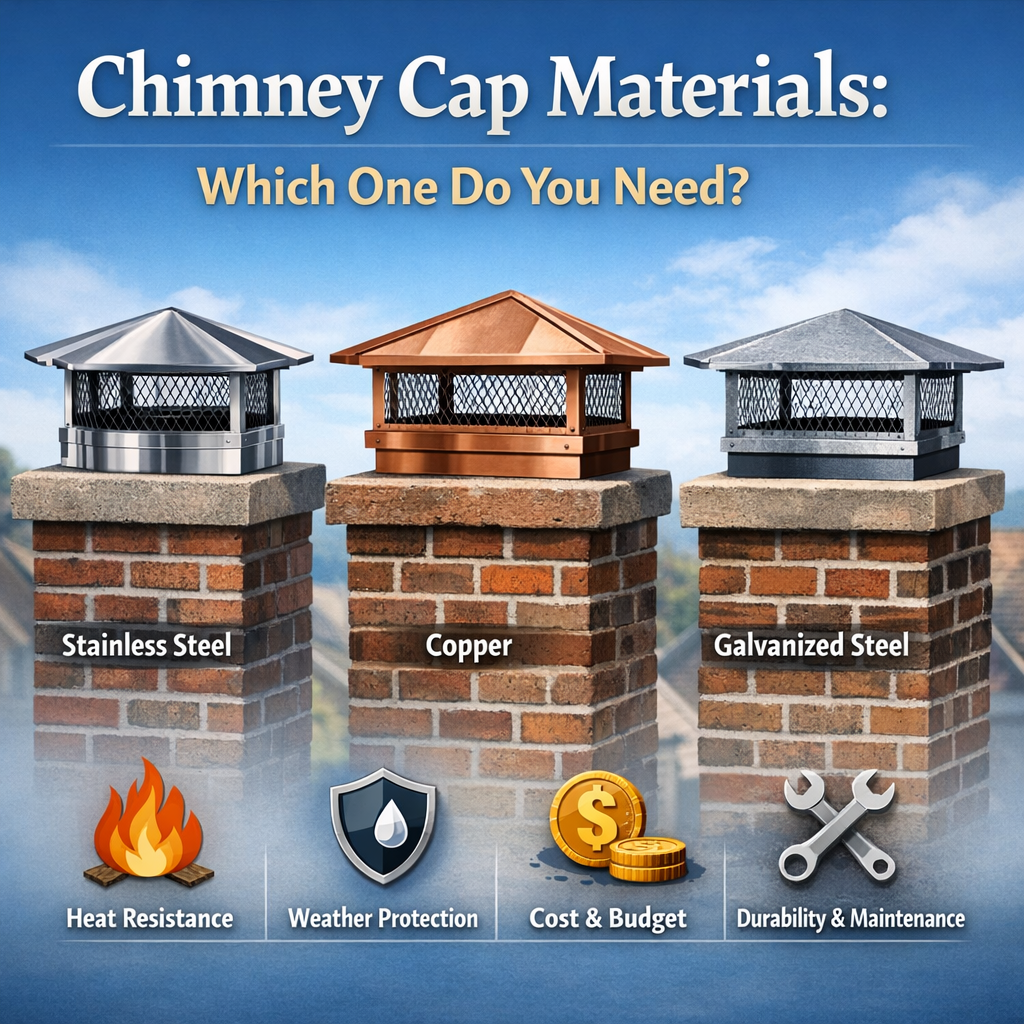
The NC Triad sits well inland from the coast, you’re not in marine-grade territory. However, the region does experience meaningful humidity, seasonal acid rain events, and precipitation patterns that are harder on galvanized steel than the product packaging implies. Here’s what years of field experience in this climate actually shows:
| Material | Typical Lifespan in NC Triad | Best Application | Notable Weakness |
|---|---|---|---|
| Galvanized Steel | 5–10 years | Budget replacement, low-use fireplaces | Zinc coating oxidizes faster with acid rain and wood smoke condensate |
| 304 Stainless Steel | 20+ years | Most residential wood and gas applications | Minor pitting possible in extreme coastal environments |
| 316 Stainless Steel | 25+ years | Within ~50 miles of saltwater | Rarely stocked at Lowe’s; usually special order |
| Copper | 50+ years | Historic homes, premium custom applications | Higher material cost; requires professional fabrication for best results |
| Aluminum | 10–15 years | Light-use gas appliance flues only | Not appropriate for high-temperature wood-burning systems |
One nuance worth understanding: galvanized steel caps look intact long after their zinc coating has degraded at the microscopic level. Surface rust doesn’t always appear immediately, but the corrosion is progressing underneath. By the time you see visible rust, the cap’s structural integrity is often already compromised. For a wood-burning fireplace that sees regular use, 304 stainless steel is the responsible baseline, not an upgrade.
A chimney cap’s shape and proportions directly affect how well your fireplace draws. This is a topic completely absent from product listing pages, but it’s one of the most important performance factors for homeowners who actually use their fireplaces.
The governing standard for chimney systems in the United States is NFPA 211, which specifies requirements for chimney caps, including mesh size. The recommended mesh opening size is 5/8 inch (16mm). This dimension is not arbitrary:
Most caps available at Lowe’s use 5/8″ mesh, which is correct. Verify this before purchasing, especially with discount or off-brand caps that may use denser mesh to appear sturdier.
The vertical clearance between the bottom of the cap’s mesh skirt and the top of the flue opening is critical. When this clearance is too small, outgoing combustion gases encounter resistance from the cap’s lower edge, creating turbulence that partially reverses airflow. The practical result is smoke that doesn’t fully exit, you may notice a faint smoky odor in the room, or visible smoke rollout when adding wood to the fire.
A general professional guideline: the mesh skirt should provide at least 5 inches of open vertical space above the flue tile. Some manufacturers rate their caps for specific minimum flue dimensions, check that specification against your actual measurement.
Many chimneys serving older homes in our area, particularly those in established residential areas, have two or more flue openings in a single chimney chase. Multi-flue caps that cover multiple openings simultaneously are convenient, but they come with a specific performance risk that product listings never mention.
When two appliances share a multi-flue cap and both operate at the same time, say, a wood-burning fireplace and a gas furnace, they create competing pressure zones within the same cap housing. The higher-pressure flue (typically the furnace, with powered draft assistance) can effectively steal draft from the lower-pressure flue (the fireplace), causing it to draw poorly or back-draft. If your home has multiple flues, separate single-flue caps are typically the better-performing solution.
Standard chimney caps, the flat-topped, mesh-skirted style that represents the majority of Lowe’s inventory, perform well in most residential situations. But they have a documented weakness: sustained directional wind.
If your chimney sits near the roof ridge and your home is exposed to prevailing winds, a common condition in rural and open landscapes, a standard flat-top cap can actually funnel wind downward into the flue, creating persistent downdraft. You’ll notice this as cold air flowing from the fireplace into the room even when the damper is closed, or difficulty establishing a good draw when lighting a fire.
Wind-directional caps (sometimes called rotating caps or wind-directional terminals) use a rotating cowl or asymmetric shroud to redirect wind energy into draft-assisting suction rather than downdraft pressure. They’re not standard stock at most big-box retailers, but they’re the correct tool for the right situation. An experienced contractor can evaluate your specific roof geometry and wind exposure to determine whether this applies to your chimney.
This warning is absent from every product listing page, and it matters significantly.
Many standard chimney caps, particularly solid-top or low-clearance designs, are not approved for use over gas appliance flues. Gas appliances produce water vapor as a combustion byproduct. When that vapor contacts a cold cap surface in winter, it condenses into liquid water mixed with combustion acidic gases. This condensate is significantly more corrosive than wood smoke, and it will destroy an inappropriate cap from the inside out while also running back down the flue liner.
Caps rated for gas appliance use are specifically designed with materials and geometry that manage this condensate issue. They’re also required to meet different clearance standards than solid-fuel caps. If your chimney vents a gas furnace, gas fireplace, or gas water heater, confirm that any cap you purchase is explicitly rated for gas appliance use, not just listed as a general chimney cap.
The Chimney Safety Institute of America (CSIA) maintains resources on proper venting standards for different appliance types and can help homeowners identify what’s appropriate for their specific system.
Installing a chimney cap on a deteriorating chimney crown doesn’t solve your moisture problem, it can accelerate it.
The chimney crown is the concrete or mortar slab that covers the top of the masonry chimney, sloping away from the flue to direct water off the sides. When the crown develops cracks, which is normal weathering, and common on Triad chimneys that have seen fifteen or twenty years of freeze-thaw cycles, water enters those cracks, sits against the masonry, and expands when temperatures drop below freezing.
A chimney cap installed over a cracked crown can actually trap water against that compromised surface, particularly if the cap’s mesh skirt channels rainwater toward the crown perimeter rather than away from it. The freeze-thaw damage that follows is progressive: small cracks become large ones, large cracks compromise the bond between the crown and the chimney masonry, and eventually you’re facing partial crown replacement. If you’re also seeing water stains on your ceiling near the fireplace, our article on ceiling leaks and finding the real source walks through how to trace that moisture back to its origin before it causes further damage.
Before installing any chimney cap, store-bought or custom-fabricated, it’s worth having the crown inspected. If the crown shows surface crazing, visible cracks wider than a hairline, or areas where the bond is separating from the chimney top, address the crown first. Crown sealer can handle minor surface cracking; larger issues require professional repair or full crown replacement.
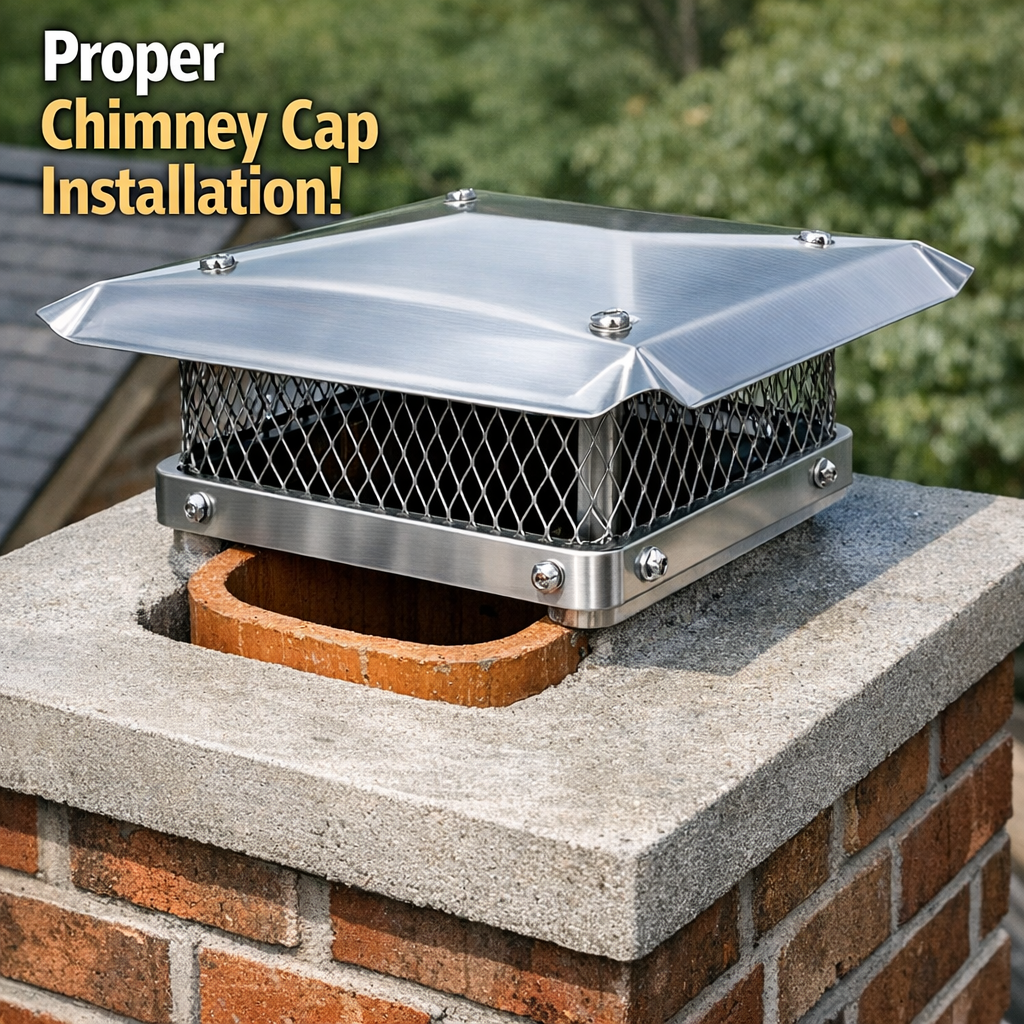
To be straightforward with you: for many homeowners in the NC Triad, a quality 304 stainless steel cap purchased at Lowe’s, correctly measured and properly installed, will do exactly what a chimney cap needs to do for many years.
The cases where a store-bought cap is appropriate:
The cases where you should consult a professional before purchasing:
At Smithrock Roofing, we fabricate custom chimney caps for situations that fall outside the standard product range, including oversized crowns, decorative copper caps for historic homes, and multi-flue configurations that require individual termination. It’s one of the services that makes a full exterior contractor relationship more useful than a single trip to the hardware store.
Before you load a chimney cap into your cart, in-store or online, work through these questions:
If you can answer all of those questions confidently, you’re ready to shop. If several of them leave you uncertain, a brief consultation with an experienced contractor, before you purchase, will save you considerably more time and trouble than returning a product that doesn’t fit or doesn’t perform.
The chimney cap is a small component, but it protects a significant system. Getting it right from the start is worth the extra care.
Many standard slip-fit and top-mount chimney caps are designed for DIY installation and include basic hardware. If your chimney has a straightforward single-flue clay tile liner in good condition and the cap dimensions match, a confident DIYer can complete the job safely. However, if your chimney is tall, your crown is damaged, you have multiple flues, or the cap requires sealant work on deteriorated masonry, professional installation is the better choice. A poor seal or incorrect fit can allow water infiltration that causes far more damage than the cap was meant to prevent.
You need to measure the interior dimensions of the flue liner opening, not the exterior of the clay tile surround. For square or rectangular flues, measure width and length inside the tile. For slip-fit caps, the cap’s listed size should correspond to those interior measurements. For top-mount caps, measure the full exterior of the chimney crown. When in doubt, size up slightly rather than down, as an undersized cap will not seat securely and may lift in high wind.
Not all chimney caps are rated for gas appliance venting. Gas flues produce different exhaust chemistry than wood-burning fireplaces, and some standard galvanized caps are not appropriate for prolonged exposure to gas combustion byproducts. When shopping at Lowe’s, check the product specification label for gas-appliance compatibility. If the listing does not specifically address gas use, contact the manufacturer before purchasing. A cap that is incompatible with gas venting can corrode prematurely and void related appliance warranties.
Lifespan depends heavily on material. Galvanized steel caps typically last several years in moderate climates before rust becomes a structural concern. Stainless steel, particularly 304 grade, can last a decade or more with no maintenance. Copper caps, while less common at big-box retailers, can outlast the chimney itself. Climate matters too: coastal salt air, freeze-thaw cycles in the Piedmont region, and heavy tree coverage all accelerate wear. Inspect your cap annually alongside your roof, and replace it at the first sign of rust-through, loose mesh, or damaged seams.
Choosing and installing the right chimney cap is the kind of job that rewards careful preparation, and the kind that goes wrong quickly when a detail is missed. Smithrock Roofing works with homeowners throughout Winston-Salem and Greensboro to make sure the entire exterior system, from the roofline down to the chimney crown, is performing the way it should. If your measurements don’t match a standard product, your crown needs attention before capping, or you simply want a professional opinion before you buy, we’re glad to help. Get a Free Estimate and let’s take a look together.

Smithrock Roofing © Copyright 2026 • All Rights Reserved • Privacy Policy • Maintained by Mongoose Digital Marketing