If you own a home in Clemmons, NC, you have probably noticed that every roofing company in the area says roughly the same things. They are family-owned, locally trusted, and offering a free estimate. They have certifications. They work with your insurance company. Their customers love them.
None of that is wrong. But when your roof is the only thing standing between your family and the weather, “roughly the same” is not a standard worth settling for.
The reality is that roofing in Clemmons carries specific challenges that most contractors never bother to explain. The Piedmont Triad’s climate creates failure modes that are different from coastal NC and different again from the mountains. Warranty terms that look impressive in a brochure contain conditions that are almost never disclosed upfront. And a roofing estimate that looks complete on the surface can be missing line items that will cost you significantly more once work is underway.
This guide is written for Clemmons homeowners who want straight answers — about what your roof actually faces here, what a properly installed system looks like, and how to read a roofing contract so you know exactly what you are buying.
Clemmons and the broader Forsyth County area occupy a geographic position that creates a specific and underappreciated weather threat. Storm systems moving northeast through the Piedmont plateau interact with pressure differentials generated by the Uwharrie Mountains to the south, producing localized wind uplift patterns that are more aggressive than regional averages suggest.
For homeowners, this means that shingle edge failure — the gradual lifting and separation of shingle tabs along the lower courses and at rakes — happens faster here than in flat, open terrain. Homes with low-slope transitions between roof sections, open ridge lines without proper hip and ridge ventilation, and southwest-facing gable ends are particularly vulnerable because the dominant storm approach vector in this region comes from the southwest.
This is not a reason to panic. It is a reason to specify the right materials and installation standards from the beginning. Architectural shingles with a wind resistance rating of 110 to 130 MPH are not an overbuilt luxury for Clemmons homes — they are the appropriate baseline. Shingles at the lower end of the performance range may meet minimum code requirements while still underperforming in the conditions this specific geography produces. If you want to understand how wind damage affects shingles and when the situation becomes serious, that article walks through the warning signs in detail.
Clemmons experiences a humid subtropical climate, which means hot, sticky summers with moisture loads that coastal roofing markets do not face in the same way. The issue is not just rain hitting your shingles — it is the moisture vapor that builds inside your attic during the summer months and works its way into your roof decking from below.
When attic ventilation is inadequate, that moisture has nowhere to go. It cycles through the decking material repeatedly, degrading the structural integrity of the wood over time. OSB decking, which became the dominant material in residential construction through the 1990s and 2000s, is more sensitive to sustained moisture exposure than older plywood panels. In a Clemmons attic in August, the difference between a properly ventilated roof system and an underventilated one is not academic — it is the difference between decking that stays sound for decades and decking that shows soft spots and delamination within ten to fifteen years.
This is a failure mode that does not announce itself until it is expensive. You will not see it from your driveway. You may not notice it during a casual attic inspection. But a thorough pre-installation assessment — using moisture meters on the decking surface and checking for deflection along the sheathing — will reveal it before a new roof goes on top of a compromised substrate.
Many homeowners associate ice dams exclusively with northern climates. Clemmons does not get the snowfall of Vermont, but it gets enough freeze-thaw cycling through December, January, and February to create genuine ice dam conditions several times per winter season.
An ice dam forms when heat escaping through an underventilated roof warms the upper sections of the roof deck, melting snow or freezing rain that then refreezes at the eave overhang — where the deck is colder because it extends beyond the building envelope. The expanding ice works under shingles, bypasses standard underlayment, and forces water directly onto the decking and into the wall cavities below.
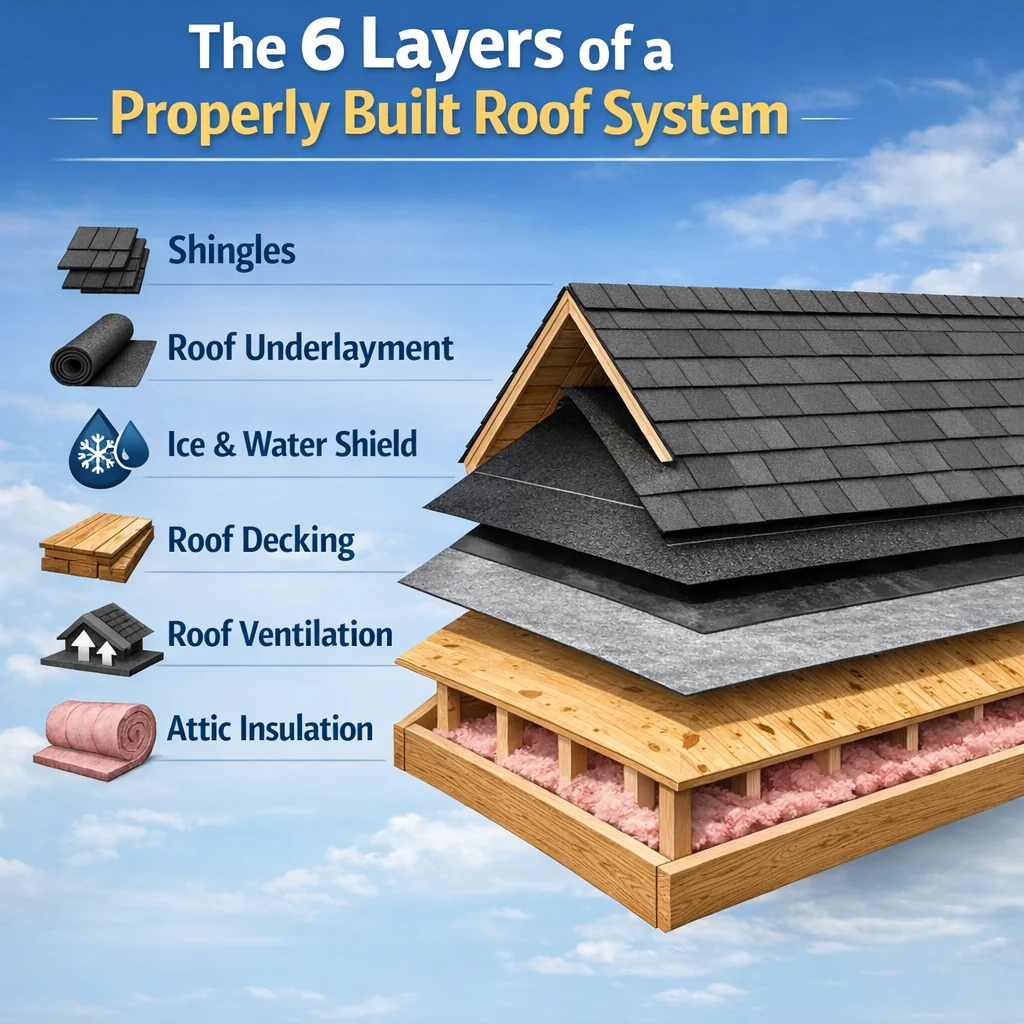
The solution is two-part: an ice and water barrier membrane installed along the first three feet of the eave (and at all valleys and penetrations), combined with a ventilation system that keeps the roof deck uniformly cold so the thermal differential that triggers the dam never develops. Both elements need to be present. One without the other is an incomplete fix. If you are dealing with this issue actively, the article on how to get rid of ice dams covers the removal and prevention steps worth knowing.
This is the section most roofing companies skip, and it is the one that matters most when something goes wrong.
A lifetime shingle warranty is a meaningful product guarantee — but it applies to the shingle itself, and only under specific conditions. The manufacturer is warranting that their product will not fail prematurely due to a manufacturing defect. They are not warranting the labor, and they are not covering failures caused by improper installation or system incompatibility.
The distinction sounds technical. In practice, it means that a large percentage of warranty claims are denied, not because the shingles failed, but because the installation around them did not meet the terms written into the warranty documentation.
Manufacturer warranties for premium shingle lines carry explicit ventilation requirements. The standard is expressed as a net-free ventilation area ratio relative to the attic floor space. The commonly required minimum is 1 square foot of net-free ventilation area for every 150 square feet of attic floor area — the 1:150 ratio.
Clemmons homes built between roughly 1985 and 2005 were frequently constructed under ventilation standards that fall short of this ratio. Ridge vents were often undersized, soffit venting was sometimes blocked during insulation installation, and power attic ventilators were added as retrofits without proper balancing between intake and exhaust.
If a contractor installs a new roof on one of these homes without correcting the ventilation deficiency, the homeowner walks away holding a warranty document that the manufacturer is legally entitled to deny in full. The contractor has fulfilled their contractual obligation on paper. The homeowner is unprotected.
A complete roof replacement on a Clemmons home should include a ventilation audit as a standard step, not an optional add-on.
Premium manufacturer warranties apply to complete roofing systems — not individual products. When a warranty specifies a complete system, it means that the starter strip, underlayment, hip and ridge cap, and shingles must all come from that manufacturer’s approved product line. Substituting a lower-cost third-party underlayment, even one that meets building code requirements, can reduce or eliminate the enhanced warranty coverage on the shingles above it.
This matters because underlayment is invisible once the job is done. It is exactly the kind of material substitution that a cost-cutting contractor can make without a homeowner ever knowing — until a claim is filed.
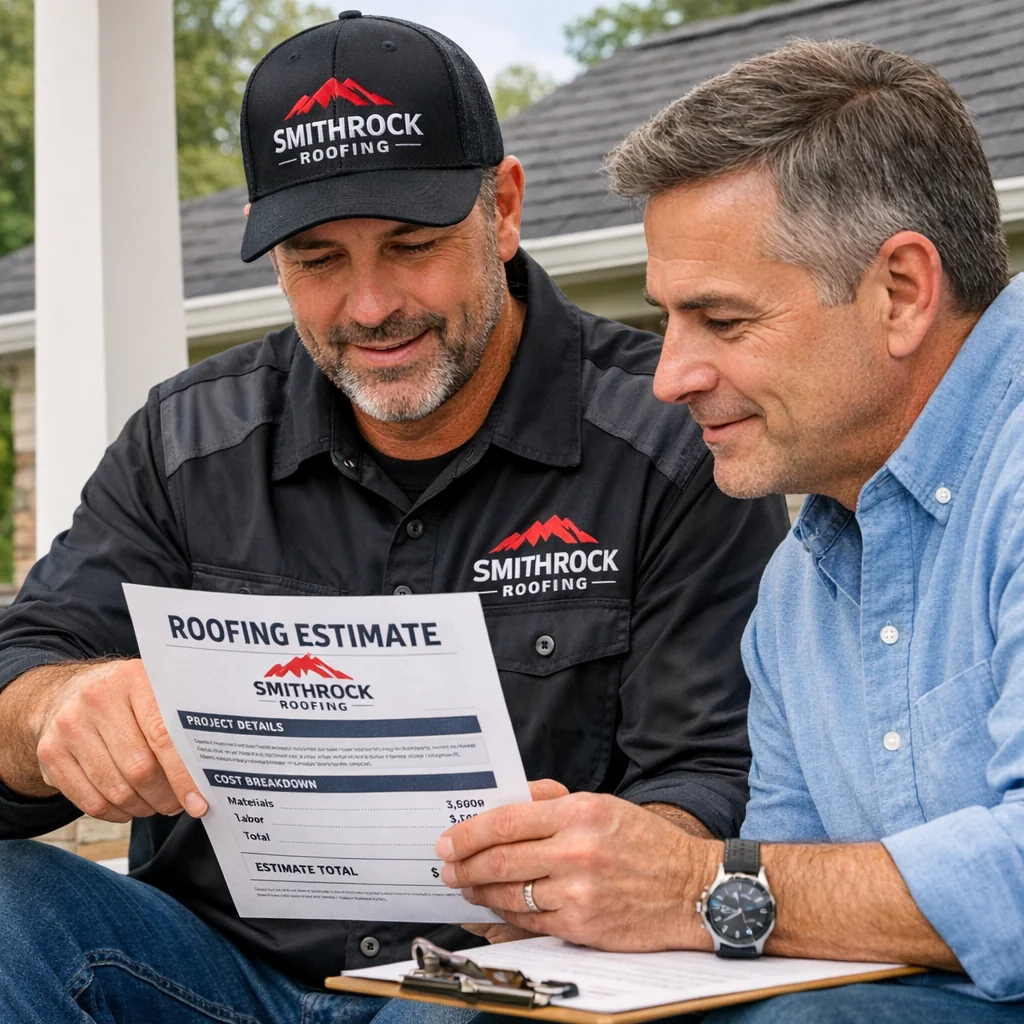
Ask for the product specifications in writing, including the underlayment, starter strip, and ridge cap. If the estimate lists “synthetic underlayment” without a brand or product name, ask what brand it is and confirm it is on the manufacturer’s approved product list for the shingle system being installed.
The most common source of warranty disputes in the Triad roofing market involves flashing — specifically, step flashing along dormers and sidewalls, and counter-flashing at chimney bases.
Flashing failures are almost never covered under manufacturer warranties because the warranty covers the shingle membrane, not the metal flashing components. But improperly installed flashing creates water infiltration that damages decking, insulation, and framing — damage that homeowners naturally expect their roof warranty to address. When the adjuster points to the flashing as the source and notes that it falls outside warranty scope, the homeowner is left with a repair bill and a warranty that technically performed as written.
The fix is to require detailed flashing specifications in any roofing estimate before work begins, and to confirm that the contractor performing the work treats flashing as a first-priority detail rather than a finishing step.
No competitor in the Clemmons market is publishing this, but it is exactly what homeowners need before they sign anything.
| Line Item | What to Look For | Red Flag |
|---|---|---|
| Decking replacement terms | Clear language on how decking damage is identified and billed | “If needed” without a defined assessment process or unit cost structure |
| Drip edge | Listed as a separate material line item | Absent entirely — required by NC Building Code R905.2.8.5 |
| Underlayment specification | Brand name and product number, not just “synthetic” | Generic description with no manufacturer reference |
| Ice and water barrier | Coverage areas specified (eaves, valleys, penetrations) | Not mentioned, or described only as “as required” |
| Nail pattern | Six-nail fastening for high-wind-rated shingle installation | Four-nail pattern only, with no wind-zone justification |
| Ridge cap product | Manufacturer-specific ridge cap matching the shingle system | “Hip and ridge shingles” without brand specification |
| Flashing scope | Step flashing, counter-flashing, and pipe boots itemized | Lump-sum labor with no detail on flashing approach |
| Disposal and haul-off | Separate line item for tear-off debris removal | Buried in a general labor line or absent entirely |
| Ventilation assessment | Noted as a pre-installation step | No mention of ventilation evaluation |
| Warranty documentation | Specific warranty tier named (e.g., full system warranty vs. standard) | “Manufacturer warranty included” without specifying coverage tier |
The fastening pattern used during shingle installation directly affects both wind resistance performance and warranty eligibility. Standard installation calls for four nails per shingle, which meets the minimum requirement for most wind zones. In Forsyth County, with its documented wind convergence patterns, six-nail fastening is the appropriate standard for maintaining wind resistance ratings at the upper end of the shingle’s specified range.
This is a detail that almost never appears in estimates unless you ask directly. If a contractor cannot confirm their nail pattern in writing, it is worth pressing the point — particularly on southwest-facing slopes, along rake edges, and at ridge transitions, where wind uplift pressure is highest.
Disposal and haul-off fees are one of the most consistent sources of post-project disputes in residential roofing in North Carolina. A complete tear-off generates significant material volume, and managing that debris responsibly has a real cost. That cost should appear clearly on your estimate before work begins, not as an invoice line you see for the first time after the job is done.
If a competing bid looks notably lower than others, the disposal fee is one of the first places to check. It may be absent from the estimate entirely, with the expectation of addressing it separately — or it may simply have been excluded to make the bid appear more competitive.
Most homeowners think of a roof as a surface. Contractors who have worked through Forsyth County storm seasons think of it as a geometry problem.
A hip roof — where all four sides slope down to the eaves — distributes wind load across multiple faces simultaneously. When wind pressure hits a hip roof, it spreads across the geometry and reduces the net uplift force on any single plane. This is why hip roofs generally outperform gable roofs in high-wind events.
A gable roof presents a flat triangular wall on two ends of the building — the gable ends. When storm-force wind hits a gable end directly, the pressure load is concentrated rather than distributed. Shingles along the rake edge (the sloped edge bordering the gable wall) are under more stress than anywhere else on the roof, and they are statistically the first to show uplift damage after a significant wind event.
For Clemmons homes with gable roofs facing southwest — the primary storm approach direction — this means the rake edge on that face is the highest-priority detail in any installation or repair project. Starter strip application, nail pattern density, and rake drip edge quality on that face deserve more attention than a standard four-sided hip roof requires.
Homes with multiple dormers, intersecting roof sections, and changes in pitch create valleys — the V-shaped channels where two roof planes meet. Valleys concentrate water runoff from both planes into a single high-volume drainage path. They are one of the most stress-tested points on any roof.
There are two acceptable approaches to valley installation: open metal valleys (where a continuous piece of metal flashing lines the valley channel) and closed-cut valleys (where shingles from one plane are laid across the valley and the opposing plane’s shingles are cut cleanly against them). Both can perform well. Both require careful execution. Poorly installed valleys — with inadequate metal width, gaps in the flashing, or improper shingle overhangs — account for a disproportionate share of leak calls in the years following a roof replacement.
On any home with complex geometry, the valley details in an estimate deserve the same scrutiny as the shingle specification.
Shingle brands and warranty tiers get most of the attention in roofing conversations. The condition of the decking underneath gets almost none — despite the fact that the best shingles in the market installed over compromised decking will underperform from day one.
A competent pre-installation deck assessment is not a visual pass from the driveway. It involves:
When a contractor performs this assessment before the tear-off is complete, they can give you a reasonably accurate picture of how much decking replacement to expect. When it is skipped, the discovery happens during tear-off — and decisions about additional material and labor get made under time pressure, without your full participation.
Ask specifically: how will you assess the deck before the new materials go on, and what is the process for communicating findings and getting approval before proceeding?
Certifications are worth understanding, not just collecting. Two credentials that appear frequently in this market represent meaningfully different levels of qualification.
A standard manufacturer certification indicates that a contractor has completed product training and met basic installation requirements. These programs are relatively accessible and serve as an entry-level quality marker.
A Master-tier certification — whether through CertainTeed’s ShingleMaster program or the equivalent top tier of another manufacturer’s credentialing program — carries stricter requirements: documented installation volume, verified customer satisfaction records, ongoing training requirements, and in some cases insurance minimums that standard certifications do not require. Master-tier contractors also typically have access to enhanced warranty tiers that are not available to standard-certified contractors — meaning the homeowner gets access to a higher level of manufacturer coverage simply by choosing a higher-credentialed installer.
When a contractor lists their certification, it is worth asking which tier they hold, what the requirements were to achieve it, and what warranty tiers that qualification unlocks for your specific project.
Beyond certifications, the practical indicators of a reliable contractor are:
Smithrock Roofing holds a CertainTeed PREMIER ShingleMaster Master Certified designation, carries 60-plus combined years of experience across our team, and backs completed work with a 5-year labor warranty alongside the full manufacturer warranty on the system installed. Our process includes a ventilation audit and deck assessment on every replacement project — not because it is required, but because installing a premium roof system over an unexamined substrate is not something we are willing to do.
Insurance claim assistance is offered by virtually every roofing contractor in the Clemmons market. Very few explain what that actually involves — and the gap between a contractor who understands the claims process and one who simply volunteers to “help” can affect your claim outcome significantly.
When a Forsyth County adjuster inspects a storm-damaged roof, they are working from a defined scope of loss methodology that prioritizes documented, visible damage attributable to the specific storm event. They are trained to distinguish storm damage from normal wear and are working within coverage terms that may exclude pre-existing deterioration.
When an experienced roofing contractor inspects the same roof, they are evaluating the complete system — including conditions that contributed to the storm damage, secondary damage that may not be visually obvious from the ground or a standard ladder inspection, and material conditions that make partial repair inadvisable even where the adjuster’s scope covers only a portion of the roof.
These two assessments frequently produce different scopes of loss. The difference is not fraud on either side — it is a difference in methodology, training, and professional objective. A roofing contractor who understands this process can document the full scope of damage in a format that speaks to the adjuster’s methodology, identify supplement items that the initial scope missed, and provide the technical backup needed to support a complete and accurate claim.
Asking a contractor how they document storm damage — specifically whether they provide a written scope of loss and how they handle discrepancies between their assessment and the adjuster’s — is a reasonable and important question before you authorize any work. The article on roof insurance claims explains the process in detail and is worth reading before you file.
Your roof is a system, and every decision made during its installation affects how the whole system performs over the coming decades. Clemmons homeowners deserve contractors who understand that — and who are willing to explain it plainly before asking for a signature.
Roof-related decisions have become more complex as material supply chains, storm patterns, and insurance practices continue to shift. These three steps give Clemmons homeowners a practical foundation heading into 2026.
1. Request a Full Roof System Audit Before the Storm Season
Rather than waiting for visible damage to prompt an inspection, schedule a documented roof system audit in late winter or early spring. A qualified contractor should provide a written report covering flashing integrity, ventilation performance, shingle condition by section, and any penetration seals. This documentation serves two purposes: it identifies maintenance items before they become emergency repairs, and it establishes a pre-storm baseline that supports a stronger insurance claim if severe weather does occur across the Forsyth County area later in the year.
2. Verify Contractor Licensing and Liability Coverage Through the NCLBGC
The North Carolina Licensing Board for General Contractors maintains a public search tool that allows homeowners to verify whether a contractor holds an active license and confirm the classification of that license. Before signing any contract — particularly for work valued above the state threshold requiring licensure — run the contractor’s name or license number through the board’s online directory. This takes less than five minutes and removes a significant layer of risk from the hiring decision.
3. Document Your Roof’s Current Condition With Dated Photography
Using a smartphone, photograph your roof from the ground at multiple angles at least once per year, and immediately following any hail event or high-wind storm. Date-stamped photographs stored in a cloud folder give you a visual record that predates any future damage claim. If an adjuster later characterizes damage as pre-existing wear, a photographic timeline provides concrete evidence to support your position. This costs nothing and requires no technical expertise.
Coverage depends on the cause of the damage, the terms of your specific policy, and whether the damage occurred during a covered storm event. Generally, sudden damage from wind, hail, or falling debris is covered, while deterioration from age or neglected maintenance is not. The most effective way to understand your position is to have a contractor who is experienced with insurance claims inspect the roof and provide a written scope of loss before you file, so you understand what to expect from the adjuster’s assessment.
A repair addresses a defined, localized area of damage — such as failed flashing around a chimney, a section of wind-lifted shingles, or a deteriorated pipe boot. A full replacement removes all existing roofing material down to the deck and installs a complete new system. The right choice depends on the age of the existing roof, the extent of damage, the compatibility of new materials with the existing system, and in some cases, insurance adjuster scope. A contractor who inspects the full roof system — not just the visible damage — is better positioned to give you an honest recommendation.
Most standard residential replacements in Clemmons are completed in a single day for crews with adequate staffing and pre-staged materials. Larger homes, complex roof geometries with multiple valleys and penetrations, or jobs that require deck repair can extend the timeline to two days or more. Weather holds, permit timelines, and material delivery schedules can also affect the schedule. A reliable contractor will give you a realistic timeline in writing before work begins, not an optimistic estimate made to close the sale.
Ask for proof of North Carolina contractor licensure and current liability and workers’ compensation insurance. Ask specifically which underlayment system and ventilation components are included — not just the shingle brand. Ask how they handle unforeseen deck damage discovered after tear-off. Ask whether they pull the required permit and whether their crew is employed directly or subcontracted. And ask how they document storm damage if an insurance claim is involved. A contractor who answers these questions clearly and without hesitation is demonstrating the kind of transparency that should accompany every roofing project.
Clemmons homeowners dealing with storm damage, aging roofs, or a new construction project deserve a contractor who brings honest assessments, licensed crews, and genuine familiarity with how roofs perform across the Piedmont Triad’s climate conditions. Smithrock Roofing proudly serves Winston-Salem, Greensboro, High Point, Kernersville, and the surrounding communities — including Clemmons — with the kind of straightforward guidance that makes an unfamiliar process feel manageable. If your roof needs attention, the best next step is a conversation before a commitment. Get a Free Estimate and let the Smithrock team walk you through exactly what your roof needs and why.
Need a local pro? Learn more about our roofing services in Clemmons.

Smithrock Roofing © Copyright 2026 • All Rights Reserved • Privacy Policy • Maintained by Mongoose Digital Marketing