
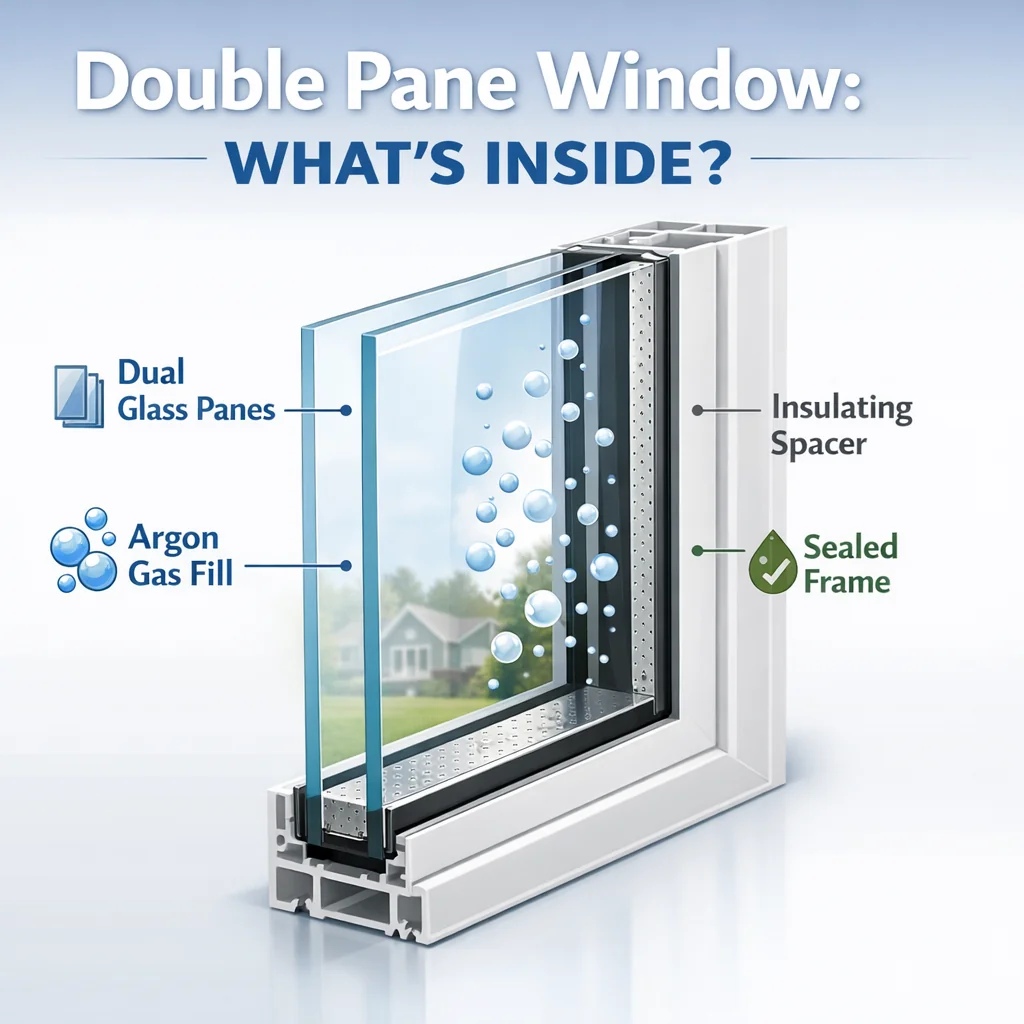
Double pane windows are one of the most straightforward upgrades a homeowner can make to improve comfort, reduce energy loss, and protect their home’s interior. The concept is simple: two panes of glass, sealed together with an insulating gap between them, work together to slow the movement of heat through your window openings. But the way that system actually functions, and why it sometimes fails, is worth understanding before you replace a single window or an entire house full of them.
This guide goes beyond the marketing bullet points. We want you to understand the physics, the tradeoffs, and the questions worth asking so that you can make a confident decision for your home.
The insulating gap between the two panes is where the real work happens. Heat moves through windows in three ways: conduction through the glass itself, convection through the gas or air in the gap, and radiation across the surfaces. A single pane of glass does almost nothing to slow any of these processes. Adding a second pane with a sealed gap between them interrupts all three.
The gap width matters more than most guides acknowledge. There is an optimal range, typically between about 1/2 inch and 3/4 inch, where convective movement inside the gap is minimized. If the gap is too narrow, heat conducts straight across. If it is too wide, the gas inside the gap develops convection loops, warm gas rising on one side and cool gas falling on the other, which steadily transfers heat from the interior pane to the exterior one. Window manufacturers engineer the gap width for exactly this reason, and it is one of the variables that separates a well-built unit from a cheap one.
Most quality double pane windows are filled with argon gas rather than regular air. Argon works because it is denser and less mobile than air. When gas molecules are heavier and slower-moving, convective heat transfer across the gap slows down considerably. The result is a measurable improvement in the window’s U-factor, which is the industry’s standard measurement for how quickly heat passes through the unit.
Krypton gas, used in some high-performance narrower-gap units, is even denser than argon and performs better in tighter spaces, but it is less commonly specified in residential windows. For most homes, argon fill in a properly sized gap is the practical performance standard. If you want to explore how these options apply to your home, our windows service covers the full range of products and configurations we install across the NC Triad.
You will see both U-factors and R-values referenced in window literature. These are inverse measurements of the same thing. R-value measures resistance to heat flow; higher is better. U-factor measures how readily heat flows through the unit; lower is better. A double pane window with a low U-factor is doing a better job of keeping conditioned air inside and outdoor temperatures outside. When comparing windows, make sure you are reading these numbers in the right direction.
Low-E, short for low-emissivity, coatings are one of the most effective performance additions available for double pane windows. A microscopically thin metallic layer is applied to one of the interior glass surfaces, and it reflects radiant heat rather than letting it pass through. The result is a window that does less thermal work passively, keeping your HVAC system from compensating for the heat bleeding in or out through the glass.
What most guides leave out is that Low-E coatings come in two distinct types, and their placement within the unit changes what they actually do for your home. For a deeper look at how this technology works in practice, the article on dual pane Low-E glass for NC homes is worth reading before you finalize your specification.
Hard coat Low-E is applied during the glass manufacturing process, fused directly to the surface. It is durable and less sensitive to handling, but it is less effective at controlling radiant heat than soft coat.
Soft coat Low-E is applied in a vacuum process after the glass is made and is sandwiched inside the sealed unit where it is protected. It performs better thermally but must stay sealed inside the unit to remain effective.
Beyond coating type, the position of the coating within the unit matters for your specific climate needs:
In a place like the NC Triad, where summers involve real heat loads and winters require meaningful heating, the right Low-E specification for your home depends on your window orientation, your home’s shading, and which seasonal problem you most want to address. A knowledgeable installer will factor this in rather than simply specifying one standard coating for every window in the house.
Need a hand with this in Winston-Salem, Greensboro and the Triad? Call (336) 971-0464 or request a free estimate. Honest answers, no pressure.
The window industry frequently frames triple pane as a straightforward step up from double pane. Add a third pane, add another insulating gap, get better performance. The logic sounds right, but there are real-world tradeoffs that matter for most homeowners.
The energy savings difference between a quality double pane and a triple pane unit is measurable on a chart but small in practice. Industry voices, including manufacturers, have stated plainly that the cost premium for triple pane does not pay back through reduced energy bills for the typical homeowner. That is not a fringe opinion; it reflects the physics of diminishing returns as you add insulating layers to an already well-performing double pane unit.
This reframes the triple pane decision entirely. If energy savings are your primary motivation, the math does not support triple pane over quality double pane. Triple pane becomes a rational choice when your motivation is something other than energy ROI, specifically noise reduction near busy roads, railways, or high-traffic areas, or personal comfort preference in an extreme cold environment.
There is a counterintuitive performance issue with triple pane windows in severe cold that rarely gets discussed. Because triple pane units are so effective at insulating, very little indoor heat bleeds outward through the unit. That means the outer pane, with no meaningful heat input from inside the home, equilibrates to outdoor ambient temperature quickly. In extreme cold conditions, this can cause frost or ice to form on the exterior glass surface.
The reasoning chain works like this: more insulation between panes means less heat reaches the outer pane, the outer pane behaves like an exposed outdoor surface, and in genuine extreme cold, that means ice on the glass you cannot control from inside. This is not a hypothetical. It is a functional performance issue in the climates where triple pane is most aggressively marketed.
Triple pane windows are heavier than double pane units, and as window sizes have grown larger in modern home design, that weight becomes a real engineering consideration. The hardware, hinges, balance systems, and frame components that allow a window to open, close, and seal properly bear that load every time the window is operated.
Over the decades-long lifespan of a quality window installation, the additional stress on hardware from a heavier triple pane unit can lead to earlier wear and replacement needs. One experienced manufacturer has noted that for homeowners who want a window to last 30 to 40 years without hardware issues, double pane remains the more reliable long-term choice.
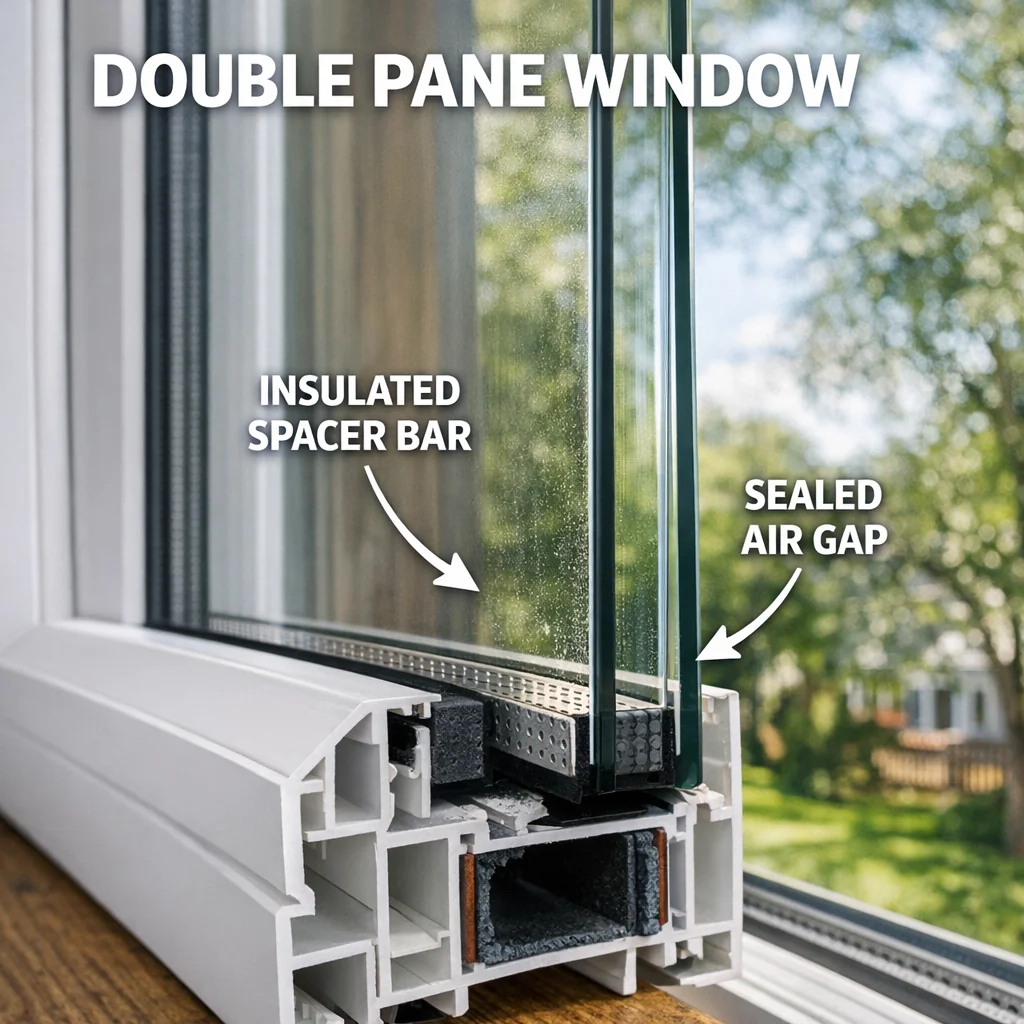
Seal failure is what turns a clear, well-performing double pane window into a fogged, milky, or streaked one. Understanding why seals fail gives you a basis for evaluating installation quality and product longevity, not just the glass itself.
Thermal cycling is the most common cause. Glass and frame materials expand and contract with temperature changes. Over years of seasonal and daily cycling, this mechanical stress fatigues the sealant material around the perimeter of the unit. Lower-quality sealants and poor bonding practices accelerate this process significantly.
Poor installation is the second major factor. A window unit that is improperly shimmed, inadequately flashed, or installed in a frame that has not been properly squared creates uneven stress on the sealed perimeter. Even a high-quality unit can fail early if the rough opening and installation are not done right.
UV degradation affects the sealant directly. Prolonged sun exposure breaks down the polymer chains in sealant materials, reducing their flexibility and adhesion over time. This is why window orientation matters for longevity as well as performance, and why frame and glazing material choices affect long-term seal integrity.
The visible signs of seal failure are fogging, condensation between the panes, a milky or hazy appearance, or in some cases a streaked residue where the gas has escaped and humidity has entered the cavity. Once the seal is broken, the insulating gas is gone and the unit’s thermal performance drops considerably. In most cases, the appropriate remedy is full unit replacement rather than attempted repair.
| Feature | Single Pane | Double Pane (Argon) | Triple Pane |
|---|---|---|---|
| Insulating layers | 1 gap | 1 sealed gap | 2 sealed gaps |
| Typical fill gas | Air | Argon | Argon or Krypton |
| U-factor (approximate range) | High (poor) | Moderate to low (good) | Low (best) |
| Noise reduction | Minimal | Moderate | Strong |
| Energy savings vs. cost premium | Baseline | Strong ROI | Weak ROI |
| Hardware longevity concern | None | None | Yes, especially large sizes |
| Exterior frost risk (severe cold) | None | Rare | Possible |
| Best suited for | Older homes, mild climates | Most residential applications | High-noise environments, personal comfort preference |
The best double pane unit on the market will underperform if it is installed in a frame that is out of square, with inadequate flashing, or with a poorly sized rough opening. The insulating gas does its job in a factory-sealed unit, but the seal depends on proper installation conditions to remain intact long-term.
This is where choosing an experienced, detail-oriented installer makes a tangible difference. At Smithrock Roofing, our window work comes with the same commitment to precision and craftsmanship that defines everything we do across roofing, siding, and gutters. We have more than 60 combined years of experience working on homes across Winston-Salem, Greensboro, High Point, Kernersville, Clemmons, Rural Hall, and the surrounding NC Triad communities, and we treat every window installation as a permanent part of the home’s exterior envelope, not just a product swap. Homeowners looking for roofing in King and the surrounding area will find the same standard of craftsmanship applied to every project we take on.
If you are ready to talk through your window project, we are straightforward to work with, easy to reach, and backed by more than 350 five-star reviews from homeowners who trusted us to get the details right.
Most double pane units are designed to last between 20 and 25 years under normal conditions, though seal longevity depends heavily on installation quality, climate exposure, and how well the frames are maintained. Windows installed in frames that flex, settle unevenly, or allow moisture intrusion tend to experience seal failure earlier. Routine caulking maintenance around the exterior frame can extend the useful life of the seal considerably.
In most cases, no. Once the seal between the two panes is compromised and the insulating gas has escaped, the only effective solution is replacing the insulated glass unit itself or the full window. Some services advertise drilling and resealing, but results are inconsistent and the insulating performance is rarely restored to its original level. Full unit replacement is generally the more reliable and lasting remedy.
Argon is a naturally occurring, non-toxic noble gas that poses no health risk. All sealed units experience a very slow rate of gas diffusion over time, but a well-manufactured and properly installed window retains the majority of its argon fill for the life of the unit. The performance difference between a window at full argon fill and one at a slightly reduced fill is minor during the early decades of use.
Double pane windows do provide a meaningful improvement over single pane glass when it comes to sound dampening, but they are not acoustically engineered by default. Their noise reduction comes primarily from the added mass and the air gap between panes. For homeowners dealing with heavy traffic, rail noise, or airport proximity, triple pane windows or specialty acoustic glazing will outperform a standard double pane unit in that specific category.
When it comes to something as permanent as window installation, the craftsmanship behind the job matters just as much as the product going into the wall, and that is exactly the standard homeowners across Winston-Salem and High Point have come to expect from Smithrock Roofing. Our team brings more than 60 combined years of hands-on experience to every project, treating your home’s exterior envelope with the same care and precision we apply to every roof, siding, and gutter job we complete. If you are ready to move forward or simply want honest answers about your windows, give us a call at (336) 971-0464 or Contact Smithrock Roofing to get started.

Smithrock Roofing © Copyright 2026 • All Rights Reserved • Privacy Policy • Maintained by Mongoose Digital Marketing