
You notice it on a cold morning: a cloudy film sitting between your window panes that no amount of cleaning will touch. Or maybe you press your hand near the glass and feel a draft that should not be there, with the frame looking perfectly intact from the outside. Both situations point to the same problem, a failed insulated glass unit, and both raise the same immediate question: does the whole window need to come out, or can the glass alone be replaced?
The honest answer is that it depends on your frame condition, and getting that assessment right before you order anything saves a significant amount of time, money, and frustration. This guide walks through how double pane window replacement actually works, what competitors and product pages rarely explain fully, and how to make a confident decision for your home.
A double pane window is built around an insulated glass unit, commonly called an IGU. The IGU consists of two panes of glass separated by a hollow spacer bar, sealed along all edges. The cavity between the panes is either filled with dehydrated air or an inert gas, typically argon, and the spacer bar contains a desiccant material that absorbs any residual moisture that enters the cavity over time.
The result is a self-contained thermal barrier. The gas fill slows heat transfer, the desiccant prevents interior condensation, and the dual-seal perimeter keeps everything stable. When every component is working, the unit insulates well and stays visually clear.
Here is the part that almost no product listing or competitor page bothers to explain: the seal does not fail because it was poorly made. It fails because glass, metal, and sealant materials all expand and contract at different rates as temperatures rise and fall. Every day, your window frames flex slightly. Over years, that repeated movement fatigues the seal at the perimeter of the IGU, and microscopic breaches develop.
Once a breach exists, outside air and moisture enter the cavity. The desiccant in the spacer bar absorbs that moisture until it is saturated, at which point condensation begins forming between the panes. That is the cloudy, fogged appearance that tells you the seal has finally failed. The glass itself may be structurally fine. The frame may be in excellent condition. But the IGU is finished and needs to be replaced.
Understanding this mechanism matters because it should inform how you approach the replacement, specifically the sealant method you use when installing the new unit. If you want a deeper look at what the full scope of replacement involves before committing to a path, the window replacement cost complete guide from Smithrock Roofing breaks down pricing variables in useful detail.
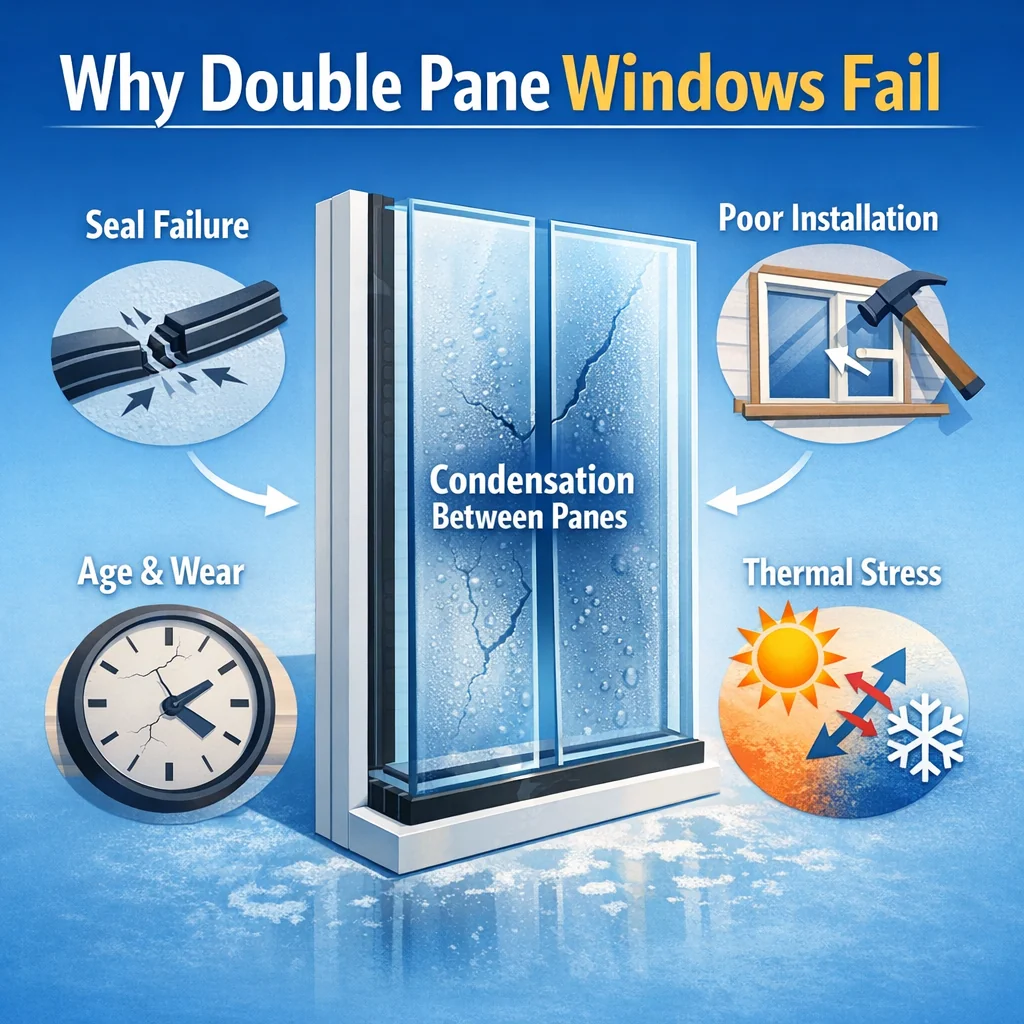
The most important decision you will make is whether to replace just the IGU or the entire window, frame and all. Replacing only the glass unit is less disruptive and generally less expensive, but it is only appropriate under specific conditions.
Glass-only replacement works when:
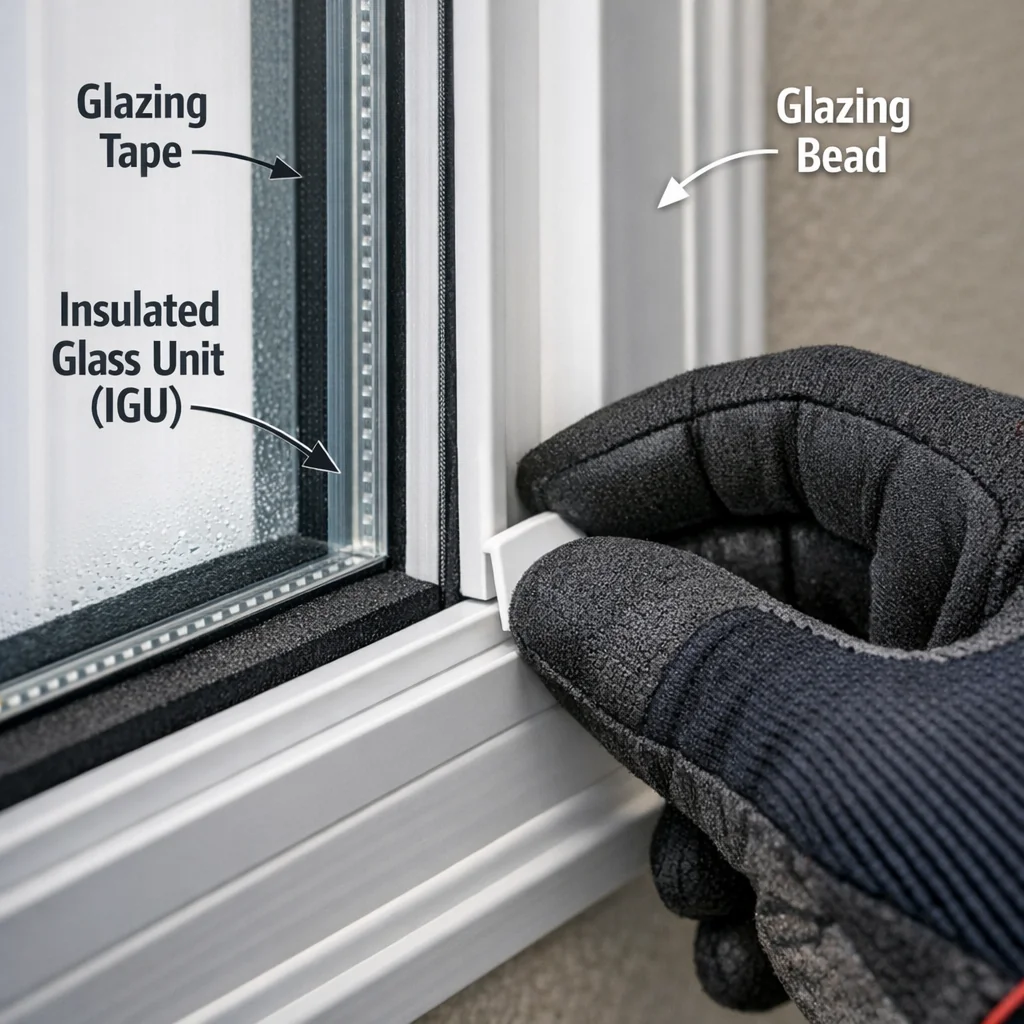
Glazing beads are the narrow strips of material, usually vinyl or wood, that hold the glass unit inside the frame. They snap or screw into place and can typically be pried off carefully with a stiff-blade tool. If they are intact, replacing the IGU is straightforward: remove the stops, lift out the old unit, clean the frame channel, install the new unit with appropriate sealant, and reinstall the stops.
The caution here is that glazing beads can be brittle, especially on older vinyl frames. They can also be painted over in wood-frame homes, making removal destructive. If the stops cannot be removed cleanly, you cannot install a new IGU without damaging the frame, and at that point the economics shift toward full window replacement.
Full replacement becomes the better call when:
A contractor worth trusting will assess your frame condition before recommending one path over the other. The goal is not to sell you a full window when glass-only would do, and it is not to install a new IGU into a compromised frame that will cause the new unit to fail prematurely. Smithrock Roofing’s windows service covers both IGU-only and full replacement scenarios, with honest assessments tailored to your frame condition.
Need a hand with this in Winston-Salem, Greensboro and the Triad? Call (336) 971-0464 or request a free estimate. Honest answers, no pressure.
If you are moving forward with IGU replacement, the unit must be ordered to exact specifications. This is where homeowners most often run into problems, either by measuring incorrectly or by selecting specifications without understanding their performance implications.
The single most common ordering mistake is measuring the glass itself rather than the frame opening. When a glazier manufactures a replacement IGU, the unit is sized to fit the frame opening with a small gap on each side, typically about an eighth of an inch, to allow for sealant and slight frame movement. If you measure the old glass and order to that dimension exactly, the new unit may fit too tightly.
Measure the frame opening (the daylight opening plus the rabbet depth on each side) and confirm the required IGU thickness by measuring the channel depth in your frame. IGUs are manufactured in a range of thicknesses, and selecting one that is too thin will leave it loose in the channel, while one that is too thick simply will not seat properly.
Many replacement IGUs are available with argon gas fill, which provides a modest improvement in thermal performance compared to dehydrated air. The catch for DIY installations, and the detail that no competitor page addresses clearly, is this: argon gas begins escaping the moment the factory seal on the old unit is broken and the frame is opened to the atmosphere. A new argon-filled unit, once removed from its packaging and installed, begins losing its gas fill during the time it spends open to air before the new perimeter seal cures.
For professional installations where the unit is sealed quickly and correctly, gas fill retention is achievable. For DIY projects, especially those that take time or require adjustments, the installed unit may end up functioning as an air-filled unit regardless of what was specified. This is not a reason to avoid replacement; air-filled double pane windows still outperform single pane glass significantly. It is simply a reason to be realistic about what you are getting and to work efficiently if gas retention matters to you.
Product pages from IGU suppliers typically list spacer options as color choices: aluminum, champagne, dark bronze, or variations of “warm edge” spacer in grey or black. This framing obscures something important.
Aluminum spacers, despite being common and cost-effective, are thermally conductive. Heat moves along an aluminum spacer from the warmer interior glass edge toward the cooler exterior glass edge, which creates a thermal bridge at the perimeter of the unit. The practical result is that the glass edge is colder than the center, which is exactly where condensation forms first and where the perimeter sealant experiences the most thermal stress.
Warm-edge spacers, made from materials with lower thermal conductivity, reduce this edge heat transfer. The glass stays more uniformly tempered across its surface, condensation risk at the edge drops, and the sealant is subjected to less thermal cycling stress. This directly relates to how long the new seal will last.
When choosing a spacer, think of it as a thermal performance specification that happens to come in different colors, not a color choice that happens to be labeled with material names.
Once the correct IGU is in hand, it needs to be seated in the frame and sealed. The two most common methods are double-sided glazing tape and silicone sealant. A popular piece of DIY advice says to simply match whatever method was originally used, but this reasoning has a flaw.
If the original sealant failed, matching it exactly may reproduce the same failure mode. The question worth asking first is why it failed.
| Failure Cause | Recommended Sealant Approach |
|---|---|
| Normal age and seal fatigue (10+ years of service) | Either method is appropriate; silicone provides a continuous seal |
| Frame flex or movement evident at corners | Flexible glazing tape is generally more accommodating of movement |
| Previous silicone that cracked or separated at edges | Consider whether frame rigidity has changed; tape may perform better |
| Previous tape that lifted or lost adhesion | Verify frame surface is clean and primed; tape adhesion failure is often a surface prep issue |
| Unknown cause | Inspect frame corners for movement; if solid, silicone; if any flex, tape |
The frame condition drives the decision. A rigid, stable frame seats well with either method. A frame that shows any movement at the corners, which you can test by pressing gently at the corner joints while watching for flex, benefits from a sealant system that accommodates that movement rather than one that cures rigid and cracks when the frame shifts.
Not every window problem is an IGU seal failure. Knowing what you are actually looking at prevents unnecessary replacement orders.
Confirmed IGU seal failure (replace the glass unit):
– Fogging or cloudy film between the panes that does not clear with temperature changes
– Visible condensation forming on the interior glass surface between the two panes
– Streaking or mineral deposits inside the unit from repeated moisture cycling
Frame or installation problems (replacement alone will not fix these):
– Drafts around the frame perimeter even though the glass looks fine
– Visible gaps between the frame and the rough opening in the wall
– Difficulty opening or closing the sash, suggesting frame warping
– Rotted or soft wood visible on the frame exterior
Both glass and frame need attention:
– Fogging combined with drafts or visible frame damage
– Multiple windows failing in a short period, which can indicate a systemic issue with the window line installed in the home
Homeowners across the NC Triad, in Winston-Salem, Greensboro, High Point, Kernersville, roofing in Clemmons, Rural Hall, King, and the surrounding communities, have options when it comes to window work. What separates a reliable contractor from a frustrating experience is not just technical skill; it is willingness to give you an honest assessment before recommending a scope of work.
At Smithrock Roofing, we have more than 60 combined years of experience working on home exteriors, and windows are part of the complete exterior picture we look at for every home we visit. Our approach is straightforward: assess what is actually happening, explain it clearly, and recommend the repair or replacement that solves the problem without overcorrecting. We back our work with a 5-year labor warranty, and our more than 350 five-star reviews from homeowners across the Triad reflect the kind of service we deliver on every job.
If you are looking at fogged windows and wondering whether you need new glass, new frames, or something else entirely, the right starting point is a conversation with someone who will look at your windows without a predetermined answer in mind.
In many cases, yes. If the glass unit itself has failed but the frame is still in good condition, a glazier or window contractor can replace just the insulated glass unit rather than the full window. This is often the most practical solution for homeowners who have solid frames but are dealing with seal failures that cause the foggy appearance between the panes.
Most insulated glass units are designed to last between 15 and 25 years, though the actual lifespan varies depending on the quality of the original installation, the climate, how much direct sun exposure the windows receive, and how well the frames have held up over time. Windows on south and west facing walls tend to experience more thermal stress and may show seal failure earlier than windows on shaded sides of the home.
Yes. When the seal between the two panes breaks down, the inert gas that was originally sealed inside the unit escapes and is replaced by ordinary air. That gas, typically argon, is part of what makes double pane windows more insulating than single pane glass. Once it is gone, the window loses a measurable portion of its insulating value, which can show up as higher heating and cooling costs over time.
Fogging, streaking, or condensation that appears between the two panes of glass points to a seal failure in the insulated glass unit itself. Drafts coming from around the edges of the window, visible gaps between the frame and the wall, or a sash that no longer opens and closes smoothly usually indicate a frame problem. Sometimes both issues are present at the same time, which is why a hands-on inspection is the most reliable way to determine what actually needs to be addressed.
Homeowners in Winston-Salem and Greensboro dealing with fogged or drafty windows deserve a straight answer about what is actually wrong before any work begins, and that is exactly the approach Smithrock Roofing brings to every exterior assessment. With more than 60 combined years of experience and a 5-year labor warranty backing every job, our team is equipped to evaluate your windows honestly and recommend only what your home genuinely needs. Call us at (336) 971-0464 or Contact Smithrock Roofing to schedule your free estimate today.

Smithrock Roofing © Copyright 2026 • All Rights Reserved • Privacy Policy • Maintained by Mongoose Digital Marketing