Hiring a roofing contractor is straightforward until something goes wrong. A leak appears, a warranty claim gets filed, and two parties, the manufacturer and the installer, each point at the other. The homeowner is left managing a dispute they never expected and were never told to prepare for. That situation is not rare, and it is not inevitable. It usually traces back to a few things that did not get explained clearly before the contract was signed.
This article covers what those things are: how the two-warranty system actually works, what job-site cleanup genuinely signals about installation quality, why your roof functions as a system rather than a stack of individual materials, and what questions to ask any contractor before work begins. If you are weighing options in Winston-Salem, Greensboro, High Point, Kernersville, Clemmons, Rural Hall, King, or anywhere else in the NC Triad, this is the reasoning behind the decision, not just the checklist.
Every reputable roofing contractor will mention warranties. Fewer explain what each one actually covers or, more importantly, what happens when they interact.
A manufacturer warranty covers defective materials. If a shingle batch was produced with a bonding flaw, a granule adhesion problem, or a dimensional inconsistency, the manufacturer is responsible. This warranty is issued by the company that made the product, and it transfers to the homeowner at the time of installation.
A workmanship warranty covers installation errors. If a flashing is improperly set, if nails are driven at the wrong angle, if underlayment is overlapped incorrectly, or if a valley is cut short, those failures fall under the installer’s workmanship warranty, not the manufacturer’s.
Here is where the problem develops. When a leak appears, the cause determines which warranty applies. Water intrusion caused by a defective shingle is a manufacturer issue. Water intrusion caused by improper flashing is an installation issue. In many cases, the cause is not immediately obvious, and without proper diagnostics, you can end up with a manufacturer saying the product is fine and a contractor saying they installed it correctly.
A contractor who backs their work with both warranties, and who holds a manufacturer certification that upgrades the warranty coverage, eliminates that finger-pointing problem. The accountability sits in one place. You can learn more about how Smithrock Roofing structures this coverage on our Warranty page.
Manufacturer certifications like CertainTeed’s PREMIER ShingleMark Master certification are not honorary titles. They require contractors to meet verified installation standards, carry adequate insurance, maintain a customer satisfaction record, and complete documented training requirements. The practical result is that certified contractors can offer enhanced warranty tiers that uncertified contractors cannot.
Smithrock Roofing holds CertainTeed PREMIER ShingleMark Master Certified status, which is one reason the warranty coverage available to our customers exceeds what a standard installation provides.
| Warranty Type | What It Covers | Who Issues It | What Can Void It |
|---|---|---|---|
| Manufacturer Warranty | Defective materials, premature failure of product | Shingle or material manufacturer | Installation by a non-certified contractor; improper ventilation |
| Standard Workmanship Warranty | Installation errors, labor defects | The roofing contractor | Damage from unrelated causes; improper maintenance |
| Enhanced Warranty (Certified Contractors) | Combined materials and labor, single point of accountability | Manufacturer, backed by certified installer | Same voiding conditions, but dispute resolution is clearer |
Ask any contractor you are considering: is your workmanship warranty separate from the manufacturer warranty, or does your certification status integrate them? And if there is a disputed claim, who arbitrates it?
Nearly every roofing contractor mentions cleanup as a selling point. What none of them explain is why it matters beyond basic courtesy.
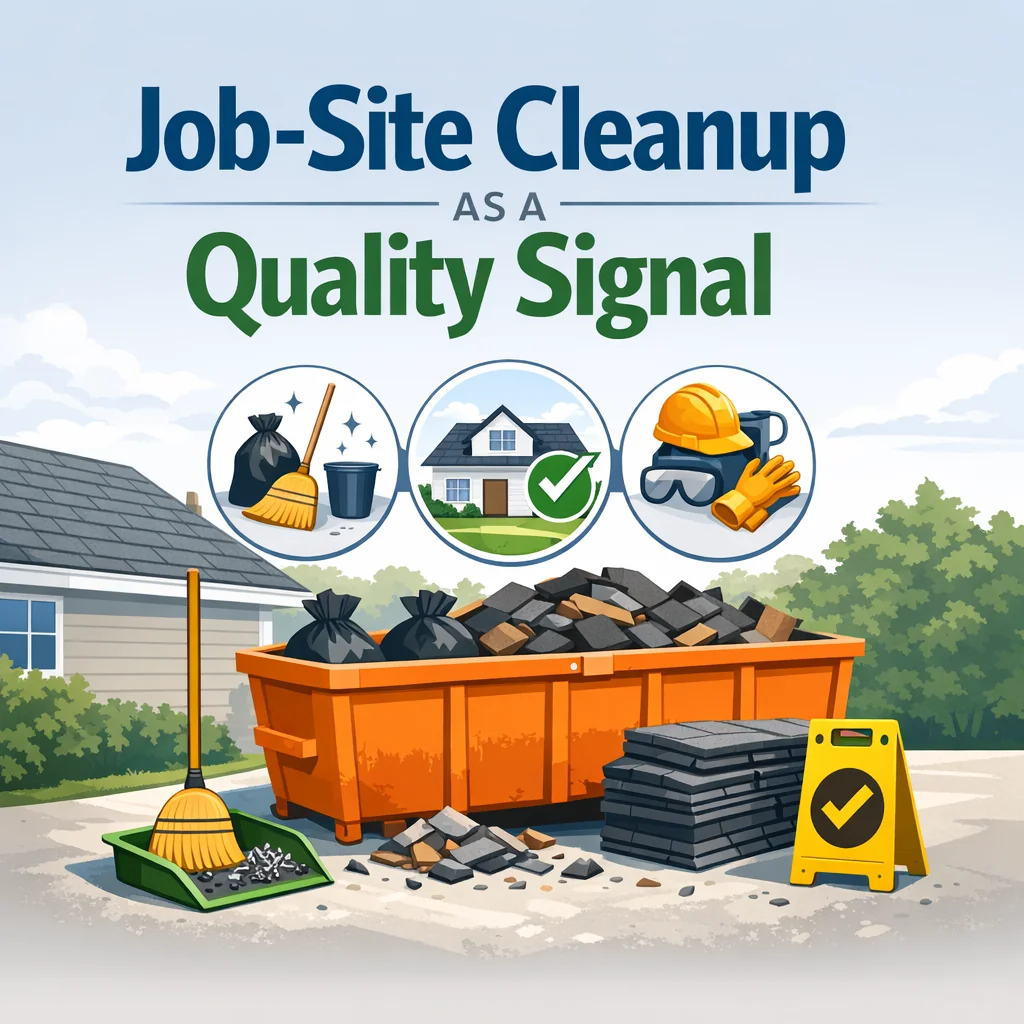
A roofing crew is on your property for one to several days depending on the scope of work. The habits they display in visible areas, your yard, your driveway, your landscaping, are the same habits they bring to areas you will never see again once the job is complete.
Flashing placement, underlayment overlap, nail pattern consistency, ridge cap alignment: none of these are visible after the shingles go down. The only real-time window you have into how a crew manages detail work is watching how they manage everything else. A crew that stages materials deliberately, sweeps for nails methodically, and removes debris at the end of each work day is showing you a discipline pattern. That same pattern is present when they set the drip edge, seat the valley flashing, and sequence the underlayment on the deck.
The inverse is also true. A crew that leaves the job site in disarray at the end of day one is revealing something about how they approach tasks where no one is watching. If you are unsure what warning signs to look for before a project begins, the article on signs of roof damage you can’t ignore offers a useful reference for assessing your roof’s current condition.
When interviewing contractors, ask directly: does cleanup happen daily or only at project completion? Listen carefully. The answer is not about aesthetics.
Need a hand with this in Winston-Salem, Greensboro and the Triad? Call (336) 971-0464 or request a free estimate. Honest answers, no pressure.
The most common framing mistake homeowners make when evaluating roofing proposals is treating a roof as a list of individual components rather than an integrated system. Contractors who reinforce that framing, whether intentionally or not, are doing you a disservice.
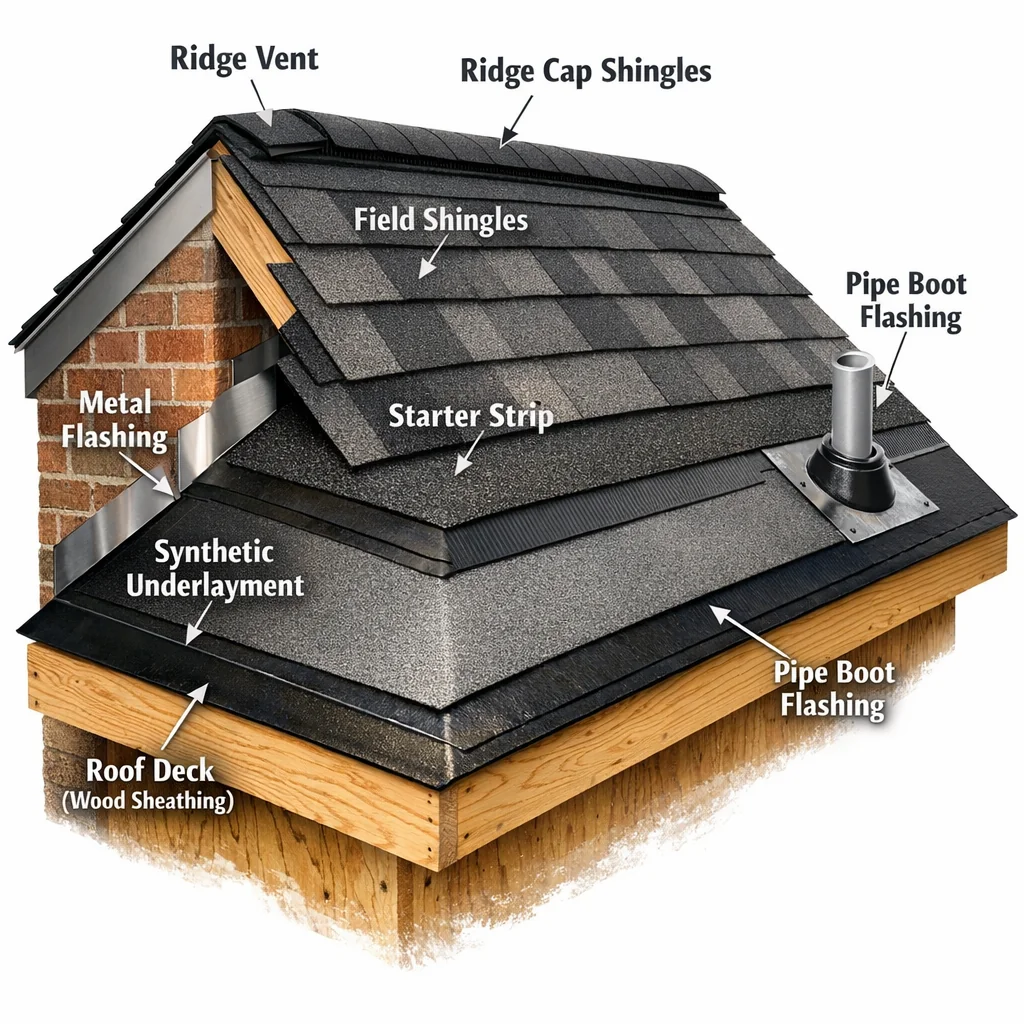
A premium shingle is designed to perform within a complete system. That system includes:
Each of these components must be correctly specified and correctly installed for the system to perform at the level the shingle warranty describes. A contractor who upgrades only the shingle without addressing deck condition, ventilation, or flashing is selling you a component. A contractor who evaluates and addresses the full system is protecting your home.
Smithrock Roofing uses CertainTeed Landmark shingles as part of a complete system installation through our roofing service, backed by 60-plus combined years of experience and a 5-year labor warranty alongside the manufacturer’s limited lifetime warranty. When you talk with our team, the conversation covers the whole roof, not just the surface layer.
Knowing the right questions creates a straightforward way to evaluate any roofing contractor, including us.
Honest answers to these questions tell you more about a contractor than any rating summary will. Smithrock Roofing has more than 350 five-star reviews across the NC Triad not because we are the loudest voice in the market, but because we answer these questions directly and then deliver on them. We are fully licensed and insured, and we work across Winston-Salem, Greensboro, High Point, Kernersville, roofing in Clemmons, Rural Hall, King, and the broader Triad area.
If you are ready to talk through your roof, we offer free estimates with no pressure and no runaround. Call us or fill out the contact form to get started.
The answer depends on factors your contractor should assess in person, including the age of the shingles, the condition of the decking beneath them, whether flashing has failed, and how ventilation is functioning. A shingle that looks worn on the surface may be covering deeper structural issues, while some visible damage is limited enough to address through targeted repair. A thorough inspection of the full system, not just the surface layer, gives you an accurate picture before any decision is made.
A manufacturer warranty covers defects in the roofing materials themselves. A labor warranty, which the installing contractor provides, covers the quality of the installation work. Both matter because a material failure and an installation failure can produce identical symptoms. Smithrock Roofing backs its work with a 5-year labor warranty alongside the manufacturer’s limited lifetime warranty on CertainTeed Landmark shingles, so both sides of the coverage are addressed.
Yes, significantly. Inadequate attic ventilation causes heat and moisture to build up beneath the roof deck, which degrades shingles from the underside and can void manufacturer warranty coverage. Proper ventilation is part of a correctly installed roofing system, not an optional upgrade. It is one of the components Smithrock Roofing evaluates as part of every project rather than treating the shingle layer as the only variable.
Most residential replacements are completed in one to two days, though the timeline depends on roof size, complexity, pitch, and the condition of the decking once the old shingles are removed. Unexpected deck damage discovered during tear-off can extend the schedule. Your contractor should communicate clearly about the timeline before work begins and keep you informed if conditions on the job change that estimate.
Smithrock Roofing has spent more than six decades of combined experience earning the trust of homeowners across Winston-Salem, Greensboro, and the broader NC Triad by doing the work right the first time and standing behind it. If your roof needs attention, whether you are in High Point, Kernersville, or anywhere in the surrounding area, our team is ready to walk you through an honest assessment with no pressure attached. Call us at (336) 971-0464 or Contact Smithrock Roofing to schedule your free estimate today.

Smithrock Roofing © Copyright 2026 • All Rights Reserved • Privacy Policy • Maintained by Mongoose Digital Marketing