You scheduled a flat roof inspection because you noticed a soft spot near the roofline and water staining on an interior ceiling. The inspector arrives, looks at your membrane, and immediately starts listing material options. Before you can ask a single question, you have a proposal in hand. That fast turnaround might feel efficient, but it skips the most important part of the job: understanding why the problem happened in the first place, and designing the installation to prevent it from recurring.
Flat roofing is one of the more misunderstood segments of residential and commercial construction. The decisions that determine whether a flat roof performs for 20-plus years or fails in five are made during the design and installation phase, not the material selection phase. Choosing the right flat roof installation contractor means understanding what those decisions are, what questions to ask before any work begins, and what separates a contractor who installs membranes from one who installs roof systems.
Smithrock Roofing serves homeowners and property owners across Winston-Salem, Greensboro, High Point, Kernersville, Clemmons, Rural Hall, King, and surrounding NC Triad communities. With 60-plus combined years of experience, a CertainTeed PREMIER ShingleMaster certification, and more than 350 five-star reviews, the team brings the same whole-system discipline to every flat roof project that has made Smithrock a trusted name in exterior work throughout the region.
On a pitched roof, gravity does most of the drainage work. Water hits the surface and moves. On a flat roof, or more accurately a low-slope roof, gravity is weaker and drainage must be engineered into the system from the start. That single difference changes nearly every installation decision that follows.
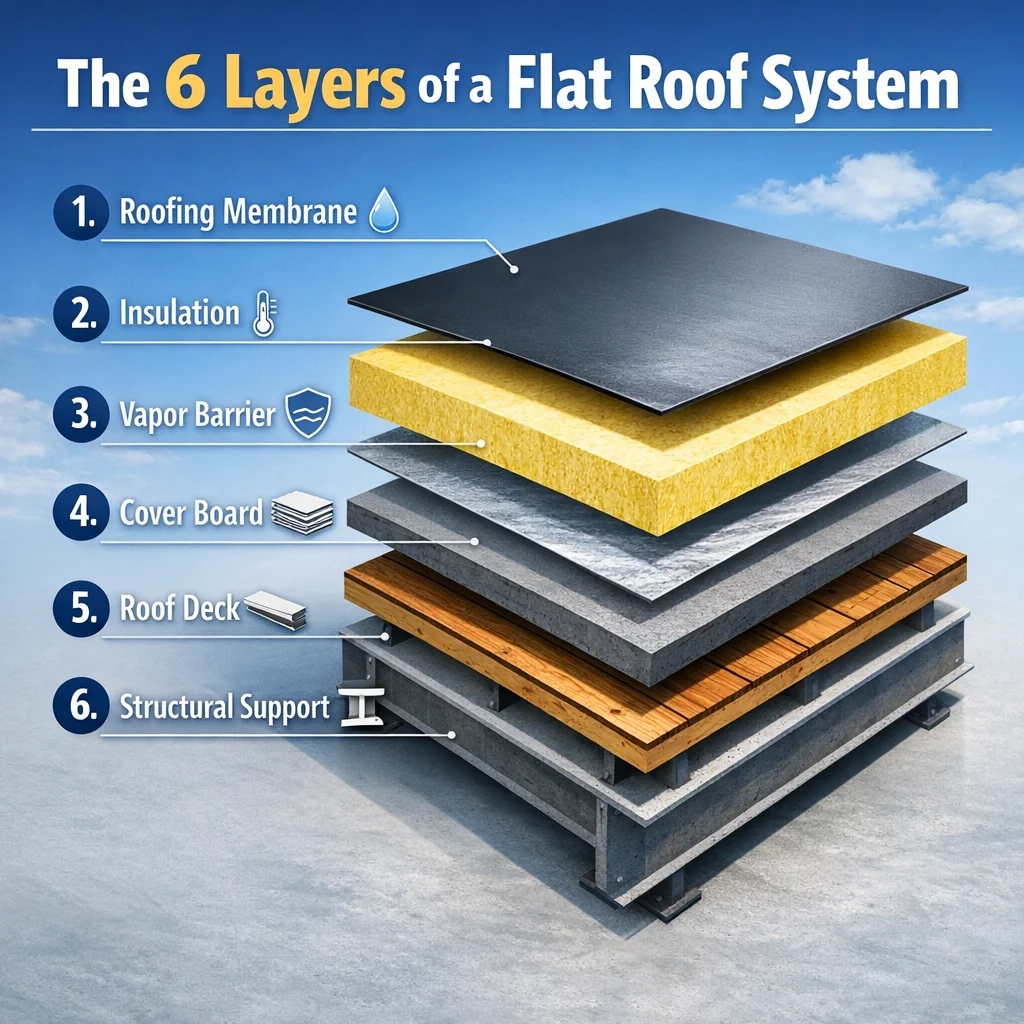
Flat roofing involves multiple interdependent layers, and each one affects how the others perform. A failure in any layer creates problems that eventually show up at the surface, which is usually the last place the failure actually originated.
The core assembly, from the structure outward, looks like this:
A contractor who speaks only about the membrane is describing one layer of a six-layer system. The other five layers determine how that membrane performs. If you want a broader overview of what professional roofing services encompass beyond the membrane layer, that context is worth reviewing before any contractor conversation begins.
TPO, PVC, EPDM, Modified Bitumen, and Built-Up Roofing are the most common flat roof membrane systems. Most contractors present these as a product list. A better way to think about them is as a set of trade-offs that interact with your building’s specific conditions.
| Membrane | Best Suited For | Key Strength | Key Limitation |
|---|---|---|---|
| TPO (Thermoplastic Polyolefin) | Residential and light commercial; energy-efficient builds | Reflective surface reduces heat gain; weldable seams | Seam quality varies significantly by installer skill |
| PVC (Polyvinyl Chloride) | Commercial and restaurant applications; chemical exposure environments | Highly durable; excellent chemical resistance | Higher material cost; less flexible in cold temperatures |
| EPDM (Ethylene Propylene Diene Monomer) | Low-traffic residential flat roofs; budget-sensitive projects | Long track record of durability; easy to repair | Dark surface absorbs heat; seams are adhered, not welded |
| Modified Bitumen | Roofs with foot traffic; re-roofing over existing systems | Torch-applied options bond tightly; good puncture resistance | Requires careful application; fire precautions during install |
| BUR (Built-Up Roofing) | Large commercial roofs; high-durability applications | Multiple redundant layers; time-tested performance | Heavy; requires skilled crew; longer installation time |
The right membrane for your project depends on the size and geometry of your roof, the building’s interior use, local temperature swings, whether the roof sees foot traffic, and what the existing substrate can support. A flat roof installation contractor who recommends a membrane before evaluating those variables is working from preference, not assessment.
Need a hand with this in Winston-Salem, Greensboro and the Triad? Call (336) 971-0464 or request a free estimate. Honest answers, no pressure.
This is the part of flat roof installation that almost never comes up in a typical contractor conversation, yet it directly affects wind uplift resistance, longevity, and whether your installation is compatible with the substrate underneath.
There are three primary attachment methods:
Mechanically Fastened
The membrane is fastened to the substrate using screws and plates at defined intervals. This is faster to install and works well on many substrates. The trade-off is that the fastener points can be stress concentrations over time, and the method relies on the fasteners remaining secure as the building shifts and the membrane expands and contracts with temperature.
Fully Adhered
The membrane is bonded directly to the cover board or substrate using adhesive across the entire surface. This creates the most uniform hold and eliminates the flutter and billowing that can develop around mechanically fastened seams in high-wind conditions. It requires a very clean, consistent substrate and more installation time.
Ballasted
The membrane is laid loose and held down by the weight of river stone or pavers. This is the fastest installation method and allows the membrane to expand freely. However, it adds significant dead load to the roof structure and is not appropriate for all buildings.
The attachment method should be chosen after evaluating the deck type, the building’s wind exposure, and the membrane system being used. Ask your contractor which method they are recommending and why. A clear, specific answer is a signal of genuine installation competence.
Ponding water is the most frequently cited flat roof problem, and it is almost always framed as something to manage after the fact. The honest answer is that chronic ponding is a design and installation failure, not an inherent flat roof characteristic.
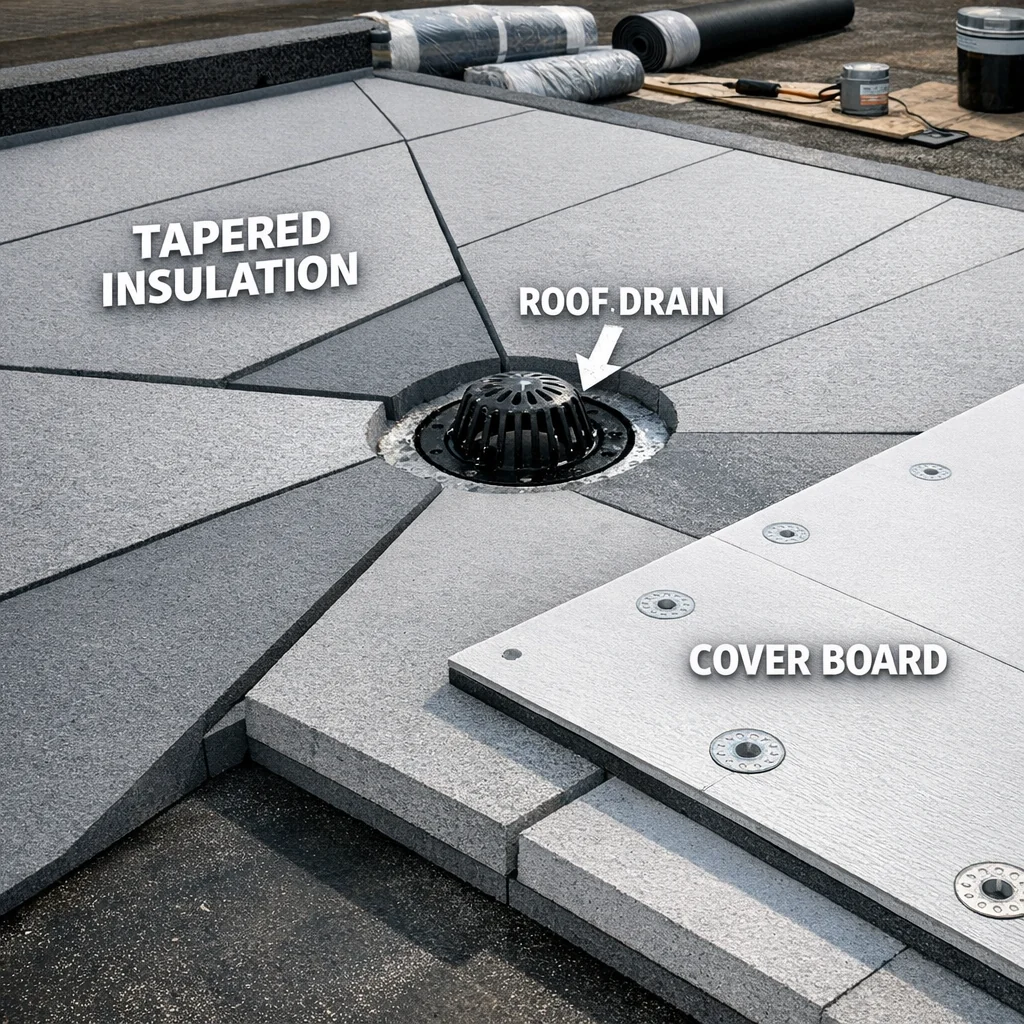
A properly installed flat roof has positive drainage slope built into it. The standard in the industry is a minimum slope of one-quarter inch of rise per horizontal foot. This slope can be achieved through structural framing, but it is more commonly built into the insulation layer using tapered insulation panels. When the insulation is flat and the drains are in the wrong location, water finds the lowest point of the roof and stays there.
If your flat roof proposal does not address drainage slope and drain placement as part of the installation plan, the conversation needs to back up. A membrane installed over a drainage problem is a membrane on a clock. For a deeper look at what goes into pricing a project like this, the article on flat roof replacement estimates breaks down the cost factors that drainage design decisions directly influence.
A contractor license tells you that a business is legally allowed to operate in North Carolina. A manufacturer certification tells you something more specific: that the contractor has been trained and tested on the installation procedures for a particular membrane system.
This distinction matters more for flat roofing than for almost any other exterior application. TPO and PVC membrane systems, for example, require heat-welded seams. The quality of those seams is not visible to the naked eye, and a poorly welded seam will not show signs of failure until water has already breached the system. Manufacturer certifications for these systems typically require the installer to demonstrate correct seam technique, correct overlap widths, and correct termination and flashing procedures.
More directly relevant to you as a property owner: many membrane manufacturer warranties are voided if the installation is not performed by a certified contractor using that manufacturer’s approved methods. You can purchase a 20-year warranted product and have no warranty coverage whatsoever if the installer was not certified in that system. Asking a contractor for their manufacturer certifications before signing a contract is not an unreasonable request. It is due diligence.
Smithrock Roofing holds CertainTeed PREMIER ShingleMaster certification and backs all work with a 5-year labor warranty alongside the applicable manufacturer warranty. That combination means the installation methodology and the material are both covered, and the company stands behind both.
Flat roofing spans both residential and commercial applications, and the same systems appear in both settings. But the installation context differs in ways that affect contractor suitability.
Residential flat roofs are common on modern architectural homes, low-slope additions, and garage roofs. They are typically smaller, have more complicated geometry (multiple planes, parapet walls, penetrations relative to overall square footage), and require a contractor comfortable working with the tighter tolerances of residential construction.
Commercial flat roofs cover larger, more uniform areas and often need to accommodate rooftop equipment. The structural loads, warranty expectations, and inspection requirements differ from residential standards.
A contractor with extensive commercial flat roofing experience is not automatically qualified to handle a complicated residential flat roof, and vice versa. Ask specifically about the type of flat roof projects in a contractor’s portfolio before committing.
Before you sign anything, these questions will tell you more about a contractor’s competence than their website ever will:
A contractor who answers each of these questions with specifics earned the right to be on your roof. A contractor who deflects with generalizations is showing you something important.
Smithrock Roofing serves the NC Triad with a straightforward approach: assess the whole system first, recommend what fits the specific roof, explain the reasoning, and back the work with a 5-year labor warranty and manufacturer coverage. With more than 350 five-star reviews across Winston-Salem, roofing in Greensboro, High Point, Kernersville, Clemmons, Rural Hall, King, and neighboring communities, the reputation is built on the kind of honest, skilled work that keeps roofs performing long after the crew has left the job site.
Most residential flat roof installations are completed within one to three days, depending on roof size, the membrane system being installed, and whether any deck repairs are needed before installation begins. Commercial projects or roofs with significant existing damage may take longer. A qualified contractor will give you a realistic timeline after assessing the specific conditions of your roof.
Poor drainage design and improper flashing at penetrations and parapet walls are the most frequent causes of early flat roof failure. When water has nowhere to go or when transitions between the membrane and vertical surfaces are not sealed correctly, leaks are almost inevitable. Choosing a contractor who addresses slope, drainage, and flashing as part of the installation, not as afterthoughts, is the most reliable way to avoid these problems.
Flat roofs do benefit from routine inspections, particularly after severe weather and at least twice per year. Because water drains more slowly across a flat surface, small issues like debris buildup around drains or minor membrane punctures can escalate faster than they would on a pitched roof. Regular inspections allow problems to be caught and corrected before they become significant structural concerns.
The right membrane depends on several factors: your climate, the substrate beneath the roof, the presence of rooftop equipment, building use, and local code requirements. TPO, EPDM, and modified bitumen each perform differently under varying conditions. A contractor who evaluates your specific roof and explains the reasoning behind their recommendation, rather than defaulting to one system for every job, is the one worth trusting with the decision.
Flat roof installation is too technical and too consequential to hand off to a contractor who treats every roof the same way. Smithrock Roofing has built a reputation across Winston-Salem and Greensboro by doing the opposite, assessing each roof as its own system, recommending what genuinely fits, and standing behind the work with both a labor warranty and manufacturer coverage. If your flat roof is due for installation or you’re not sure where things stand, call (336) 971-0464 or Contact Smithrock Roofing to get an honest assessment from a team that knows this region and knows flat roofs.

Smithrock Roofing © Copyright 2026 • All Rights Reserved • Privacy Policy • Maintained by Mongoose Digital Marketing