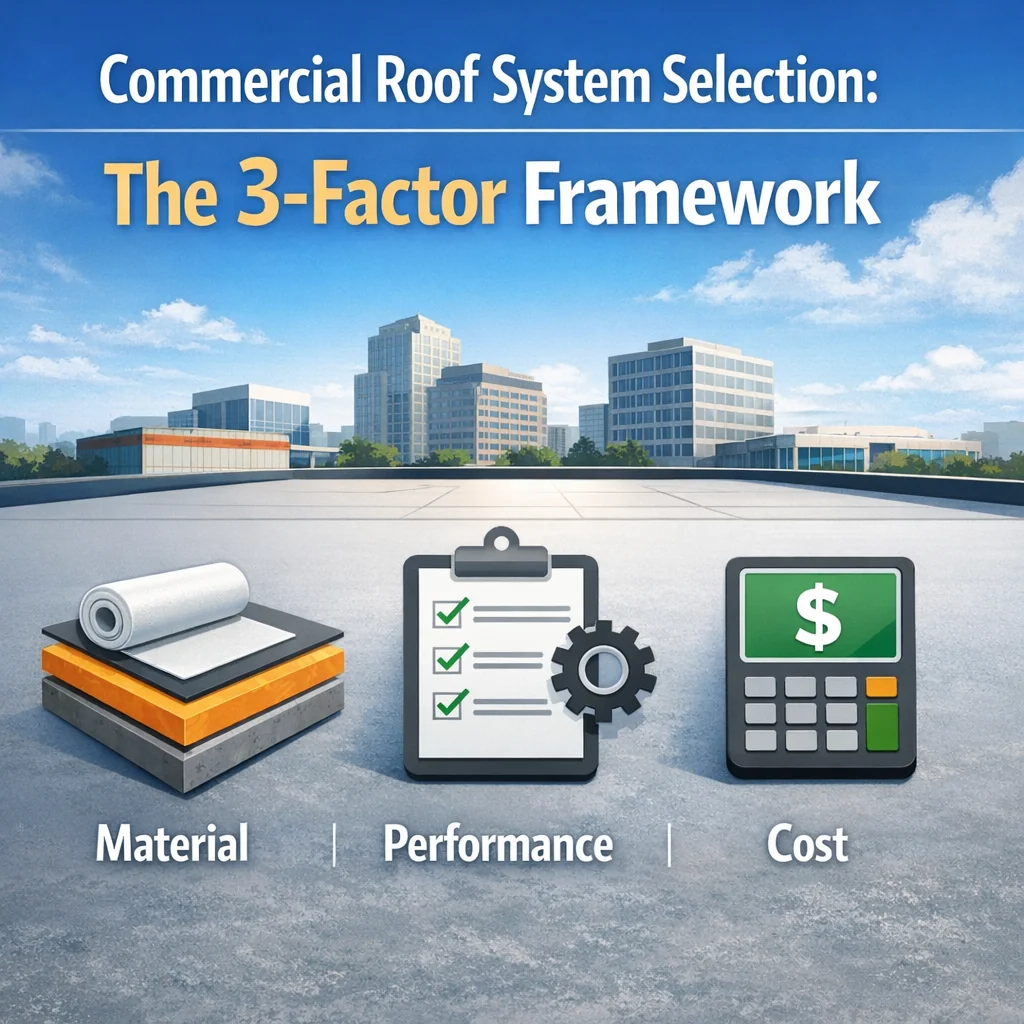
Commercial roofing decisions go sideways most often at the beginning of the process, not at the end. A property owner or facilities manager requests bids, receives a list of available roof systems, and is asked to choose without being given the logic that should drive that choice. Contractors list TPO, EPDM, PVC, modified bitumen, and metal as parallel options, but never explain which building conditions favor one system over another. The result is that price becomes the default decision variable, when it should be one of the last factors considered.
This article works through the actual evaluation sequence an experienced commercial roofing professional uses, explains what warranty structures mean for your claims experience, and describes what genuine multi-property service looks like in practice. The goal is to give building owners and facilities directors in the Greensboro area the framework to ask better questions and make more confident decisions.
The question commercial property owners most often want answered is simple: which roof system is right for my building? The honest answer is that the building answers that question before the contractor does. A few observable conditions narrow the field significantly.
Flat and low-slope commercial roofs depend on drainage performance more than any other single variable. If a roof has compromised slope, undersized drains, or recurring ponding, that condition must be addressed before a membrane system is selected, not after. Standing water accelerates the degradation of some membrane types faster than others, and installing a system that is sensitive to prolonged moisture contact onto a roof with drainage problems is a decision you will pay for before the warranty period ends.
Once drainage capacity is confirmed or corrected, the substrate condition determines whether a recover (installing a new membrane over the existing system) is structurally sound, or whether a full tear-off is required. This matters because some membrane systems perform differently over aged insulation or irregular substrates. For a deeper look at how these factors interact across different system types, the Commercial Roofing Systems: What Owners Must Know article covers the full landscape in detail.
HVAC units, skylights, pipe boots, curbs, and exhaust vents are the points where most commercial roofs fail. The more of these penetrations a roof has, the more critical the membrane’s termination and flashing performance becomes. Some membrane systems seal more reliably at complex termination points than others, and a building with high penetration density needs a system selected with that in mind, not one chosen because it was the lowest bid.
This is why walking the roof before recommending a system is not optional. A contractor who provides a system recommendation from a square footage figure and a photograph is skipping the step that protects you.
What happens inside the building directly affects what belongs on top of it. Industrial operations that generate heat, chemical fumes, or extreme temperature cycling place different demands on a membrane than a standard office building or retail space. Rooftop foot traffic from mechanical maintenance also matters. A system appropriate for a climate-controlled professional building may not hold up under the same conditions as one covering a manufacturing facility.
These three factors, drainage, penetration density, and building usage, form a sequence. Work through them in order and the list of viable systems shortens considerably. What remains is a genuinely appropriate shortlist, not a full product catalog handed to a buyer without context.
Warranties are listed by almost every commercial roofing contractor in Greensboro. They are rarely explained from the perspective of what happens when you need to use one.
Many commercial roofing engagements produce two separate warranty documents: one from the manufacturer covering materials, and one from the contractor covering workmanship. On paper, this looks like comprehensive coverage. In practice, when a leak appears, the first conversation is often about which party is responsible, not about fixing the problem.
The contractor may assert the membrane itself failed. The manufacturer may assert the membrane was improperly installed. That dispute can run for weeks while a tenant complaint goes unresolved or interior damage continues. A property manager dealing with a water intrusion event does not have time for a liability negotiation between two parties pointing at each other.
A single-source warranty assigns both material and workmanship accountability to one party. When a problem occurs, there is one call, one responsible party, and no preliminary dispute about jurisdiction. For occupied commercial buildings where tenant relationships and property condition are both on the line, this distinction is worth understanding before you sign a contract. Our roofing service is structured with this accountability model in mind, so clients are never left navigating competing claims between parties.
Warranty terms matter as much as warranty length. Common conditions that void or limit commercial roofing warranties include:
Understanding these conditions before work begins allows you to build roof access protocols and maintenance documentation practices that keep coverage intact across the full warranty term.
Need a hand with this in Winston-Salem, Greensboro and the Triad? Call (336) 971-0464 or request a free estimate. Honest answers, no pressure.
Property owners and investors managing multiple commercial buildings in the Triad area have fundamentally different needs than an owner-operator with a single location. The difference is not scale. It is structure.
A portfolio owner needs to compare roof asset risk across buildings, not just know that each building “passed inspection.” That comparison requires reports structured consistently across all properties, using the same condition categories, priority ratings, and remaining service life estimates. Without a standardized format, a facilities director or asset manager cannot make side-by-side capital planning decisions. They are reading five different documents with five different formats and trying to synthesize a replacement schedule by hand.
Not every roof in a portfolio fails on the same schedule. A sound multi-property service relationship produces a priority tier for each asset, updated after each inspection cycle, so that limited capital is directed toward the buildings with the highest risk first. This also allows for phased replacement planning that aligns with annual budget cycles rather than forcing emergency decisions when a roof fails without warning.
Commercial property investors, particularly those managing assets from outside the Greensboro market, need a contractor who functions as a reliable local information source. Inspection documentation should be clear enough that a decision-maker who has never visited the property can understand its condition and act on it. Photographs tied to specific roof zones, written condition summaries without contractor jargon, and explicit recommended action timelines make that possible.
The intake process for a multi-property relationship looks different from a single-project inquiry. If a contractor’s entire engagement model is built around one address, one project, and one estimate, they are not equipped to serve a portfolio owner, regardless of what their website says.
Maintenance programs are mentioned by most commercial roofing contractors. What is rarely explained is that inspection frequency and scope should match the roof system, not be applied uniformly across different membrane types.
| Roof System | Recommended Inspection Frequency | Key Maintenance Focus Areas |
|---|---|---|
| TPO / PVC Membrane | Twice annually, plus post-severe-weather | Seam integrity, termination points, drain condition |
| EPDM | Twice annually | Lap seams, flashings, pitch pockets, drain guards |
| Modified Bitumen | Twice annually | Surface cracking, blister formation, lap adhesion |
| Built-Up Roofing (BUR) | Annually, plus after major weather events | Gravel displacement, flashing condition, ponding areas |
| Metal Roofing | Annually | Fastener condition, sealant at penetrations, panel seam integrity |
| SPF (Spray Polyurethane Foam) | Twice annually | Coating wear, surface impact damage, drainage |
A maintenance visit should produce a written record of conditions observed, any repairs completed, and a recommendation for the next inspection interval. Without that documentation, warranty coverage may be at risk, and you lose the inspection history that supports informed capital planning decisions. The Commercial Roof Inspections Guide outlines exactly what a thorough inspection should document and why that record matters over the life of the roof system.
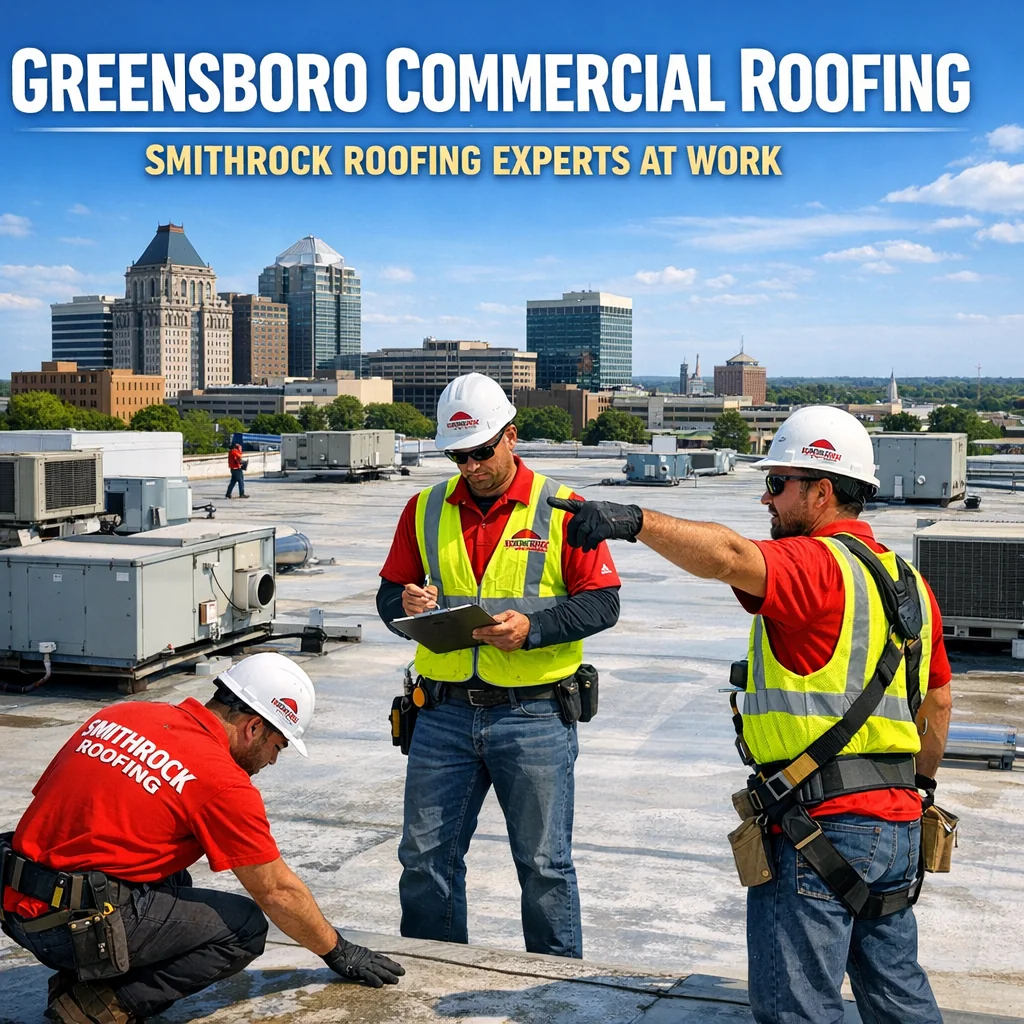
Smithrock Roofing works with commercial property owners throughout roofing in Greensboro, Winston-Salem, High Point, Kernersville, Clemmons, Rural Hall, King, and Mount Airy. If you are managing a commercial property or a portfolio of assets in the NC Triad and want a straightforward conversation about your roof system, our team is ready to walk the roof with you and give you an honest assessment of what you are working with.
The answer depends on several factors: the age of the roof system, the extent and location of damage, how much of the membrane or substrate has been compromised, and whether active leaks have caused interior damage. A qualified inspector can assess the roof’s remaining serviceable life and give you a clear picture of whether targeted repairs will extend performance or whether replacement is the more cost-effective path over a three-to-five year horizon.
A manufacturer’s warranty covers defects in materials under specific conditions, and most require proof of regular inspections to remain valid. A maintenance agreement is a service relationship with your roofing contractor that keeps the roof in warrantable condition through scheduled inspections, minor repairs, and documented records. The two work together, one without the other leaves gaps in your coverage and your planning.
Project timelines vary based on the roof system being installed, the square footage of the building, access conditions, and weather. A straightforward single-layer membrane replacement on a mid-size commercial building will move faster than a complete tear-off with substrate repairs or a phased project on an occupied facility. Your contractor should give you a realistic schedule before work begins, not a range so wide it provides no useful information.
Yes. Most commercial roof failures that result in significant interior damage or structural repair costs begin as conditions that are not yet visible from inside the building, seam separation, flashing deterioration, or compressed insulation from ponding water. Waiting for a visible leak to schedule an inspection means the damage is already well underway. Twice-annual inspections on most membrane systems catch developing issues while repair scope is still manageable.
Smithrock Roofing works with commercial property owners and facility managers across the NC Triad, including Greensboro and High Point, who need straightforward answers and reliable workmanship from a contractor that understands the demands of commercial roof systems. Whether you are addressing a repair, planning a replacement, or establishing a maintenance program for a multi-property portfolio, our team is equipped to walk the roof with you, assess what you are working with honestly, and help you make informed decisions without the pressure. Call us at (336) 971-0464 or Contact Smithrock Roofing to schedule your assessment today.

Smithrock Roofing © Copyright 2026 • All Rights Reserved • Privacy Policy • Maintained by Mongoose Digital Marketing