
Water finds the path of least resistance, and around a home that path often leads straight to the foundation. The result is familiar: soggy low spots in the yard that never fully dry out, water stains creeping up basement walls, and eventually cracks that grow wider with each freeze-thaw cycle. The good news is that most drainage failures follow a predictable pattern, and once you understand what is actually happening underground and on the surface, the right solution becomes much easier to identify.
This article lays out a diagnostic framework for water drainage from your house, explains why the same symptom can have very different causes, and walks through the solutions that address each one. If you have been reading about French drains and downspout extensions but still are not sure which one applies to your situation, this is where that confusion ends.
Before picking a solution, you need to know what kind of water problem you have. Mixing these up is the most common reason a drainage fix does not hold.
Surface water is water that pools on top of the ground after rain. You see it on your lawn, driveway, or patio. It collects because the ground is either too flat, sloping toward the house, or so compacted that rain cannot soak in fast enough. (neavegroup.com)
Sub-surface water is water that collects underground. It may not be visible on the surface at all. Instead, you notice it through damp basement walls, efflorescence (white mineral deposits), or water seeping through the floor. This water travels through the soil and builds up hydrostatic pressure against your foundation. (landscapedrains.com)
Many homes deal with both types at once. Installing a French drain when the real problem is surface runoff from a sloped driveway addresses the wrong issue. Installing a trench drain when the problem is sub-surface hydrostatic pressure does the same. A layered solution is often necessary, but the sequence matters: address surface grading first, then intercept sub-surface water, then manage where the collected water discharges.
Have a gutter or drainage question about your home? Send a message with your town, where water collects, when it happens, and whether the downspout outlet is visible. Mention this article about water drainage from house and ask for a written explanation of possible next steps. You can also review Gutters.
One of the most overlooked causes of drainage failure is what happens to soil after a basement is built. Contractors excavate to install the foundation, then push the loose soil back in around it. Because that backfill is never compacted properly, it settles over the following years and begins to slope inward toward the house rather than away from it. (youtube.com – Home RenoVision DIY)
This means a home that had acceptable drainage when it was new can develop serious problems five or ten years later, even without any major landscaping changes. Regrading the yard may fix the symptom temporarily, but if the underlying soil continues to settle, the problem will return.
If your home is relatively new and you are noticing drainage issues for the first time, check whether the grade along the foundation has reversed. You can do this with a long level and a tape measure: place the level on the soil about a foot from the house and check the direction of slope. The ground should fall away from the foundation, not toward it.
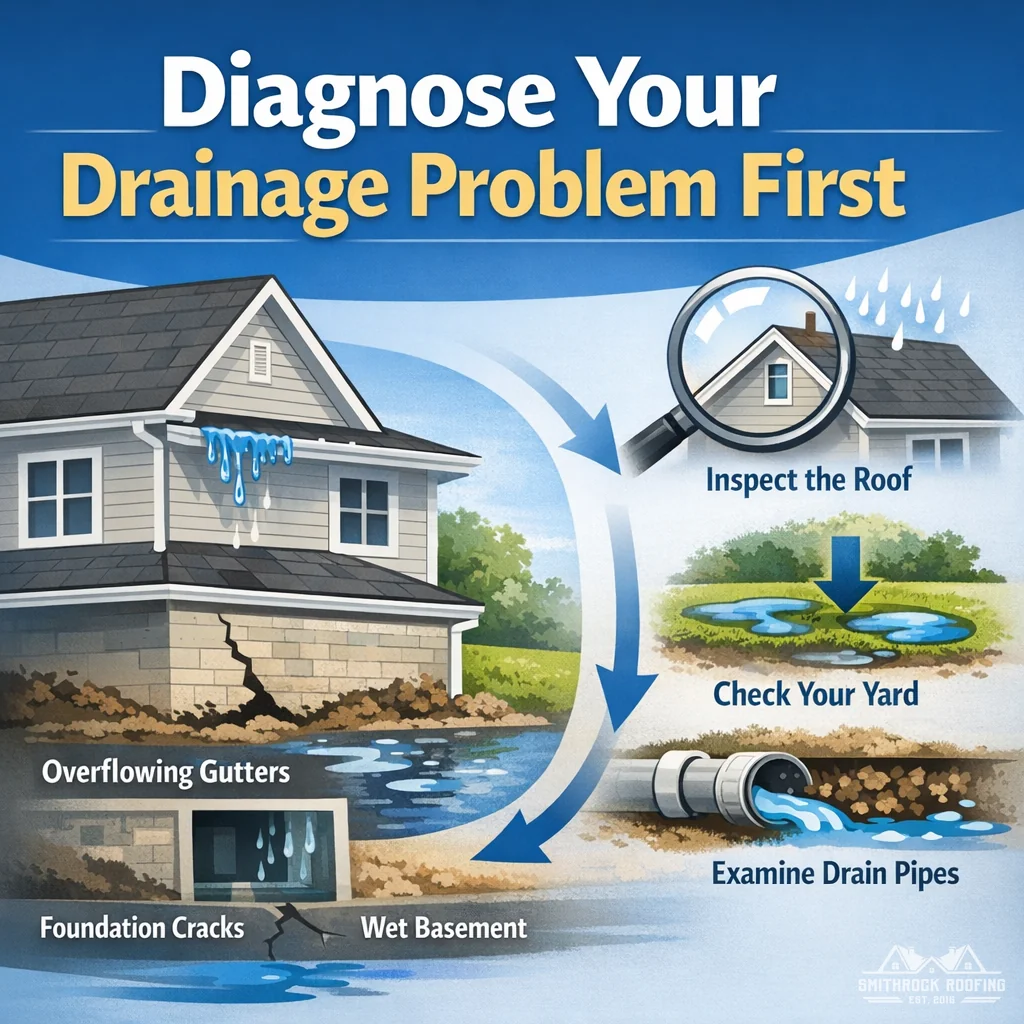
Illustration, not a photograph of a completed client project.
Regrading is the most fundamental fix for surface water. The goal is to restore a slope that carries water away from the foundation. This Old House notes that regrading involves adding a few inches of clay-type soil and pitching it away from the home. (thisoldhouse.com) Keep in mind that regrading is a temporary fix if soil settlement is still occurring. In those cases, the area may need to be monitored and re-addressed as the ground continues to compact.
Trench drains are the right choice for concentrated surface runoff in paved areas, such as at the base of a driveway apron or in front of a garage. These are surface-level channels with grated covers that intercept sheet flow before it reaches a slab or the foundation. (neavegroup.com) They handle surface water only; they do not address what is happening underground.
Soil aeration helps when compaction prevents rainwater from absorbing into the lawn quickly enough. A core aerator, which pulls small plugs from the soil, creates pathways for water to reach the root zone rather than sheeting across the surface. (thisoldhouse.com)
Permeable hardscape materials such as gravel or permeable pavers allow water to pass through rather than shed onto the lawn. If existing concrete or brick surfaces are directing runoff toward the house, replacing them or redirecting their drainage can make a meaningful difference. (thisoldhouse.com)
French drains are the standard solution for intercepting underground water before it reaches the foundation. A trench is dug along the path where water collects, lined with gravel, and a perforated pipe is laid inside, typically wrapped in a filter sock to keep fine soil from clogging the perforations. The pipe then carries collected water to a lower discharge point such as a dry well, a street drain, or a natural low spot on the property. (youtube.com – Home RenoVision DIY; landscapedrains.com)
Dry wells work as a receiving point for water collected by French drains or downspout systems. They are essentially buried containers filled with stone that allow water to percolate slowly into the surrounding soil, keeping it well away from the foundation. (thisoldhouse.com)
Downspouts are neither a surface water fix nor a sub-surface water fix in isolation. They are a source control measure. If your gutters are dumping water within a few feet of the foundation, they are actively contributing to whatever drainage problem exists below. Extending downspouts or connecting them to a buried pipe that discharges at the curb or into a dry well is often the first and most cost-effective step before any excavation happens. (thisoldhouse.com)
For buried downspout runs, smooth-wall solid PVC pipe (such as SDR35) is the appropriate choice. Corrugated accordion pipe should only be used as a temporary, above-ground solution; buried corrugated pipe deteriorates, collapses, and allows sediment to accumulate in its ridges, eventually blocking flow entirely. If you want a deeper look at how to approach this properly, our article on burying gutter downspouts covers the full underground drainage process in detail. (youtube.com – Storm Water Drainage Solutions)
The choice between corrugated pipe and solid PVC is not a matter of preference. It comes down to what the pipe is being asked to do. (youtube.com – Storm Water Drainage Solutions)
| Application | Recommended Pipe Type | Why |
|---|---|---|
| French drain (groundwater collection) | Perforated corrugated with filter sock | Perforations along the length collect water from surrounding soil; low flow velocity; gravel bed provides structural support |
| Downspout drainage (concentrated roof runoff) | Smooth-wall solid PVC (SDR35) | Higher flow velocity; smooth interior prevents debris hang-up that corrugated ribs cause; structural integrity underground |
| Temporary surface diversion | Corrugated accordion (above ground only) | Acceptable short-term only; must be removed before burial |
| Surface drain to street or dry well | Smooth-wall solid PVC | Carries concentrated flow from catch basins or trench drains; debris risk requires smooth interior |
Regardless of which pipe you use, slope is non-negotiable. Drainage pipe that does not maintain adequate fall along its run will hold standing water, allow sediment to settle, and eventually block. Without adequate slope built in from the start, the system will underperform no matter how well it is installed. Consult a qualified drainage professional for the specific drop-per-run requirements appropriate to your site conditions and pipe diameter.
The discharge point is where homeowners and even some contractors get careless. A French drain that terminates 10 feet from the foundation has simply moved the problem closer to a neighbor’s property or back toward your own if the ground slopes the wrong way. Effective discharge options include:
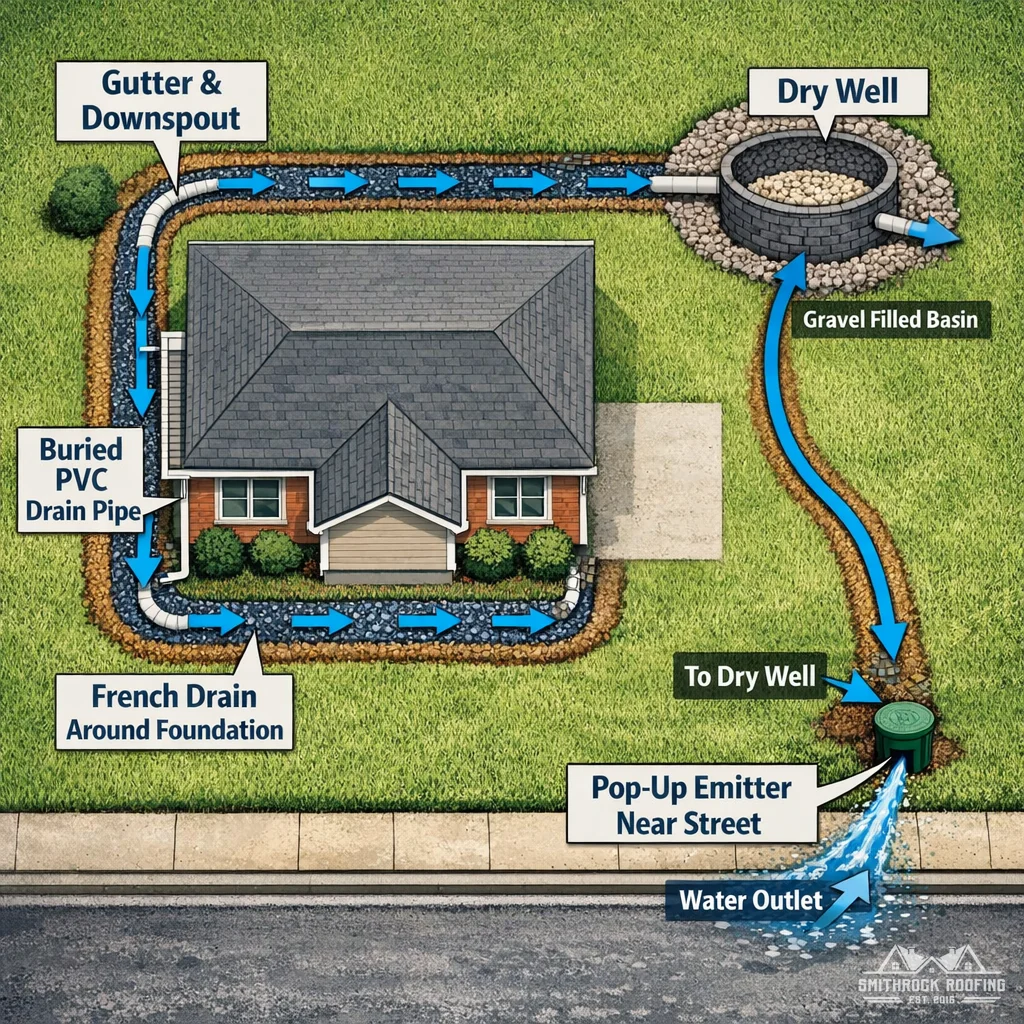
Illustration, not a photograph of a completed client project.
A drainage system that handles yard water well but ignores the roof is incomplete. Gutters collect water from the entire roof surface and concentrate it into downspouts. If those downspouts terminate at the foundation or within a few feet of it, they are delivering a significant volume of water directly to the most vulnerable point on your property.
Clean, properly pitched gutters with downspouts that extend or connect to a buried system are not optional extras. They are part of the drainage chain. A clogged gutter that overflows at the fascia sends water sheeting down the exterior wall and pooling at the foundation just as reliably as a missing downspout extension would. (thisoldhouse.com)
For homeowners across Winston-Salem, Greensboro, High Point, Kernersville, and the surrounding Triad communities, Smithrock Roofing handles gutters as part of its full exterior services, which means drainage considerations at the roofline do not have to be handled separately from the rest of your home’s exterior health. If you suspect your gutters are contributing to a drainage problem, a gutter inspection is a practical first step before committing to larger yard work.
Drainage problems rarely fix themselves, and the longer water sits against a foundation, the more expensive the consequences become. Identifying whether you are dealing with surface water, sub-surface water, or both, and then choosing the right pipe material, slope, and discharge point, puts you well ahead of most homeowners and most of the generic advice that gets passed around. When you are ready to talk through what is happening at your specific property, Smithrock Roofing is here to help you work through it.
A French drain is a sub-surface system designed to intercept groundwater moving through the soil before it reaches your foundation. It uses a perforated pipe wrapped in a filter sock, set in a gravel-filled trench, so water can enter through the pipe’s length and be carried away underground. (landscapedrains.com) A trench drain, by contrast, is a surface system. It sits at ground level with a grated cover and is designed to catch sheet flow running across pavement or hardscape. (neavegroup.com) If your problem is wet basement walls or saturated soil around the foundation, a French drain addresses the cause. If your problem is water running across your driveway toward the garage, a trench drain is the right tool. Installing either one for the wrong problem will not resolve the issue.
No. Corrugated accordion pipe is appropriate only as a temporary, above-ground solution. Buried corrugated pipe deteriorates over time, and the ridges along its interior allow sediment to accumulate and eventually block flow. For any permanently buried downspout run, smooth-wall solid PVC pipe such as SDR35 is the correct choice. Its smooth interior keeps debris moving through the pipe rather than catching on corrugations, and it maintains its structural integrity underground in a way that flexible accordion pipe cannot. (youtube.com – Storm Water Drainage Solutions)
Place a long level on the soil roughly one foot from your foundation and check which direction the ground slopes. The ground should fall away from the house, not toward it. If it slopes inward, surface water is being directed toward your foundation every time it rains. This is a particularly common finding in homes with basements, where the backfill soil pushed in around the foundation after construction settles over time and reverses the original outward slope. (youtube.com – Home RenoVision DIY) If you confirm the grade has reversed, regrading with a clay-type soil to restore a slope away from the house is typically the starting point before any other drainage work is considered. (thisoldhouse.com)
No. Gutters and downspouts are part of the same drainage chain. A yard drainage system that handles groundwater and surface runoff effectively can still be overwhelmed if downspouts are terminating within a few feet of the foundation and delivering concentrated roof runoff directly to that location. Clogged gutters that overflow at the fascia produce the same result. (thisoldhouse.com) For a drainage solution to hold over time, the roof water source needs to be managed alongside whatever is happening in the yard. Extending downspouts or connecting them to a buried pipe that discharges well away from the foundation is often the most straightforward first step before committing to larger excavation work.
Water drainage failures are almost always predictable once you know what to look for. The distinction between surface water and sub-surface water narrows the list of effective solutions considerably, and getting that diagnosis right before selecting materials or digging anything is what separates a fix that holds from one that gets redone in three years. Grading, pipe selection, slope, and discharge point each play a role, and none of them works well in isolation when the others are neglected.
For homeowners in Winston-Salem, Greensboro, High Point, Kernersville, and the surrounding Triad area, the roofline is part of this picture. If gutters and downspouts are contributing to drainage pressure at the foundation, that piece of the system deserves attention alongside whatever is happening in the yard. Smithrock Roofing works across these communities on exterior services that include gutters, and homeowners looking for roofing in Clemmons will find that the same drainage-aware approach applies there as well. If you have questions about how your roof drainage connects to a larger water management concern, reaching out in writing is a straightforward way to start the conversation.

Smithrock Roofing © Copyright 2026 • All Rights Reserved • Privacy Policy • Maintained by Mongoose Digital Marketing