New insulated windows are double- or triple-pane glass units sealed with an inert gas fill (like argon) between the panes to dramatically reduce heat transfer — keeping your home warmer in winter and cooler in summer. For decades, windows were the weakest link in a home’s thermal envelope. A single sheet of glass provides almost no resistance to the biting winds of a North Carolina winter or the sweltering humidity of a Piedmont summer. Today, however, engineering has transformed the humble window into a high-tech barrier that manages light, heat, and sound with incredible precision.
Here’s what you need to know at a glance:
If your home still has older windows, you’re likely losing money every month. Drafts, condensation on the glass, and rooms that never quite reach the right temperature — these are all signs that your windows are working against you. In the Triad area, where temperatures can fluctuate wildly between day and night, the thermal stress on old wood or single-pane aluminum frames is immense. This leads to warping, air gaps, and a constant strain on your HVAC system.
The good news? Upgrading to new insulated windows addresses all of these problems at once. It is not merely a cosmetic fix; it is a fundamental improvement to the structural efficiency of your property. Beyond energy savings, insulated windows protect your furniture from UV fading, reduce outside noise from traffic or neighbors, and can add real value to your home. Homeowners who replace their windows typically recoup around 78% of the cost when they sell, making it one of the highest-ROI projects in the remodeling industry.
This guide walks you through everything — how insulated windows work, what specs actually matter, how to choose the right option for your climate, and what to expect from professional installation.
Basic New insulated windows glossary:
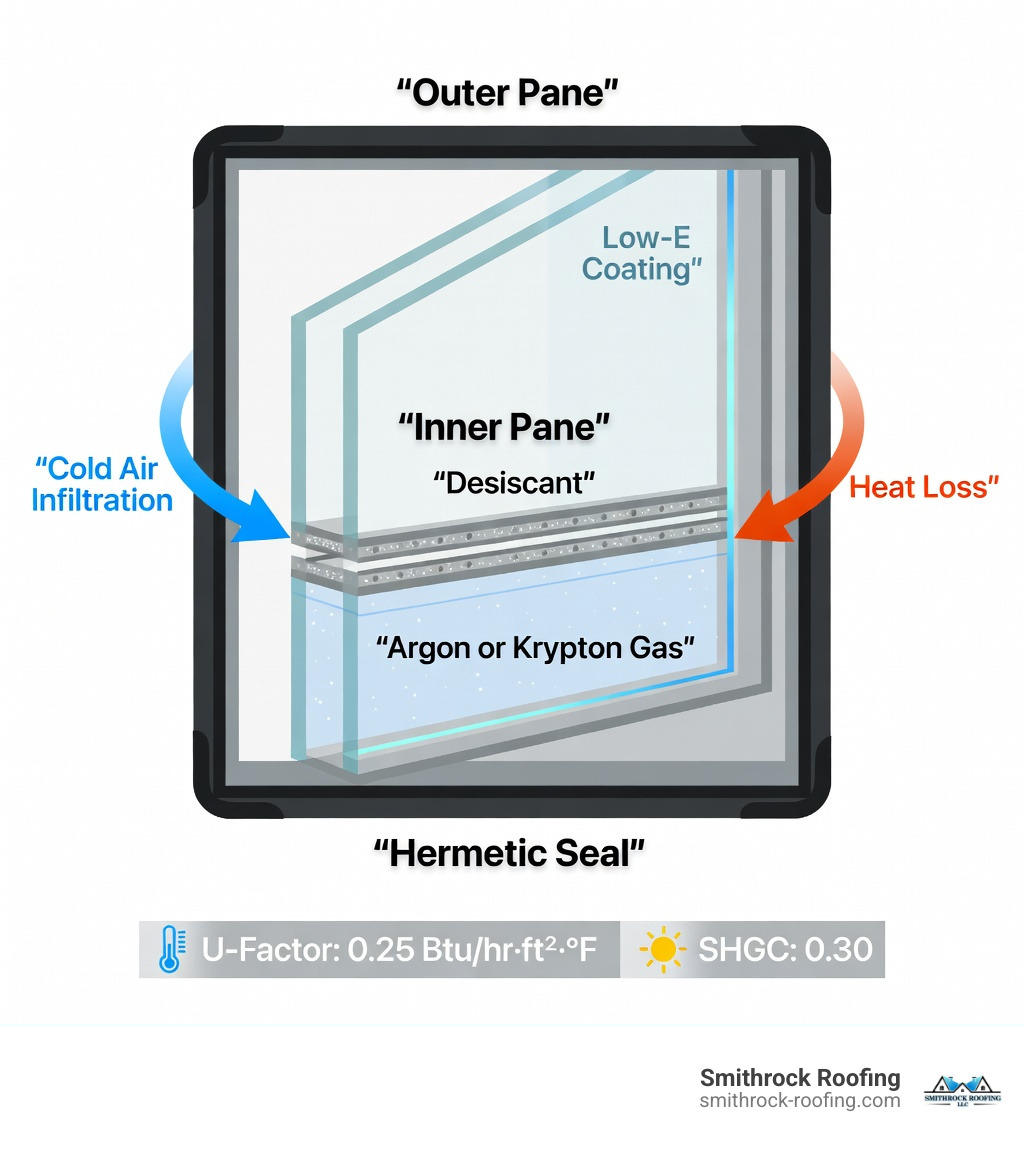
To truly appreciate why New insulated windows are such a game-changer, we have to look past the glass and into the “sandwich” that makes up a modern window. In the industry, we call these Insulated Glass Units, or IGUs. Unlike the single sheets of glass found in older homes across Winston-Salem and Greensboro, an IGU is a factory-sealed system designed to act as a barrier against the elements. The evolution from single-pane to multi-pane technology represents the single greatest leap in residential energy efficiency in the last fifty years.
An IGU consists of two or more panes of glass separated by a spacer. This creates a pocket of air or, more commonly, an inert gas. This pocket is the secret sauce of insulation. Because air and gas are poor conductors of heat compared to solid glass, they slow down the movement of energy from one side to the other. To keep this system working for decades, the unit is protected by a dual-seal system. The primary seal provides the initial moisture barrier, while the secondary seal provides structural integrity. Inside the spacers, you’ll often find desiccants—small beads that absorb any trace of moisture to prevent that dreaded “foggy window” look that occurs when a seal fails.
The physics of a window involves three types of heat transfer: conduction, convection, and radiation. New insulated windows are engineered to fight all three simultaneously, creating a comprehensive thermal shield.
When evaluating window insulation, the number of panes is the most obvious variable. While single-pane windows are essentially obsolete for energy efficiency, the choice between double and triple-pane is a common debate for homeowners in Clemmons or Kernersville.
| Feature | Single-Pane | Double-Pane | Triple-Pane |
|---|---|---|---|
| Insulation (R-Value) | Very Low (~1) | High (~3-4) | Very High (~5-7+) |
| Noise Reduction | Minimal | Significant | Superior |
| Condensation Risk | High | Low | Very Low |
| Weight | Light | Moderate | Heavy |
| Cost-to-Benefit | Poor | Excellent | High Investment |
For more details on the tech behind these units, check out the Department of Energy’s guide on window types. Understanding these nuances helps you make an informed decision that fits both your budget and your comfort goals.
If you’ve ever looked at a window sticker and felt like you were reading a math textbook, you aren’t alone. However, understanding these numbers is the only way to ensure you’re getting the right New insulated windows for your specific needs. These ratings are provided by the National Fenestration Rating Council (NFRC) and represent “whole-unit” performance, meaning they account for the glass, the frame, and the spacers combined. A window with great glass but a cheap, leaky frame will still perform poorly overall.
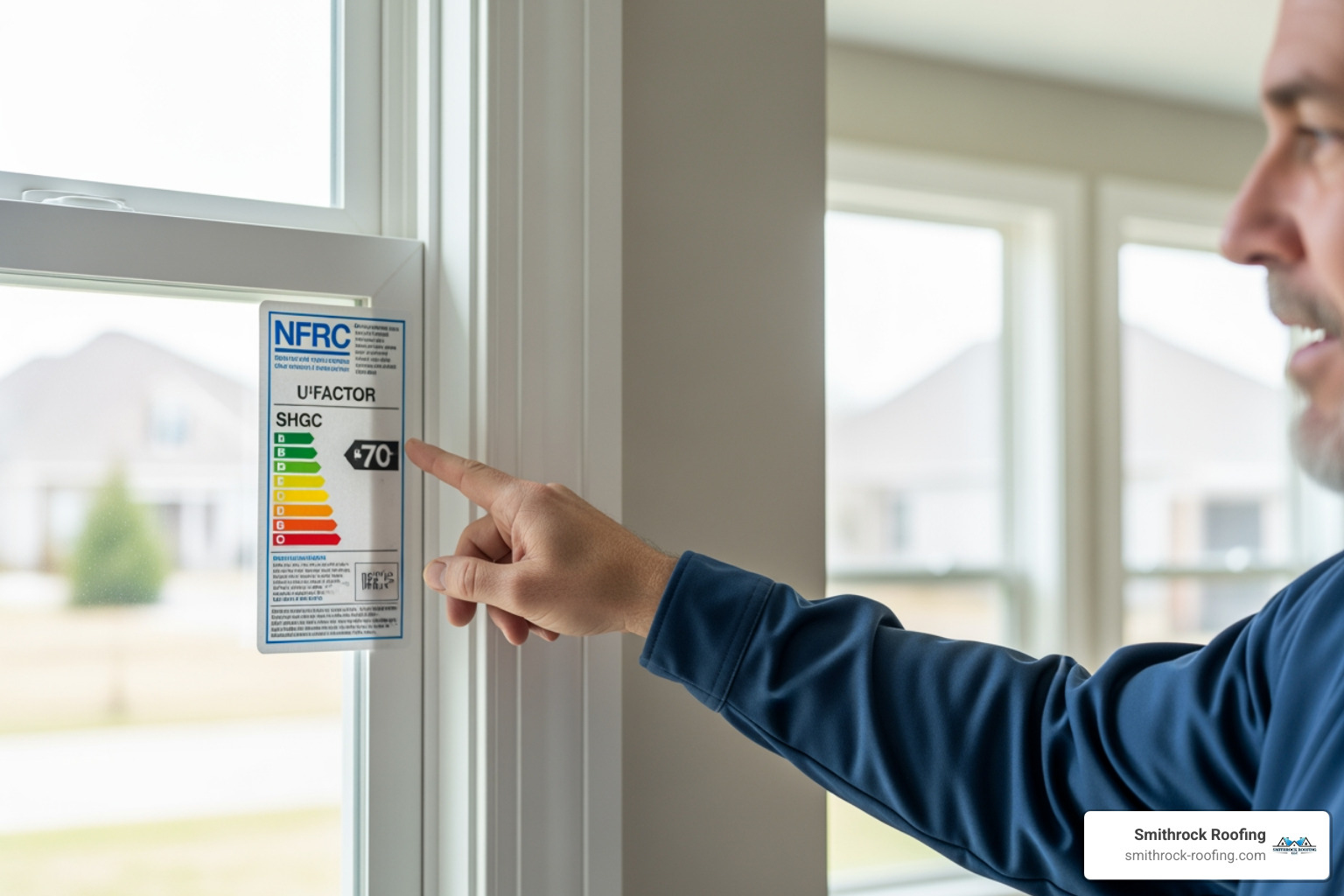
North Carolina sits in a bit of a “swing” zone. We have cold snaps that require good U-factors, but our summers are legendary for their heat and humidity. This makes the best windows for insulation those that balance both metrics. The ENERGY STAR program actually divides the country into zones; North Carolina falls into the North-Central or South-Central zones depending on the specific county.
For homeowners in places like Mount Airy or Pilot Mountain, consider your home’s orientation:
For a deeper dive into these metrics, the Consumer Guide to Energy-Efficient Windows is an excellent resource. It explains how the NFRC tests these units in laboratory conditions to ensure the ratings you see on the sticker are accurate and comparable across brands.
We’ve mentioned Low-E and gas fills, but it’s worth explaining why they are essential for energy efficient window upgrades. Low-E coatings are designed to manage infrared light (heat) and UV light (the stuff that fades your rugs). By reflecting these while letting visible light pass through, you get a bright home without the temperature spikes. There are different “recipes” for Low-E coatings; some are optimized for high solar gain, while others are optimized for solar rejection.
Gas fills, usually Argon, are used because they are more viscous than air. Think of it like trying to swim through water versus honey—the “honey” (Argon) slows down the movement of heat significantly. Because Argon is colorless, odorless, and non-toxic, you’ll never know it’s there, but your utility bill certainly will. Krypton is even more efficient than Argon but is typically reserved for triple-pane units because it performs best in smaller gaps.
Upgrading to New insulated windows isn’t just a maintenance task; it’s a strategic investment in your lifestyle and your wallet. According to data from Remodeling Magazine, homeowners can recoup about 78% of the cost of window replacement when it comes time to sell. That is a higher return than many kitchen or bathroom remodels, which often only recoup 60-65%. In a competitive real estate market like Winston-Salem, having brand-new, energy-efficient windows can be the deciding factor for a buyer.
Beyond the resale value, the daily savings are impressive. Replacing old, leaky windows with ENERGY STAR-qualified models can save you 7% to 15% on your annual energy bills. In a large home in High Point or Greensboro, those savings add up to hundreds of dollars every year. Over the 20-year lifespan of the windows, they can effectively pay for themselves through reduced utility costs alone.
Furthermore, let’s talk about your furniture and interior finishes. UV rays are the enemy of your favorite leather armchair, expensive hardwood floors, and even your wall paint. Modern Low-E glass can block up to 75% to 90% of UV-induced fading, acting like a permanent sunscreen for your home’s interior. This preserves the beauty and value of your belongings for years longer than standard glass.
Do you live near a busy intersection in Winston-Salem? Or perhaps your neighbor’s lawnmower seems to run 24/7? New insulated windows provide a much-needed acoustic buffer. By using different glass thicknesses (dissimilar glass) and the dampening effect of gas fills, IGUs significantly improve Sound Transmission Class (STC) ratings. A standard single-pane window has an STC of about 26; a high-quality insulated window can reach 32 to 35, which represents a massive reduction in perceived noise.
Security is another major perk that homeowners often overlook. Most modern insulated windows use tempered or laminated glass options. Tempered glass is four times stronger than standard “annealed” glass and, if it does break, it crumbles into small, dull cubes rather than jagged shards. Laminated glass, which features a plastic interlayer, is even harder to penetrate, often frustrating would-be intruders until they give up. For more on how this fits into a full home upgrade, see our window replacement services.
Let’s be honest: old, peeling window frames are an eyesore. Whether you prefer the classic look of replacement windows for homes or the sleek lines of modern vinyl, new windows instantly refresh your home’s exterior. They signal to the world (and potential buyers) that the home is well-maintained and modern.
In the Triad area, vinyl frames are incredibly popular because they are virtually maintenance-free—no painting or staining required. They won’t rot like wood or pit like aluminum. When potential buyers see new, high-performance windows, they see a home that won’t require immediate, expensive repairs. It provides peace of mind that is invaluable during a home sale. Additionally, modern windows are much easier to clean, often featuring tilt-in sashes that allow you to wash the outside of the glass from inside your house.
You could buy the most expensive window in the world, but if it’s installed poorly, it’s just a very expensive draft. Professional installation is non-negotiable for New insulated windows. The process begins with a precise measurement of the “rough opening.” Even a quarter-inch discrepancy can lead to gaps that allow air and water to bypass the window’s insulation entirely. We focus on precision air sealing using specialized low-expansion foams and high-quality flashing to ensure no water or air can sneak around the frame.
Proper installation also protects your warranty. Many manufacturers will void a 20-25 year warranty if the unit isn’t installed exactly to their specifications. For instance, if the window isn’t perfectly level and plumb, the sashes may not seal correctly, leading to premature seal failure in the IGU. Additionally, if your home was built before 1978, we follow strict EPA lead-safe practices to ensure your family isn’t exposed to lead dust during the removal of old frames. If you’re looking for the right team, we can help you with finding window installers who understand these local requirements.
When upgrading, you generally have two choices for installation:
Every home is unique, and sometimes a standard rectangle just won’t do. Modern manufacturing allows for incredible customization. From elegant arches to striking octagon units, we can provide window glass replacement for almost any shape. You can also choose from various hardware finishes, such as brushed nickel or oil-rubbed bronze, to match your interior decor.
When ordering custom units, we also consider technical factors like:
A common myth is that you can only replace windows in the spring or summer. In reality, fall and winter are the perfect time for window replacements.
Why? Because that’s when you’ll feel the immediate impact of the upgrade. Installing in the colder months allows us to identify and seal the most stubborn drafts right away. Plus, modern sealants are designed to cure effectively even in lower temperatures, ensuring a weather-tight fit that lasts for decades. Our crews are trained to work one window at a time, minimizing the time your home is exposed to the cold air.
Most high-quality New insulated windows last between 20 and 25 years. The main factor is the integrity of the seal. Over time, environmental stressors like extreme heat and cold cause the window materials to expand and contract (a process called solar pumping). Eventually, the seal may fail, allowing the inert gas to escape and moisture-laden air to enter, which leads to fogging. Choosing units with high-quality stainless steel or structural foam spacers can push this lifespan to the upper limit.
This is a great question for homeowners on a budget. If your window frames are in excellent structural condition—meaning no rot, warping, or insect damage—you can often perform an IGU-only replacement. This involves removing the old glass unit and sliding in a new, energy-efficient one. However, if the frames are drafty, made of uninsulated aluminum, or showing signs of wood rot, a full window frame replacement is usually the better long-term value because it addresses the efficiency of the entire opening.
Yes! Under the Inflation Reduction Act, the federal government provides significant tax credits for homeowners who install ENERGY STAR-certified products. You can often claim 30% of the project cost, up to a certain annual limit. These incentives change periodically, so it’s always a good idea to check the ENERGY STAR Rebate Finder or consult with a tax professional. Many local utility companies in North Carolina, like Duke Energy, also offer rebates or low-interest financing for energy-efficiency upgrades.
Surprisingly, condensation on the exterior of the glass is actually a sign that your windows are working perfectly! It happens when the outer pane of glass becomes colder than the dew point of the outside air. Because the insulation is so good, the heat from inside your house isn’t reaching the outer pane to warm it up. This usually happens on humid mornings and disappears as soon as the sun comes up.
All IGUs will lose gas at an incredibly slow rate—typically less than 1% per year. High-quality manufacturers use sophisticated sealing techniques to ensure that even after 20 years, the window still contains enough Argon to maintain its high thermal performance. If you see fogging between the panes, however, that indicates a total seal failure, and the unit should be replaced under warranty.
Upgrading to New insulated windows is one of the few home improvements that pays you back every single month. It is a rare trifecta of benefits: you save money on utilities, you increase the market value of your property, and you significantly improve your daily quality of life. No longer will you have to avoid the “cold chair” by the window in January or crank the AC to max just to combat the afternoon sun in July.
At Smithrock Roofing, we are proud to serve communities from Winston-Salem to Greensboro and everywhere in between. We understand the unique climate challenges of the Piedmont Triad and specialize in high-performance solutions like the Norandex eXtreme 3000S windows. These windows offer industry-leading vinyl construction, multi-chambered frames for extra insulation, and advanced Low-E glass packages that exceed ENERGY STAR requirements.
Whether you are looking to boost your curb appeal, reduce your carbon footprint, or finally stop those winter chills, we are here to help you make the best choice for your home. Our team provides expert guidance from the initial measurement to the final bead of caulk, ensuring your investment is protected for decades to come.
Ready to see the difference for yourself? Transform your home with the ultimate guide to window upgrades and take the first step toward a more comfortable, efficient, and beautiful future. Contact us today for a consultation and let us help you turn your house into a high-performance sanctuary.
Smithrock Roofing © Copyright 2026 • All Rights Reserved • Privacy Policy • Maintained by Mongoose Digital Marketing