
Burying gutter downspouts is a highly effective method for protecting your home from water damage. It channels rainwater far from your foundation, preventing costly issues while improving your property’s appearance and safety.
Quick Answer: The Essential Steps for Burying Gutter Downspouts
The Stakes Are High for Your Home
The financial stakes are high. Uncontrolled roof runoff can lead to water damage incidents averaging $11,000, foundation repairs costing $5,000 to $20,000, and basement flooding repairs around $10,000.
When downspouts release water next to your foundation, the soil becomes saturated, leading to basement leaks, landscape erosion, and compromised structural integrity. While above-ground extensions offer a temporary fix, they are unsightly, create tripping hazards, and are easily damaged.
An underground system solves these problems by safely channeling water away through buried pipes. The result is a protected foundation, a pristine lawn, and peace of mind. This guide covers every step, from planning to maintenance, giving you the knowledge to tackle the project yourself or understand the work of a professional.

This section will explore the compelling reasons to undertake this project and the potential challenges to consider, helping you make an informed decision for your home.
For homeowners in areas like Winston-Salem, King, or Kernersville, NC, managing rainwater effectively is about safeguarding your most valuable asset. Burying gutter downspout systems offers a multitude of advantages.
For comprehensive water management solutions, including professional gutter and downspout installation, explore our services at Gutter and Downspout Installation.
While the benefits are compelling, it’s important to understand the potential challenges to ensure the long-term success of your system.
To help you weigh your options, here’s a quick comparison:
| Feature | Buried Downspouts | Above-Ground Extensions |
|---|---|---|
| Aesthetics | Excellent (hidden) | Poor (visible, can detract from curb appeal) |
| Foundation Protection | Excellent (channels water far away) | Fair (may not extend far enough, prone to shifting) |
| Safety | Excellent (no trip hazards) | Poor (creates tripping hazards) |
| Maintenance | More complex (requires inspection/flushing) | Simple (easy to clean, replace) |
| Installation Effort | High (digging, pipe laying) | Low (simple attachment) |
| Durability | High (when properly installed with quality materials) | Low (prone to damage from lawnmowers, foot traffic) |
| Clogging Risk | Moderate (requires guards/filters) | Low (easy to clear, visible) |
| Freezing Risk | Moderate (if not installed correctly) | Low (less likely to hold water if sloped) |
Proper planning is the most critical phase for a successful and long-lasting buried downspout system. This involves selecting the right materials, mapping the layout, and understanding local rules.
Gathering all necessary tools and materials beforehand will make the installation process much smoother.
Here’s what you’ll need for burying gutter downspout drains:
This stage ensures you avoid costly mistakes and lay the groundwork for an efficient drainage system.
First, conduct a site assessment. Walk your property in areas like Pfafftown or Trinity, NC, to observe where water flows and pools during rain. This helps identify the best path for your trenches. Crucially, call 811 before you dig. This free, mandatory service marks underground utility lines, preventing dangerous and costly accidents. Next, sketch a site plan, mapping a trench path that leads to a discharge location at least 10 feet from your foundation. The entire path must have a continuous downhill slope to let gravity do the work. Finally, ensure your route avoids septic systems and other known underground hazards.
For professional assistance with planning and installation, check out our Gutter Installation Services Near Me.
Before starting, comply with local rules. Check municipal stormwater regulations in your area, whether it’s Winston-Salem, Greensboro, or High Point, NC. These codes often dictate how and where you can discharge rainwater. If your home is in a Homeowners’ Association (HOA), review its covenants for any rules on drainage systems. Also, be mindful of property line considerations; ensure your system doesn’t flood a neighbor’s yard. For larger projects, a permit might be required, so it’s always best to check with your local building department first.
With your plan in place, it’s time to get to work. Follow these steps carefully for a professional-quality installation that will protect your home for years to come.
A well-dug trench is fundamental to the success of your buried downspout system.
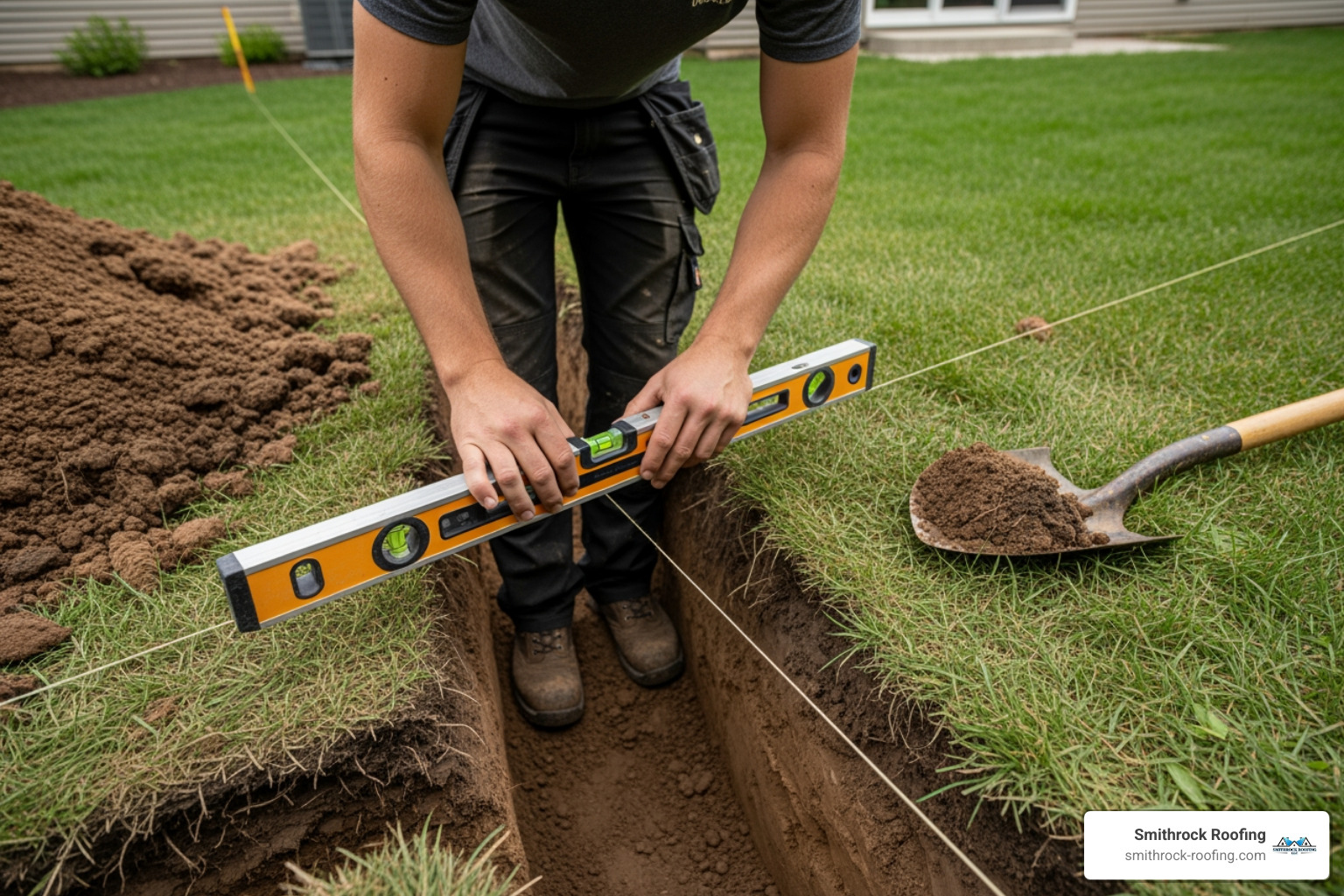
Using stakes and string, mark the path you planned. Dig a trench at least 12 to 18 inches deep. This protects the pipe from surface activity and helps prevent freezing in North Carolina winters. The trench should be about 6 inches wider than the pipe’s diameter to allow room for gravel. The most critical part is establishing the correct slope. Aim for a drop of at least 1/8 inch per foot (or 1 inch per 10 feet) away from the house. Use a level on a string line stretched between stakes to check the slope continuously as you dig.
Once the trench is dug, it’s time to install the heart of your burying gutter downspout system: the pipe.

First, remove the existing elbow at the bottom of your downspout. Attach a downspout-to-pipe adapter, which transitions from the rectangular downspout to your round drainage pipe. Secure this connection with screws or waterproof tape to prevent leaks. For PVC connections, use PVC primer and cement for a watertight bond. Begin laying the pipe in the trench, starting at the adapter and working toward the discharge point. Ensure the pipe is laid smoothly without sags, which can trap water. Connect sections of pipe as needed, ensuring all joints are secure.
For a robust and leak-free system, consider our professional services in Seamless Gutter Installation.
Proper backfilling is key to the system’s stability. Start by adding a 2-4 inch layer of gravel to the bottom of the trench, creating a stable bed for the pipe. Next, wrap the pipe and gravel completely with landscape fabric. This barrier prevents soil, sediment, and roots from entering and clogging the system. Finally, fill the rest of the trench with the excavated soil. Add the soil in layers, compacting each layer as you go to prevent the ground from settling and creating a depression in your lawn.
After the hard work of digging and pipe laying, it’s time for the final touches.
Install the discharge outlet at the end of the pipe. A pop-up emitter sits flush with the lawn and opens with water pressure, while an atrium grate is a fixed cover. Before covering everything, test the system with a hose. Run water into the downspout and check for leaks along the trench and ensure water flows freely from the outlet. Once you’ve confirmed it works correctly, restore the lawn by replacing sod or spreading grass seed. For landscaping, consider shallow-rooted plants over the trench and decorative river rock around the discharge point.
A properly installed burying gutter downspout system is a significant asset, but it requires routine maintenance to ensure its longevity and effectiveness in North Carolina’s varied weather.
Immediately after installation and periodically thereafter, verify that your system is performing as expected. The simplest method is the garden hose test. Place a running hose in the top of the downspout for several minutes. Walk the trench line and check all connections for drips or seeping water. Most importantly, watch the outlet to ensure water is discharging freely and not backing up toward the foundation.
Proactive maintenance is key to preventing problems. We recommend annual inspections of your entire system. The single most important task is keeping your gutters clean. Debris in gutters is the primary source of clogs in buried pipes. To significantly reduce this risk, install Gutter Guard Installation. Periodically flush the underground pipes with a high-pressure hose to clear out any accumulated sediment. Finally, keep the pop-up emitter clear of grass and debris to ensure it can open properly.
Even with good maintenance, problems can arise. Here’s how to address them.
While burying gutter downspout systems offers superior protection, it’s helpful to understand other drainage solutions available in areas like Clemmons, East Bend, or Rural Hall, NC. Each has its own purpose, and they can often be combined for a comprehensive water management strategy.
These are the most common and least invasive solutions, but they come with significant drawbacks that make them a temporary fix at best.
For more comprehensive water management, your buried downspout can be part of a larger, more sophisticated system. It’s important to understand the distinction: a buried downspout line uses a solid, non-perforated pipe to transport water from the gutter to a specific outlet. The following systems manage water differently.
For complex drainage issues, these systems can be integrated. Smithrock Roofing can advise on a custom assessment and solution for your property.
The ideal depth for burying gutter downspout extensions is 12 to 18 inches. This protects the pipe from surface damage and helps prevent freezing. Most importantly, the trench must maintain a consistent downward slope of at least 1/8 inch per foot (or 1 inch per 10 feet) to ensure water flows away from your home.
We highly recommend using solid, smooth-wall PVC pipe, often Schedule 40. This type of pipe is exceptionally durable, resistant to crushing, and its smooth interior minimizes the chance of debris getting trapped. While corrugated pipe is more flexible for DIY installation, its ribbed interior is prone to clogs and it is less durable than PVC.
Prevention starts at the roofline. The best method is installing effective Gutter Guard Installation to stop leaves and large debris from ever entering the system. For extra protection, a downspout filter or catch basin can be installed where the downspout meets the underground pipe to capture smaller sediment. Regular cleaning of your gutters remains essential.
Burying gutter downspout systems is a rewarding project that provides powerful protection against water damage, improves your home’s curb appeal, and eliminates safety hazards. While it requires careful planning and physical effort, a properly installed system is a long-term investment in your property’s health and value. By directing rainwater safely away from your foundation, you’re preventing costly repairs, safeguarding your landscaping, and enhancing the overall aesthetics and safety of your property in communities like Winston-Salem, King, Clemmons, and beyond.
For a comprehensive approach to your home’s exterior water management, from professional installation to expert advice, the team at Smithrock Roofing can ensure your home is protected from the top down. We bring our expertise in roofing, windows, siding, and, of course, gutters, to provide integrated solutions that stand the test of time. Ready to take control of your home’s drainage? Explore our complete Gutters services to learn more and secure your foundation today.

Smithrock Roofing © Copyright 2026 • All Rights Reserved • Privacy Policy • Maintained by Mongoose Digital Marketing