
A concrete tile roof is a durable system, but when a tile cracks or shifts, the repair process is more involved than it first appears. Water does not stop at a broken tile; it continues down through the underlayment and into the deck if the conditions are right. The most common mistake homeowners and inexperienced contractors make is treating a cracked tile as the entire problem, when the tile is actually the outer shell of a two-layer waterproofing system. This article explains both layers, what determines the right repair approach for your specific roof, and what to look for when tiles come up so you do not solve one problem while missing another.
The most frequent cause of a cracked concrete tile is foot traffic during routine maintenance or inspection. This is not random bad luck; it reflects the structural reality of how tiles are installed. Each tile rests on a horizontal batten below and contacts the deck at its upper edge, leaving the center of the tile essentially suspended in mid-air. When weight lands on that unsupported mid-span, the tile bends and breaks. The trailing lower lip, by contrast, sits directly over the batten and can bear weight without flexing.
[SOURCE: Russ Richards tile repair video, https://www.youtube.com/watch?v=BWf2i7rIjiM]
This matters for two reasons. First, it tells you that a cluster of broken tiles on a single slope often points to a recent rooftop visit rather than a material defect or age-related failure. Second, it means that any future work on the roof, including the repair itself, requires deliberate foot placement to avoid creating additional damage.
Cracked tiles can also result from age-related surface degradation, impact from debris, or freeze-thaw cycling. A single tile can break while the adjacent tiles remain completely sound. That is actually good news because concrete tile systems are designed for individual tile replacement, provided the repair is approached correctly. For a closer look at how a broken roof tile leak develops and what warning signs to watch for, that informational article covers the causes and early indicators in detail.
Have a roofing question about your home? Send a message with your town, your current roof material and the repair or material question you want to resolve. Mention this article about concrete tile roof repair and ask for a written explanation of possible next steps. You can also review Roofing.
Before anything is touched on a concrete tile roof, one diagnostic question determines the entire repair approach: how are the tiles attached?
Roofing practices shifted significantly around 1994-1995. On roofs built before that transition, only the first and second courses were typically nailed; tiles in the field relied on their own substantial weight for retention. On roofs built after that period, individual nailing of every tile became standard. Some local codes during the transition era also permitted nailing every other row, creating a third scenario.
[SOURCE: Russ Richards tile repair video, https://www.youtube.com/watch?v=BWf2i7rIjiM]
This is not just historical trivia. It is a practical decision point that changes what you need, what you risk, and how long the job takes.
| Nailing Regime | Typical Era | What It Means for Tile Removal |
|---|---|---|
| First two courses nailed only | Pre-1994/1995 | Field tiles may lift with hand pressure; hammer and pry bar often sufficient |
| Every tile nailed | Post-1994/1995 | A reciprocating saw or nail-cutting tool is required for every single tile removed |
| Every other row nailed | Transition era, code-dependent | Mixed approach; some tiles lift freely, others require cutting |
The practical test is simple: before committing to a removal technique, attempt to lift an adjacent field tile with hand pressure. If it does not move, the roof is in a fully-nailed regime and power tools are not optional. Attempting to pry a nailed tile without cutting the fastener risks snapping the tile above or beside the one you are trying to remove, multiplying the repair scope immediately.
Concrete tiles are the visible, durable outer shell of the roof. They shed the bulk of rainfall, resist UV degradation, and provide impact protection. But they are not the waterproofing membrane. That role belongs to the underlayment, the layer of material installed directly over the roof deck beneath the battens and tiles.
When a tile cracks, water enters through that crack during rain. If the underlayment beneath is intact, it redirects that water and the deck stays dry. If the underlayment has degraded, been punctured, or worn through from repeated water exposure, the deck begins to absorb moisture, and what started as a tile repair becomes a deck repair or worse.
[SOURCE: DIYAroundTheHome video, https://www.youtube.com/watch?v=8r-Vii9rtvs]
[SOURCE: Todco Roofing, https://todcoroofing.com/tile-roofing/repair]
The critical point that most repair guides miss is this: lifting tiles for a repair creates a rare, direct view of the underlayment and battens beneath. That window should not be wasted. Every time tiles come up, a thorough assessment of the underlayment condition, batten integrity, and nail-hole penetration should happen before the new tile goes in. Our roofing service is built around this system-level approach, ensuring the full assembly is evaluated whenever tile work is performed.
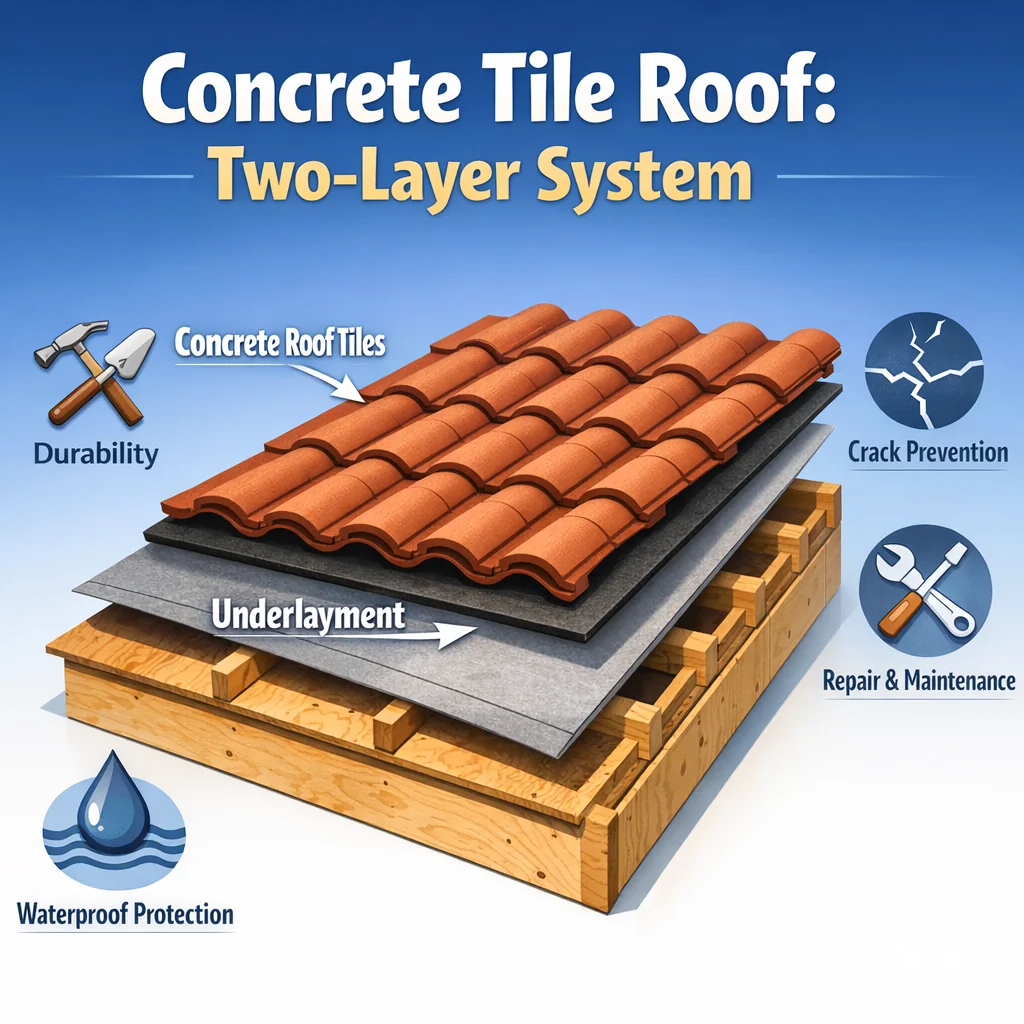
Illustration, not a photograph of a completed client project.
When a replacement tile is set in place, it needs to be secured. The preferred method is nailing through the tile’s nail hole into the batten or deck. This creates a mechanical fastener that does not degrade with heat cycles.
The complication is that once the original nail is cut and removed, the hole in the deck is in a fixed position. The replacement tile’s nail hole may not align with that original penetration point. When re-nailing is not feasible due to access or alignment, roofing cement applied along the tile’s outer edge is a code-permissible alternative.
[SOURCE: Russ Richards tile repair video, https://www.youtube.com/watch?v=BWf2i7rIjiM]
It is worth being clear about what cement-only attachment is and is not. It is a recognized, legal repair method. It is also the approach used precisely when nailing is not possible, not because it is equivalent to nailing. On steeper-pitch roofs or in areas with more frequent high winds, a cement-only attachment places the full retention load on an adhesive that is subject to thermal cycling and eventual degradation. A contractor who understands the hierarchy will re-nail wherever access allows and use cement as the informed fallback, not the default.
When either method is used, any exposed nail holes left behind from the removed fastener should be sealed with roofing cement to prevent moisture penetration through the deck.
Because tile removal is a relatively rare event, treating it as an inspection opportunity adds meaningful value at no additional disruption. When tiles are lifted, a qualified assessment should cover the following:
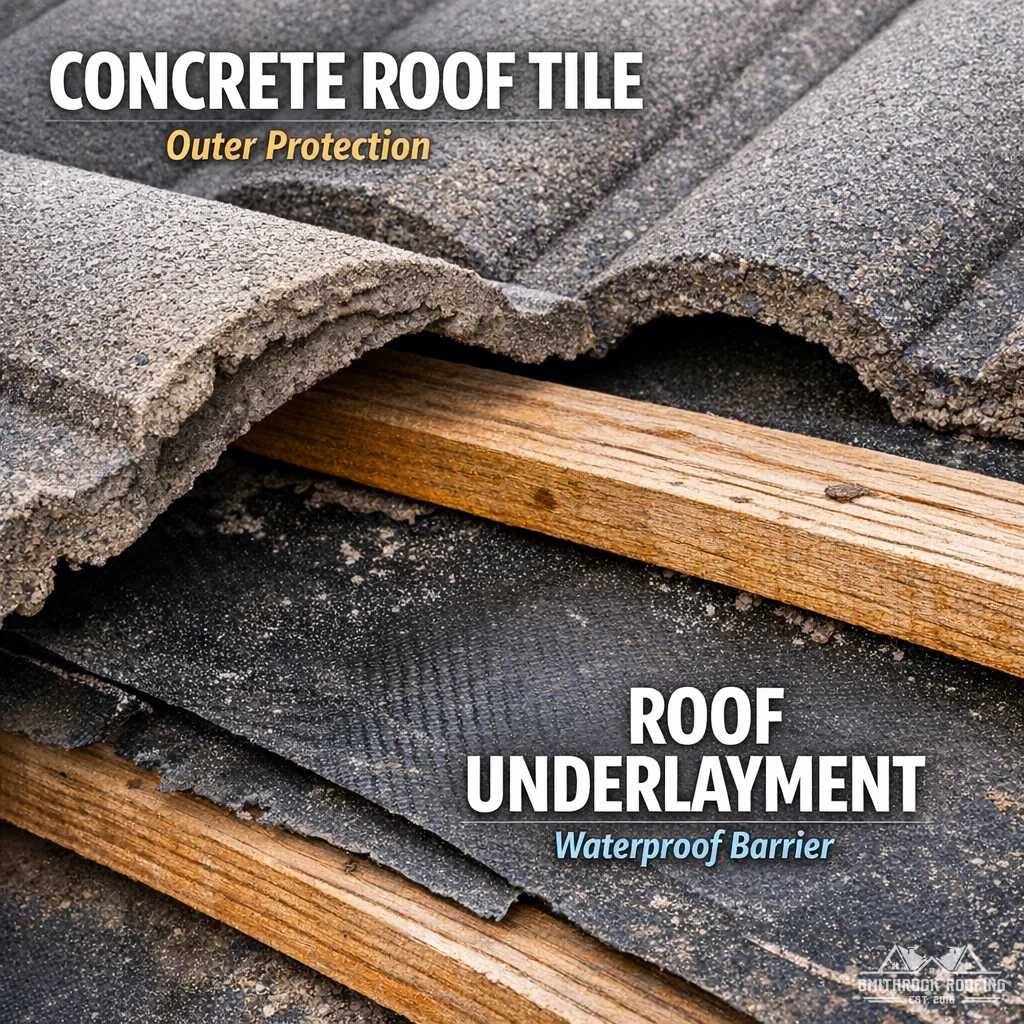
Illustration, not a photograph of a completed client project.
A concrete tile system is built to last decades, but the underlayment beneath it has a shorter service life. When underlayment degradation is widespread rather than isolated to one spot, patching beneath a single tile buys time without resolving the underlying problem. A thorough repair of the tile buys some time, but if the underlayment is approaching the end of its useful life across the whole roof surface, a full underlayment replacement becomes the more honest recommendation.
[SOURCE: DIYAroundTheHome video, https://www.youtube.com/watch?v=8r-Vii9rtvs]
Identifying that threshold is a judgment call that requires experience. The same visual indicators that flag a spot repair, brittleness, cracking, moisture staining on the deck, also indicate when a larger intervention is overdue. A contractor who treats every tile repair as a system-level assessment is in a position to give that honest evaluation rather than patch and return repeatedly. The roof repair vs. replacement article outlines how to weigh those options when the scope of the problem is unclear.
For homeowners across Winston-Salem, Greensboro, High Point, Kernersville, Clemmons, Rural Hall, King, and Mount Airy with concrete tile roofs, the right question after any tile damage is not just “which tile needs to come out,” but “what does the repair tell us about the condition of the roof beneath it.” Answering that question accurately is the difference between a repair that lasts and one that sets up the next service call.
The answer depends on your roof’s nailing regime and your comfort working at height. On an older pre-1994/1995 roof where field tiles are held by weight rather than fasteners, a single tile in an accessible location may lift with hand pressure, and the replacement process is relatively straightforward. On a fully-nailed roof, every surrounding tile requires a reciprocating saw to cut the fastener before removal, and the risk of breaking additional tiles during that process is significant. Beyond the tile swap itself, the more important variable is what gets missed: an inexperienced repair that skips underlayment and batten inspection may fix the visible crack while leaving an active leak path in place. If there is any doubt about the nailing regime, roof pitch, or the condition of what is beneath the tile, a qualified contractor is the more reliable path.
You cannot assess underlayment condition from the ground or even from the tile surface. The underlayment is only visible when tiles are lifted. During any tile repair, the exposed section should be checked for brittleness, cracking, thinning from repeated water contact, and moisture staining on the deck below. A single damaged section directly beneath a cracked tile is a localized problem. Widespread brittleness or cracking across multiple lifted areas, combined with the age of the roof, signals that the underlayment is nearing the end of its service life across the whole surface. At that point, repeated spot repairs address individual tiles while the underlying waterproofing membrane continues to deteriorate.
Roofing cement is a code-permissible and legitimate re-attachment method used specifically when re-nailing is not physically possible after the original nail is cut and removed. It is not equivalent to a mechanical fastener in long-term durability. Cement is subject to thermal cycling over years of heating and cooling, and its adhesive strength degrades over time. On steeper-pitch roofs or in areas with more frequent high winds, a cement-only attachment places the full load on that degrading bond. How long a cement attachment holds depends on the pitch of the roof, local wind exposure, and the quality of application. A contractor who re-nails wherever access allows and uses cement only as a true fallback is making the more durable decision.
Not necessarily, but a cluster of cracked tiles in one area warrants a more thorough assessment than a single tile repair. A concentrated pattern of breakage often points to foot traffic during a prior maintenance or inspection visit rather than widespread material failure, and in that case individual tile replacements may resolve the visible damage. However, the same cluster of lifted tiles provides an opportunity to assess underlayment condition across that section. If the underlayment shows signs of broad degradation beneath multiple tiles in the same zone, the conversation shifts from tile replacement toward underlayment repair or eventual full replacement. The tile condition and the underlayment condition are related questions, but they do not always have the same answer.
A concrete tile roof is a durable system built to last decades, but its longevity depends on treating it as a system rather than a surface. The tile that cracks is the starting point of the diagnostic process, not the end of it. What is below that tile, the underlayment, the battens, and the deck, determines whether a repair holds or whether a larger problem continues quietly behind the work that was just done.
For homeowners in Winston-Salem, Greensboro, High Point, Kernersville, Clemmons, Rural Hall, King, and Mount Airy, concrete tile roofs bring specific considerations around the nailing era of the roof, regional wind exposure, and the age of the underlayment relative to the tile above it. The right repair approach begins with understanding those variables, not with assuming the cracked tile is the whole story.

Smithrock Roofing © Copyright 2026 • All Rights Reserved • Privacy Policy • Maintained by Mongoose Digital Marketing