
A note on the numbers: the figures in this guide are national industry averages compiled for research — they are not Smithrock Roofing quotes. Every home and project is different, which is why our in-home assessments and written quotes are always free.
Your home’s gutter system is its unsung hero, a critical component of its overall water management strategy. Understanding the cost of cleaning gutters and downspouts—which typically ranges from $100 to $360, with a national average of $166—is the first step toward responsible homeownership. This isn’t just another maintenance expense; it’s a small, preventative investment that protects your property from catastrophic water damage.
Here’s a quick breakdown of what you can expect to pay for professional service:
Quick Cost Breakdown:
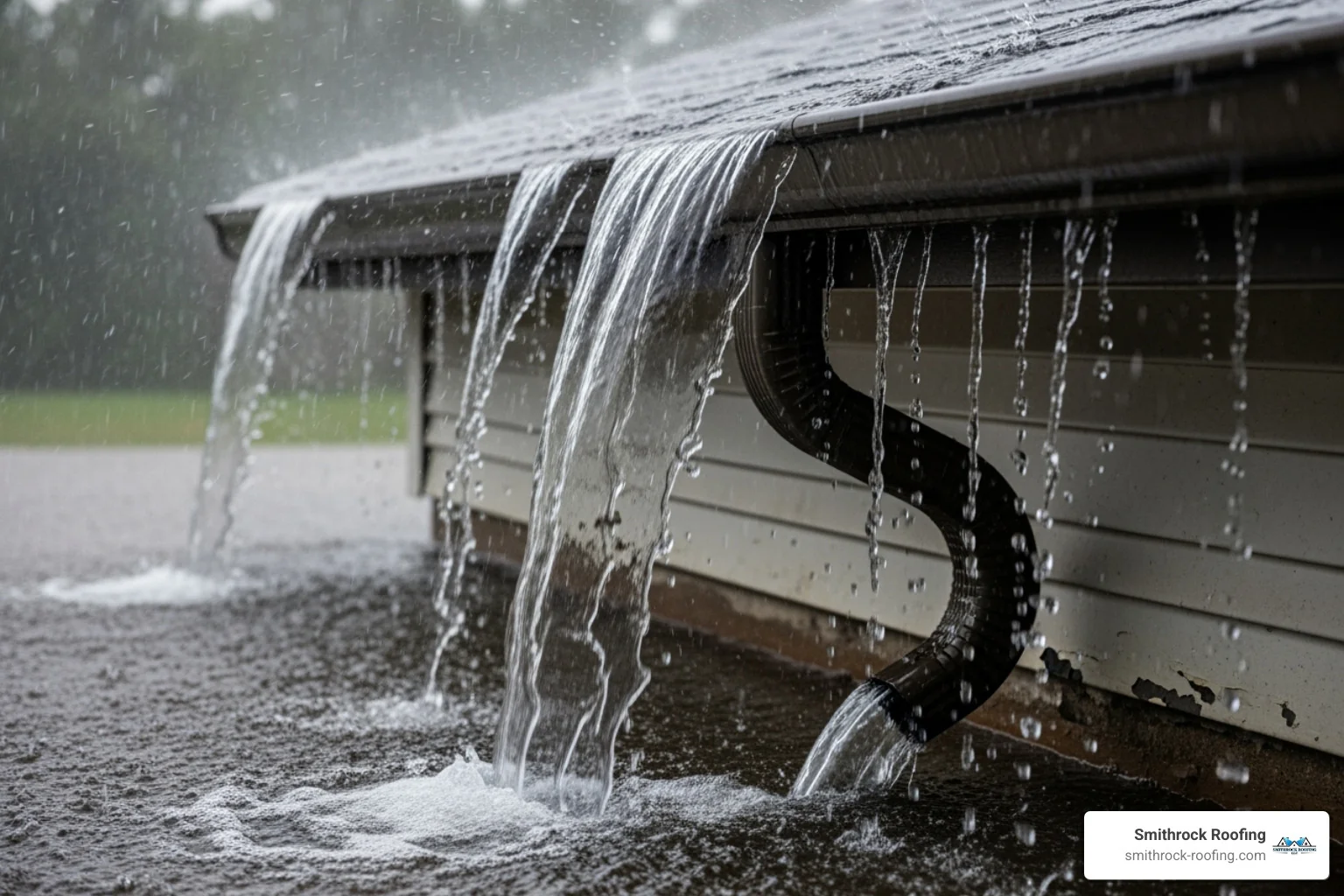
Gutters are your home’s first and most important line of defense against rainwater. They form a carefully engineered channel designed to capture thousands of gallons of water from your roof and direct it safely away from your home’s structure. When this system becomes clogged with leaves, twigs, shingle grit, and other debris, it fails. Water has nowhere to go but over the edge, cascading down your walls and pooling directly at your foundation. This overflow can trigger a domino effect of serious and expensive problems, including foundation cracks, roof leaks, basement flooding, and wood rot in your fascia and siding.
The sheer weight of accumulated debris poses another significant threat. Water is heavy, and when combined with soggy leaves and sludge, it can create immense strain on your gutters. One professional service reported removing over 50 pounds of wet, compacted leaves from a single gutter system—a burden that had caused the gutters to detach completely from the house, damaging the roofline in the process.
Regular cleaning saves an incredible amount of money in the long run. A minor foundation crack repair can start at $500, while major structural repairs involving piering or waterproofing can easily exceed $10,000. Compare that to the few hundred dollars for a professional cleaning, and the value becomes crystal clear. Timing also plays a role; scheduling during peak seasons like late fall and early spring can increase costs by 10-50% due to high demand.
With over 15 years of hands-on experience in exterior construction, I’m Jordan Smith, and I’ve witnessed firsthand how a simple, overlooked task like gutter cleaning can escalate into a homeowner’s worst nightmare. This guide is designed to demystify the cost of cleaning gutters and downspouts, empowering you to budget for this essential maintenance, ask the right questions, and protect your most valuable asset from preventable harm.
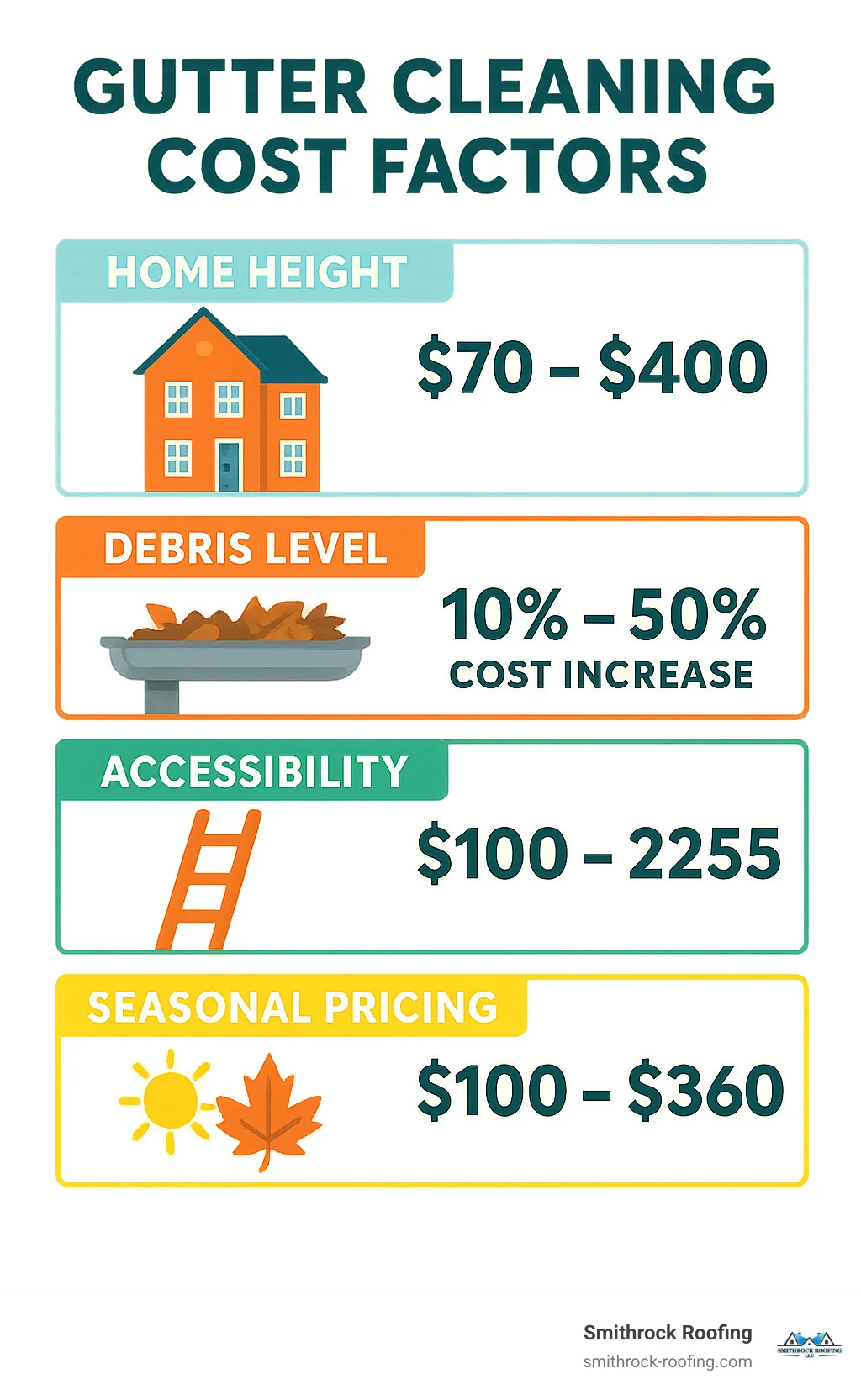
Most homeowners are pleasantly surprised to learn that professional gutter cleaning is a highly affordable service, typically costing between $100 and $360. The national average hovers around $166 for a standard single-family home, a small price for the significant protection it provides.
Labor is the primary driver of this cost, accounting for approximately 70% of your total bill. This fee covers much more than just manual labor; it includes the professional’s time, specialized equipment, liability insurance, and deep expertise in safely navigating ladders and complex rooflines. It ensures every inch of your gutter system, from the highest channel to the final downspout elbow, is clear and functioning correctly.
To provide accurate pricing, companies typically use one of three models:
Your geographic location also plays a significant role due to regional differences in the cost of living and labor. Homeowners in dense, expensive metropolitan areas like New York City or San Francisco can expect to pay a premium, while those in more affordable regions, such as the Southeast or Midwest, will often find lower prices.
Quoting by the linear foot is a straightforward and equitable pricing method. It allows for a customized quote based on your home’s specific dimensions. Most homes have between 150 to 200 linear feet of gutters. You can get a rough estimate by measuring the exterior perimeter of your home where the gutters are installed.

For a typical two-story home with 175 linear feet of gutters, you can expect a cleaning cost between $105 and $280, depending on other factors.
Height is the single greatest factor influencing cost because it directly correlates with risk, complexity, and time. Every additional story requires more advanced safety protocols and specialized equipment, which is factored into the price.

Working on taller homes requires specialized equipment like 40-foot extension ladders, ladder stabilizers to prevent slippage, and personal fall arrest systems (safety harnesses), all of which take time to set up and use correctly.
If you’ve postponed gutter cleaning for several seasons, expect to pay more. Heavy buildup from chronically neglected gutters can increase your costs by 10% to 50%, potentially pushing a standard $160 job to over $250 and complex jobs over $500.
This price jump is because the debris is no longer just loose leaves. Over time, organic matter decomposes into a dense, heavy, and compacted sludge that is far more difficult and time-consuming to remove. This cement-like compost often requires hand tools and significant effort to break up and scoop out.
The types of debris also matter. Soggy, matted leaves are heavy. Interlocking pine needles form dense plugs that are tough to pull apart. Heavy shingle grit, a byproduct of asphalt shingle aging, is abrasive and adds significant weight. Animal nests from birds, squirrels, or insects create structured blockages that must be carefully and completely removed.
Most professional quotes include debris disposal fees, which typically account for $0.14 to $0.16 per linear foot of the total cost. This ensures all the gunk is bagged, removed from your property, and disposed of legally, leaving your yard clean and saving you a trip to the dump. Regular, biannual cleaning prevents this heavy buildup, keeping your costs low and predictable.
When you hire a reputable professional for gutter cleaning, you’re investing in more than just debris removal. The service is an opportunity to get an expert assessment of your entire water drainage system, catching small problems before they escalate into costly repairs.
Since cleaners work at roof level, they have a unique vantage point to spot issues a homeowner would never see from the ground. A standard service almost always includes a thorough visual inspection, which is invaluable for proactive home maintenance. A professional will check for:
Many homeowners find it highly cost-effective to bundle services. For example, roof debris removal (using a leaf blower to clear the roof surface) typically adds just $75 to $250 to your bill. This is a wise add-on because it prevents the next rainstorm from immediately washing a new batch of leaves into your freshly cleaned gutters. Similarly, bundling with services like power washing or window cleaning can often lead to a package discount.
During the cleaning, professionals also get an up-close look at your fascia and soffit. The fascia is the long, straight board that runs along the lower edge of the roof, and it’s what your gutters are mounted to. The soffit is the underside of the roof overhang. If water has been overflowing, these wooden components are prime candidates for rot and pest infestations. Catching this damage early can mean a simple board replacement instead of a major structural repair costing thousands.
Clean gutters are useless if the downspouts are clogged. All the debris from your entire gutter run must pass through a narrow downspout opening, making it a common bottleneck. Clogs frequently form at the elbows or bends in the downspout, causing water to back up and overflow at the top.
Because clearing these stubborn blockages requires extra time and specific techniques, most professionals treat it as a separate but essential service, adding $50 to $150 to your total cost. The process involves more than just a quick rinse. Technicians may use a high-pressure water jet or a plumber’s snake (auger) to forcefully break up and flush out compacted debris. In severe cases, they may need to temporarily disassemble the downspout to remove the obstruction manually. Ensuring your downspouts are clear is non-negotiable for a functional system.
More info about Gutter and Downspout Installation.
One of the greatest advantages of professional cleaning is the on-the-spot identification and repair of minor damage. Your cleaner is hands-on with your system and will notice issues you can’t see, such as leaks at the seams, sagging gutters pulling away from the fascia due to loose hangers, dented sections, or corrosion on older metal gutters.
The good news is that most of these issues are inexpensive to fix when caught early. Addressing them during the cleaning appointment is highly efficient, as the contractor is already on-site with ladders and tools, saving you the cost of a separate service call. Typical repair costs include:
These minor repairs are far cheaper than a full gutter replacement and prevent small issues from causing significant water damage.
If you’re tired of the recurring cost and hassle of seasonal gutter cleaning, gutter guards are a popular long-term solution. These systems act as a filter, allowing water to enter the gutter while blocking leaves, pine needles, and other large debris. However, it’s crucial to understand they are for debris prevention, not elimination of all maintenance.
The installation cost for professional-grade gutter guards typically ranges from $6 to $8 per linear foot, which translates to $1,200 to $1,600 for a home with 200 feet of gutters. While this is a significant upfront investment, the return on investment can be substantial. There are several types to consider:
With quality gutter guards, you can expect a 50-75% cost reduction in long-term maintenance. Many homeowners go from cleaning their gutters twice a year to only needing a light surface cleaning of the guards every two to three years. If you currently spend $400 annually on cleaning, your guards could pay for themselves in just six to eight years. Beyond that, you enjoy decades of reduced maintenance costs and enhanced peace of mind.
Learn about the Cost to Install Gutter Guards Per Foot.
Each year, homeowners face the classic dilemma: “Should I clean my gutters myself or hire a professional?” This decision involves a careful trade-off between your budget, your time, your physical ability, and your tolerance for risk. A thorough understanding of the pros and cons of each path can help you make the safest and most cost-effective choice for your situation.
| Feature | DIY Gutter Cleaning | Professional Gutter Cleaning |
|---|---|---|
| Cost | Low upfront cost ($20-$100 for tools), but high potential for hidden costs (medical bills, home damage). | Higher upfront cost ($100-$360), but predictable and all-inclusive. |
| Time | Significant time commitment (2-5 hours for an average home), plus tool setup and cleanup. | Highly efficient (30-90 minutes for an average home), freeing up your weekend. |
| Safety | High risk of falls and injury. The CDC reports over 164,000 ER visits from ladder falls annually. | Professionals are trained in ladder safety, insured, and use proper safety equipment (harnesses, stabilizers). |
| Equipment | Requires purchasing or owning basic tools (ladder, gloves, scoop, hose). | Professionals use industrial-grade equipment for efficiency and safety. |
| Effectiveness | Varies by skill. High potential for missed spots, incomplete downspout flushing, or overlooking damage. | Guarantees a thorough cleaning, including downspout flushing and a basic system inspection. |
| Liability | You are 100% liable for any personal injury or damage to your property. | Reputable companies carry liability insurance and worker’s compensation, protecting you from accidents. |
The primary motivation for DIY gutter cleaning is cost savings. If you already own the necessary tools, your only investment is your time and physical effort. However, this project is often more demanding and dangerous than it appears.
Essential Tools for DIY Cleaning:
The DIY Process and Its Dangers:
The safety risks cannot be overstated. Ladder falls are a leading cause of home-related injuries, many of them serious. Beyond falls, there’s a risk of encountering power lines near the roof, discovering pest nests (wasps, rodents), or damaging the gutters or shingles yourself by applying too much force or placing the ladder incorrectly. A project intended to save $166 can quickly turn into a multi-thousand-dollar medical or repair bill.
When you hire a professional, you’re not just paying for labor; you’re investing in expertise, efficiency, and safety. Professionals have cleaned thousands of gutters and know how to handle any situation, from standard leaf buildup to complex, multi-story jobs with severe blockages.
They arrive with proper tools and safety equipment, including industrial-grade ladders, high-powered blowers, pressure washers with specialized nozzles, and the necessary safety harnesses and fall protection gear required by OSHA for high or steep roofs. This allows them to work more safely and effectively than any DIYer.
Efficiency is a major benefit. A professional crew can typically clean the gutters on an average home in 30 to 90 minutes, a task that could take a homeowner half a day. This saves you valuable time and strenuous physical labor.
Crucially, reputable companies carry liability insurance and worker’s compensation. This is a critical protection for you as a homeowner. If a worker is injured on your property or your property is damaged during the service, their insurance covers it. This peace of mind is one of the most valuable aspects of hiring a professional.
Finally, the service includes a basic inspection. As they clean, technicians will spot loose fasteners, leaking seams, or sagging sections, providing you with a report of your system’s health. This early detection of minor issues is a value-added benefit that helps you prevent major repairs down the line.
Details on our Gutter Installation Service
Proactive gutter maintenance is one of the most intelligent and cost-effective strategies for protecting your home’s value and structural integrity. By staying ahead of debris buildup, you are actively shielding your home from a cascade of expensive and stressful problems.
The financial argument is compelling. Compare the average $166 cost of a professional cleaning to the potential repair bills from neglect: foundation repairs can range from $5,000 to $15,000 or more, roof damage from ice dams can easily cost thousands, and replacing rotted siding can run $5,000 to $15,000. When gutters overflow, water saturates your home’s most vulnerable components—the foundation, basement, siding, and fascia boards—leading to rot, mold, and structural failure. Preventative maintenance is unequivocally the more affordable choice.
Your home will provide clear visual cues when your gutters are failing. Learning to recognize these warning signs allows you to act swiftly before a minor clog becomes a major catastrophe.
For most homes, the golden rule for gutter maintenance is twice a year: once in the late spring and once in the late fall.
However, your specific situation may require a different schedule:
With strategic planning, you can manage your gutter maintenance costs effectively without sacrificing quality.
Here are detailed answers to the most common questions homeowners have about the cost of cleaning gutters and downspouts and what the service entails.
A comprehensive professional service is far more than just scooping out a few leaves. A quality service package should always include the following steps:
Yes, absolutely. Clogged gutters are one of the leading and most preventable causes of serious foundation damage. It’s a slow but destructive process.
Here’s how it happens: When gutters overflow, thousands of gallons of rainwater are dumped directly at the base of your home. This oversaturates the soil, causing it to expand and exert immense hydrostatic pressure against your foundation walls. Over time, this relentless pressure can cause the concrete to crack. Once cracks form, water can seep into your basement or crawlspace, leading to chronic dampness, dangerous mold growth, and further degradation of the foundation’s structural integrity.
Considering that foundation repairs are notoriously expensive, often costing between $5,000 and $15,000, the few hundred dollars spent on annual gutter cleaning is an incredibly wise investment in preventing a financial catastrophe.
In most cases, you do not need to be home for the service to be completed. Professional crews are self-sufficient and can perform all the work on the exterior of your house without needing to interrupt your day.
The two main requirements from the homeowner are ensuring that technicians have unobstructed access to the perimeter of the home (e.g., gates are unlocked) and that an outdoor water spigot is turned on and accessible. The water source is essential for the critical step of flushing and testing the downspouts.
It is always a good practice to confirm this with your service provider when you schedule the appointment. You should also ensure any pets are secured safely indoors during the service window for their safety and the safety of the technicians.
When performed by a trained professional using the correct equipment, pressure washing is a safe and effective method for cleaning gutters. However, using excessive pressure can damage older, weakened gutters or strip paint. Professionals use nozzles and pressure settings that are powerful enough to clear debris but gentle enough to not harm the system. It is generally not recommended for a DIYer to use a high-powered pressure washer on their gutters without experience.
A reputable professional will not perform any repairs without your authorization. The standard procedure is to document any discovered issues (like leaks, loose sections, or rot) with clear photographs. They will then present you with a report of their findings and a separate, no-obligation quote detailing the recommended repairs and associated costs. This allows you to make an informed decision about how to proceed.
Understanding the cost of cleaning gutters and downspouts is fundamentally about risk management. It’s about recognizing that a small, predictable expense is the key to protecting your largest and most important financial asset: your home. By investing in routine maintenance, you are taking control and preventing small, manageable issues from spiraling into devastatingly expensive emergencies.
As we’ve detailed, a professional cleaning typically costs between $100 to $360, with a national average of around $166. This price is not just for labor; it’s for the expertise, safety, and efficiency that comes with hiring trained professionals to maintain your home’s vital water drainage system. The cost scales logically with the job’s complexity, height, and risk, ensuring a fair price for the work performed.
Remember, regular maintenance is preventative care for your home. The consequences of neglect are severe and financially crippling. Foundation damage can easily exceed $10,000, a new roof can cost $15,000 or more, and siding replacement is another five-figure expense. These are not abstract risks; they are the direct and foreseeable outcomes of failing to maintain your gutters. The cost of decades of routine cleanings is a mere fraction of the cost of a single one of these major repairs.
By being a proactive homeowner—learning to spot early warning signs like water stains on siding or sagging gutters and adhering to a simple twice-yearly cleaning schedule—you are building a shield that protects your home from water damage, foundation problems, pest infestations, and landscape erosion.
Smart homeowners can further optimize their investment by scheduling service during off-peak seasons, bundling with other exterior work, and maintaining a consistent cleaning schedule to avoid the surcharges that come with severely neglected systems.
While the DIY route may seem like a way to save money, the combination of significant safety risks, the substantial time commitment, and the high likelihood of an incomplete job makes professional service the wiser and safer choice for most families. The liability protection, guaranteed results, and invaluable peace of mind are well worth the modest investment.
At Smithrock Roofing, we understand that your home is your sanctuary. That’s why we are committed to providing comprehensive Gutter services that go beyond a basic cleaning. From expert repairs and gutter guard installations to complete system replacements, our team is here to ensure your home remains safe, dry, and protected through every season. Every dollar you invest in proper gutter maintenance today is an investment in your home’s future and your own financial security.
Need a local pro? Learn more about our gutter installation and repair in King.

Smithrock Roofing © Copyright 2026 • All Rights Reserved • Privacy Policy • Maintained by Mongoose Digital Marketing