A roof leak doesn’t wait for business hours. It shows up at midnight during a thunderstorm rolling off the Blue Ridge, or on a Tuesday afternoon when a line of storms sweeps across Forsyth County and leaves you standing in your living room with a bucket and a knot in your stomach. The stress is real, and the decisions you make in the first hour matter more than most people realize.
This guide is written for Winston-Salem homeowners dealing with an active leak or trying to get ahead of the next one. We’re going to cover things most roofing articles skip entirely — including how to tell whether you actually have a roof leak, what Winston-Salem’s specific housing stock means for your risk profile, and what the insurance process actually looks like under North Carolina law. No filler, no scare tactics. Just honest, field-tested information from a team that has been on these roofs for decades.
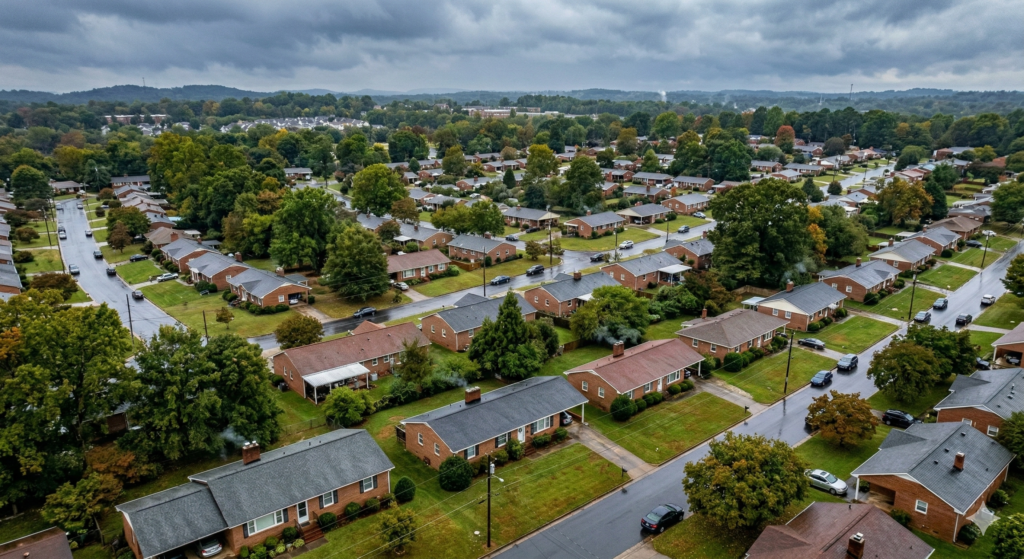
A quiet afternoon in a Winston-Salem neighborhood, where the rhythmic patterns of brick and shingle glisten under a cooling North Carolina rain.
Here’s something experienced roofers know but rarely say out loud: a meaningful number of emergency “roof leak” calls turn out to be something else entirely. Attic condensation, HVAC condensate line failures, and cracked plumbing vent stacks all produce ceiling stains and dripping water that look identical to a roof leak from inside your home. Some contractors — not all of them honest ones — are happy to let you assume the worst and schedule repairs accordingly.
We’d rather save you that trouble.
Before you call anyone, note exactly when the water appears. This one piece of information cuts diagnostic time significantly and can prevent unnecessary repair charges.
If water appears during or immediately after rainfall: You likely have a roof leak, damaged flashing, or a compromised roof penetration. This is the scenario where emergency roof repair is warranted.
If water appears on dry days, primarily in cold mornings, or consistently during HVAC operation: You’re probably looking at one of these non-roof causes:
A genuine roof leak almost always correlates directly with rain events. If your ceiling drips without rain, get your HVAC system and plumbing checked before scheduling roofing work.
Generic roofing advice treats every house the same. It isn’t. Winston-Salem and the surrounding Forsyth County area have a housing inventory heavily weighted toward brick ranch homes, split-levels, and cape cods built between 1955 and 1985. These homes were well-built for their era, but they share structural characteristics that create predictable, recurring leak points that a contractor without genuine local experience will miss.
1. Chimney Cricket Failures
Any chimney wider than 30 inches on the uphill side requires a cricket — a small peaked diverter that channels water around the chimney base. Many homes built in the 1960s and 1970s across neighborhoods like Buena Vista, Washington Park, Sherwood Forest, and the Reynolds area were constructed without them. The result is standing water pooling directly against the chimney base every time it rains. Over years, this saturates the mortar, works behind the step flashing, and produces leaks that seem to “move around” because water is tracking down the interior of the chimney chase before it finds the ceiling.
If you have a brick chimney and recurring leaks near it, the absence of a cricket is the first thing a qualified roofer should check.
2. Low-Slope Addition Leaks
Rear additions and garage conversions on 1960s-1980s homes frequently have flat or low-pitch roof sections. These sections require modified bitumen, TPO membrane, or a comparable low-slope roofing system — not standard asphalt shingles, which need a minimum 2:12 pitch to drain properly and a minimum 4:12 pitch to perform as intended.
When previous owners re-roofed a low-slope addition with standard shingles to save money, leaks aren’t just possible — they’re mathematically inevitable. Water backs up under the shingles on shallow pitches, saturates the underlayment, and works through the deck. These repairs require removing the shingles entirely and installing an appropriate membrane system, not simply replacing the shingles on top.
3. Undersized Valley Flashing
Aluminum valley flashing installed in 1970s construction was frequently under-gauge — 0.019 inches was common, against the modern standard of 0.024 inches. Thinner aluminum corrodes faster, and the galvanic interaction between the aluminum and older steel fasteners accelerates that process. By the time a home built in 1972 reaches its second or third owner, the valley flashing is often at end-of-life regardless of what the shingles look like from the street. A roof that “looks fine” can have valleys that are actively channeling water onto the deck every time it rains.
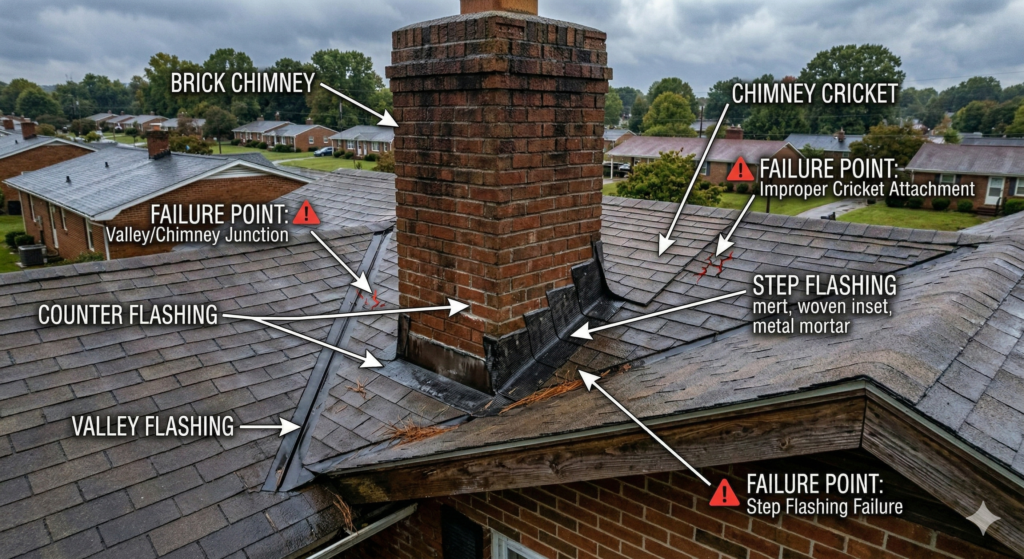
Understanding the anatomy of your roof: Proper installation of crickets and flashing is essential for diverting water away from chimneys and preventing costly structural leaks.
You’ll read on plenty of roofing websites that “Winston-Salem weather is unpredictable.” That’s true in the casual sense, but it undersells what’s actually happening meteorologically and why it matters for your roof.
The Piedmont Triad sits at the base of the Blue Ridge Escarpment — the sharp elevation drop from the mountains to the piedmont plateau. This geography does something specific: it intensifies and accelerates storm cells as they move eastward out of the mountains. Moisture-laden systems that would moderate over a gradual slope instead descend rapidly and maintain energy, producing heavy, concentrated rainfall events that hit neighborhoods like Ardmore, Reynolda, and Clemmons harder than the raw forecast often suggests.
Beyond summer storms, Winston-Salem sits in a freeze-thaw zone that creates ice dam risk that many homeowners don’t associate with the Piedmont. We’re not the mountains, but Forsyth County averages enough sub-freezing winter days that ice dams form regularly along the eaves of homes with inadequate attic insulation. When ice backs up under shingles and melts, it follows the path of least resistance — and that path often ends at your ceiling.
Understanding the local weather patterns explains why speed matters differently depending on the season:
| Season | Primary Threat | Why Fast Response Matters |
|---|---|---|
| Late Spring / Summer | Intense convective storms, high rainfall rate | Water intrusion happens fast; saturated decking can develop mold within 24–48 hours in NC humidity |
| Fall | Extended rain events, wind-driven rain | Persistent moisture without drying time compounds deck damage; valley areas most vulnerable |
| Winter | Freeze-thaw cycles, ice dam formation | Ice dam water bypasses all shingle protection; interior damage can be extensive before it’s visible |
| Early Spring | Residual ice damage reveals itself, heavy rain | Damage from winter freeze-thaw cycles becomes apparent; flashing failures surface as ice melts |
Temporary tarping is almost always the right first step after storm damage. But the way a tarp is installed — and documented — has direct consequences for your insurance claim. This is one of the most significant gaps in standard roofing advice, and it’s worth understanding before you sign anything.
Your homeowner’s insurance policy requires you to take reasonable steps to prevent further damage after a covered loss. This is called the duty to mitigate, and it matters in a very specific way during emergency repairs.
A tarp that fails — because it wasn’t secured at the ridgeline, had insufficient overlap, or wasn’t properly ballasted — and allows additional water intrusion can result in that additional damage being denied as “preventable.” The insurer’s position is that you had an opportunity to stop the damage and the method you used was inadequate. This is not theoretical. It happens, and it happens more often with DIY tarping or with contractors who throw a lightweight poly tarp over a roof and call it emergency mitigation.
When you’re evaluating a contractor for emergency tarping in Winston-Salem, ask these specific questions:
Under NCGS §58-63-15, North Carolina insurers are required to acknowledge a claim within 10 days of filing and complete their investigation within 30 days. If your adjuster is unresponsive or the process is dragging past those thresholds, this statute provides you with legal recourse worth knowing about.
Additionally, NC law under NCGS §58-3-185 addresses policy provisions broadly, but the practical element most homeowners encounter is the one-year window from the date of loss to file a claim for most standard homeowner’s policies. In the stress of dealing with active damage, it’s easy to put off formal claim filing — don’t.
One more insurance issue worth understanding: matching disputes. When a section of your roof is repaired or replaced after storm damage, the repaired area may not visually match the undamaged sections — particularly on roofs with weathered or discontinued shingle profiles. NC homeowners have argued these cases successfully, but it requires documentation from the outset. Photograph your entire roof before any repairs begin, not just the damaged section.
Every roofing website tells you to “check for a license.” Almost none of them explain what that means in North Carolina specifically, or how to verify it in under a minute.
North Carolina contractor licensing for roofing work falls under the NC Licensing Board for General Contractors (NCLB). For roofing projects, the relevant classifications are:
| License Classification | What It Covers | What to Look For |
|---|---|---|
| Limited License | Projects up to $500,000 in value | Sufficient for most residential roofing work |
| Intermediate License | Projects up to $1,000,000 | Common for larger residential and light commercial |
| Unlimited License | No cap on project value | Full commercial and large-scale residential |
To verify a contractor’s NC license, visit nclbgc.org and use the license search tool. Enter the contractor’s name or license number and confirm that the license is active, not expired, and not under disciplinary action. This takes approximately 60 seconds and is worth every one of them.
Beyond the state license, look for:
North Carolina has adopted the 2018 International Residential Code (IRC) with state-specific amendments. Two sections are directly relevant to emergency roof repair work, and knowing they exist helps you have a more informed conversation with any contractor:
IRC R905.2 covers minimum installation standards for asphalt shingles — including fastener placement, overlap requirements, and underlayment specifications. A repair that doesn’t meet R905.2 standards isn’t just substandard; it can complicate your warranty claims and future insurance filings.
IRC R903.2 addresses flashing requirements at all roof penetrations, valleys, and wall intersections. This section is significant because flashing repairs are the most common component of emergency leak repair — and the most commonly done incorrectly by contractors cutting corners under time pressure.
When a repair is completed, you’re entitled to ask whether the work meets 2018 IRC standards. A qualified contractor will answer that question directly and without hesitation.
“Minor repairs take one to two days.” You’ll see this everywhere. It tells you almost nothing, because the actual timeline depends on variables that are entirely specific to your situation.
1. Deck condition
This is the single biggest variable. If water intrusion has saturated and softened the roof deck (typically 5/8″ OSB or plywood on homes in this area), sections of deck must be replaced before new materials go down. Deck damage isn’t visible until old materials are removed, which means any timeline estimate given before tear-off begins is genuinely a best guess.
2. Flashing scope
Spot patching over failed flashing is a same-day repair. Replacing step flashing along an entire chimney chase, or re-flashing a dormer on a steeply-pitched roof, adds complexity and time — especially on the older home configurations common in Winston-Salem’s established neighborhoods.
3. Material availability
Emergency repairs using materials that match your existing roof depend on what’s in local supply. CertainTeed Landmark shingles, for example, carry an extensive color palette with consistent regional availability. Older or discontinued shingle profiles may require sourcing time, which affects both the timeline and potentially the matching dispute issue discussed earlier.
4. Weather windows
Asphalt shingles should not be installed in temperatures below 40°F without modified installation protocols. In Winston-Salem winters, this creates legitimate scheduling constraints — not contractor excuses. A contractor who guarantees a specific completion date on a winter repair without noting this caveat isn’t being honest with you.
5. Permit requirements
Forsyth County requires permits for full replacements and significant structural repairs. Emergency temporary repairs (tarping, limited flashing repair) typically don’t require permits, but any scope expansion into structural deck work or full replacement does. A contractor who skips the permit step to move faster is saving themselves time and creating a problem for you at resale.
If you’re reading this because you have an active leak or you’ve just discovered water damage, here’s where to focus your energy.
Pull out your phone and photograph every affected area — interior water stains, damaged ceilings, any visible exterior damage from the ground. If it’s safe to access your attic, photograph the underside of the deck. Timestamps matter for insurance claims, and this documentation protects you if there’s any dispute about pre-existing conditions versus storm damage. Do this before a tarp goes up and before any contractor begins work.
There’s a meaningful difference between a contractor who walks your roof for ten minutes and hands you a number and one who conducts a thorough damage assessment that identifies both the primary failure point and any secondary vulnerabilities. In 2026, the most useful thing you can do after an emergency temporary repair is get a documented assessment that captures the full scope of damage in writing. This protects you during insurance negotiations and gives you an honest baseline for repair versus replacement decisions. For a deeper look at what the residential roof storm damage assessment and repair process involves, our comprehensive guide walks through every stage in detail. Smithrock Roofing provides detailed assessments backed by 60+ combined years of experience reading roof systems — not just quoting materials and labor.
With emergency repairs, the pressure to act fast is real — but a signed contract with an uncertified contractor can void your existing manufacturer warranty and leave you without recourse if the repair fails. Ask specifically whether the contractor is manufacturer-certified and what labor warranty covers the completed work. Smithrock Roofing holds CertainTeed SELECT ShingleMaster certification and backs every job with a 5-year labor warranty alongside the manufacturer’s limited lifetime warranty. That combination of credentials isn’t common in this market, and it matters when water is finding its way back in six months later.
Response time varies by contractor availability and weather conditions, but reputable local contractors can typically deploy for emergency tarping and temporary stabilization within 24 to 48 hours of an initial call. Permanent repair scheduling depends on material availability, permit requirements for larger scopes of work, and the condition of your roof deck once old materials are removed. Any contractor promising a precise completion date before they’ve assessed your roof in person is giving you a number rather than an honest answer.
Most standard homeowner’s insurance policies in North Carolina cover sudden, storm-related roof damage — including emergency temporary repairs like tarping. What they typically don’t cover is damage resulting from deferred maintenance or gradual deterioration. The distinction matters because adjusters are trained to identify pre-existing wear, and documentation of the storm event is critical to a successful claim. Photograph everything immediately, report promptly, and make sure your contractor provides written documentation of the damage scope. Smithrock Roofing works regularly with insurance claims and can help you understand what the assessment shows before you file.
The honest answer is that you often can’t know for certain until a contractor removes damaged materials and evaluates the deck condition beneath them. That said, roofs showing widespread granule loss, multiple failed flashing points, visible sagging, or active leaks in several locations simultaneously are typically better candidates for full replacement than repeated spot repairs. A roof in the 20- to 25-year range in Winston-Salem’s climate is likely approaching the end of its serviceable life regardless of the current emergency. A trustworthy contractor will show you what they find and explain the tradeoffs clearly — not steer you toward the higher-ticket option by default.
Move furniture and valuables away from the affected area, place buckets or towels to collect dripping water, and if there’s a bulging area in the ceiling, carefully puncture it to allow water to drain rather than pool (pooled water adds weight and increases collapse risk). Take photographs of all interior damage with timestamps before cleanup. If the leak is severe or there’s any sign of structural compromise, contact a roofing professional immediately rather than attempting roof access yourself. Temporary tarping by an experienced contractor is far safer and more effective than DIY solutions during or after a storm event.
A leaking roof is stressful, and the pressure to make fast decisions with incomplete information is one of the harder parts of the experience. Our goal with this guide has been to give you the context you need to move quickly without moving blindly — to understand what you’re dealing with, what questions to ask, and what separates a repair that holds from one that doesn’t.
If you’re dealing with an active leak or storm damage anywhere in the Winston-Salem area, we’re ready to help with an honest assessment and workmanship you can stand behind. Contact Us to schedule your inspection or get answers to questions specific to your home.
Smithrock Roofing © Copyright 2026 • All Rights Reserved • Privacy Policy • Maintained by Mongoose Digital Marketing