A roof leak rarely announces itself at a convenient time. More often, it’s a Saturday night during a thunderstorm rolling in off the Piedmont when you notice the ceiling stain, hear the drip, or feel the soft give of wet drywall overhead. The instinct is to panic, and honestly, some urgency is warranted. But panic without direction leads to expensive mistakes.
This guide is written for homeowners across Winston-Salem, Greensboro, High Point, Kernersville, Clemmons, Rural Hall, and King who are dealing with an active roof leak or want to understand what a real emergency response looks like before one ever happens. We’re going to go deeper than the standard “call a roofer and take photos” advice, because you deserve to understand what’s actually happening to your home and what a competent repair response truly involves.
Before anything else, it helps to know what you’re dealing with. Not every leak requires a 2 a.m. phone call, but some situations absolutely do. Misreading the severity in either direction costs you.
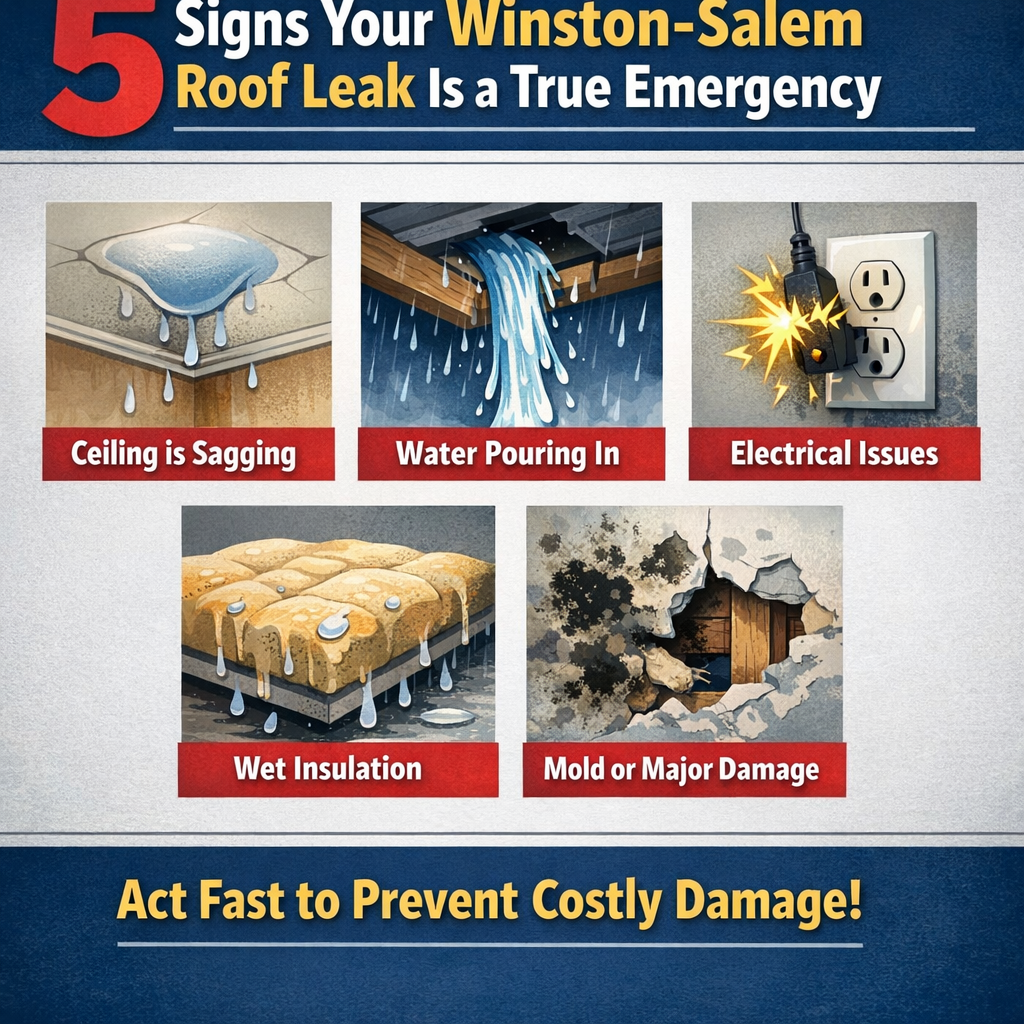
A true roofing emergency exists when any of the following conditions are present:
Urgent but non-emergency situationsmeaning you need professional attention within 24 to 48 hours, not necessarily at midnight, include:
This distinction matters because it helps you respond proportionately. An emergency calls for immediate containment and an emergency call to your contractor. An urgent situation calls for immediate interior protection and a first-thing-in-the-morning call, not waiting two weeks, but also not creating additional roof hazards by attempting repairs yourself in the dark during a storm.
Need a hand with this in Winston-Salem, Greensboro and the NC Triad? Call (336) 971-0464 or request a free estimate. Honest answers, no pressure.
Here’s something most generic roofing guides won’t tell you: where you live directly shapes how and where your roof fails. Winston-Salem and the surrounding NC Triad sit in a microclimatic zone that creates failure patterns distinct from what you’d see on the coast or in the mountains.
In our area, heavy summer convective storms can carry wind-driven rain at low angles, sometimes nearly horizontal, that standard shingle overlap simply was not engineered to resist. Most homeowners assume the vulnerable spots are chimneys, valleys, and skylights. Those are real failure points, but the windward rake edge the sloped edge of your roof along the gable end, is frequently overlooked and highly vulnerable in wind-driven rain events.
When wind-driven rain reaches that angle, it moves under shingles at the edge rather than shedding off them. Starter strip adhesion fails, the rake drip edge lifts, and water wicks directly into the roof deck before ever reaching the attic floor. By the time you see a ceiling stain in an upstairs bedroom near an exterior wall, the decking along that rake may have been wet through multiple storm cycles already.
Clay-heavy soil with high shrink-swell characteristics is common in many regions. Over decades, seasonal moisture changes cause measurable foundation movement in older homes, and that movement travels upward. Roof structures experience subtle racking at ridge and hip intersections, opening hairline stress fractures that widen slightly with each temperature swing. These micro-gaps at ridge caps and hip flashing are invisible to a casual exterior inspection but become water entry points during sustained rain.
This is especially relevant in established neighborhoods where the housing stock ranges from 50 to 100 years old.
In our area, winters don’t produce the sustained freezing that northern states endure, but the pattern of repeated freeze-thaw cycling, temperatures that drop below freezing overnight and climb above it by afternoon, is actually more damaging to roofing sealants than sustained cold. Each cycle causes slight expansion and contraction at every sealed joint: around pipe boots, along step flashing, at chimney counter-flashing, and at any penetration. After enough cycles, the sealant loses adhesion and cracks. Water finds these joints during the next rain event.
This is one of the most important, and most consistently underexplained, realities of roof leak repair. The visible damage inside your home is almost never located directly below the entry point on your roof.
When water breaches the outer surface of your roof, it doesn’t fall straight down. It hits the roof deck, typically OSB or plywood, and follows the path of least resistance. That means it travels along the underside of the deck, wicking along rafter bays and following framing members, before it drops somewhere onto your ceiling drywall or insulation. The horizontal travel distance from breach point to visible interior damage is commonly 6 to 15 feet.
In homes built between 1960 and 1990, which represents a substantial portion of the housing stock in many neighborhoods across our area, blown-in attic insulation adds another layer of complexity. That insulation completely obscures the travel path. You may see a ceiling stain in a second-floor hallway when the actual breach is near the ridge line above the master bedroom. For a deeper look at tracing ceiling water intrusion back to its source, the article Ceiling Leak? Find the Real Source Before You Call Anyone walks through the diagnostic process in detail.
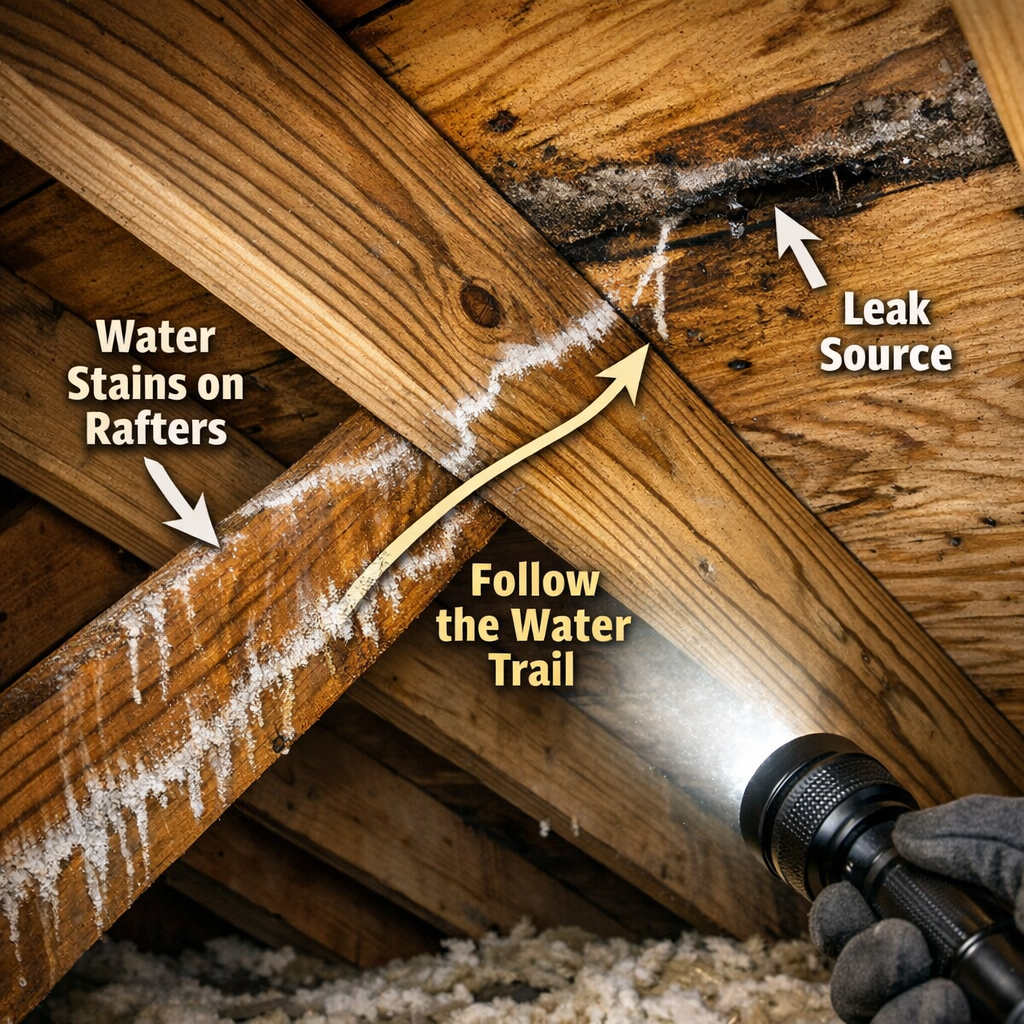
If you’re able to safely access your attic during daylight hours after the rain has stopped, here is a specific technique that experienced roofers use to trace the true breach location:
Look for tide marks on the rafter wood, not just wet spots.
Tide marks are the white or gray mineral deposit lines left on wood after water has dried. They outline the historical water travel path and are visible long after active moisture is gone. Fresh wet spots show you where water is today. Tide marks show you where it has been traveling over timepointing toward the actual entry point at the roof surface.
Run the tide mark lines uphill (toward the ridge) rather than following them downhill. The breach is almost always at or above the highest visible tide mark, on the same rafter bay or within one bay on either side.
This single diagnostic step can save you from the costly mistake of repairing the wrong section of your roof, a mistake that reveals itself at the next rain event.
Most homeowners who’ve encountered roofing content online have seen “emergency tarping” listed as a service. What almost no one explains is that a tarp installed incorrectly can cause more damage than the original breach.
The single most common tarping mistake, made by well-meaning homeowners and undertrained crews alike, is securing the tarp only to the damaged section of the roof without running it over the ridge.
A tarp that stops at the ridge and is weighted or nailed on the uphill edge creates a water scoop. Rain and wind drive water under the uphill edge, the tarp billows, and water is channeled directly into the breach point at higher volume than if no tarp were present at all. The tarp becomes a funnel.
A correctly installed emergency tarp must:
In sustained wind, which is common during and after heavy storms in our area, even a correctly installed tarp must be checked. Tarps are a 24-to-72-hour measure, not a repair. Their purpose is to stop escalating damage while permanent repair is scheduled.
One of the most significant omissions in standard roofing content is the complete failure to acknowledge that leak diagnosis and repair strategy depend heavily on how old your roof is.
| Roof Age | Likely Failure Mode | Repair Approach | Insurance Relevance |
|---|---|---|---|
| Under 7 years | Isolated installation defect, flashing failure, or storm impact | Targeted repair to specific breach point; decking almost always sound | Storm damage claims typically strong; manufacturing defect may trigger warranty claim |
| 7–15 years | Flashing sealant degradation, pipe boot failure, wind-lifted shingles | Targeted repair with full flashing inspection; deck spot-check warranted | Storm damage claims viable if event is documented; adjuster will assess depreciation |
| 15–20 years | Multiple simultaneous failure points beginning to develop | Comprehensive inspection critical; partial re-roof may outperform repeated spot repairs | Adjuster may flag pre-existing deterioration; supplement documentation becomes important |
| 20+ years | Systemic failure across shingle surface, decking integrity at risk | Full replacement often more cost-effective than continued repair; decking assessment is non-negotiable | Carrier may apply significant depreciation; ACV vs. RCV policy distinction becomes critical |
A 6-year-old roof leaking after a documented hail event and a 24-year-old roof leaking after the same storm are completely different repair scenarios. The materials involved, the insurance strategy, the scope of inspection, and the honest conversation about repair versus replacement all change based on roof age. If you’re weighing whether repair or full replacement makes more sense for your home, the article Roof Repair vs. Replacement in Winston-Salem: Key Criteria breaks down the decision factors in detail.
When a contractor gives you an identical assessment protocol regardless of your roof’s age, that’s worth noting.
Here is a technical reality that separates thorough roof repair from surface-level patch work: the condition of your roof decking, the OSB or plywood layer beneath your shingles, determines whether any repair above it will last.
In homes with a history of slow leaks, which is common across older neighborhoods where deferred maintenance accumulates over decades, the decking may be soft, delaminated, or compromised even in areas where the surface shingles appear intact. A shingle-level repair installed over soft decking will fail, typically at the first significant rain event after the repair.
A responsible repair process includes:
Skipping this step is not a cost-saving measure, it’s a cost-deferral that creates a callback situation and leaves the homeowner no better protected than before the repair.
Flashing failure is one of the leading causes of roof leaks, and it’s listed as such on virtually every roofing website in Winston-Salem. What none of those sites explain is what actual flashing repair involves, and why the difference between a proper reflash and a caulk-over is measured in years of service life.
Chimney flashing is a layered system, and each layer has a specific function:
When a contractor tells you a chimney flashing leak can be fixed by “resealing,” ask specifically whether the counter-flashing is set into the mortar or surface-applied, and whether the step flashing is being replaced or simply resealed over. That answer tells you whether you’re getting a repair or a temporary fix. For a full breakdown of what proper chimney flashing repair involves and what it typically costs, see the article Chimney Flashing Repair: Why Leaks Keep Coming Back.
This section covers something most roofing content either ignores entirely or handles so briefly it’s useless. Your insurance claim outcome depends in part on decisions you make in the first 24 to 48 hours after discovering damage.
Before the adjuster arrives, locate your policy documents and identify whether your dwelling coverage is written on an Actual Cash Value (ACV) or Replacement Cost Value (RCV) basis.
This distinction directly affects your out-of-pocket exposure and your repair timeline decision-making.
The first payment you receive from your insurance carrier after a storm damage claim is almost never the final payment. Here’s why:
Initial adjuster assessments are conducted from the ground or on a quick roof walk. They document visible damage. What they frequently miss, and what a thorough repair process commonly uncovers, is hidden damage beneath intact-looking shingles: compromised decking, saturated insulation, deteriorated step flashing beneath surface shingles that appeared undamaged.
When a contractor uncovers hidden damage during the repair process, a supplemental claim can be filed with documentation of the additional scope. This is standard practice on storm damage repairs and is not a dispute with your carrier, it is the expected second step in the process.
One specific thing to ask any contractor you’re considering: do they have experience writing Xactimate estimates?
Xactimate is the estimating software that most major insurance carriers use to process repair claims. A contractor who submits damage documentation in a format incompatible with Xactimate line items will consistently under-document scope, leaving legitimate claim value unrecovered. This costs you money on materials and repair quality, not the contractor.
Insurance carriers draw a firm line between sudden, accidental damage (a storm event, a fallen branch, hail impact) and gradual deterioration (a roof that has been aging and developing failures over months or years). Claims based on sudden damage events are covered under standard homeowner policies. Gradual deterioration is not.
This means two things for your claim:
Every roofing site mentions mold as a risk of delayed leak repair. Almost none give you the actual timeline.
In North Carolina’s climate, where summer relative humidity regularly exceeds 70 percent and attic temperatures spike above 120°F, mold colonization on wet drywall, wood framing, and cellulose insulation can begin within 24 to 48 hours of initial water exposure under warm weather conditions. This is not a worst-case estimate; it reflects the documented growth conditions for common mold species including Aspergillus and Stachybotrys on cellulose-based materials in humid environments.
The practical implication: a Saturday storm that soaks your attic insulation and ceiling drywall, left unaddressed through a long weekend, may present active mold growth by the time a contractor arrives Monday morning. That changes the remediation scope, the insurance documentation requirements, and the health implications for your household considerably.
Speed of response is not just about preventing further structural water damage. In this climate, it is directly connected to air quality and indoor environmental health.
Knowing the underlying mechanics of a roof leak is useful, but when water is coming through your ceiling right now, here is the sequential response that limits damage while you wait for professional help:
A roof leak repair is only as good as the materials and methods used to complete it. This is worth stating plainly because it’s where corners are most commonly cut.
Smithrock Roofing installs CertainTeed Landmark shingles and holds CertainTeed PREMIER ShingleMark Master Certification, a credential that requires demonstrated installation excellence and is held by fewer than one percent of roofing contractors nationally. That certification means repairs and replacements are eligible for the strongest manufacturer warranty coverage available, including the limited lifetime warranty on materials.
Our team brings over 60 combined years of field experience across the NC Triad, which means we have been in hundreds of local attics, diagnosed the tide marks on the rafter wood, walked the decks on homes throughout the area, and understand exactly how local storm patterns interact with specific roof systems and housing vintages. That’s not a credential you hang on a wall, it’s pattern recognition built from years of doing this work in this specific region.
When you call about an emergency roof leak, you’re not talking to a call center routing your claim. You’re talking to people who know your neighborhood, understand your climate, and will give you a straight answer about what your roof actually needs.
An emergency roof leak response isn’t just about speed, though speed matters. It’s about arriving with the knowledge to correctly diagnose where the water is actually entering, the tools and materials to stabilize the situation immediately, and the honesty to tell you what the repair scope actually involves.
A contractor who shows up quickly, installs a tarp that turns into a water scoop, misses the tide marks in the attic, and patches the wrong section of the roof has not helped you. They’ve given you a false sense of resolution while the underlying problem remains.
If you’re in Winston-Salem, Greensboro, High Point, Kernersville, Clemmons, Rural Hall, King, or anywhere across the NC Triad and you’re dealing with an active or recent roof leak, Smithrock Roofing is ready to give you the real assessment your home deserves, backed by our A+ BBB rating, 312+ five-star reviews, and the kind of local knowledge that only comes from years of working on roofs in this exact region.
Smithrock Roofing prioritizes emergency calls across Winston-Salem and the broader NC Triad. Response times vary based on current demand and weather conditions, but the goal is always to get a qualified technician to your property as quickly as safely possible, typically within the same day for active leak situations. When you call, you’re speaking directly with people who know the region and can give you a realistic timeline based on what’s actually happening on the ground.
A properly installed emergency tarp can absolutely prevent additional water intrusion, but the key word is properly. A tarp that isn’t anchored correctly, doesn’t extend far enough past the damaged section, or is installed without accounting for drainage direction can collect water rather than redirect it. Smithrock Roofing’s emergency tarp installations are done with attention to slope, coverage area, and secure fastening so the tarp functions as a genuine protective barrier while permanent repairs are planned.
Coverage depends on the cause of the leak and the specific language in your policy. Damage from sudden storm events, high winds, hail, fallen limbs, is typically covered under standard homeowner’s policies. Leaks attributed to gradual deterioration or deferred maintenance are often excluded. Smithrock Roofing can document the damage thoroughly and help you understand what the inspection revealed, which is useful information to have when you contact your insurance adjuster. We recommend reviewing your policy and contacting your insurer promptly after any storm-related damage.
Smithrock Roofing provides emergency roof leak response throughout Winston-Salem, Greensboro, High Point, Kernersville, Clemmons, Rural Hall, King, and surrounding communities across Forsyth and Guilford counties. If you’re in the NC Triad and dealing with an active or recent roof leak, reach out directly, the team can confirm service availability for your specific location when you call.
When water is moving through your ceiling, the last thing you need is guesswork, you need a local team that understands the housing stock in our area, knows how local storm systems behave, and will give you an honest assessment of what your roof actually requires. Smithrock Roofing has built that reputation across Forsyth County and beyond, one repair at a time, and we stand behind every inspection and installation with the credentials and reviews to back it up. If you’re in Winston-Salem, Kernersville, or anywhere across the NC Triad, we’re ready to help, Contact Smithrock Roofing today and let’s get your home protected.

Smithrock Roofing © Copyright 2026 • All Rights Reserved • Privacy Policy • Maintained by Mongoose Digital Marketing