A damaged roof doesn’t wait for a convenient time. Maybe you heard the crack of a limb during last night’s storm, or you woke up to a water stain spreading across your ceiling. Whatever brought you here, the situation is real, and the decisions you make in the next few hours genuinely matter — not just for your home, but for your insurance claim.
This guide is written specifically for homeowners in King and the surrounding Stokes County area. It covers what’s actually happening to your home when the roof is breached, what your insurance policy likely requires of you, and how to tell a legitimate local contractor from the out-of-state crews that roll in after every major weather event. You won’t find generic advice padded to fill a page. You’ll find what an experienced roofer with deep roots in the NC Triad would actually tell you face to face.
Most emergency roofing content reads like it could apply to any zip code in the country. King is not every zip code.
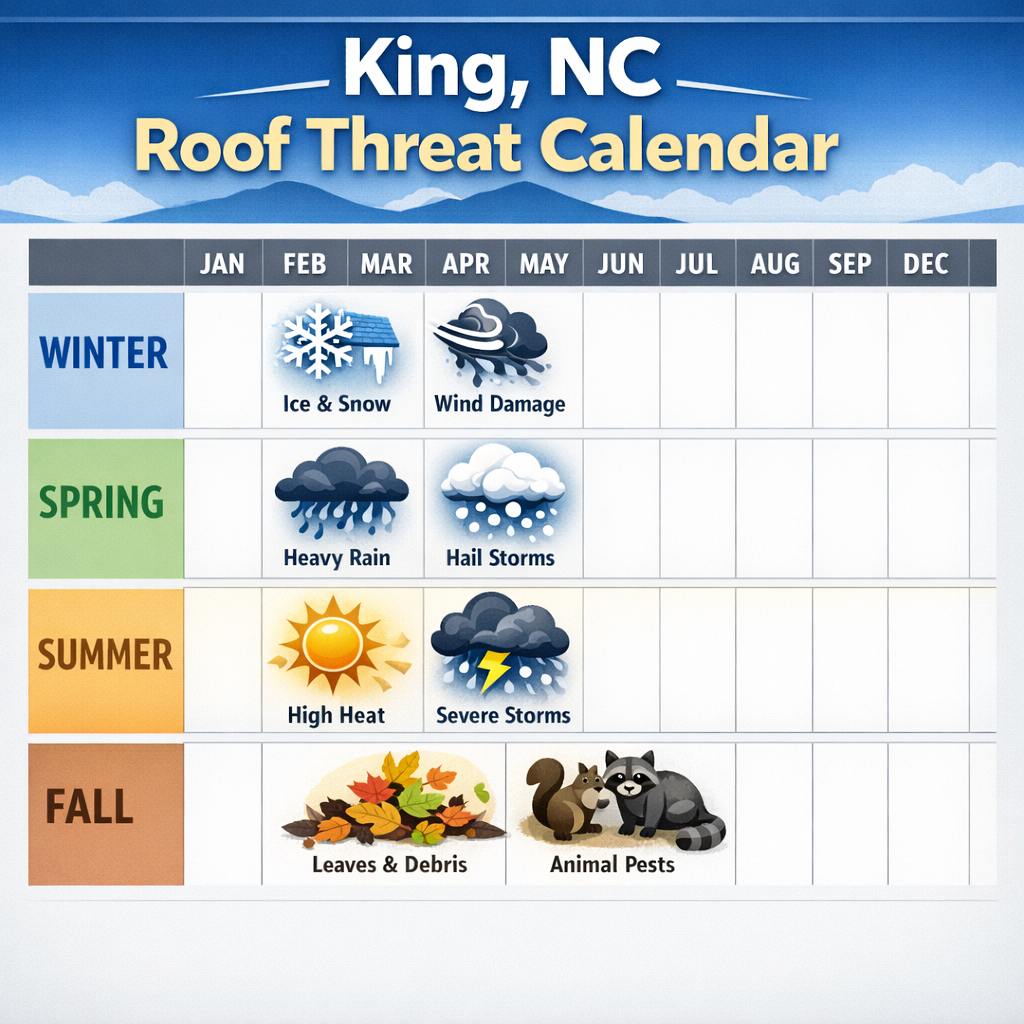
The city sits at an elevation transition point where cold air drainage from the Blue Ridge foothills meets the moisture-heavy air mass of the Piedmont. That combination creates weather patterns that behave differently here than they do even twenty miles east in Winston-Salem or Greensboro. Understanding that is the starting point for understanding why roofs fail the way they do in this area.
When cold air pools in the foothills and pushes southeast into Stokes County, north-facing roof planes in King experience a disproportionately high rate of ice dam formation compared to communities deeper in the Piedmont. This isn’t a minor seasonal nuisance — it’s a specific failure mode that requires a different emergency response than wind or impact damage.
Here’s the mechanism: warm air leaking from the conditioned living space heats the upper roof deck. Snow on the upper plane melts and runs down toward the eaves. At the overhang, where there’s no heat from below, that water refreezes into a ridge of ice. As the dam grows, subsequent meltwater backs up behind it, gets forced underneath the shingles, bypasses the underlayment, and enters the decking and framing.
The emergency repair priority for ice dam damage is not to reshingle. It’s to assess whether the OSB decking has absorbed water. Decking that has been saturated and then dried through multiple freeze-thaw cycles develops structural delamination that no layer of new shingles will fix. A contractor who doesn’t start with that assessment — and document it — is skipping a step that will cost you significantly more down the road. For a deeper look at how ice dams form and what you can do about them, the article How to Get Rid of Ice Dams covers the mechanics and mitigation options in detail.
King also sits within the documented path of late-spring derecho events that track across the Piedmont from the southwest. These aren’t standard thunderstorms. Derechos produce sustained, straight-line winds that load roof structures differently than rotational wind events. Ridge caps, hip caps, and exposed step flashing at dormers are the first failure points.
Compounding this is King’s housing stock. A significant portion of homes in the area were built in the 1970s through 1990s as ranch-style construction with low-slope roof geometries — typically 3:12 to 4:12 pitch. These roofs drain more slowly than steeper modern builds. In a heavy rain event, even a relatively small breach can allow significant water intrusion because there’s less gravitational force moving water away from the opening. Emergency tarping on a low-slope surface also requires a different installation approach than tarping a 6:12 or steeper roof — the tarp must be weighted or mechanically secured with greater care to prevent uplift.
This is the section most roofing websites skip because it requires knowing building science rather than just marketing copy. If your roof has been breached, here is what is happening on a documented timeline — and why each hour matters.
The moment water contacts your roof decking, the clock starts on structural integrity. Standard OSB (oriented strand board) decking — the material under your shingles on the vast majority of homes in King — begins absorbing moisture within the first few hours of exposure. OSB is engineered wood, and while it performs well when dry and protected, it is not waterproof. Sustained wetting causes the board to swell along its edges, weakening the nail-pull resistance that holds your shingles in place.
If the intrusion reaches your attic insulation — particularly blown-in fiberglass or cellulose — that insulation becomes a moisture sponge that holds water against the decking and ceiling joists long after the rain stops.
Water that has moved through the decking and insulation will reach the ceiling drywall and top plates of the wall framing below. Drywall begins to deform and lose structural integrity quickly when saturated. More critically, the top plates and ceiling joists begin absorbing moisture into the wood grain. This is the stage at which the scope of your damage claim begins to expand significantly — damage that could have been limited to roofing materials and decking now involves interior finish work and potentially framing.
North Carolina’s climate is not forgiving on this point. The combination of ambient humidity, warm temperatures during the warmer months, and organic material (wood framing, drywall paper facing) creates ideal conditions for mold colonization. Building science research consistently places the mold initiation window at 48 to 72 hours under these conditions. Once mold establishes in a wall cavity or attic, remediation costs and timelines expand substantially, and your insurance claim becomes more complicated.
This is not meant to alarm you unnecessarily. It is meant to explain, in concrete terms, why the standard advice to “call immediately” is grounded in building science rather than sales urgency.
This is the piece of information that most emergency roofing content ignores entirely, and it’s one of the most important things a King homeowner can understand.
Nearly every standard homeowner’s insurance policy in North Carolina contains a provision commonly called the Duties After Loss clause. The language varies by carrier, but the core requirement is consistent: after a covered loss, the policyholder is obligated to take reasonable steps to protect the property from further damage.
In practical terms, this means that if your roof is breached and you do not make a reasonable effort to prevent additional water intrusion — through temporary tarping, covering openings, or other mitigation — your insurer may have grounds to deny the portion of your claim attributable to subsequent damage. The original storm damage is covered. The water damage to your drywall and framing that occurred over the following three days because the opening wasn’t secured may not be, if the adjuster determines you failed to mitigate.
Emergency tarping is not an upsell. Under the terms of most policies, it is a documented obligation.
When your adjuster processes your claim, they will calculate the loss using one of two methods. Understanding which one applies to your policy before the adjuster arrives saves significant confusion later.
| Claim Type | What It Pays | What It Means for You |
|---|---|---|
| Actual Cash Value (ACV) | Replacement cost minus depreciation based on the roof’s age and condition | You receive less than the full replacement cost. The gap between the ACV payment and the actual repair cost is your responsibility. |
| Replacement Cost Value (RCV) | Full cost to repair or replace with like-kind materials, without depreciation deduction | You typically receive an initial ACV payment, then a supplemental payment (the “recoverable depreciation”) once the work is completed and documented. |
| ACV with Roof Schedule | Some NC policies apply a separate depreciation schedule specifically to roofing — even if the rest of the policy is RCV | The roof may be depreciated more aggressively than other structural components. Review your Declarations page carefully. |
The contractor you hire should be able to provide a written scope of damage in a format compatible with Xactimate, the estimating software used by most insurance adjusters. A scope that matches the adjuster’s format reduces back-and-forth and helps ensure that legitimate line items — like ice-and-water shield replacement, decking repair, or drip edge — are not overlooked in the initial estimate. For a full breakdown of what to expect throughout this process, the article Don’t Get Ripped Off: The Essential Steps for Your Roof Insurance Claim is a practical resource for NC homeowners navigating a storm damage claim.
Your own documentation is a legitimate and valuable part of your claim file. Before the contractor or adjuster arrives:
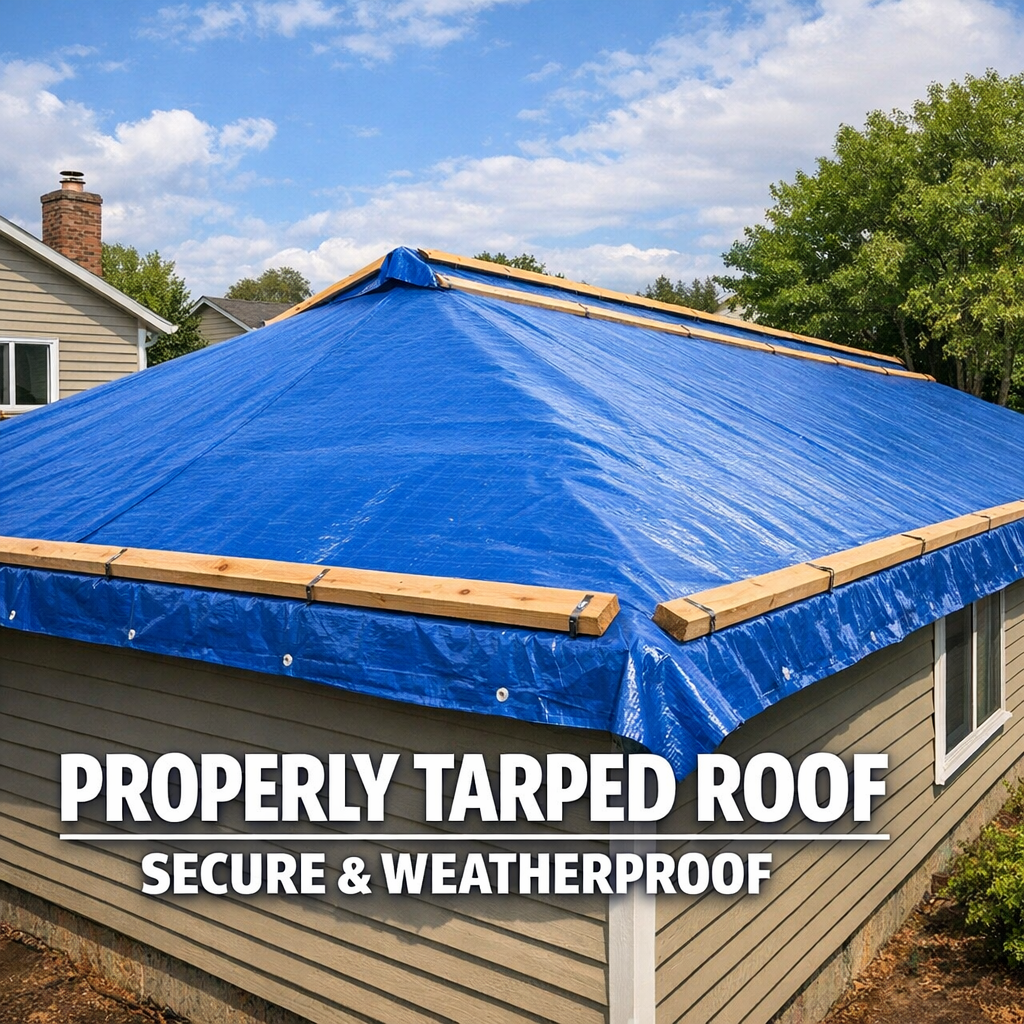
A tarp draped loosely over a damaged section of roof is not temporary weather protection. In a wind event, an improperly secured tarp becomes a sail — and the mechanical forces it generates can pull up surrounding undamaged shingles, widen the breach, and in some cases, give your insurer grounds to attribute subsequent damage to the contractor’s work rather than the original storm.
A properly installed mechanical tarp involves:
The technique required on a low-slope King ranch home is different from what works on a steeper build. On a 3:12 or 4:12 pitch, water moves slowly, and a poorly terminated tarp edge can redirect more water into the structure than it keeps out.
After any significant weather event in King or the broader Stokes County area, out-of-state contractors arrive quickly. Some are legitimate companies expanding their service area during high-demand periods. Many are not. The damage they leave behind — shoddy repairs, voided manufacturer warranties, and signed documents that transfer your insurance claim rights away from you — is a documented consumer protection problem in North Carolina.
North Carolina requires that any contractor performing roofing work above a certain project value hold a valid license issued by the NC Licensing Board for General Contractors (NCLBGC). Verification takes less than two minutes on the NCLBGC’s public license lookup database at nclbgc.org. Enter the company name or the individual’s name and confirm:
A legitimate contractor will hand you their license number without hesitation. If there’s any reluctance or vagueness, that is the answer.
The phrase “comprehensive workmanship warranty” that appears across most competitor websites is not a warranty. It is marketing language. A warranty that protects you contains specific, stated terms. When evaluating any roofing contractor in King, ask for the following in writing before work begins:
| Warranty Component | What to Ask For | Why It Matters |
|---|---|---|
| Duration | Exact number of years, with start date | A warranty with no stated duration is unenforceable |
| Named Warrantor | The legal name of the company or individual responsible | If the contractor dissolves the business, who honors the warranty? |
| Covered Failures | Specific list of what constitutes a warranty claim | “Workmanship” without definition covers nothing in practice |
| Transferability | Whether the warranty transfers to a new owner on home sale | Affects resale value and is relevant to your home equity |
| Exclusions | What voids the warranty | Maintenance obligations, acts of nature, and modification clauses are common exclusions |
| Manufacturer Warranty | Separate documentation from the shingle manufacturer | Only certified installers can register manufacturer warranties — verify the installer is actually certified |
Smithrock Roofing backs repair and replacement work with a 5-year labor warranty and registers the CertainTeed limited lifetime manufacturer warranty on every eligible project — because we’re CertainTeed PREMIER ShingleMark Master Certified, which is a credential that requires demonstrated installation standards, not just a fee. The warranty documentation is written, specific, and handed to the homeowner at project completion. You can review the full details of what our warranty covers before any work begins.
One technical reality that rarely appears in roofing content — and that matters significantly during King’s winter emergency season — is the temperature limitation of asphalt shingle installation.
Standard asphalt shingles rely on a thermally activated adhesive strip to self-seal after installation. That seal requires ambient and surface temperatures above approximately 40°F, with some CertainTeed products specifying 50°F as the minimum for self-sealing to occur reliably. Emergency repairs performed in January or February in King — when temperatures regularly drop into the 20s and 30s — will not self-seal through passive thermal activation alone.
A knowledgeable contractor performing cold-weather emergency repairs should be doing the following:
If a contractor is nailing shingles in freezing conditions without discussing these steps, they are cutting corners that will show up as failures in the first warm-weather wind event.
Homeowners in King, NC who want to reduce emergency roof repair exposure and navigate claims more effectively in 2026 should prioritize three specific steps before the next severe weather season begins.
1. Schedule a Post-Winter Inspection in March or April
Winter in King is harder on roofing systems than most homeowners realize. Freeze-thaw cycling, ice damming along eaves, and cold-weather repairs that haven’t fully sealed yet all create conditions that show up as failures in spring. A documented inspection in early spring — before storm season — creates a baseline condition record that becomes critical if you file a wind or hail claim later in the year. Smithrock Roofing offers post-winter inspections specifically designed to identify deferred damage before it becomes an emergency.
2. Build a Pre-Storm Documentation File
Insurance claims are resolved faster and more favorably when homeowners can demonstrate pre-loss condition. In 2026, use your phone to photograph the full roof surface from multiple ground angles, capture attic framing and insulation condition, and photograph all existing flashing, valleys, and penetrations. Date-stamp everything and store copies in cloud backup. This takes under an hour and fundamentally changes your leverage in a post-storm claim.
3. Verify Your Roofer’s Manufacturer Certification Before Any Work Begins
As contractor volume increases in the King area following storm events, the gap between certified and uncertified installers will widen. Before signing any contract in 2026, verify the contractor’s certification status directly through the manufacturer’s website — not through the contractor’s own marketing materials. CertainTeed’s contractor locator, for example, confirms certification tier in real time. This single step eliminates the majority of warranty and workmanship risk homeowners face after emergency repairs.
Response times for emergency roof repair in King, NC depend on weather conditions and contractor capacity at the time of your call. Smithrock Roofing serves the King area with priority emergency response and works to deploy same-day when storm volume allows. The most important step is calling as early as possible — storm events in Stokes and Forsyth counties generate high service demand quickly, and early callers receive faster scheduling windows. Temporary tarping and leak mitigation can typically be completed within hours of contact during active weather events.
Most standard homeowner’s insurance policies in North Carolina cover sudden, accidental damage caused by wind, hail, falling trees, and similar storm events. Emergency roof repairs that stem from these causes are generally claimable, subject to your deductible and policy exclusions. Coverage is typically not provided for damage resulting from deferred maintenance, gradual deterioration, or pre-existing conditions. Working with a contractor who provides detailed documentation — including photographs, written damage assessments, and material specifications — significantly strengthens your claim and reduces the likelihood of a dispute with your adjuster.
The immediate priority after storm damage is protecting your interior from water infiltration. If it is safe to do so, place buckets or plastic sheeting under active leaks and move valuables away from affected areas. Do not attempt to access the roof yourself during or immediately after a storm. Document all visible damage from the ground using your phone — photograph the roofline, gutters, soffits, and any debris — before any cleanup occurs. Contact a licensed local roofing contractor to deploy emergency tarping as quickly as possible. Notify your insurance carrier promptly and preserve all damage documentation for your claim file.
The repair-versus-replacement decision depends on the scope of damage, the age and existing condition of the roofing system, and the structural integrity of the underlying decking. Isolated damage to a limited number of shingles or a specific flashing zone on a relatively young roof generally warrants repair. Widespread granule loss, systemic shingle failure, significant decking damage, or a roof already near or past its service life often makes replacement the more cost-effective long-term choice — particularly when an insurance claim is involved. A qualified contractor should provide a written assessment that clearly distinguishes between storm-caused damage and pre-existing wear, since that distinction directly affects your coverage eligibility.
Cold-weather roof repairs can be reliable when performed correctly, but they require specific techniques that differ from warm-weather installation. Below approximately 40°F, standard asphalt shingles will not self-seal through thermal activation alone. A qualified contractor performing emergency repairs in winter should hand-seal every shingle tab with roofing cement, use cold-weather compatible adhesives at all flashing and underlayment terminations, apply additional fasteners above standard nailing patterns, and document the temperature conditions at the time of repair. Repairs performed in freezing conditions without these compensating steps are likely to fail during the first significant wind event once temperatures rise.
At minimum, any roofing contractor you hire in King, NC should carry active general liability insurance and workers’ compensation coverage — and should provide certificates of insurance naming you as an additional insured before work begins. Beyond baseline licensing, manufacturer certification programs such as CertainTeed’s ShingleMaster credentialing indicate demonstrated installation standards and the ability to register extended manufacturer warranties on your behalf. Verify certification status directly through the manufacturer’s website rather than relying solely on the contractor’s marketing. Additional indicators of a reliable contractor include a local physical address, documented references in the King and Stokes County area, and written warranties covering both labor and materials.
Emergency roof damage in King, NC is not a situation that rewards hesitation or guesswork. The decisions made in the first hours — who you call, what gets documented, and how the initial repair is performed — determine your water damage exposure, your insurance outcome, and whether the repair holds through the next season. Working with a certified, locally accountable contractor who provides written scopes, proper cold-weather technique, and manufacturer-backed warranties is not a premium consideration — it is the baseline standard you should expect.
Smithrock Roofing is CertainTeed PREMIER ShingleMark Master Certified, locally operated, and ready to respond when it matters. If your roof has sustained storm damage or you want a documented inspection before the next weather event, the next step is straightforward.
Smithrock Roofing © Copyright 2026 • All Rights Reserved • Privacy Policy • Maintained by Mongoose Digital Marketing