Gutter Guards Winston-Salem NC: What Actually Works

Do Gutter Guards Actually Work? A Winston-Salem Homeowner’s Honest Guide

If you’ve spent any time researching gutter guards in Winston-Salem, you’ve probably noticed that most of what’s out there reads the same way: a few bullet points about preventing clogs, a handful of five-star reviews, and a call-to-action to schedule a free estimate. What you rarely find is a straight answer to the questions that actually matter — which guard type holds up in this specific climate, what the installation process should actually look like, and what “lifetime warranty” really means when it’s written in small print.

That’s what this guide is here to do.

Winston-Salem’s tree canopy, humidity levels, and clay-heavy soils create a very specific set of challenges for residential gutter systems — challenges that generic advice simply doesn’t address. After 60+ combined years working on homes across the NC Triad, we’ve learned that the right gutter guard decision isn’t just about picking a product. It’s about understanding your property, your roof, and the conditions your home deals with every single season.


Why Winston-Salem Is Harder on Gutters Than Most People Realize

The Piedmont Triad sits in a transitional climate zone — warmer and wetter than the NC mountains, but subject to more dramatic seasonal swings than the coastal plain. That combination creates year-round gutter stress that homeowners in other parts of the country simply don’t experience at the same intensity.

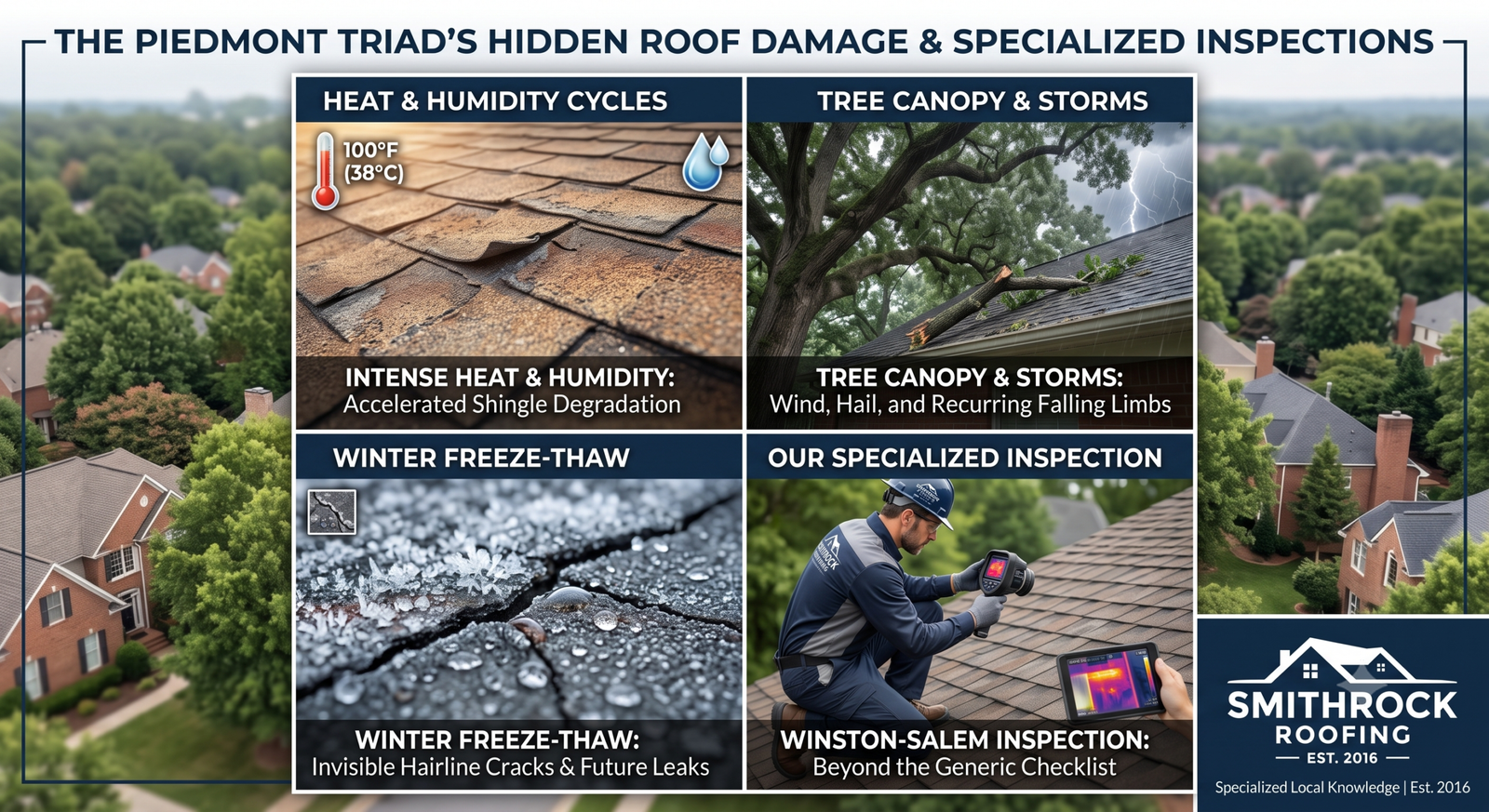
But climate alone doesn’t tell the whole story. Winston-Salem consistently ranks among the best-canopied cities in the Piedmont, and that urban tree coverage — while genuinely beautiful — means your gutters are dealing with a debris profile that varies significantly depending on where you live within the city.

The Tree Canopy Problem: It’s Not Just “Fall Leaves”

Most gutter guard marketing is designed around a single scenario: autumn leaf drop. That picture is incomplete for Winston-Salem homeowners, because the trees in this area don’t all behave the same way, and some of the most problematic species drop debris year-round.

Here’s what you’re actually dealing with, depending on your neighborhood:

  • Loblolly Pine — Common in southwestern Winston-Salem and neighborhoods near Lewisville and Clemmons. Loblolly pines shed needles continuously, not just in fall. Pine needles are arguably the single hardest debris type for gutter guards to handle: their narrow diameter allows them to penetrate standard mesh openings, and their waxy coating causes them to mat together and bridge across apertures, creating a surface that water can’t pass through.

  • Sweetgum Trees — Prevalent in older established neighborhoods like Buena Vista and Ardmore. Sweetgums drop spiky seed balls (commonly called “gumballs”) that can puncture foam insert guards, lodge diagonally in mesh openings, and are heavy enough to resist being blown clear by wind or rain.

  • White Oak — Dominant in areas like Reynolda and Irving Park. White oak produces large, flat leaves that behave differently in wind events than maple or poplar leaves — they tend to “sail” horizontally into gutters rather than landing on top of a guard and washing off.

Understanding which trees surround your home isn’t a trivial detail. It should directly inform which guard system you choose.

The Blue Ridge Effect and Storm Intensity

Winston-Salem’s position at the eastern edge of the Piedmont, near the Blue Ridge escarpment, means it receives orographic-influenced rain events that can produce intense, short-duration downpours. These high-volume storms are a documented failure mode for certain guard types — particularly reverse-curve systems, which rely on surface tension to direct water into the gutter. When rainfall exceeds a certain flow rate, water overshoots the guard entirely rather than following the curved surface. For a home with a steep roof pitch or a large drainage plane feeding into a single gutter run, this is a real-world performance problem, not a theoretical one.

Clay Soil and the Foundation Damage Connection

This is the part most conversations about gutters skip entirely. Winston-Salem’s Piedmont soils are predominantly clay-heavy. Clay doesn’t absorb water the way sandy or loamy soils do — it holds it near the surface and channels it laterally. When gutters overflow or downspouts discharge too close to the foundation, that water saturates clay soil against your foundation walls. Over time, this creates hydrostatic pressure that contributes to basement seepage, crawlspace moisture problems, and in severe cases, foundation cracking and settling.

Properly functioning gutters — protected by well-chosen guards — are the first line of defense against this kind of slow-burn damage. It’s one reason we take gutter work seriously as a structural concern, not just an aesthetic one. For a deeper look at how Winston-Salem’s specific conditions affect your entire gutter system, the article Gutters Winston-Salem NC: What Local Homes Really Need covers the full picture.


A Practical Comparison of Gutter Guard Types

Not all gutter guards are built the same, and each type carries real trade-offs that most product literature conveniently glosses over. Here’s an honest breakdown of how the major categories perform in conditions like those found across the NC Triad:

Guard TypeBest ForLimitations in Winston-Salem ConditionsMaintenance Reality
Micro-Mesh (Aluminum Frame, Stainless Steel Mesh)Mixed debris environments; homes with pine treesFine mesh can become biofilm-coated in high-pollen seasons; requires periodic rinsing every 2–3 yearsLow but not zero; still the most reliable option for most properties
Micro-Mesh (Aluminum Frame, Aluminum Mesh)Budget-conscious installsAluminum mesh corrodes faster in humid environments; mesh aperture can warp over time, enlarging openingsModerate; may need replacement sooner than stainless
Reverse-Curve / Gutter HelmetLarge, flat leaf debrisFails in high-volume rainfall events; surface tension breaks down at steep pitches; pine needles and seed pods bypass the systemModerate; periodic flushing required; water overshoot can be chronic
Foam InsertLight debris in low-tree environmentsSweetgum seed balls puncture foam; foam retains moisture and promotes moss, mold, and algae growth in Winston-Salem’s humidity; degrades UV exposureHigh; typically requires replacement within 3–5 years
Screen / Perforated CoverBasic debris exclusionLarge perforations allow pine needles and small debris through; tends to sag and separate from gutter over timeModerate to high; debris accumulates on top and must be cleared manually
Brush InsertTemporary or seasonal useBristles trap debris internally; extremely difficult to clean once clogged; not a long-term solutionVery high; not recommended as a permanent installation

The Pollen Problem: A Triad-Specific Caveat for Micro-Mesh

The NC Triad consistently ranks among the highest-pollen regions in the Southeast, with peak events in spring (tree pollen) and fall (ragweed and mold spores). Fine micro-mesh guards — which are often correctly recommended as the highest-performing option — carry one honest caveat in this environment: over three to five years without periodic rinsing, pollen and organic fine particles can bond with moisture to form a biofilm layer across the mesh surface. This doesn’t mean micro-mesh is the wrong choice. It means homeowners should plan for an occasional low-pressure rinse to maintain performance, and any contractor who tells you otherwise isn’t being fully straight with you.

Winston-Salem Gutter Guard: Match Your Trees to Your Guard


What a Proper Gutter Guard Installation Actually Involves

Here’s something almost no competitor puts in writing: the product is only half the equation. The installation process determines whether a guard system performs as advertised — or becomes an expensive source of new problems.

The Fascia Board Assessment

This is the step that separates a professional installation from a rushed one, and it’s the step most commonly skipped.

Winston-Salem homes built between 1960 and 1990 — which represent a substantial portion of the housing stock in neighborhoods like Sherwood Forest, Sunset Hills, and Country Club Hills — are particularly vulnerable to fascia board deterioration. The region’s humid subtropical climate accelerates wood rot, especially on north-facing roof lines and sections shaded by the tree canopy discussed above.

Here’s why this matters directly for gutter guard installation:

Many guard systems — including popular reverse-curve and fascia-mount micro-mesh designs — attach directly to the fascia board. The fascia becomes a structural anchor point for the guard, which means its condition isn’t cosmetic — it’s a load-bearing consideration. Installing guards over compromised fascia creates two compounding problems:

  1. The guards will not hold their alignment over time, allowing gaps for debris and pests to enter.
  2. The guard system itself can trap additional moisture against already-rotted wood, accelerating deterioration behind the scenes where it won’t be noticed until the damage is significant.

A thorough installation starts with a physical fascia inspection — checking for soft spots under paint, delamination of wood layers, and signs of moisture infiltration. Any section showing active rot should be addressed before guard installation proceeds. If an installer doesn’t mention this step during their site visit, that’s worth asking about directly. For a thorough breakdown of what this process involves and what to budget for, the guide on fascia and soffit repair is worth reading before your installation conversation.

The right question to ask any installer: “What is your protocol if you find fascia rot during the installation?” A contractor with a clear, specific answer to that question is one worth working with.

Gutter Pitch and Outlet Sizing

Two installation details that rarely make it into consumer-facing content:

Gutter pitch — gutters should slope slightly toward downspouts (approximately a quarter-inch of drop per ten feet of run) to prevent standing water. Many homes develop pitch problems as fascia boards settle or shift over time. Installing guards over a poorly pitched gutter section locks that problem in place and creates a moisture-retention issue that will eventually show up as mold, wood staining, or overflow damage.

Downspout sizing and placement — the number and diameter of downspouts should be matched to the square footage of roof drainage plane feeding into each gutter run. A common error on older Winston-Salem homes is that original downspouts were sized for open gutters with no guards — once guards slow the water entry rate slightly, undersized downspouts can create backup during heavy rain events. A professional installation accounts for this relationship.

The Roof Warranty Interaction: What Every Winston-Salem Homeowner Should Understand

This topic gets a brief mention from a few competitors, but none of them actually explain what the concern is or how to evaluate it. It deserves a full explanation.

Most major asphalt shingle manufacturers — including CertainTeed, GAF, and Owens Corning — include language in their warranty documentation stating that products installed under or against the shingles by a non-certified roofing contractor may void the shingle warranty. This isn’t obscure fine print. It’s a standard clause that applies to a common installation method.

The installation method in question is the “slip-under” technique used by reverse-curve gutter helmets and some snap-in guard systems, where a lip or flange slides underneath the first course of shingles to create a mounting point. This method lifts the shingle tab away from the roof deck, even slightly, and that disturbance is what creates warranty exposure.

Fascia-board-only attachment systems — where the guard mounts entirely to the fascia without touching the shingles — carry the lowest risk for roof warranty interaction.

The correct question to ask isn’t “does this void my warranty?” (any installer will say no). The correct question is: “How exactly is this system attached to my home, and does that attachment method interact with my shingle manufacturer’s warranty terms?” If you have a newer roof with an active manufacturer warranty, that distinction is worth protecting.

A close-up photo of a contractor performing a roofing fascia board inspection during a gutter guard installation on a Winston-Salem home, showing the inspector pressing against the wooden fascia board to check for soft spots while the existing gutter is partially visible below. Natural lighting, residential neighborhood context visible in background.


Honest Maintenance Expectations: What No One Tells You

The phrase “never clean your gutters again” is one of the most common — and most misleading — claims in the gutter guard industry. A well-chosen, properly installed guard system will dramatically reduce the frequency and difficulty of gutter maintenance. It will not eliminate it entirely.

Here’s a realistic maintenance picture by guard type over time:

Micro-Mesh (Stainless Steel) — The Long-Term Standard

  • Years 1–3: Minimal maintenance. Debris sits on top of the mesh and typically washes clear in rain events.
  • Years 3–5: Low-pressure rinse recommended, particularly after heavy pollen seasons, to clear biofilm accumulation.
  • Years 5–15: Annual visual inspection to check for mesh damage, sagging, or separation at seams. Occasional rinse as needed.
  • 15+ Years: Assess frame and mesh condition; stainless mesh lasts significantly longer than aluminum mesh under Triad humidity conditions.

Reverse-Curve Systems

  • Ongoing: Monitor for debris accumulation on the curved surface, particularly after sweetgum seed ball season. Debris that lodges in the opening gap must be cleared manually — this typically requires a ladder and is not a simple rinse job.
  • High-rainfall events: Inspect downspouts and ground-level areas for signs of water overshoot, which indicates the system is exceeding its flow capacity.

Foam and Brush Inserts

  • These are not long-term solutions for Winston-Salem homes. Foam degrades in UV exposure and retains moisture in humid conditions; brush inserts trap debris internally and become nearly impossible to clean once saturated. Honest maintenance expectations for these types are high, and replacement cycles are short.

Early Warning Signs That Any Guard System Needs Attention

  • Visible overflow or water staining on fascia boards or siding during rain
  • Seedlings or moss growing from the guard surface (indicates organic matter accumulation)
  • Separated or sagging guard sections (attachment failure, often related to fascia deterioration)
  • Standing water in gutters visible after dry periods (indicates pitch or outlet blockage)

Understanding Warranty Language Before You Sign Anything

“Lifetime warranty” is a phrase that appears on most gutter guard marketing materials. It is worth understanding exactly what that phrase covers — and what it doesn’t.

Product Warranty vs. Workmanship Warranty

These are two separate documents covering two separate things. A product warranty covers defects in the guard material itself — mesh failures, frame corrosion, structural deformation. A workmanship warranty covers the installation — whether the guards were attached correctly, whether the system performs as specified for your home.

Both matter. A guard that fails because of poor installation isn’t covered under a product warranty. A guard that develops a material defect isn’t covered under a workmanship warranty. Confirming that both are in place — and understanding the duration of each — is part of a responsible purchase decision. Smithrock’s warranty documentation covers both product and workmanship protections, and we’re happy to walk through it with you before you sign anything.

What “Transferable” Actually Means

Some warranties are marketed as transferable to a future homeowner, which sounds like a selling point. In practice, transferability provisions often require written notice to the manufacturer within a specified window after a property sale, and some require payment of a transfer fee. In a real estate transaction, the burden of documenting and transferring the warranty typically falls on the seller. If you’re planning to sell your home within the warranty period, understanding the transfer requirements in advance is worth the effort.

Common Exclusions to Look For

  • Damage caused by ice damming (relevant in years with hard freezes, which Winston-Salem does experience periodically)
  • Damage attributed to improper maintenance or failure to follow cleaning guidelines
  • Voiding language tied to modifications, painting, or other work performed near the gutter system
  • “Acts of God” exclusions that may apply to storm or wind damage events

Questions Worth Asking Any Gutter Guard Installer in Winston-Salem

Before scheduling an installation, these are the questions that will tell you whether you’re working with a contractor who knows what they’re doing:

  • “What tree species are on my property, and how does that affect which guard type you’re recommending?” An installer who gives you a generic recommendation without considering your specific debris profile is guessing.

  • “Will you inspect my fascia before installation, and what happens if you find rot?” Any answer other than a specific protocol is a flag.

  • “How is this system attached — does it touch my shingles?” Especially important if your roof is newer and carries an active manufacturer warranty.

  • “What is the realistic maintenance schedule for this system over the next ten years?” Honest installers give honest answers. Anyone who says “none” is overselling.

  • “Are the product warranty and workmanship warranty separate documents, and can I see both before I sign?” Reputable contractors have no issue with this request.

At Smithrock Roofing, we’ve been answering these questions — and the harder follow-up questions — for homeowners across Winston-Salem, Greensboro, High Point, Kernersville, Clemmons, Rural Hall, and King for years. We’re not going to tell you a product solves every problem. We’re going to look at your home, understand what you’re dealing with, and give you a recommendation we’d stand behind for our own houses.

If you want to talk through what’s right for your property, we’re ready when you are.


For more information on the NC Triad’s urban tree canopy and how it affects residential properties, the City of Winston-Salem’s Urban Forestry program provides locally specific resources. For homeowners researching shingle warranty terms, CertainTeed’s official warranty documentation is available directly from the manufacturer.

Strategic Recommendations for 2026

As you plan your gutter guard project, three specific steps will help you make a more informed decision and protect your investment long-term:

1. Schedule a Pre-Installation Fascia and Soffit Inspection
Before any guard system goes on, have a qualified contractor assess the condition of your fascia boards, soffit, and existing gutter attachment points. Winston-Salem’s combination of heavy pollen seasons, summer humidity, and frequent freeze-thaw cycles in winter creates conditions where wood rot can develop quietly behind gutters for years. Discovering structural issues after installation adds complications that a pre-install inspection would have avoided entirely.

2. Document Your Tree Canopy Before You Buy
Walk your property in late fall when leaves are down and photograph the species and density of trees within dropping distance of your roofline. Note which sections of gutter fill fastest and what the debris looks like — pine needles, sweet gum balls, large oak leaves, or fine maple seeds all interact differently with guard systems. Bringing this documentation to your installer conversation will produce a significantly more accurate recommendation than a generic site visit.

3. Request a Written Maintenance Calendar at the Time of Installation
In 2026 and beyond, hold any installer accountable to a specific, written maintenance schedule tied to the product they install. This document becomes part of your home file, helps you stay on top of seasonal flushes, and gives you something concrete to reference if warranty questions arise down the road. If a contractor won’t put a maintenance expectation in writing, that tells you something important about how they stand behind their work.


Frequently Asked Questions

Do gutter guards completely eliminate the need for gutter cleaning in Winston-Salem?

No, and any installer who tells you otherwise is overselling the product. Winston-Salem’s tree canopy — which includes heavy populations of oak, sweet gum, pine, and tulip poplar — produces a wide variety of debris types across multiple seasons. While a well-matched gutter guard system will significantly reduce how often you need to clean your gutters, most systems still require periodic flushing or surface clearing, particularly after heavy pollen season in spring and leaf drop in fall. The goal is to reduce maintenance burden, not eliminate it entirely.

Will installing gutter guards void my roof’s shingle warranty?

It depends on the system and how it’s attached. Some gutter guard products are designed to slide under the first course of shingles for anchoring, which can potentially affect the terms of certain manufacturer warranties. Before installation, confirm with your contractor exactly how the system attaches, then cross-reference that with your shingle warranty documentation. Reputable installers in the Winston-Salem area will be familiar with this concern and should be able to walk you through attachment methods that keep your warranty intact.

Which type of gutter guard works best for homes with pine trees?

Micro-mesh systems with a fine enough aperture are generally the most effective option for homes with significant pine tree coverage. Pine needles are one of the most difficult debris types for gutter guards to manage — they are long and thin, which means they can bridge across larger openings in reverse-curve or basic screen systems and eventually work their way inside. A quality micro-mesh system with a surface designed to shed rather than trap needles performs better in this specific situation, though no system is entirely immune. How many pine trees you have, how close they are to the roofline, and which direction they shed will all affect real-world performance.

How do I know if my fascia is healthy enough to support a gutter guard installation?

Signs of fascia trouble include gutters that visibly sag, pull away from the roofline, or show water staining along the board surface. When you press a screwdriver gently against the wood — in areas you can safely reach — soft or spongy spots indicate rot. However, the most reliable assessment comes from a contractor who physically inspects the fascia before installation, not after. At Smithrock Roofing, we make this part of the evaluation process for every home we look at, because installing a new system over compromised wood defeats the purpose of the investment.


Conclusion

Winston-Salem and the surrounding Triad communities present a genuinely demanding environment for gutters — the combination of a dense urban tree canopy, humid summers, and variable winters means that getting the right system installed correctly matters more here than in many other parts of the country. Smithrock Roofing has worked with homeowners across Winston-Salem and Kernersville long enough to know that a real recommendation comes from looking at a specific home, not running through a product catalog. If you’re ready to have an honest conversation about what’s right for your property, we’re here to help — Get a Free Estimate and let’s figure it out together.

Share:

Categories

Follow us

You can find us on Facebook, Instagram, and Google.
Smithrock Roofing LLC logo featuring stylized rooftops with chimneys and arched windows
Smithrock Roofing proudly services the cities of Winston-Salem, King, Clemmons, Lewisville, Pilot Mountain, East Bend, Mt. Airy, Kernersville, Siloam, Danbury, High Point, Trinity, Pfafftown, Tobaccoville, Greensboro, Walnut Cove, Belews Creek, Rural Hall, Pinnacle, Bethania, Advance, Wallburg, Horneytown, Union Cross, and Midway, NC.

Newsletter

Sign up to receive important tips, special offers, and discounts.

Smithrock Roofing © Copyright 2026 • All Rights Reserved • Privacy Policy • Maintained by Mongoose Digital Marketing