
Gutter repair in Rural Hall, NC is one of those home maintenance decisions that looks simple from the outside but gets complicated fast once you start asking the right questions. The gutter is leaking, or sagging, or overflowing, and the homeowner wants it fixed. What most service pages never explain is that the same symptom can mean completely different things, and picking the wrong fix wastes money while the real problem quietly gets worse. This guide walks through how to read what your gutters are actually telling you, how to decide whether repair or replacement makes sense, what kind of contractor is suited for which scope of work, and what to understand about gutter guards before anyone tries to sell you one.
Gutters sit at the intersection of your roof, your fascia, your siding, and your foundation drainage. When one part of that system fails, water finds a new path, and those paths almost always lead somewhere expensive.
A failed end cap is a good example. On its own, it is a small repair that takes a professional a few minutes to address. Left alone through one rainy season, the water that escapes that cap runs directly down the fascia board behind it. Fascia boards are wood. Prolonged moisture contact leads to rot. Once the fascia rots, the gutter hanger that is nailed into it loses its anchor, which causes the gutter to sag. The sag causes pooling, which causes more overflow, which introduces moisture to the soffit. By this point, what started as a five-minute fix has become a job that may involve a carpenter, a roofer, and a gutter installer working together.
This cause-and-effect chain is entirely absent from most competitor pages, which list symptoms without ever explaining the downstream consequences of ignoring them. For a deeper look at how roof and gutter failures interact, the article on roof and gutter repair walks through how damage in one system accelerates deterioration in the other.
Have a gutter or drainage question about your home? Send a message with your town, where water collects, when it happens, and whether the downspout outlet is visible. Mention this article about gutter repair rural hall nc and ask for a written explanation of possible next steps. You can also review Gutters.
The most useful thing a knowledgeable contractor can offer a homeowner is not a service menu, it is a reasoning framework for connecting what they can see to what is actually wrong. Here is how to think through the most common gutter symptoms.
Sagging is one of the most visible gutter problems, and it has at least three distinct root causes.
The homeowner looking at a sagging gutter cannot necessarily tell which of these is the cause from the ground. That diagnosis requires a hands-on inspection, which is exactly why a thorough assessment before quoting is a sign of a professional contractor, not a sales tactic.
Leaks at seams usually indicate that the original sealant has aged and cracked. This is a repair, and a straightforward one, as long as the surrounding gutter material is otherwise sound. If the metal around the joint is corroded, pitted, or visibly thin, resealing will not hold long. At that point, section replacement is the smarter call.
Overflow during rain is not always a repair issue. It can signal a clog, which is a cleaning issue. But it can also signal that the downspout is blocked underground, that the gutter pitch has shifted, or that the gutter is simply undersized for the roof area it is draining. Cleaning a gutter that is structurally mismatched to your roof will not solve the problem.
This is a warning sign, not a primary symptom. It suggests water has been escaping the gutter system and reaching the fascia over a period of time. By the time staining is visible, there is likely some degree of wood deterioration behind the gutter. This warrants a fascia inspection as part of any repair assessment.
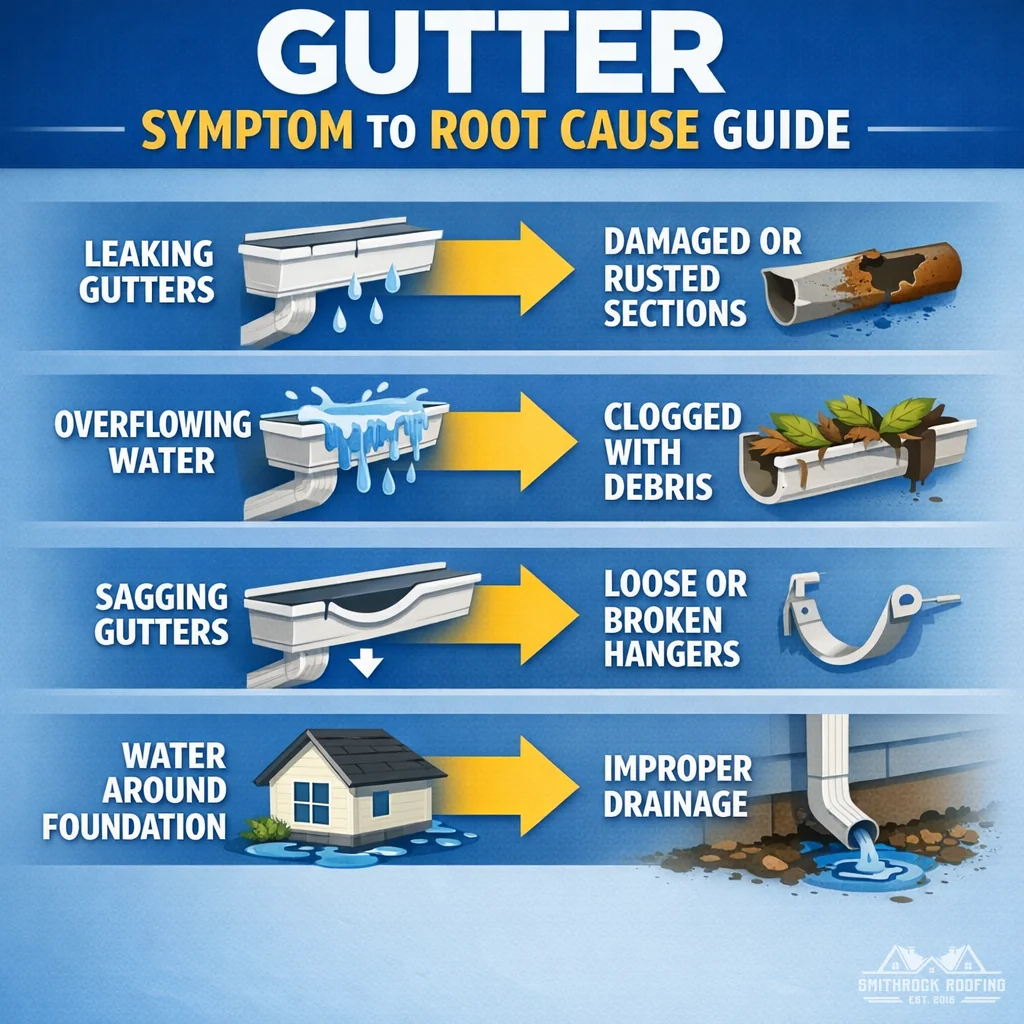
Illustration, not a photograph of a completed client project.
Most pages on gutter repair say replacement is appropriate when gutters are “beyond repair or have reached the end of their lifespan.” That is technically accurate and practically useless. Here is a more grounded way to think through the decision.
| Situation | Repair or Replace? | Why |
|---|---|---|
| Single failed hanger, sound fascia and gutter | Repair | Isolated mechanical failure with no structural concern |
| Multiple hangers failing along a run | Assess carefully | Could signal fascia softening or original installation issues along the full length |
| Leaking joint, metal in good condition | Repair | Reseal or reapply joint compound |
| Leaking joint with corroded surrounding metal | Replace section | Reseal will not hold on compromised material |
| Fascia rotted behind the gutter | Structural repair first, then gutter work | No gutter fix will hold until the anchor point is sound |
| Gutters consistently overflow despite being clear | Replace with correct sizing or slope | Cleaning and repair do not fix a design problem |
| Gutter system is 20-plus years old with multiple issues | Replace | Piecemeal repairs on aging material become more expensive than a fresh system |
| Storm damage to one section of an otherwise sound system | Repair or partial replacement | Match the material and profile to the existing system |
The principle here is that repair makes sense when the failure is isolated and the surrounding system is sound. Replacement makes sense when the failure reflects a broader pattern, a material condition issue, or a fundamental design problem. If you are weighing the cost of a full replacement, the gutter replacement cost per foot guide breaks down current pricing and what drives variation between estimates. A good contractor should be able to explain which scenario applies to your home and why before any work begins.
Rural Hall homeowners searching for gutter repair will find several different kinds of service providers presenting themselves as equivalent options. They are not, and understanding the distinction protects you.
A licensed general contractor in North Carolina can legally perform structural repairs, including fascia board replacement that is connected to gutter work. If your gutter assessment reveals that the fascia needs to be rebuilt before the new gutter can be attached, a licensed general contractor can handle that scope without subcontracting it out or leaving it undone.
A gutter-specialist company that is not licensed as a general contractor can typically install and repair gutter systems. What they may not be licensed to handle is the structural carpentry behind the gutter if the fascia is compromised.
A handyman or owner-operated service may be perfectly suited for routine cleaning, minor joint repairs, and hanger replacements on otherwise sound systems. The limitation comes when the job expands into structural repair territory.
None of this makes one type of provider better across the board. It means you need to match the contractor to the actual scope of your repair. If your inspection reveals damage limited to the gutter itself, a qualified gutter specialist is a reasonable choice. If there is any evidence of fascia or structural damage, a licensed general contractor is the appropriate call.
Smithrock Roofing is fully licensed and insured, with exterior experience spanning roofing, gutters, siding, windows, and custom chimney caps. That breadth matters precisely because gutter problems rarely stay contained to just the gutter.
Gutter guards are frequently presented as a solution that eliminates cleaning needs. The more accurate framing is that they reduce cleaning frequency, not that they eliminate it, and the right type depends on what your specific property is dealing with.
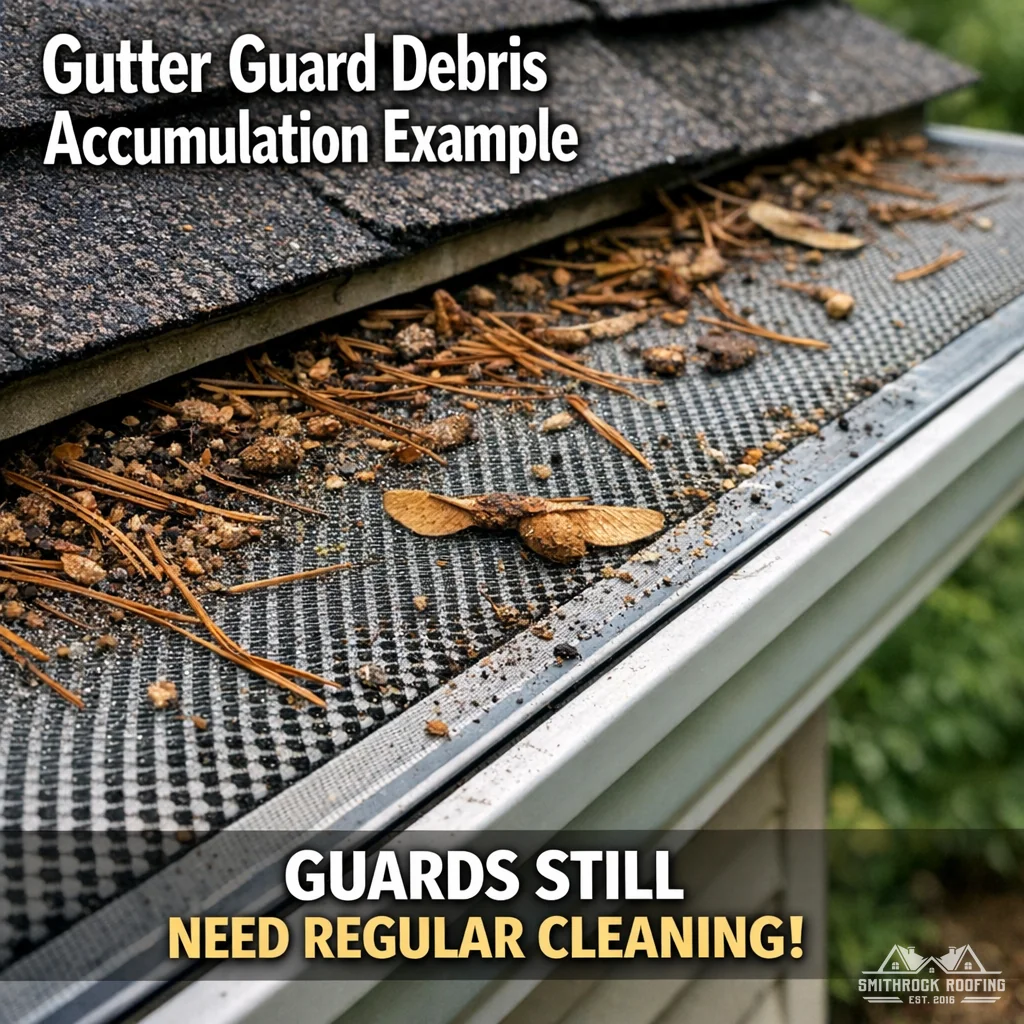
Illustration, not a photograph of a completed client project.
A “clog-free warranty” and a “maintenance-free system” are not the same promise, even when both terms appear in marketing materials. A clog-free warranty typically means the manufacturer or installer will address documented clogs during the warranty period. It does not mean the system requires no attention. Reading the actual warranty document before purchasing any guard system is worth the time.
The debris profile around your specific property should drive the guard selection. A home surrounded by mature hardwoods dropping large leaves every fall has different needs than a home near pine trees, where the concern is small needles and resin-coated particles. A contractor who asks about your tree canopy before recommending a guard type is demonstrating the kind of diagnostic thinking that leads to good long-term results.
Gutter systems are not isolated products. They connect to your roof, your fascia, your soffits, and your foundation drainage, and a problem in one area reliably signals something worth checking in the adjacent areas. That is why Smithrock Roofing approaches gutter work as part of a full exterior assessment rather than a single-trade transaction.
Smithrock Roofing serves Rural Hall, Winston-Salem, Kernersville, King, and the broader NC Triad. Homeowners looking for roofing in Mount Airy will find the same thorough, diagnostic approach that guides every Smithrock project. When something looks off beyond the gutters themselves, we say so. That honesty is not an upsell strategy; it is how we protect homeowners from spending money on a repair that will not hold because the underlying issue was left unaddressed.
If your gutters need attention, the right starting point is always an honest assessment of what is actually happening and why. Contact Smithrock Roofing to schedule yours.
The clearest signal that replacement makes more sense than repair is when the failure reflects a pattern rather than an isolated incident. A single failed hanger on an otherwise sound system is a repair. Multiple hangers failing along the same run, persistent leaks at several joints, or a gutter that consistently overflows despite being clean all suggest a broader problem that targeted fixes will not resolve. Age matters too: a system showing several issues simultaneously after two decades of service is typically better served by a fresh installation than by repeated piecemeal repairs. A hands-on inspection is the only reliable way to determine which category your gutters fall into.
Recent installation and sagging are not mutually exclusive. The most common cause in newer systems is that the hangers were fastened into fascia boards that were already softening from prior water exposure, so the fasteners never achieved a solid anchor. It can also indicate that the original hanger spacing was too wide for the weight the gutters carry when full of water or debris. A third possibility is that the gutter was installed without adequate pitch toward the downspout, so water pools in sections and the accumulated weight stresses the hangers over time. Each of these has a different fix, which is why the starting point should always be a diagnostic inspection rather than simply reattaching what has come loose.
No. Gutter guards reduce the frequency of cleaning, but no guard type eliminates the need for it entirely. Micro-mesh guards, which are among the most effective at blocking debris, still accumulate fine particles, shingle granules, and seed pods on the mesh surface over time. Those materials need to be cleared periodically or they can restrict water flow across the guard. The right guard type depends on the specific debris your property generates, which is largely determined by the trees around your home. A contractor who asks about your tree canopy before recommending a guard is approaching the question correctly.
It matters when the scope of work extends beyond the gutter itself. Replacing a gutter section or resealing a joint is gutter work. But if the fascia board behind the gutter has rotted, that is structural carpentry, and in North Carolina that scope requires a general contractor license. A gutter-only operation may not be licensed to perform that repair, which means the fascia issue could either be left unaddressed or handled by someone operating outside their licensed scope. If your assessment reveals any sign of fascia deterioration, confirming that your contractor holds a North Carolina General Contractor license before work begins is a straightforward way to protect yourself.
Gutter repair in Rural Hall, NC is not a single decision so much as a sequence of smaller ones: identifying the actual root cause behind the visible symptom, determining whether the repair scope stays within the gutter itself or extends into the structure behind it, choosing the right type of contractor for the actual work involved, and deciding whether guards make sense given your property’s specific debris environment. Getting any one of those decisions wrong does not just delay the fix; it can quietly set up a larger problem while the original issue continues to cause damage.
The most reliable starting point is an honest, thorough assessment by a contractor experienced enough to recognize when a gutter problem is pointing to something beyond the gutter. That is what Smithrock Roofing brings to every exterior project in Rural Hall and across the NC Triad.

Smithrock Roofing © Copyright 2026 • All Rights Reserved • Privacy Policy • Maintained by Mongoose Digital Marketing