
Most homeowners don’t think much about their gutters — until water starts showing up somewhere it shouldn’t. A stain on the soffit. Mud splashed against the foundation. A basement that never used to take on water. By the time those signs appear, the gutter system has usually been losing the battle for months, sometimes years.
If you’ve started searching for gutter replacement near me, you’re probably past the “is this a problem?” stage and into the “how do I fix it the right way?” stage. That’s exactly what this guide is built for.
We’re not going to hand you a vague checklist of warning signs and tell you to call for a free quote. Instead, we’re going to walk you through what separates a gutter system that protects your home for 20-plus years from one that fails in five — including the technical details most contractors never bother to explain, the cost variables that actually move your estimate, and the contractor vetting questions that protect you from low-ball bids and shoddy installs.
Gutters are a relatively modest investment compared to what they protect. Foundation repairs run $5,000 to $50,000. Fascia and soffit rot can cascade into structural damage. A properly installed gutter system — sized correctly, built with quality materials, and hung to precise tolerances — costs a fraction of that and prevents all of it.
Let’s make sure you get that protection done right.
Here’s something the average service-page article won’t tell you: the material your gutters are made of matters far less than most people assume. Aluminum gutters are marketed as lasting 20 years. Copper gutters are quoted at 50 years. Those numbers reflect ideal conditions and quality installation — and both can fall well short when the underlying system design is wrong.
The two most common reasons gutter systems fail prematurely have nothing to do with whether you chose aluminum or steel. They come down to sizing and installation mechanics.
Gutter sizing is the single most overlooked factor in residential gutter replacement, and it’s the one that generates the most callbacks, overflows, and foundation complaints.
The standard 5-inch K-style gutter — what most contractors install by default — handles approximately 5,520 square inches of roof drainage area. A 6-inch K-style handles roughly 7,960 square inches. That difference sounds like a minor upgrade. On a steeply pitched roof with large drainage planes, it’s the difference between a system that works and one that dumps water over the front lip every time it rains hard.
Here’s the calculation that should be driving your gutter size selection:
If a contractor quotes your home without walking the roofline, measuring drainage planes, and accounting for pitch, they are guessing. And a wrong guess means your new gutters overflow in moderate rain — regardless of whether they’re aluminum, seamless, or freshly installed.
Material and sizing aside, how gutters are physically hung determines how long they’ll stay functional. There are three installation specs that separate quality work from work that looks fine on day one and sags within three years:
Hanger spacing: Hidden hangers — the bracket-and-screw system that replaced old spike-and-ferrule installation — should be placed every 24 to 36 inches along the gutter run. Wider spacing allows the gutter to flex, sag, and hold standing water. In areas with ice load or heavy debris, 24-inch spacing is the right call.
Slope: Gutters aren’t installed level. A properly sloped gutter pitches approximately 1/4 inch for every 10 linear feet toward the nearest downspout. Too little pitch and water pools, accelerating corrosion and mosquito habitat. Too much pitch and the far end of the gutter sits visibly high, creating an aesthetic problem and a point where debris accumulates.
Downspout ratio: One downspout for every 30 to 40 linear feet of gutter is the standard. Longer runs without adequate downspouts create pressure buildup during heavy rain events. This is also where discharge location matters — a downspout that terminates 6 inches from the foundation is barely better than no gutter at all.

Most homeowners have heard that seamless gutters are better than sectional gutters. Fewer understand why — and that lack of understanding makes it easy for contractors to charge a premium without delivering the quality that justifies it.
Sectional gutters are assembled from pre-cut pieces, typically 10-foot lengths, joined at seams with connectors and sealant. The failure point is the joint. Every seam is sealed with caulk or polymer-based sealant at installation, and that sealant has a functional lifespan of roughly 5 to 7 years under normal thermal cycling. Every winter contraction and summer expansion works that joint. Once the sealant breaks down, the joint leaks — and by that point, it’s usually leaked long enough to start rotting the fascia behind it.
Seamless gutters are roll-formed on-site from a continuous coil of aluminum (or steel, or copper) using a machine that fabricates the exact length needed for each run. There are no mid-run seams. Joints only exist at corners and end caps, reducing leak points to the absolute minimum.
The practical upshot: seamless gutters aren’t magic, but they eliminate the most common failure point. They still require quality sealant at the miters, proper slope, and correct hanger spacing. A seamless gutter installed sloppily will still fail. But a well-installed seamless system removes the single most predictable maintenance headache from the equation. For a deeper look at what professional seamless gutter installation involves — including what to expect on installation day — that article covers the process in full.
One thing worth knowing: seamless gutter fabrication requires a roll-forming machine. This is not a DIY project. Any contractor offering seamless gutters should be fabricating them on-site or delivering custom-cut runs — not assembling long sectional pieces and calling them seamless.
Aluminum is the dominant material in residential gutter replacement, and for most homes, it’s the right call. But “aluminum gutters last 20 years” is a marketing average, not a guarantee — and the single biggest variable isn’t brand or color. It’s gauge thickness.
Standard aluminum gutters are fabricated at 0.019-inch gauge. That’s adequate for light-duty applications, but it dents easily, flexes under debris load, and shows its age faster in regions with ice, heavy tree coverage, or frequent ladder access for cleaning.
Premium aluminum gutters run at 0.027-inch gauge. That’s nearly 40% thicker. The difference in hand-feel is immediately noticeable, and the difference in longevity is meaningful — heavier gauge aluminum resists denting, holds its shape under ice load, and maintains hanger contact better over time.
Here’s a side-by-side comparison of the most common gutter materials:
| Material | Typical Gauge/Thickness | Expected Lifespan | Weight | Key Advantage | Key Limitation |
|---|---|---|---|---|---|
| Standard Aluminum (0.019″) | 0.019 inch | 15–20 years | Light | Low cost, widely available | Dents easily, shorter functional life |
| Premium Aluminum (0.027″) | 0.027 inch | 20–30 years | Moderate | Durability, holds shape under load | Moderate cost increase |
| Galvanized Steel | 26–28 gauge | 20–30 years | Heavy | Dent-resistant, handles heavy debris | Prone to rust at cut edges and seams |
| Galvalume Steel | 24–26 gauge | 30–40 years | Heavy | Superior corrosion resistance vs. galvanized | Higher cost, limited contractor familiarity |
| Copper | 16–20 oz per sq ft | 50–100 years | Heavy | Exceptional longevity, improves aesthetically with age | Significantly higher material and labor cost |
| Vinyl/PVC | N/A | 10–15 years | Very light | Lowest upfront cost | Brittle in cold climates, fades, sags under heat |
For most homes in the NC Triad, 0.027-inch aluminum in a seamless profile is the practical sweet spot — durable enough to last, cost-effective enough to make financial sense, and compatible with the kind of weather patterns this region actually sees. Vinyl is a false economy in climates with temperature swings. Copper is worth the investment on historically significant homes or premium builds where aesthetics and longevity justify the cost.
This is where homeowners lose money — not because they picked the wrong material, but because they accepted an estimate that was missing critical line items. A low bid that omits fascia inspection, specifies thin-gauge material, and skips hanger spacing details isn’t a bargain. It’s a liability.
A professional, written gutter replacement estimate should include every one of the following items. If it doesn’t, ask specifically about each gap before signing anything.
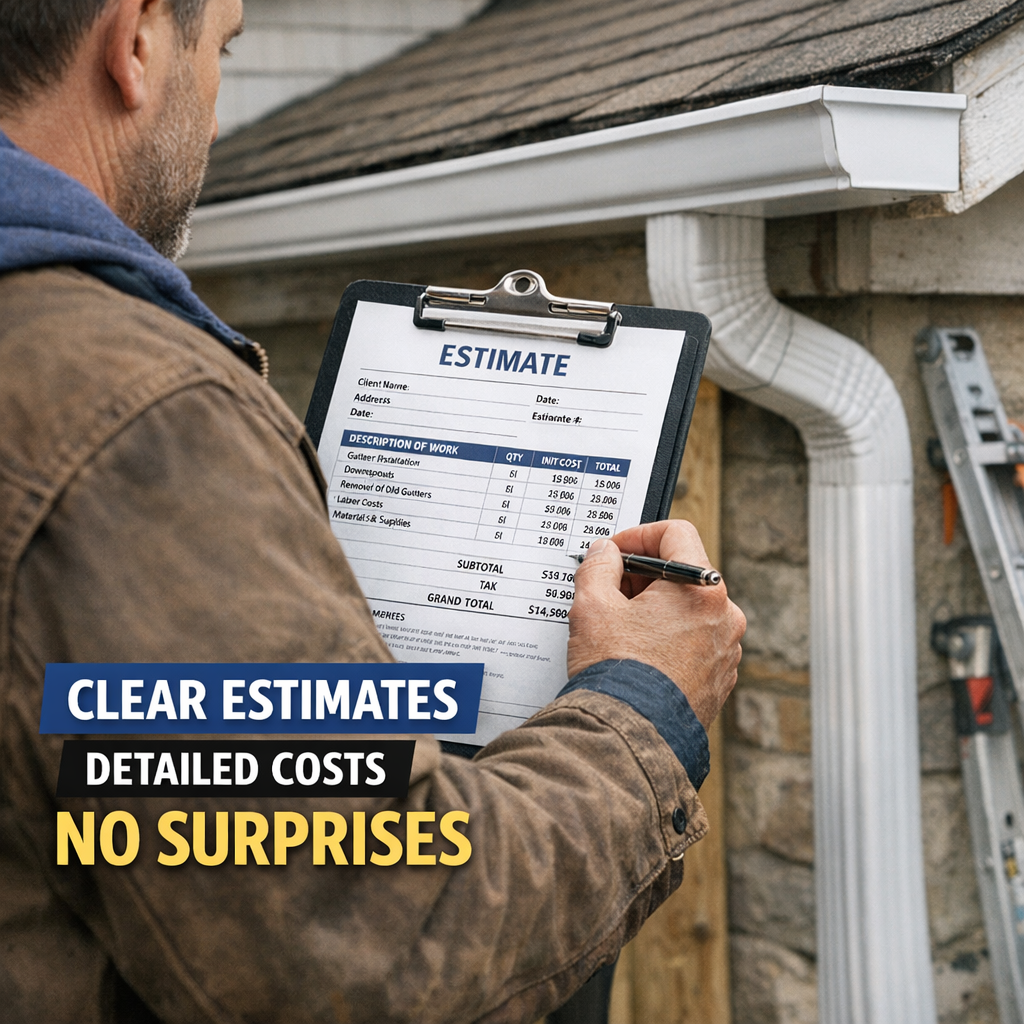
If you’ve spent any time researching gutter replacement costs online, you’ve probably hit a wall of “prices vary — contact us for a quote” non-answers. That’s not useful when you’re trying to budget and compare bids. Here’s an honest breakdown of what drives cost and what realistic ranges look like for 2024–2025.
Five variables account for the majority of cost variation between homes and between bids:
1. Linear footage and home footprint
More linear feet of gutter = more material, more labor, more time. A ranch home and a two-story colonial with the same square footage can have very different gutter runs depending on roof design.
2. Stories
Second-story work adds 15 to 25% to labor cost. Taller ladder staging, additional safety equipment, and slower working pace all factor in. Three-story homes add more.
3. Fascia board condition
If fascia boards are rotten — and they frequently are under failing gutters, because that’s where water pools — they need to be replaced before new gutters go up. Hanging new gutters on rotten wood is the equivalent of repainting over rust. Fascia replacement typically runs $5 to $12 per linear foot depending on material and accessibility. The article on fascia and soffit repair covers what to expect from that process in detail.
4. Corner count and run complexity
Every inside or outside miter adds materials and time. A simple rectangular ranch home has four corners. A home with multiple roofline transitions, dormers, or bump-outs can have a dozen or more, and each one requires precise fitting and sealant.
5. Downspout extensions and drainage
Standard downspouts terminate at grade. Underground drainage extensions that carry water away from the foundation are often quoted separately and can add $150 to $800 depending on run length and whether trenching is required.
| Scope | Lower Range | Mid Range | Upper Range |
|---|---|---|---|
| 150 linear ft, aluminum, single-story | $850 | $1,400 | $2,200 |
| 200 linear ft, aluminum, two-story | $1,200 | $2,100 | $3,400 |
| Full replacement with fascia board repair | $2,500 | $4,500 | $8,000+ |
| Copper gutter replacement (150 linear ft) | $4,500 | $7,500 | $14,000+ |
These ranges reflect professional installation with quality materials, proper removal and haul-away, and written warranty coverage. A bid that lands significantly below the low end of these ranges should prompt specific questions about what’s different — gauge, hanger type, whether fascia inspection is included, and what the warranty actually covers.
A straightforward rule of thumb: if the cost to repair the existing system exceeds 33 to 40% of a full replacement quote, replacement is almost always the better financial decision. Partial repairs on a system that’s failing in multiple locations typically hold for two to four years before the next section fails — and you end up spending repair money two or three times before eventually replacing anyway.
The comparison that puts this in perspective: a full gutter replacement on most homes costs $1,000 to $5,000. A foundation repair caused by years of improper drainage costs $5,000 to $50,000. The gutters are the far cheaper problem to solve.
As you plan your gutter replacement project heading into 2026, three specific resources and steps will help you move from research to confident decision:
1. Use an AI-powered local contractor matching service
Platforms like Angi Pro, Thumbtack, or HomeAdvisor’s updated matching algorithm now cross-reference contractor license status, insurance verification, and real customer reviews in real time. Rather than cold-calling from a search results page, use these tools to generate two or three vetted bids simultaneously. Specify seamless aluminum or your preferred material upfront so every quote is comparing identical scope.
2. Request a written fascia and soffit inspection report before signing
Make this a non-negotiable part of your contractor vetting process. Any reputable installer should perform — and document — a fascia board inspection before final pricing. Ask for it in writing. If rot is discovered mid-job without a pre-agreed change order rate, costs can escalate unexpectedly. A contractor willing to provide this report before you sign is demonstrating exactly the kind of transparency you want.
3. Pair your new gutters with a gutter protection system evaluation
By 2026, micro-mesh gutter guard technology has matured significantly. Before your installation is complete, ask your contractor to quote a micro-mesh cover system simultaneously. Installing protection at the same time as new gutters eliminates a future labor call and keeps your new system performing at capacity for a decade or more without seasonal cleaning. Compare the added cost against your local cleaning rates multiplied over ten years — the math frequently favors doing it at once.
On an average single-story home with approximately 150 to 175 linear feet of guttering, professional replacement using standard 0.027-gauge seamless aluminum typically costs between $850 and $2,200 in 2024–2025. Two-story homes or those with complex rooflines, fascia repairs, or premium materials like steel or copper will fall higher in the range. Always collect at least three written bids and confirm each one includes material gauge, hanger type, haul-away, and warranty terms.
The clearest rule of thumb is cost-based: if repair quotes exceed 33 to 40% of a full replacement quote, replacement is the stronger financial decision. Beyond cost, consider the age of the system, the number of failure points, and whether the underlying fascia boards show rot or water damage. A system failing in multiple locations simultaneously — leaking seams, pulling hangers, sagging runs — is past the point where targeted repairs will provide lasting value.
Seamless aluminum remains the best overall choice for the majority of residential homes. It offers an excellent balance of durability, corrosion resistance, light weight, and cost. Properly installed 0.032-gauge aluminum gutters can last 20 years or more. Steel is preferable in regions with heavy snow loads or extreme weather. Copper is the premium lifetime option but commands a significantly higher price. Vinyl is the least expensive option but is not recommended in climates with significant freeze-thaw cycles due to brittleness over time.
Most standard residential gutter replacements are completed in a single day. A straightforward single-story home typically takes four to six hours from removal of the old system to final downspout installation. Larger two-story homes, those with complex rooflines, or projects requiring fascia board repair may extend to a full day or require a return visit. Confirm timeline expectations with your contractor before the project begins, especially if scaffolding or specialty equipment is required.
For most homeowners, yes — particularly when installed at the same time as new gutters. Micro-mesh gutter guards are the highest-performing category and can reduce or eliminate routine gutter cleaning for a decade or more. Installing them during replacement avoids a future labor charge and ensures a clean, warranty-backed installation. Compare the added upfront cost against your current annual cleaning expense multiplied over ten years. In most cases, quality gutter protection pays for itself within five to seven years.
Homeowners insurance may cover gutter replacement if the damage was caused by a covered peril such as a severe storm, hail, falling tree, or fire. Standard wear, age-related deterioration, and neglect are not covered. If you believe storm damage is a contributing factor, document the damage thoroughly with photos and contact your insurance carrier before scheduling repairs. A reputable contractor can also provide documentation of storm-related damage to support a claim, but be cautious of contractors who encourage inflated or fraudulent claims.
Start by requesting at least three written bids from licensed, insured contractors with verifiable local reviews. Check their license status through your state contractor licensing board and confirm they carry both general liability and workers’ compensation insurance. Ask specifically about material gauge, hanger spacing, fascia inspection process, and warranty terms. A contractor unwilling to provide written documentation of any of these items is a red flag. Word-of-mouth referrals from neighbors with similar homes remain one of the most reliable screening methods available.
Your gutters are a small percentage of your home’s total value but protect a significant portion of its structural integrity. A failing gutter system is not a cosmetic inconvenience — it is an active, accelerating risk to your fascia, soffit, siding, foundation, and landscaping. The good news is that it is also one of the most straightforward and cost-effective home systems to address when caught in time.
Use the cost benchmarks, material comparisons, and contractor vetting criteria in this guide to approach the process with clarity. Get multiple written bids, ask the right questions, and treat your warranty documentation as a permanent home record. A well-installed gutter system, properly maintained, should give you two decades of reliable performance and one less expensive problem to solve.
When you are ready to take the next step, our team is here to provide an honest assessment and a transparent quote for your specific home. Contact Us

Smithrock Roofing © Copyright 2026 • All Rights Reserved • Privacy Policy • Maintained by Mongoose Digital Marketing