Searching for “local metal roofers near me” feels simple enough. You type it in, a map pack appears, and suddenly you’re looking at a list of contractors, all of them claiming to be the most experienced, the most trusted, the best rated. The harder question isn’t where to find metal roofers. It’s how to tell a genuinely qualified one from someone who installed a handful of standing seam panels last spring and updated their website.
That’s what this guide is really about.
Smithrock Roofing has served homeowners across Winston-Salem, Greensboro, High Point, Kernersville, Clemmons, Rural Hall, King, and the wider NC Triad for years, and the questions we hear before a metal roofing project are remarkably consistent. Homeowners want to understand what they’re actually buying, what separates a quality installation from a shortcut-filled one, and how to walk into a contractor conversation without feeling like they’re at a disadvantage.
We’re going to answer all of that here, plainly, honestly, and with the kind of detail that most roofing websites deliberately skip.
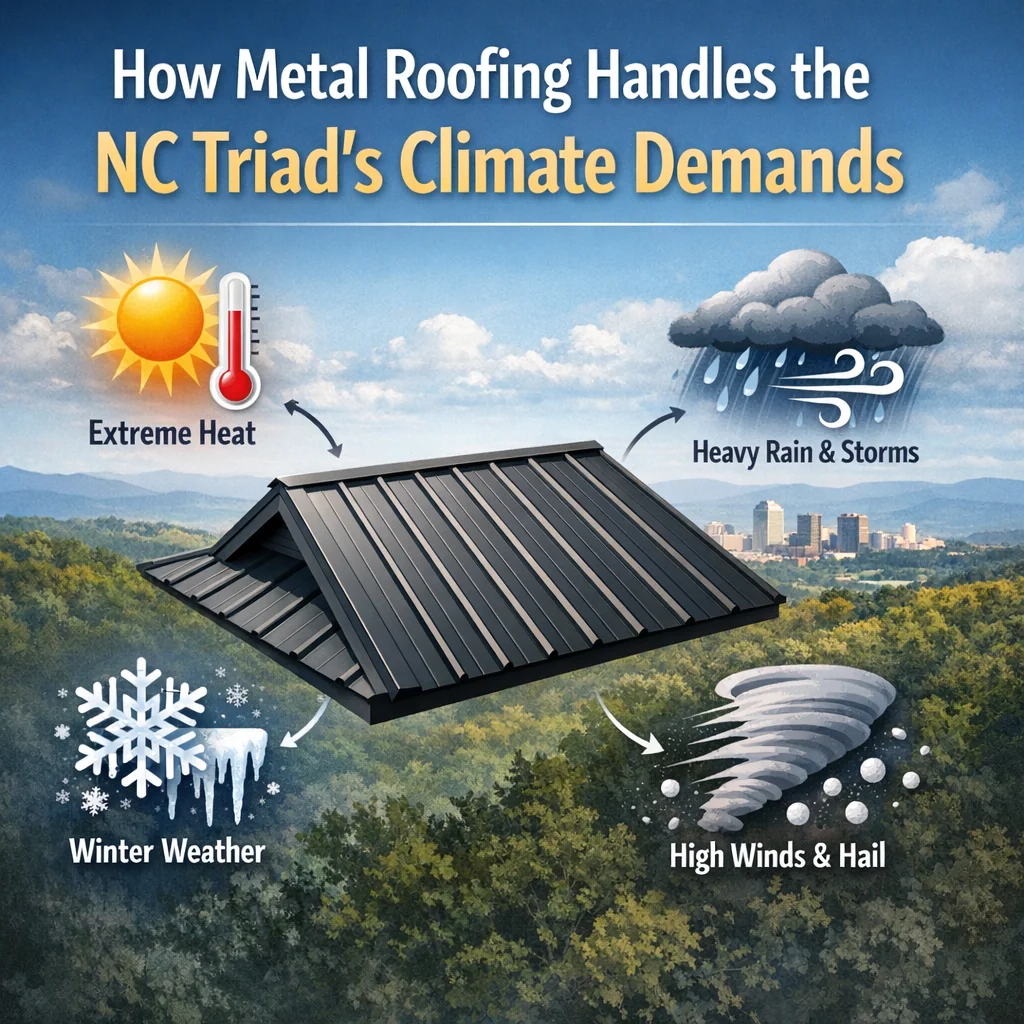
Before evaluating any contractor, it helps to understand why metal roofing is worth serious consideration for homes in this part of North Carolina in the first place. The local climate isn’t extreme by national standards, but it’s genuinely demanding on roofing materials.
Our area sees cold winters with ice storm potential, humid summers that cycle roofing materials through significant thermal expansion and contraction, and enough severe thunderstorm activity to matter when you’re making a long-term material decision. Local terrain can channel storm systems in ways that produce localized wind events that plain weather data doesn’t always capture.
Asphalt shingles, the dominant roofing material in this market, handle these conditions adequately for their lifespan, but that lifespan is the issue. A quality asphalt shingle installation in the Triad typically performs well for 20 to 30 years before replacement becomes the honest recommendation. A properly installed metal roof on the same home is a one-generation decision. For many homeowners, that changes the entire calculation.
Thermal cycling is more relevant to Triad homeowners than the marketing materials usually admit. Metal expands and contracts with temperature changes. In a climate that moves between single-digit winter nights and 95-degree summer afternoons, a roof experiences hundreds of significant thermal cycles over its life. This is not a problem with a properly engineered installation, floating clip systems on standing seam panels are specifically designed to accommodate this movement. But it is a problem if a contractor uses exposed fasteners in an application designed for a concealed-clip system, or if fastener patterns are wrong for the panel profile being used.
Ice and freeze-thaw dynamics matter in our area more than they would in coastal regions. Ice damming, where heat escaping through the roof deck melts snow that refreezes at the cold eave, is a legitimate risk on steeper-pitch homes common throughout our region. Metal roofing, particularly standing seam, sheds ice and snow faster than granulated asphalt because the smooth surface offers less grip. That’s a genuine advantage here. But it only holds if the underlayment selection and installation account for the ice-dam zone at the eave, typically the first three feet from the eave edge. If you want to understand how to address this problem once it forms, our article on how to get rid of ice dams covers the full process.
Humidity and ventilation present a less visible but equally important challenge. North Carolina’s summer humidity levels mean that any moisture that finds its way into a roofing assembly, through inadequate ventilation, improperly lapped underlayment, or condensation buildup between a cold metal panel and a warm interior, can cause real damage. Proper substrate preparation and vapor management are not optional details on a metal roofing project in this region. They’re where a good contractor earns the difference.
Need a hand with this in Winston-Salem, Greensboro and the NC Triad? Call (336) 971-0464 or request a free estimate. Honest answers, no pressure.
Here is one of the most important concepts in metal roofing, and one that almost no contractor website bothers to explain clearly.
When a salesperson tells you a metal panel is “rated for 130-mph winds,” they are citing a component rating, the performance specification for the panel itself under controlled test conditions. What they are not telling you is that the actual wind performance of your installed roof is a system ratingdetermined by the combination of every element in the assembly working together.
That system includes:
A high-quality standing seam panel installed over a deteriorated or undersized deck with the wrong clip spacing does not perform at its rated specification. The rating belongs to the complete, properly installed assembly, not the panel alone.
A contractor who understands metal roofing as a system will talk about the deck condition early. They’ll discuss whether your existing sheathing is structurally sound, whether a tear-off or an overlay is appropriate, and what underlayment is specified for the panel system they’re proposing. They’ll be able to tell you the tested assembly reference, the specific test standard that validates the system’s performance claim.
A contractor who doesn’t understand this will hand you a panel brochure with a wind rating highlighted, and that’s the extent of the technical conversation.
This distinction isn’t about being overly technical. It’s a reliable signal of whether the person selling you a roof knows how to build one correctly.
The Triad market sees three primary metal roofing products on residential projects. Each has genuine strengths, and the right choice depends on your home’s architecture, your priorities, and your roof’s pitch and geometry.
| Roof Type | Profile | Typical Pitch Range | Fastener Style | Key Advantage | Consideration |
|---|---|---|---|---|---|
| Standing Seam | Raised interlocking seams, clean lines | 3:12 and above (low-slope variants exist) | Concealed clips | Allows thermal movement; no exposed fasteners to back out | Higher fabrication complexity; requires precise installation |
| Metal Shingles | Mimics traditional shingle or slate appearance | 3:12 and above | Exposed or hidden depending on system | HOA-friendly appearance; familiar look | Exposed fasteners on some systems need periodic inspection |
| Stone-Coated Steel | Steel panel with stone aggregate surface | 2:12 and above | Exposed fasteners with sealant | Looks like tile or shakes; familiar aesthetic | Stone coating adds weight; fastener sealant needs monitoring over time |
| Corrugated / Ribbed Panel | Agricultural-style exposed fastener panel | 3:12 and above | Exposed fasteners | Lower material complexity | Not ideal for most residential applications in covenant communities |
For most residential projects across Winston-Salem, Greensboro, and High Point, standing seam and metal shingle systems are the most appropriate choices. Standing seam is the technically superior option for longevity and low-maintenance performance. Metal shingles often thread the needle for homeowners who want metal performance but whose neighborhood aesthetic, or HOA, favors a more traditional roofline. Our article on metal roofing in High Point NC goes deeper on how these options compare for local homes specifically.
Stone-coated steel deserves a straightforward mention because it’s marketed aggressively and genuinely has merit. The aggregate surface is real, the impact resistance is real, and the product can look very much like clay tile or wood shakes from street level. The considerations worth knowing: the stone coating is bonded to the steel substrate, and if that bond degrades, or if the coating is damaged during installation, moisture can work under the surface in ways that aren’t immediately visible. It’s a good product in the hands of an installer who knows it well and understands those vulnerabilities.
This is the section that most roofing websites skip entirely, because answering it honestly means giving you the tools to evaluate anyone, including the website you’re reading. We’ll do it anyway, because homeowners who feel confident in their contractor selection make better decisions, have better experiences, and end up with better roofs.
A qualified metal roofing contractor should be able to hand you the complete product approval documentation for the specific system being proposed, not a generic manufacturer brochure. This documentation identifies the tested assembly: the panel, the clip specification, the underlayment type, the fastener size and pattern, and the deck attachment requirements that together produce the rated performance.
If a contractor cannot produce this, or looks at you blankly when you ask, that is meaningful information about how they approach the technical side of their work.
In North Carolina, roofing contractors are licensed at the state level. Verify that the contractor’s license is current and active through the NC Licensing Board for General Contractors. Confirm they carry general liability insurance and workers’ compensation coverage, and ask for certificates, not just verbal assurances. Workers’ comp coverage matters particularly for metal roofing projects, where working on pitched surfaces with large panels is physically demanding work.
Some contractors run their own trained, consistent crews. Others use subcontractors, sometimes different subcontractors on different projects. Neither model is inherently disqualifying, but the question is worth asking directly: will the crew installing my roof be your own employees, or subcontractors? If subcontractors, what quality oversight does the contractor maintain on-site?
Consistency in crew training is especially important for metal roofing. The tolerances and sequencing in a standing seam installation, particularly around penetrations like chimneys, skylights, and pipe boots, require specific knowledge that a generalist roofing crew may not have.
This is one of the most commonly misunderstood aspects of any roofing project, and it matters more on a metal roof than on an asphalt one because you’ll be living with the decision for 40+ years.
There are two separate warranties involved in every metal roofing project:
The manufacturer’s material warranty covers defects in the roofing product itself, the panels, coatings, and factory components. This warranty is between you and the manufacturer, and it typically has specific requirements: that the product was installed according to the manufacturer’s specifications, that a registered installer performed the work, and that you file any claim within prescribed timelines and with required documentation.
The contractor’s workmanship warranty covers the installation itself, how the panels were fastened, how the flashings were sealed, how the penetrations were finished. This warranty is between you and the contractor. It does not overlap with the manufacturer warranty; they cover different things.
Ask explicitly: if I have a leak in year seven, who do I call, and what does that claim process look like? The answer will tell you a great deal about how the contractor thinks about their relationship with you after the project ends.
At Smithrock Roofing, we back our work with a 5-year labor warranty alongside the manufacturer’s limited lifetime warranty on materials, and we explain clearly what each one covers before we ask anyone to sign anything. You can review the full details of our warranty coverage before signing anything.
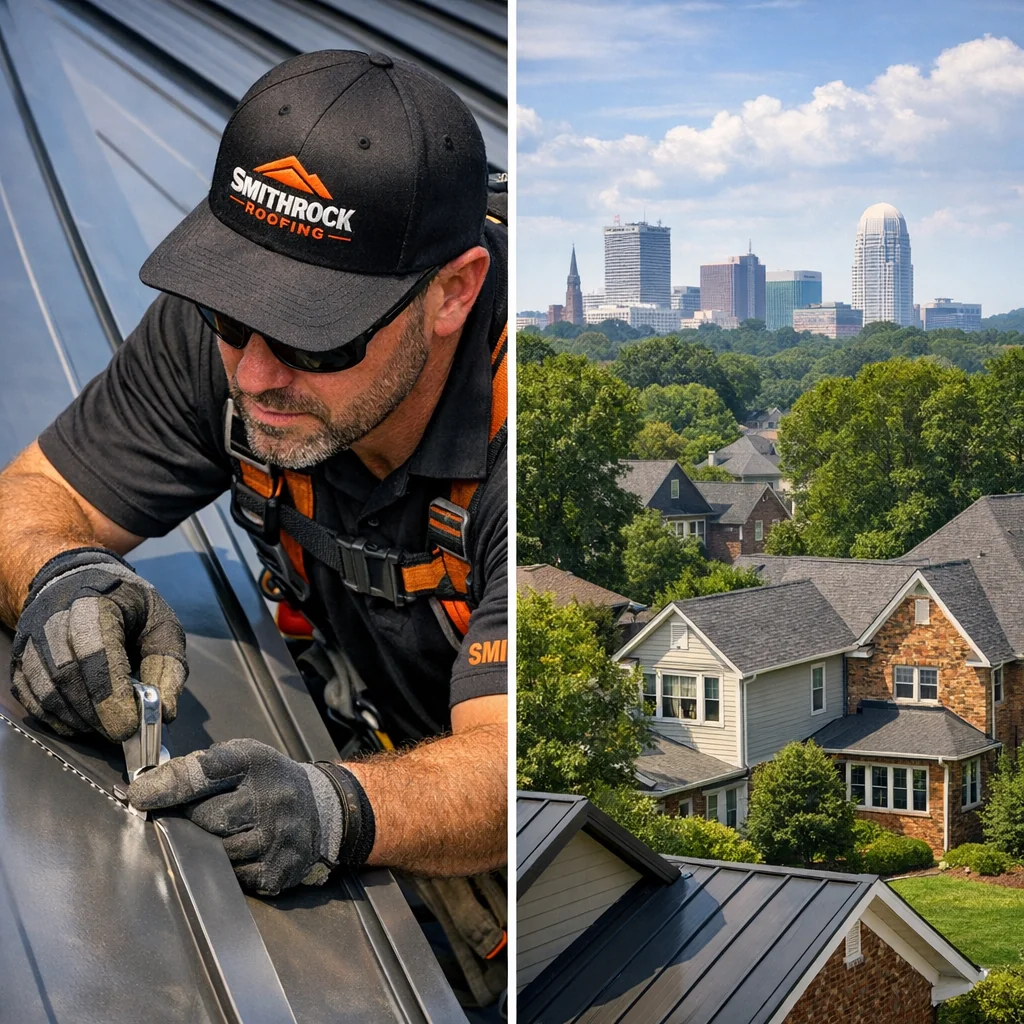
A quality metal roofing installation isn’t a fast project, and homeowners should be cautious of timelines that seem unusually compressed. Here’s what the process looks like on a properly run project.
Before any metal panel goes on, the deck condition has to be evaluated honestly. This means checking the sheathing for soft spots, rot, delamination, or inadequate thickness. Metal roofing telegraphs substrate imperfections, an uneven deck will show in the finished panel surface. Any compromised sheathing should be replaced before the new system goes down.
On a re-roof over an existing asphalt installation, the decision about whether to tear off or overlay is a material one. Overlays are sometimes appropriate, but they introduce weight, can affect the deck attachment rating, and can trap moisture from the existing material below. A contractor who recommends an overlay without examining the existing roof condition and discussing the tradeoffs is cutting a corner you’ll pay for eventually.
The underlayment sits between your deck and your metal panels, and it does several jobs simultaneously: it provides a secondary water barrier, it reduces noise from rain on the metal surface, it protects the deck during installation, and it manages vapor movement in your roofing assembly. For the NC Triad’s climate, with both ice-event risk and summer humidity, underlayment selection is a meaningful decision, not a commodity choice.
Self-adhering ice-and-water barrier membrane at eave areas (typically the first three feet from eave edge and at all valley areas) is standard practice for North Carolina applications. The field area typically uses a synthetic underlayment rated for metal roofing applications, standard felt is not appropriate under most metal systems because of adhesion and moisture interaction concerns.
Standing seam panels are typically fabricated on-site or delivered to length, custom fit to your roof, not cut from a standard sheet. The installation begins at the eave and works toward the ridge, with each panel engaging the previous one through the seam profile. Clips are set to the panel manufacturer’s specified pattern, and the seaming process, whether hand-seamed or machine-seamed, follows the manufacturer’s sequence.
The penetration flashings and edge conditions are where most metal roofing failures originate. Chimney flashings, pipe boot details, valley treatments, and ridge caps all require specific sequencing and attention. These areas don’t fail because the panel is inadequate, they fail because the integration between the panel system and the penetration was rushed or improperly detailed.
A permitted metal roofing project in our area will include a building department inspection before the permit can be closed. That inspection validates that the installation meets local building code requirements. Do not confuse a passing inspection with a comprehensive quality review, the inspector is checking code compliance, not performing a craftsman’s review of every seam. Your contractor’s own closeout walkthrough should include a detailed inspection of all penetrations, edge conditions, and panel seams before they leave the job site.
Technical competence, understanding systems, deck conditions, fastener patterns, and underlayment selection, is the baseline for any contractor worth hiring. What separates good from great is the way a contractor communicates with you through the process.
A great local metal roofer explains what they find when they open up a problem area, without turning it into an upsell. They tell you what is going on and what the options are, and they let you make a decision. They schedule honestly, not promising a start date they can’t meet, and they treat your property with respect throughout the project. Job-site cleanliness matters. So does a final walkthrough with you rather than just a closed permit and a departed crew.
Smithrock Roofing has built a reputation across the NC Triad, 312+ five-star reviews, an A+ rating with the Better Business Bureau, and 60+ combined years of experience, by treating those standards as minimums, not aspirations. Our CertainTeed PREMIER ShingleMaster certification means our installation teams are trained and accountable to standards that go beyond general contractor licensing.
When you call us, you’re talking to a team that knows this region’s weather, knows these neighborhoods, and knows what a properly installed metal roof looks like decades after the crew leaves. That’s the standard we hold ourselves to, and it’s the standard you should hold any contractor to when you’re making a decision that will outlast two decades of everything else on your home.
The search for “local metal roofers near me” is a starting point, not an ending one. Before you call the first contractor on the list, give yourself a foundation:
When you’re ready to talk to a team that will answer every one of those questions plainly and back up the answers with documentation, Smithrock Roofing is ready. We serve Winston-Salem, Greensboro, High Point, Kernersville, Clemmons, Rural Hall, King, and the surrounding Triad communities, and we’d be glad to put our experience to work on your home.
Metal roofing tends to be an excellent fit for homes across Winston-Salem, Greensboro, and the surrounding Triad area because of the region’s combination of summer heat, periodic ice events, and storm exposure. If your current roof is aging, if you’ve experienced repeated issues with shingles failing after severe weather, or if you’re planning to stay in your home for the long term, metal is worth a serious conversation. The right contractor will evaluate your specific roof geometry, existing structure, and neighborhood context, including any HOA guidelines, before recommending a system.
The most important questions center on accountability rather than price. Ask whether they carry active general liability and workers’ compensation insurance, and request certificates rather than taking their word for it. Ask who specifically will be on the crew, whether they’re direct employees or subcontracted labor. Ask what underlayment system they use beneath the metal and why. Ask about the warranty structure, specifically distinguishing between the manufacturer’s material warranty and the contractor’s workmanship warranty. A contractor who answers these questions thoroughly and without hesitation is one worth continuing the conversation with.
The timeline depends heavily on the size and complexity of your roof. A straightforward installation on a modest single-story home may be completed within a few days. Larger homes, steeper pitches, roofs with multiple penetrations like chimneys and skylights, or projects involving tear-off of existing material will take longer. Your contractor should give you a realistic project timeline during the estimate process, not a vague range designed to manage expectations after the fact. Weather windows in our area also factor in, particularly if your project falls during a stretch of unpredictable spring or fall weather.
Metal roofing is generally lower maintenance than asphalt shingles over its service life, but it is not zero maintenance. Periodic inspections, typically recommended every few years or after significant storm events, allow a qualified roofer to check panel fasteners, examine sealants around penetrations, and clear any debris accumulation that could trap moisture in valleys. Gutters should be kept clear, as they are with any roofing system. The key advantage is that metal does not granulate, curl, or crack the way asphalt does, which means the list of things that can go wrong between inspections is considerably shorter.
Choosing a metal roof is a long-term decision, and it deserves a long-term contractor, one with deep roots in the communities being served and a track record that local homeowners can verify in person. Smithrock Roofing has built that track record across Winston-Salem, High Point, and the broader Triad region one roof at a time, and we’re ready to bring that same standard of work to your home. If you’re ready to get honest answers and a thorough estimate from a team that will still be here long after installation day, we’d love to hear from you, Contact Smithrock Roofing and let’s start the conversation.

Smithrock Roofing © Copyright 2026 • All Rights Reserved • Privacy Policy • Maintained by Mongoose Digital Marketing