Choosing a residential roof repair company comes down to finding someone who can accurately diagnose what your roof actually needs, not just describe what they can see from the ground. This article explains how a proper repair diagnosis works, what separates a complete estimate from an incomplete one, how to approach the repair-versus-replace decision, and what to look for in a contractor’s credentials and warranty terms.
Most homeowners call a roofing company because they see a symptom: a water stain on the ceiling, a missing shingle, granules collecting in the gutters. The symptom is real, but it is rarely the complete picture. A reliable residential roof repair company treats that symptom as a starting point, not a conclusion.
Your roof has two main protective layers that work together but age differently. The surface material, whether asphalt shingles or another type, handles UV exposure, impact, and shedding water. Beneath it sits the underlayment, a waterproofing membrane that acts as a secondary barrier if the surface is ever compromised.
Here is why this distinction matters in a repair context: the surface material and the underlayment do not wear out on the same timeline or for the same reasons. A roof can have shingles that still look acceptable while the underlayment has degraded significantly. The reverse is also possible. A contractor who only inspects what is visible and quotes a surface repair without evaluating underlayment condition is not diagnosing the roof. They are describing its appearance.
When Smithrock Roofing conducts an inspection, the evaluation covers both layers. If a repair quote does not address underlayment condition, ask directly why. The answer will tell you a great deal about how thorough the contractor’s scope actually is.
Below the underlayment sits the roof deck, the structural sheathing that everything else is fastened to. Persistent moisture intrusion, even minor and slow, can cause deck sheathing to soften or delaminate over time. A repair that replaces surface shingles and even the underlayment over a compromised deck is building on a weak foundation. A complete diagnosis includes confirming deck integrity in the affected area before any repair is quoted or executed.
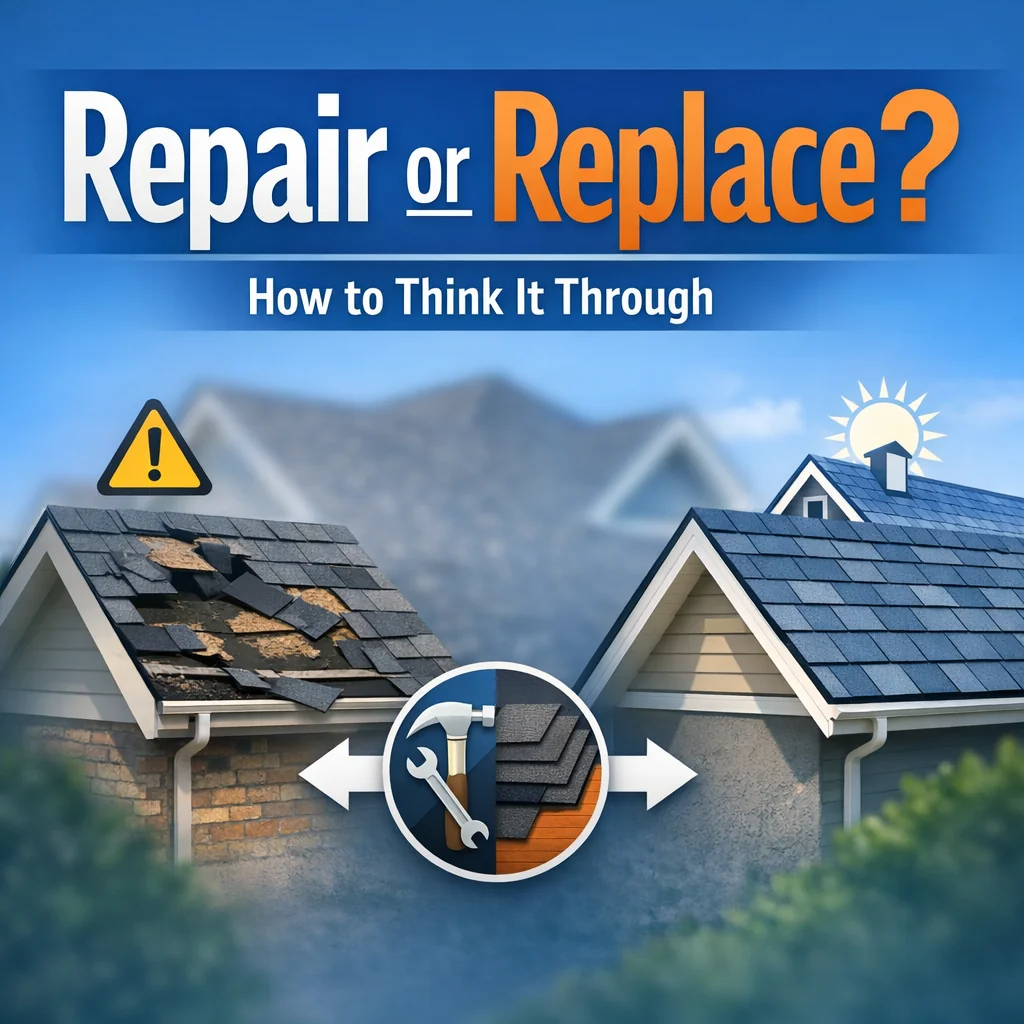
The repair-versus-replace question is genuinely difficult in certain situations, and any contractor who answers it immediately without a thorough inspection is giving you a guess, not a recommendation. That said, there is a logical framework for thinking through it. For a deeper look at how this decision plays out locally, the article on roof repair vs. replacement in Winston-Salem walks through the key considerations in detail.
Repair makes sense when damage is isolated, the roof is relatively young, and both the underlayment and deck are structurally sound. If a storm takes out a section of shingles on one slope of a seven-year-old roof that was properly installed, repair is almost certainly the appropriate response. You are restoring a specific failure on an otherwise healthy system.
A commonly used industry benchmark is the 50% threshold: if the estimated repair cost approaches half the cost of a full replacement, replacement tends to be the wiser long-term decision. The reasoning behind this threshold is not complicated once you see it clearly. A repair on a significantly degraded roof is not just paying for the visible damage. It is paying for labor and materials on a system, deck, underlayment, and remaining surface material, that will likely require further intervention in the near term. If a substantial repair is followed by full replacement two or three years later, the homeowner has effectively paid considerably more than replacement would have cost to begin with.
The affected area also matters. When damage covers more than roughly a quarter of the total roof surface, the economics of patching begin to shift. Widespread wear is rarely isolated to what is visible.
Roofs under 15 years old with isolated damage almost always favor repair. Roofs over 20 years old with meaningful damage almost always favor replacement. The range in between, roughly 15 to 20 years, is where the decision is genuinely ambiguous and where professional judgment matters most. If your roof sits in that window, do not expect a responsible contractor to give you an answer without first putting eyes and hands on the actual condition of the underlayment and deck.
Need a hand with this in Winston-Salem, Greensboro and the Triad? Call (336) 971-0464 or request a free estimate. Honest answers, no pressure.
Certifications are worth understanding, not just accepting at face value.
Smithrock Roofing holds CertainTeed PREMIER ShingleMark Master Certification. Here is what that means in practical terms. CertainTeed’s master-level certification is not awarded for longevity alone. It requires contractors to meet installation standards, maintain trained crews, and pass quality benchmarks that CertainTeed reviews on an ongoing basis. The direct benefit to you as a homeowner is this: when a certified installer places CertainTeed products, you qualify for the full manufacturer warranty, including the limited lifetime warranty on CertainTeed Landmark shingles. If a non-certified contractor installs the same product, that warranty coverage may be reduced or void entirely. The certification is not a marketing badge. It is the condition under which your material warranty is valid.
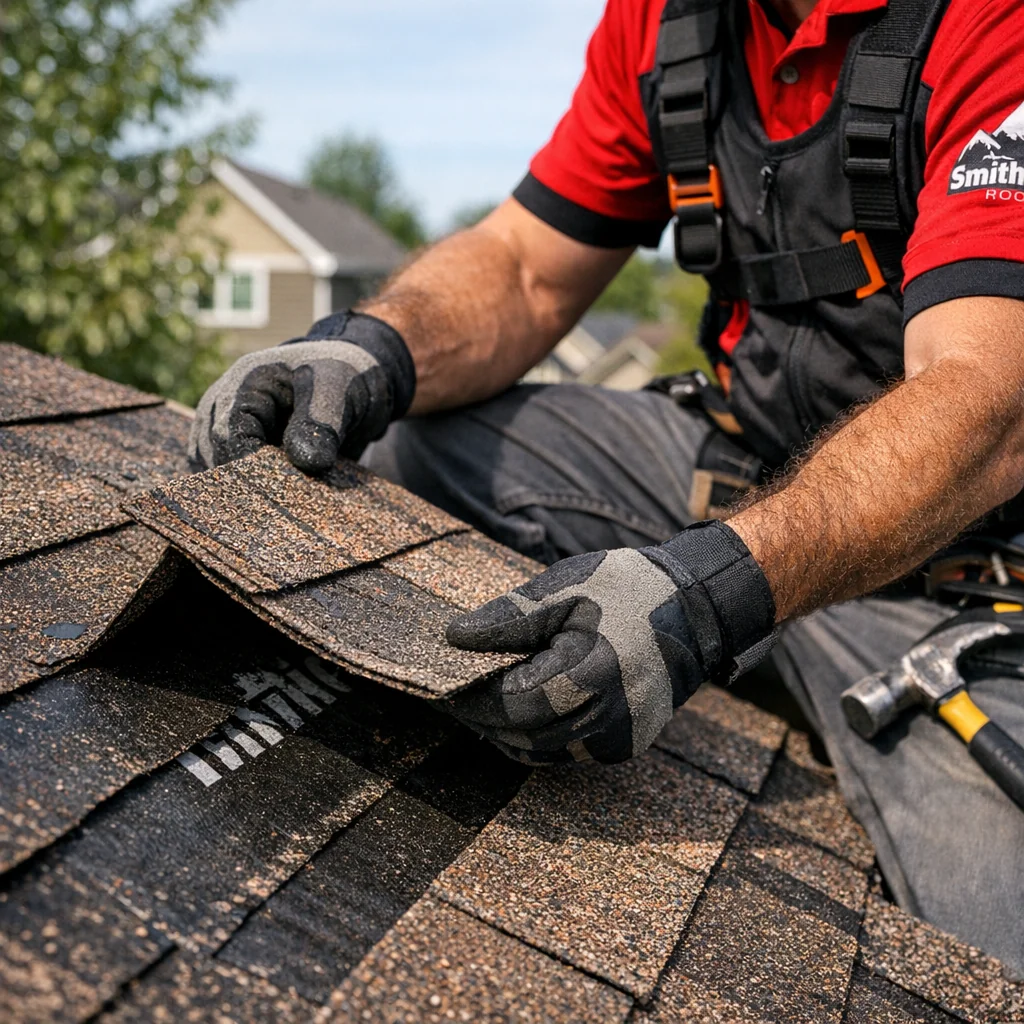
Beyond certifications, look for contractors who carry full licensing and insurance for your state, and who have a verifiable local reputation. Smithrock Roofing has served homeowners across Winston-Salem, Greensboro, High Point, Kernersville, Clemmons, Rural Hall, roofing in King, and the surrounding NC Triad for years, and has built more than 350 five-star reviews on the back of that work. A local track record is something a national chain cannot replicate.
Most contractors mention workmanship warranties. Fewer explain them clearly. Here is what you should ask before signing anything.
| Question to Ask | Why It Matters |
|---|---|
| How long does the labor warranty last? | Smithrock Roofing backs work with a 5-year labor warranty. Shorter terms are worth noting. |
| What voids the workmanship warranty? | Unauthorized modifications, improper maintenance, or acts of nature may all affect coverage. Know before you sign. |
| Does my installation qualify for the full manufacturer warranty? | Only certified installers can activate full material warranties on premium products. |
| How do the two warranties interact if I have a leak? | Material and labor warranties cover different failure types. Understand which applies to which scenario. |
| Is the warranty transferable if I sell the home? | Transferable warranties are a genuine selling point; not all are. |
A 5-year labor warranty, combined with a limited lifetime manufacturer warranty on CertainTeed materials, gives homeowners two distinct layers of protection. The labor warranty covers installation workmanship. The manufacturer warranty covers material defects in the shingles themselves. Both matter, and both should be in writing before work begins. You can learn more about what our coverage includes through our roofing service.
If your repair need stems from storm damage, the order in which you contact people affects your outcome in a meaningful way. Multiple roofing companies claim they “work with your adjuster.” What that phrase tends to obscure is that timing makes a significant difference.
An insurance adjuster’s initial visit establishes the damage baseline that your claim is built on. That baseline determines what the claim covers. If a roofing contractor documents the damage independently before the adjuster has filed initial findings, that documentation can support and strengthen your claim from the beginning. If the contractor’s documentation only arrives after the adjuster has already submitted findings, the contractor is reacting to an established record rather than contributing to it.
The practical recommendation is straightforward: if you have storm damage, call a qualified roofing contractor before the adjuster visits. A contractor who can be present during or before the adjuster’s inspection, with their own documentation in hand, is in a far stronger position to advocate for a complete and accurate claim scope on your behalf. Our article on residential roof storm damage walks through the full repair process in detail.
Smithrock Roofing has walked homeowners through this process across the NC Triad. We know what thorough damage documentation looks like, and we understand how to communicate clearly with adjusters so that nothing legitimate gets left out of your claim.
When you are evaluating a residential roof repair company, the right questions are the ones this article covers: What does your inspection actually include? Is underlayment on the checklist? Can you explain why repair or replacement is the right call for my specific situation? What does the labor warranty cover and what voids it? A contractor who can answer all of those clearly, without deflecting or oversimplifying, is one worth trusting with your home.
The answer depends on the extent of damage, the age of the roof, and the condition of the underlayment and decking beneath the surface. A thorough inspection that goes beyond a visual check of the shingles is the only reliable way to make that determination. A contractor who can point to specific findings and explain the reasoning behind their recommendation, rather than defaulting to replacement because it generates more revenue, is one worth listening to. Ask them to walk you through what they found and why it leads to their conclusion.
A complete inspection covers more than the shingles. It should include the underlayment, flashing around chimneys and penetrations, ridge caps, soffit and fascia condition, attic ventilation, and the decking itself where accessible. If a contractor’s inspection checklist stops at the shingle layer, they may be missing the conditions that cause ongoing or recurring problems after the repair is done.
Labor warranties cover the quality of the installation work itself, meaning if a repair fails because of how it was done, the contractor is responsible for fixing it. Common exclusions include damage caused by subsequent storms, improper attic ventilation that affects shingle performance, and work performed on the roof by another party after the original repair. Always ask for the warranty in writing and read through what voids it before work begins.
Call a qualified roofing contractor first. The documentation gathered before your insurance adjuster’s initial visit can directly influence the scope and accuracy of your claim. Once an adjuster submits their initial findings, that record becomes the baseline the claim is built on. A contractor who can document damage independently, and be present during or before the adjuster’s inspection, is in a much better position to make sure nothing legitimate gets overlooked.
Smithrock Roofing has been helping homeowners across Winston-Salem and Greensboro navigate repairs, storm claims, and the sometimes confusing process of figuring out what their roof actually needs, with honest inspections and clear communication from start to finish. If your roof needs attention and you want a straightforward conversation with a local team that knows the NC Triad, call us at (336) 971-0464 or Get a Free Estimate today.

Smithrock Roofing © Copyright 2026 • All Rights Reserved • Privacy Policy • Maintained by Mongoose Digital Marketing