
Deciding whether to repair or replace your roof comes down to three things: the age of the system, the scope and distribution of the damage, and the condition of the underlying decking. Get those three factors clearly in front of you and the decision becomes straightforward. Skip any one of them and you risk spending money on a repair that buys you only another year or two, or committing to a full replacement when a targeted fix would have served you well for the life of the roof.
This guide walks through how roof damage actually develops, how to read the signs correctly, and how to think through the repair-versus-replace question with real clarity.
Most homeowners think of roof problems as isolated events: a shingle blows off, a leak appears, something gets fixed. In practice, a roof is an interconnected drainage system, and problems rarely stay isolated.
Flashing is the metal material installed wherever the roof meets a vertical surface: around chimneys, skylights, dormers, and roof-to-wall transitions. It is responsible for a disproportionate share of residential leaks, and the reason is physical rather than coincidental.
Metal and masonry have different thermal expansion rates. Every temperature shift causes these two materials to move slightly against each other. Over years of heating and cooling, the seal between them works loose. This is not a defect in any one installation; it is the expected behavior of dissimilar materials under repeated mechanical stress.
What this means practically: if you have a chimney or skylight and you develop a leak, that junction is the first place a qualified roofer should examine, regardless of what the roof looks like from the street. A visual scan from the ground that produces “the shingles look fine” is not a roof inspection. Flashing failures are invisible at a distance.
Asphalt shingles are manufactured with a layer of mineral granules embedded in the surface. Those granules do more than provide color. They shield the asphalt substrate beneath them from UV radiation. Once granule loss accelerates, the asphalt degrades, becomes brittle, and cracks. Water finds those cracks.
Granule loss shows up in gutters and at downspout outlets as gritty sediment. Seeing moderate granule loss on a roof that is 8 years old is a different situation than seeing it on a roof that is 18 years old. In the first case it may indicate a manufacturing issue or storm impact. In the second, it is often a sign the system is approaching the end of its serviceable life.
Clogged gutters are frequently listed as a cause of roof leaks, which is accurate but incomplete. When gutters back up, standing water is forced under the lower courses of shingles and into the roof assembly. By the time water is entering the structure, the gutter is the trigger but the roof membrane and flashing at the eave are the actual points of failure. Clearing the gutter solves the trigger; it does not repair whatever damage the water intrusion has already caused to the underlying materials.
The simplified version of this decision goes: under 15 years old, repair; over 20 years old, consider replacing. That guidance holds at the extremes. The problem is that a large number of homeowners are dealing with roofs somewhere between those two benchmarks, and for them the age rule alone is not enough. For a deeper look at how this decision plays out in the local climate, the Roof Repair vs. Replacement Explained article walks through the specific factors that matter most in this region.
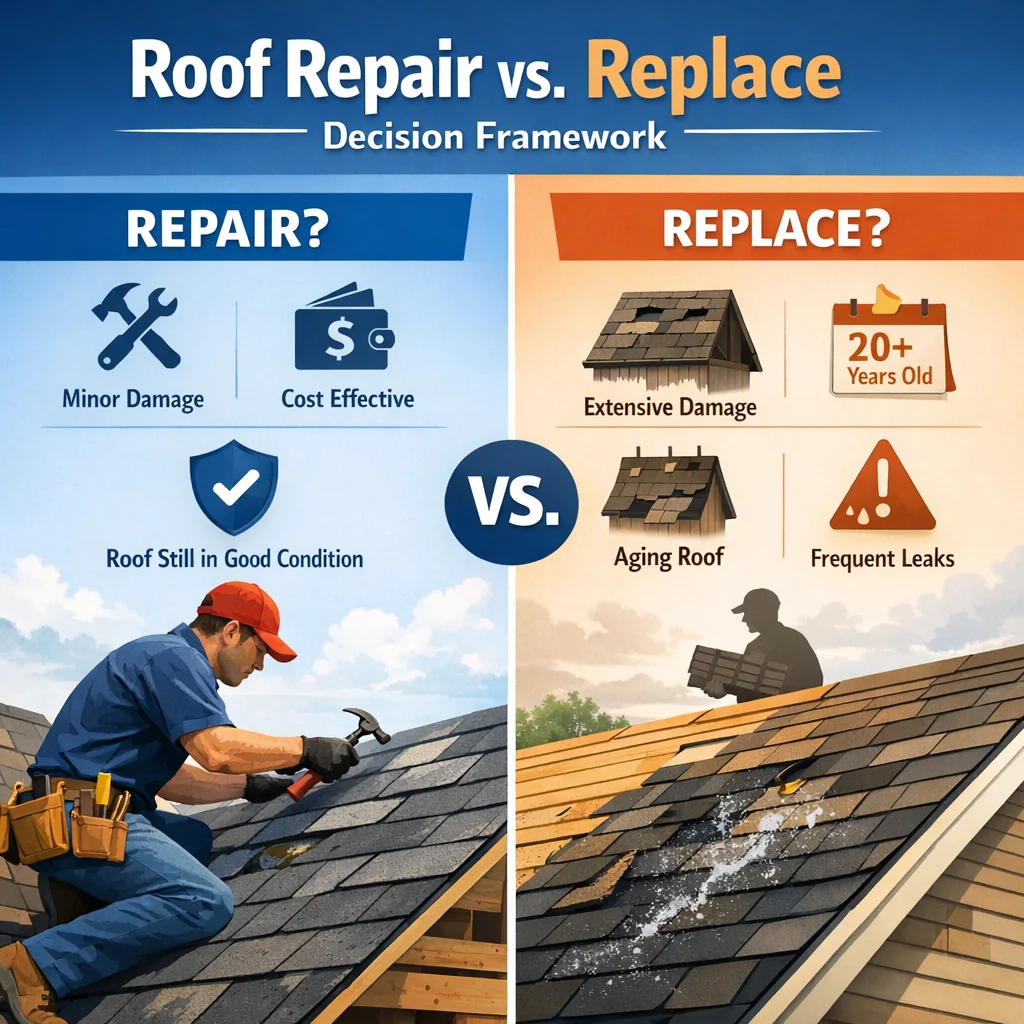
A 17-year-old roof with two active leaks is not an easy call, and anyone who tells you otherwise without inspecting the decking is not giving you a complete answer. Here is how a legitimate evaluation works in that scenario:
| Factor | Lean Toward Repair | Lean Toward Replacement |
|---|---|---|
| Damage location | Single localized area | Two or more separate sections |
| Decking condition | Solid, no soft spots | Soft spots, staining, or rot present |
| Shingle condition elsewhere | Granules intact, no widespread cracking | Widespread granule loss or brittleness |
| Flashing condition | Isolated failure at one junction | Multiple failed junctions |
| Leak history | First occurrence | Recurring or multiple simultaneous leaks |
| Remaining service life | Reasonable remaining life expected | System showing signs of systemic decline |
No single row in that table decides the answer. A 17-year-old roof with isolated damage, solid decking, and no history of prior leaks may be an excellent repair candidate. The same age roof with soft decking, granule loss across three elevations, and two active leaks is a different situation entirely.
One leak in one location after a severe storm is an event. Two leaks in two unrelated areas of the roof without a single storm event is a pattern. The distinction matters because localized repairs address events; only a full system evaluation addresses patterns. If a roof is generating new leaks in new locations over a relatively short span of time, that distribution of failure is telling you something about the overall system condition that a series of patch repairs will not solve.
Need a hand with this in Winston-Salem, Greensboro and the Triad? Call (336) 971-0464 or request a free estimate. Honest answers, no pressure.
A reliable roof repair begins with an inspection that covers not just the visible damage but the areas adjacent to it. Shingles are the outermost layer of a multi-layer assembly. Damage to shingles can indicate damage to the underlayment or decking beneath them, and a repair that addresses only the shingles while leaving compromised underlayment in place is not a complete repair.
At Smithrock Roofing, we bring more than 60 combined years of experience to that inspection. Our teams are CertainTeed PREMIER ShingleMaster certified, which means installation standards are held to a specific technical level, not just a general sense of “doing it right.” That certification matters because most manufacturer warranties, including the limited lifetime warranty on CertainTeed Landmark shingles, require documented installation compliance to remain valid. Material brand and warranty language mean little if installation does not meet the conditions the warranty actually requires. You can learn more about the full scope of our roofing service and what sets our installation standards apart.
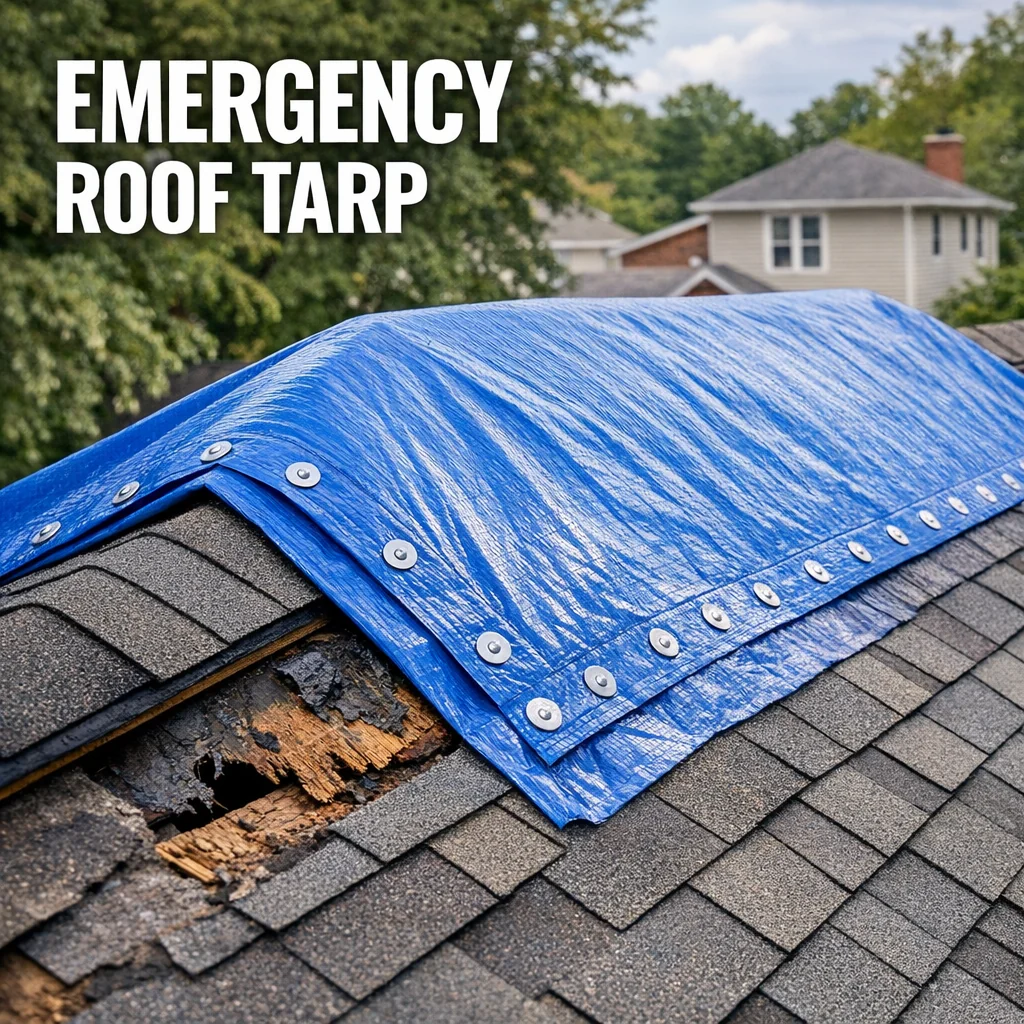
When a storm creates an immediate opening in the roof, tarping is the right first response. It is also a step that is easy to do inadequately. A tarp that stops further damage has to extend past the ridge of the roof rather than stopping at the opening, must be mechanically anchored rather than held by weight alone, and must have edges sealed at any penetration point. A tarp that does not meet those conditions can redirect water into areas that were previously dry, creating new damage while appearing to address the original problem.
A workmanship warranty covers the quality of the installation work itself, separate from the manufacturer’s material warranty. When you’re evaluating a contractor, the question worth asking is not just how long the warranty lasts but what specific scenarios it covers. If the same area leaks again within the warranty period, what is the process for determining whether that’s a workmanship issue or something else? At Smithrock Roofing, we back our work with a 5-year labor warranty alongside the manufacturer’s limited lifetime material warranty, and we maintain direct accountability for everything on that job site. When the same crew that diagnosed your roof is the crew that repairs it, there is no ambiguity about who is responsible for the outcome.
Homeowners across roofing in Winston-Salem, Greensboro, High Point, Kernersville, Clemmons, Rural Hall, and King trust Smithrock Roofing because we do not separate honest assessment from quality work. More than 350 five-star Google reviews reflect what happens when a company treats every inspection as a conversation rather than a sales call. If your roof is showing signs of damage or you are trying to make a repair-versus-replace decision, the right starting point is a thorough inspection from a team that will tell you what they find, not what they think you want to hear.
The answer depends on several factors, including the age of the roof, the extent of the damage, and whether the underlying decking and structure have been compromised. A localized issue, such as a few missing shingles or a single flashing failure, often qualifies for repair, especially on a newer roof. When damage is widespread, when granule loss is significant across the entire surface, or when the roof has already reached the end of its expected lifespan, replacement is typically the more sound investment. A thorough inspection from a qualified contractor will give you a clear picture of which path makes sense for your specific situation.
Start by documenting the damage from the ground using photos or video without putting yourself at risk. If there is any interior water intrusion, place containers to collect dripping water and protect belongings from further exposure. Contact a licensed roofing contractor as soon as possible to assess the damage and, if necessary, install an emergency tarp to prevent additional water entry. Avoid walking on the roof yourself, and be cautious of contractors who appear unsolicited after a storm, as high-pressure sales tactics following weather events are a common concern in this industry. The Residential Roof Storm Damage: A Complete Repair Guide is a useful resource for understanding the full sequence of steps after a weather event.
Many homeowner’s insurance policies do cover sudden damage caused by wind, hail, or falling debris, but coverage varies by policy, carrier, and the specific circumstances of the damage. Routine wear and pre-existing conditions are generally not covered. A reputable roofing contractor can help you document the damage thoroughly, which supports your claim when working with your insurance adjuster. It is always worth reviewing your policy carefully and contacting your insurance provider early in the process to understand what your coverage includes.
Most residential roof repairs are completed within a single day, though the timeline depends on the scope of the work, the accessibility of the affected areas, and weather conditions at the time of the job. Larger repairs involving significant decking replacement or extensive flashing work may require additional time. A reliable contractor will give you a realistic schedule before work begins and communicate clearly if anything changes once the job is underway.
When your roof is damaged, you deserve straightforward answers and work you can stand behind for years to come, that is exactly what Smithrock Roofing delivers to homeowners throughout Winston-Salem, Greensboro, and the surrounding communities every day. Whether you are dealing with storm damage, an aging roof, or a leak you cannot explain, our team is ready to give you an honest assessment and quality craftsmanship backed by a real warranty. Call us at (336) 971-0464 or Contact Smithrock Roofing to schedule your free estimate today.

Smithrock Roofing © Copyright 2026 • All Rights Reserved • Privacy Policy • Maintained by Mongoose Digital Marketing