Most roofing content written for the Mt. Airy area follows the same tired formula: a list of services, a mention of Andy Griffith country, and a phone number. If you’ve already read three pages that look exactly like that, you’ve noticed they don’t actually answer the questions a homeowner needs answered before making a real decision.
This guide is different. We’re going to cover the things that actually matter — why Mt. Airy’s geography creates roof stress patterns that piedmont homeowners don’t face, what NC building code requires for your specific county, how to tell the difference between a repair and a replacement situation before anyone sets foot on your roof, and how to evaluate any contractor you bring onto your property.
Whether you’re dealing with a leak after a recent storm or noticing signs of wear you’ve been putting off, understanding the full picture protects your home and your wallet.
Here’s something most roofing companies serving this area won’t tell you, largely because they don’t specialize here: Mt. Airy is not the same as Winston-Salem.
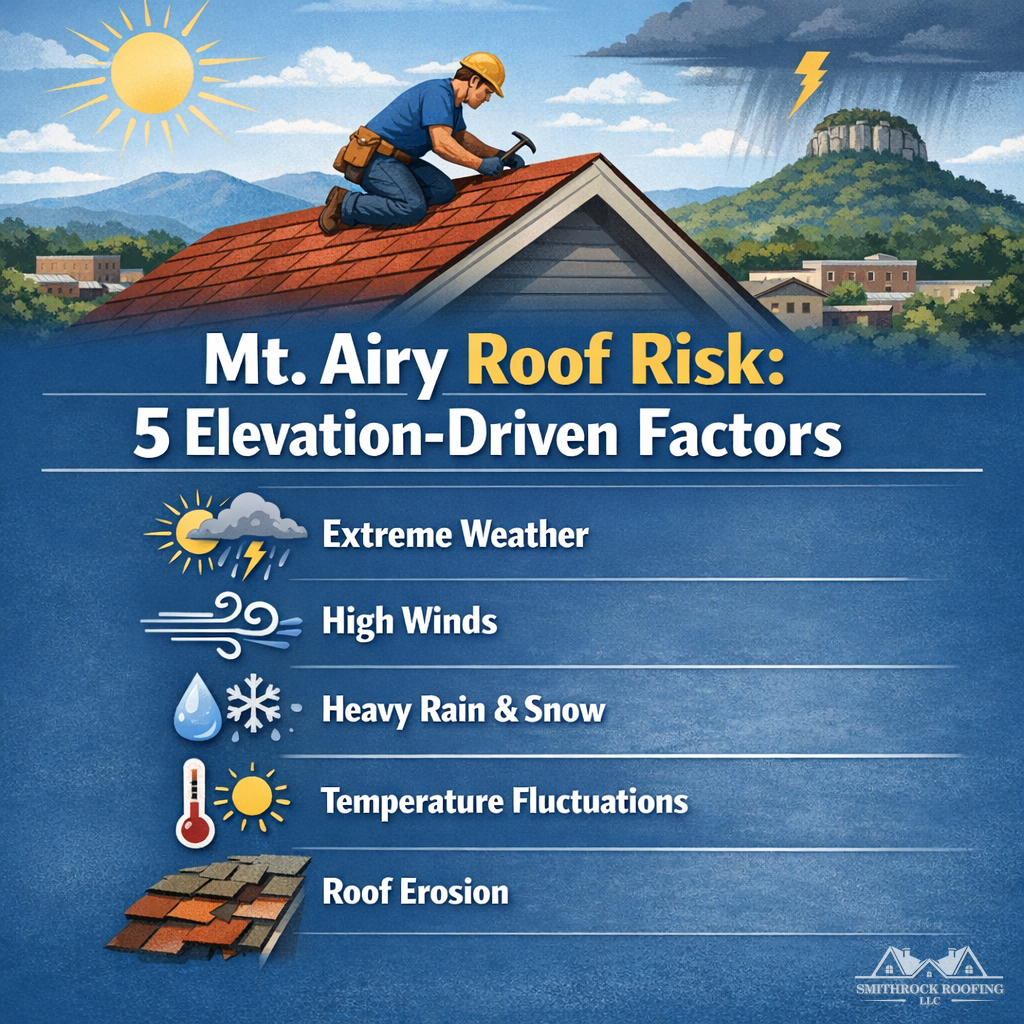
Sitting at roughly 1,070 feet elevation in the Blue Ridge foothills, Mt. Airy experiences a distinct microclimate that sets it apart from the NC Triad cities Smithrock Roofing serves in the piedmont. The elevation difference is real, and its effects on your roof are measurable.
In the piedmont — Greensboro, Winston-Salem, High Point — winter temperatures dip, but sustained freezing is relatively brief. In Mt. Airy and Surry County, the foothills climate produces something more problematic for roofing systems: repeated freeze-thaw cycling.
Warm afternoons followed by below-freezing nights cause the materials in your roof to expand and contract, over and over, throughout the winter months. This cycling puts direct stress on:
This is wear that accumulates gradually and doesn’t always announce itself with a dramatic leak. Instead, you’ll see subtle granule loss, slightly lifted shingle edges on north-facing slopes, or flashing that’s begun to pull away from its sealed edge.
Ice dams are largely absent from roofing conversations in the piedmont because they’re genuinely rare there. In Mt. Airy, they’re a legitimate concern that homeowners should understand.
An ice dam forms when heat escaping from the conditioned space below your roof melts snow on the upper portions of the roof. That snowmelt runs down the slope until it reaches the cold eave overhang, where it refreezes. Over successive melt-refreeze cycles, a ridge of ice builds up. Water pooling behind that dam has nowhere to go but under your shingles.
The result is interior water infiltration — often appearing as a ceiling stain or wall discoloration — that looks like a shingle problem but is actually a ventilation and insulation problem at the attic level. If you’re already seeing water stains inside your home, the article Ceiling Leak? Find the Real Source Before You Call Anyone walks through how to trace infiltration back to its origin before anyone sets foot on your roof.
Properly addressing ice dam risk means looking at your roofing system as a whole: shingles, yes, but also attic insulation levels, ventilation intake and exhaust balance, and whether ice-and-water shield underlayment was correctly installed at your eaves. If a contractor shows up and only talks about shingles, that’s a sign they’re not thinking about your specific situation.
Because of these elevation-driven conditions, some materials simply outperform others in the Mt. Airy context:
The right material recommendation should always account for your roof’s geometry, your attic’s ventilation condition, and your local climate. Anyone giving you a material recommendation without asking about those factors is guessing.
This is a topic that almost never appears in roofing content, and it should — because the consequences of not understanding it can follow you years after the work is done.
North Carolina follows the NC State Residential Building Code, which is based on the International Residential Code with state-specific amendments. Permit requirements are then administered at the county level by Surry County Inspections.
Here’s the practical breakdown:
| Type of Work | Permit Typically Required? | Notes |
|---|---|---|
| Like-for-like shingle repair (small area) | No | Minor repairs replacing damaged shingles in-kind generally don’t require a permit |
| Full roof replacement | Yes | Structural exposure, new underlayment, and full tear-off trigger permit requirements in most NC counties |
| Structural decking repair or replacement | Yes | Any work touching the roof deck is typically permit-eligible |
| Flashing replacement around chimney or skylights | Situational | Depends on scope; ask your contractor to confirm |
| New skylight installation | Yes | New penetrations require permits and inspections |
| Ventilation system changes | Yes | Modifications to ridge vents, soffit systems, or powered ventilators typically require permits |
Here’s the honest truth about skipping permits: it may save a small amount of time and money in the short term, but it creates real problems when you sell your home or file an insurance claim.
Real estate transactions in North Carolina involve disclosure requirements. Unpermitted structural work — including major roof replacements — can complicate the sale, reduce your negotiating position, or require costly retroactive permitting before closing. Insurance companies can also use unpermitted work as grounds to reduce or deny claims related to that work.
Any reputable contractor will pull the appropriate permits and schedule inspections without you having to ask. If a contractor suggests skipping the permit process “to save you money,” that’s a significant red flag.
Surry County falls under the NC State Residential Building Code wind speed design standard, which generally requires installations rated to withstand high wind events. This translates to specific requirements your contractor should be following:
You can ask any contractor you’re evaluating: “What nail pattern do you use, and does it meet NC code for this wind zone?” A qualified contractor will answer that question without hesitation. One who fumbles it or gets defensive is telling you something.
Every competitor in the Mt. Airy market either implies that only a contractor can make this determination — which is technically true for a final answer — or says nothing useful at all. The truth is that homeowners can gather a lot of meaningful information before anyone climbs on their roof.
Here’s how to think through it systematically.
A roof repair makes sense when damage is localized, the underlying system is sound, and the roof has meaningful remaining service life. Look for:
Replacement becomes the more responsible recommendation when multiple factors converge:
Experienced roofing professionals use a general principle worth understanding: if the scope of repair approaches or exceeds one-third of what a full replacement would cost, the math typically favors replacement. This isn’t about the dollar figures themselves — it’s about the underlying reasoning.
Investing significantly in a roof that has limited remaining useful life means you’re spending money to delay an inevitable replacement, not to avoid one. The remaining life of the system is the variable that makes repair either smart or wasteful. For a deeper look at how these cost thresholds break down in the NC market, the Roofing Cost Guide for NC Triad Homeowners provides current figures and context that help you evaluate contractor quotes with confidence.
Before calling anyone, a homeowner can safely observe several things:
From the ground, with binoculars:
– Missing or visibly displaced shingles
– Shingle edges that are curling upward (cupping) or downward (clawing) — both indicate age-related failure
– Dark streaking indicating algae growth (primarily cosmetic but worth noting)
– Visible sagging along the ridge line or on a roof plane — a structural concern requiring immediate attention
From inside your attic:
– Daylight visible through the decking — a clear indicator of gaps or failures that need immediate repair
– Water stains on the underside of the decking — even if currently dry, these mark previous infiltration points
– Frost or moisture on the underside of decking in winter — a ventilation failure signature specific to Mt. Airy’s climate conditions
– Adequate insulation levels at the attic floor — relevant to ice dam prevention
This is one of the most consequential things a homeowner can understand, and almost no competitor content explains it.
When a roofing contractor completes work on your home, you should receive protection from two distinct warranties — and confusing them can leave you without coverage when you actually need it.
This warranty comes from the company that made your shingles — in Smithrock Roofing’s case, CertainTeed. It covers defects in the material itself: premature granule loss, manufacturing inconsistencies, or product failures that aren’t related to installation.
What most homeowners don’t know: manufacturer warranties are voided by improper installation. If a contractor installs your CertainTeed shingles with the wrong nail pattern, in the wrong temperature range, without the required underlayment, or without properly installing starter strips — the warranty is compromised before the first raindrop falls. This is why contractor certification matters. Smithrock Roofing holds CertainTeed PREMIER ShingleMark Master Certification, which means the installation follows the standards required to keep that manufacturer warranty intact and transferable.
This warranty comes from the contractor and covers how the work was done — not the material, but the installation. It protects you if a flashing seal fails prematurely because it was improperly applied, or if a leak develops because underlayment lapping wasn’t correctly executed.
Smithrock Roofing backs its work with a 5-year labor warranty — you can review exactly what that covers on the Warranty page — which is the contractor’s direct commitment to stand behind the installation quality. When evaluating any contractor, ask specifically: “What does your workmanship warranty cover, and for how long?” Then get it in writing.
“Licensed and insured” is the floor, not the ceiling. Here’s what actually matters when you’re deciding who to trust with your home.
North Carolina’s Licensing Board for General Contractors (NCLBGC) administers licensing for roofing contractors. A licensed contractor has met minimum requirements for financial responsibility and demonstrated knowledge of the trade. You can verify a license at the NCLBGC website using the contractor’s name or license number.
Be aware: unlicensed contractors operating in NC are doing so illegally, and your insurance coverage for that work is not guaranteed.
Ask any contractor for a Certificate of Insurance (COI) before work begins. This document should show:
A contractor who hesitates to provide a COI or provides one that doesn’t cover the project dates is presenting a meaningful risk.
Beyond state licensing, manufacturer certification programs like CertainTeed’s ShingleMaster program require contractors to demonstrate installation knowledge, maintain appropriate licensing and insurance, and commit to training. The PREMIER ShingleMark Master level — which Smithrock Roofing holds — is the highest tier in that program and unlocks enhanced warranty options for homeowners.
This matters because it means a third party — the manufacturer — has evaluated and certified the contractor’s qualifications independently of what the contractor says about themselves.
When a wind event or hail storm moves through Surry County, what you do in the first two to three days can directly affect how your insurance claim is handled.
Different storm events produce different failure patterns, and your insurer’s adjuster will be looking for specific evidence:
Wind damage indicators:
– Missing shingles or shingles lifted at the adhesive strip
– Granule loss concentrated along shingle edges (as opposed to center-field loss from hail)
– Debris impact damage — branches, gravel, or airborne material that has struck the surface
– Flashing displacement at ridges, hips, or penetrations
Hail damage indicators:
– Circular impact marks with a soft, bruised center on shingles — distinct from normal weathering
– Dented metal components: gutters, vent caps, flashing, and HVAC equipment (these document the storm’s intensity)
– Cracked ridge cap shingles
Ice/freeze damage indicators:
– Shingle lifting along eave edges following a freeze event
– Water staining on interior ceilings that appeared during or after a freeze cycle
– Gutter damage from ice weight
Smithrock Roofing serves the NC Triad and surrounding communities, including Mt. Airy and Surry County. With more than 60 combined years of experience, A+ BBB accreditation, and 312+ five-star reviews, we bring the same standard of work to every home we touch — whether it’s a targeted flashing repair or a full roof replacement.
What we do differently: we look at your roof as a system. Shingles are part of the picture, but so is your ventilation, your underlayment condition, your flashing integrity, and your attic’s insulation levels — especially important given Mt. Airy’s freeze-thaw climate. Our consultations are educational, not sales-driven. We’ll tell you what we see, explain what it means, and give you the information you need to make a confident decision.
If you’re in Mt. Airy and have questions about your roof’s condition, give us a call. We’ll walk your property, give you an honest assessment, and show you exactly what we’re seeing — no pressure, no guesswork.
As you plan ahead for your home’s roofing needs in Mt. Airy and Surry County, three steps can help you stay ahead of problems rather than reacting to them:
1. Schedule a Professional Roof Assessment Early in the Year
Winter freeze-thaw cycles put real stress on shingles, flashing, and ridge caps. Booking a professional inspection in late winter or early spring — before storm season arrives — gives you a clear picture of your roof’s condition and time to address any vulnerabilities before they become emergencies. This is especially relevant for homes in Mt. Airy that sit at higher elevations and see more frequent ice events than lower-lying parts of the Triad.
2. Install or Upgrade Attic Ventilation and Insulation
With evolving energy codes and increasingly variable winters in the NC foothills, attic performance matters more than ever. Proper intake and exhaust ventilation prevents the moisture buildup and temperature differentials that accelerate shingle aging and contribute to ice dam formation. Ask your roofing contractor to assess your current setup as part of any inspection — it’s one of the most overlooked factors in long-term roof performance.
3. Create a Home Storm Documentation System
Apps and cloud storage have made it easy to maintain a simple photo log of your roof’s condition over time. Taking dated photographs from the ground after each significant storm — and storing them alongside your insurance documents — makes the claims process faster and gives you a reliable baseline if damage is ever disputed. Pair this with saved local weather records when major events occur.
Most roofing professionals recommend at least one inspection per year, with a second check following any significant weather event such as a hailstorm, high-wind event, or an extended freeze-thaw period. Mt. Airy’s elevation and climate mean roofs here often experience more thermal cycling than homes in lower parts of the Piedmont, which can accelerate wear on flashing joints and ridge cap shingles. An annual professional inspection — separate from any damage claim — helps you catch small issues before they become structural problems.
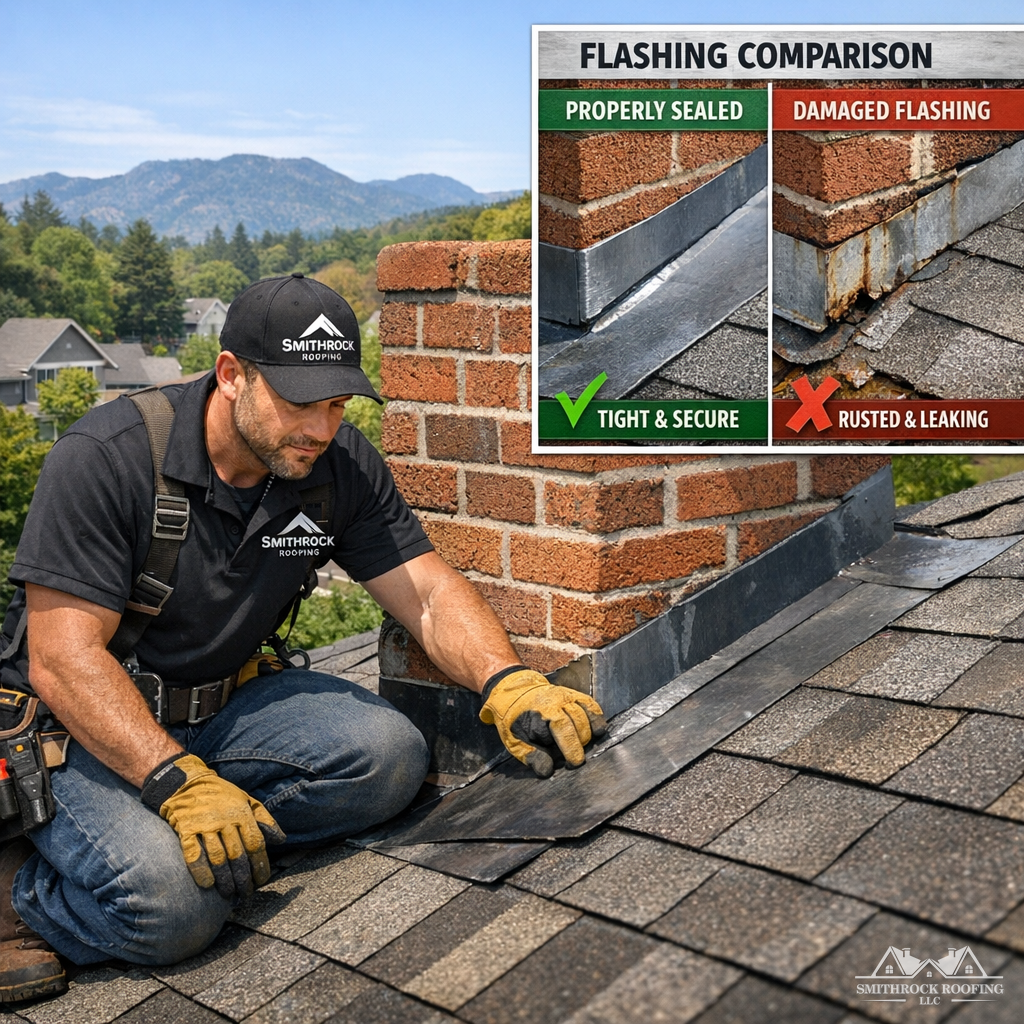
Failed or improperly installed flashing accounts for a significant share of residential roof leaks in this region. Flashing seals the transitions between your shingles and vertical surfaces — chimneys, skylights, walls, and valleys — and it’s subjected to constant movement from thermal expansion and contraction. When flashing lifts, cracks, or separates, water follows the gap directly into the roof deck. Damaged or missing shingle granules, deteriorated pipe boot seals, and poor attic ventilation leading to moisture buildup are other frequent contributors.
Most standard homeowners insurance policies in North Carolina do cover sudden damage caused by hail and wind, though coverage details, deductibles, and depreciation schedules vary significantly by policy. The critical factor is documentation: insurers want to see that the damage resulted from a specific storm event rather than gradual wear. Before you authorize any repairs beyond emergency weatherproofing, contact your insurer to open a claim and have a professional inspection completed so the scope of damage is properly recorded.
This depends on several factors: the age of your current roofing system, the extent and location of the damage, and the condition of your underlayment and roof deck. Localized damage on an otherwise sound, relatively young roof often warrants a targeted repair. But if your shingles have lost most of their granule layer, if the damage is widespread, or if your roof is approaching the end of its expected service life, a full replacement is frequently the more cost-effective long-term decision. A reputable roofing contractor should be willing to show you exactly what they’re seeing and explain the reasoning behind their recommendation without pressuring you toward a specific outcome.
Mt. Airy homeowners deserve straight answers and quality work — not guesswork or high-pressure sales pitches. Smithrock Roofing has built its reputation across the NC Triad by doing the job right the first time, and that same commitment extends to every home we inspect and every repair we complete in Surry County and the surrounding communities. If you’re ready for an honest assessment of your roof’s condition, we’re ready to help. Get a Free Estimate and let’s take a look together.

Smithrock Roofing © Copyright 2026 • All Rights Reserved • Privacy Policy • Maintained by Mongoose Digital Marketing