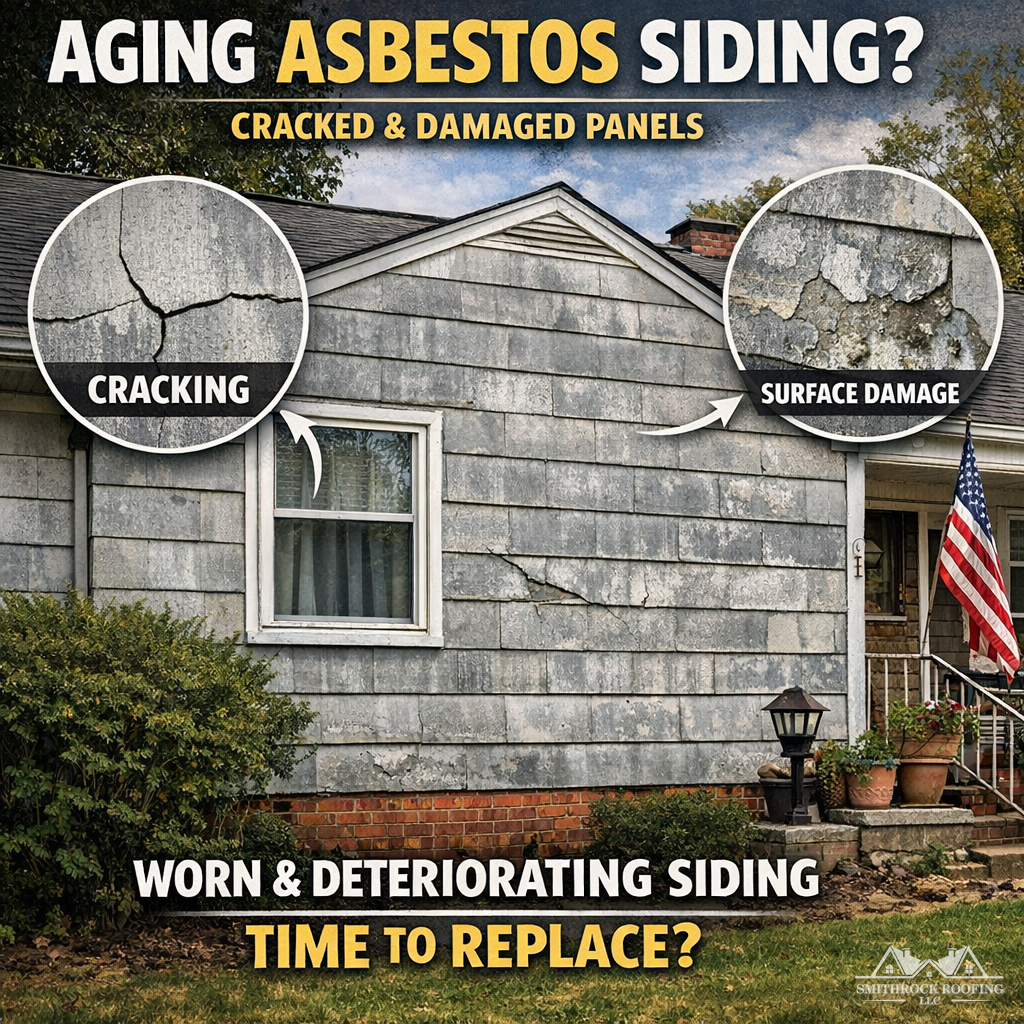
If you own an older home in the Triad and you’re starting to ask questions about your siding, there’s a good chance asbestos has already crossed your mind. Homes built between roughly 1920 and 1980 across Greensboro, Winston-Salem, High Point, Kernersville, Clemmons, Rural Hall, and King frequently used asbestos-containing siding materials, and many of those homes are still standing in excellent neighborhoods, well-loved and well-maintained, with that original siding still on the walls.
The good news: having asbestos siding does not automatically mean you have an emergency. The challenging news: replacing it is a layered process that involves regulatory requirements, licensed specialists, and often a few surprises once the old material comes off. Homeowners who understand the full picture make better decisions, avoid costly mistakes, and keep their families safe through the process.
This guide cuts through the generic information you’ll find elsewhere and focuses specifically on what the asbestos siding replacement process looks like for homeowners right here in the NC Triad, including the state-level regulations, the realities of what’s typically hiding underneath mid-century siding, and why this project almost always involves two separate contractors rather than one.
Rapid residential development through the mid-twentieth century shaped many neighborhoods in our area. Homes built during this era reflect the construction standards of the time, and asbestos-cement siding was considered a premium, durable product through most of that period.
Manufactured in flat or textured panels designed to mimic slate or wood shingles, asbestos-cement siding was marketed for its fire resistance, low maintenance, and longevity. It did its job. The problem is that decades of weathering, physical impact, and aging have left many of these panels in varying states of condition, and that condition matters enormously for what happens next.
Need a hand with this in Winston-Salem, Greensboro and the NC Triad? Call (336) 971-0464 or request a free estimate. Honest answers, no pressure.
This is where most general online resources let homeowners down. You’ll commonly read that asbestos siding “may pose a risk” or that “condition is a cost factor”but those statements skip over the single most important technical and legal distinction in the entire project.
Friable asbestos-containing material (ACM) can be crumbled, pulverized, or reduced to powder by ordinary hand pressure. When asbestos fibers become airborne, they become an inhalation hazard. Friable material triggers the strictest regulatory protocols, the most restrictive abatement procedures, and the most controlled disposal requirements.
Non-friable ACM is bound material that cannot be easily crumbled under normal hand pressure. Intact asbestos-cement siding panels are typically non-friable, the asbestos fibers are locked within a cement matrix. However, panels that are cracked, crumbling, heavily weathered, or mechanically broken during removal can become friable during the work process itself.
This distinction is not just academic. It directly determines:
For Triad homeowners, understanding this distinction before hiring anyone puts you in a far stronger position when reviewing proposals and asking the right questions.
Competitors on this topic consistently tell homeowners to “check local laws.” That’s unhelpful. Here is what the actual regulatory landscape looks like for an NC Triad homeowner planning an asbestos siding replacement.
The primary state-level authority is the NC Asbestos Hazard Management Programadministered through the NC Department of Health and Human Services (DHHS), Division of Public Health. This program oversees licensing for asbestos abatement contractors and individual workers operating in North Carolina.
This is a separate and distinct credentialing system from a general contractor’s license. A contractor who holds a valid NC general contractor license is not automatically qualified or legally authorized to perform asbestos abatement. When you hire for this work, you need to verify that the abatement contractor and the individual workers on your job hold NC DHHS asbestos abatement credentials specifically.
At the federal level, the EPA NESHAP regulations (40 CFR Part 61, Subpart M) govern asbestos during renovation and demolition projects. For residential projects, these regulations typically become relevant when the amount of regulated asbestos-containing material being disturbed meets or exceeds specific thresholds.
When those thresholds are met, a written notification to the NC Division of Air Quality is required before abatement work begins. This notification must be submitted in advance, not after the work starts. Your abatement contractor is responsible for managing this notification as part of their scope, but you as the homeowner should confirm it’s being handled before any siding comes off your house.
OSHA 29 CFR 1926.1101 sets the occupational health standards that protect workers performing asbestos abatement on your property. These standards dictate personal protective equipment, engineering controls, air monitoring requirements, and decontamination procedures. A properly credentialed abatement crew will operate in full compliance with these standards as a matter of course.
Homeowners sometimes wonder whether regulatory compliance is really their concern or just the contractor’s problem. The honest answer: it can be both. Depending on the circumstances, property owners can face liability exposure when abatement work is performed improperly on their property, including stop-work orders, remediation requirements, and in serious cases, civil penalties. Hiring a properly licensed NC abatement contractor, confirming the required notifications have been filed, and retaining all documentation from the project is how you protect yourself.
This is one of the most important practical points that homeowners rarely encounter in online research, and it catches many people off guard when they start making calls.
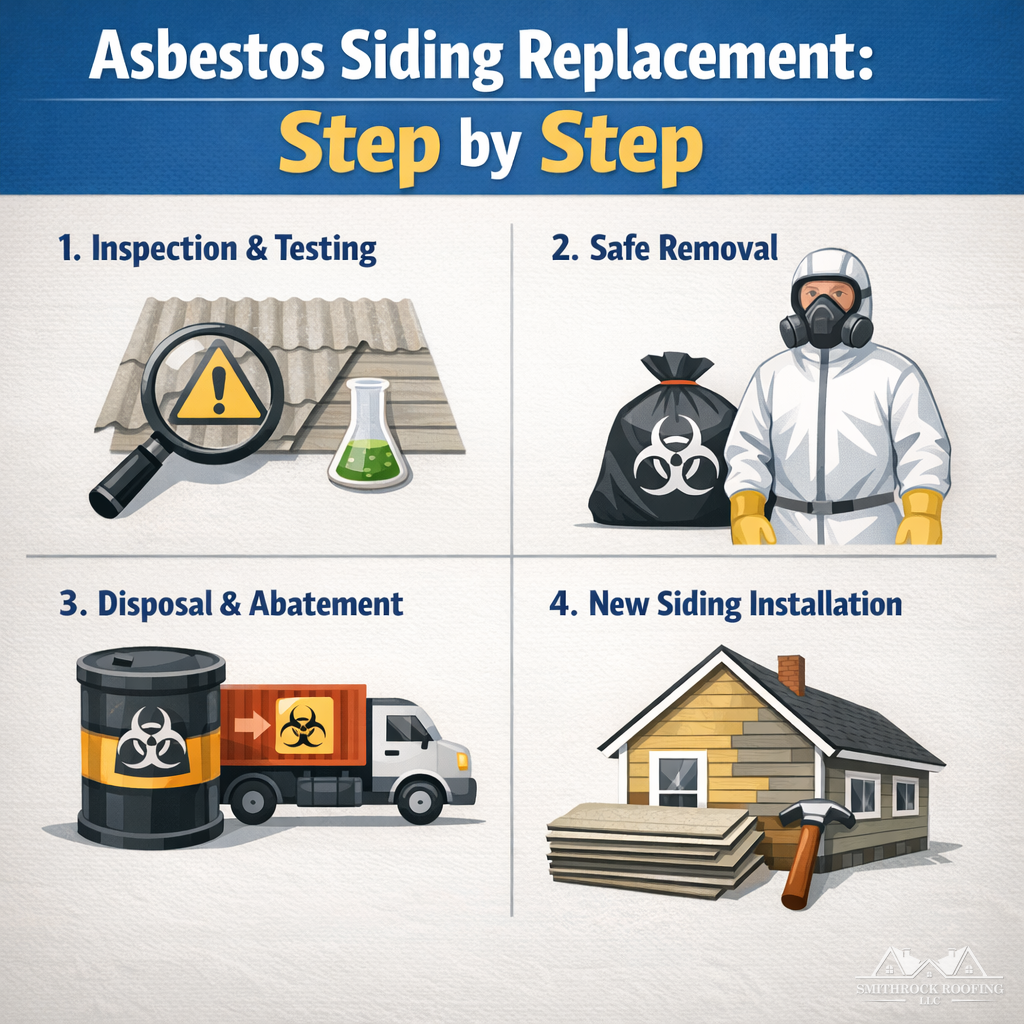
Asbestos siding replacement is almost always two separate projects with two separate contractorssequenced in order:
Contract 1, Abatement: A licensed NC asbestos abatement contractor removes the existing asbestos siding under controlled conditions, packages it according to regulatory requirements, documents the waste stream, and disposes of it at an authorized facility. They may also perform post-abatement air clearance testing, or a third-party industrial hygienist may be engaged independently to conduct that testing.
Contract 2, Siding Installation: Once the abatement is complete and clearance has been confirmed, a licensed exterior contractor installs the new siding system over whatever substrate is revealed.
These two scopes require different licenses, different expertise, and different insurance. A general contractor who tells you they can handle the asbestos removal and the new siding installation as one seamless package should be asked specifically about their NC DHHS asbestos abatement credentials before you proceed.
Understanding this sequencing also helps you plan realistically. There is typically a gap between the completion of abatement and the start of siding installation, time for clearance testing, documentation, and mobilization of the installation crew. That gap is normal and should be factored into your project timeline.
Generic articles mention “disposal fees” as a line item and leave it at that. The reality is more specific, and understanding it helps you evaluate whether your abatement contractor is operating legitimately.
Asbestos waste from residential siding removal is classified as a regulated hazardous waste and must be transported and disposed of at a facility that is specifically permitted to accept it under NC Department of Environmental Quality (NCDEQ) requirements. Not every landfill in the Triad region or surrounding counties can legally accept this material.
Legitimate abatement contractors maintain:
– A documented chain of custody for all asbestos waste
– Proper waste manifests showing the material from your property was transported to an authorized facility
– Records that can be provided to you upon project completion
When reviewing proposals from abatement contractors, it is entirely appropriate to ask how waste will be packaged, transported, and disposed of, and to request a copy of the disposal documentation after the work is complete. A qualified contractor will not hesitate to answer these questions. If a contractor is vague about disposal, treat that as a serious warning sign.
Here is a step that is missing from virtually every consumer-facing article on this topic: the project is not complete when the siding comes off the wall.
Air clearance testingtypically performed using phase-contrast microscopy (PCM) or transmission electron microscopy (TEM) sampling, is conducted after abatement is complete and the work area has been cleaned. The purpose is to confirm that airborne fiber concentrations have returned to acceptable levels before the containment is removed and the area is re-occupied or opened to subsequent trades.
Depending on the scope of your project, air clearance testing may be:
– Conducted by the abatement contractor’s own industrial hygienist
– Required to be performed by an independent third-party Certified Industrial Hygienist (CIH)
– Specified as a requirement in the project’s written scope of work
The presence of a Certified Industrial Hygienist (CIH) on larger or more complex projects adds an important layer of independent oversight. The CIH designs the abatement specifications, monitors the work as it proceeds, and conducts or oversees clearance testing, all independently of the abatement contractor. This separation of roles is standard practice on commercial projects and increasingly common on significant residential abatement jobs.
Your job as a homeowner: do not accept verbal assurances that the air is clear. Request documentation of clearance testing results as part of your project close-out package.
This is where the replacement conversation gets genuinely interesting, and where many homeowners are caught off guard by scope and cost factors they never anticipated.
Every general article about asbestos siding replacement focuses on choosing the new material that goes on. Almost none of them address what comes off and what’s revealed underneath. In mid-century Triad homes, that revelation often tells its own story.
Homes built through the mid-twentieth century were commonly framed with board sheathingindividual planks running diagonally or horizontally across the framing, rather than the plywood or OSB panels used in modern construction. This sheathing has been enclosed beneath asbestos panels for decades, sometimes since the 1940s or 1950s.
When that old siding comes off, it is not uncommon to find:
Addressing this substrate damage is not optional. New siding installed over compromised sheathing will not perform correctly, will not carry a valid manufacturer warranty, and will create ongoing moisture problems.
Many mid-century Triad homes never had a proper weather-resistive barrier (WRB) installed beneath the original siding. The asbestos-cement panels themselves provided a degree of weather resistance, but there was often nothing systematically managing moisture between the siding and the sheathing.
When new siding goes on, a proper WRB installation is not just best practice, it’s a fundamental part of the building envelope that the house likely never had. This is actually an opportunity: the replacement project allows you to give your home moisture management it has never had before.
Board sheathing provides essentially no insulation value. If your home has older exterior walls and insufficient insulation, the moment when the exterior siding is stripped is the ideal window, quite literally, to integrate continuous exterior insulation between the sheathing and the new cladding. This is significantly less disruptive and expensive to install during a siding replacement than as a standalone project, and the long-term energy performance improvement can be meaningful.
Homes constructed before roughly 1960 across the Triad were frequently built with balloon framinga structural system where wall studs run continuously from the foundation to the roof without the platform breaks used in modern platform framing. This affects how new siding systems are attached, specifically, where nailers are located, what fastening patterns are appropriate, and whether additional backing or furring is needed for certain new siding products.
A skilled exterior contractor assesses this during the substrate inspection phase and designs the attachment system accordingly.
Many homeowners research encapsulation as a lower-disruption, lower-cost alternative to full removal. Here is the honest picture for NC Triad homeowners specifically.
Encapsulation, applying a bonding agent or coating over asbestos-containing material to seal the fibers in place, can be appropriate for certain interior asbestos applications. For exterior siding, it is far more complicated:
Here is a downstream consequence that almost no article addresses: if you encapsulate rather than remove, the asbestos siding remains on the structure. This creates an ongoing disclosure obligation when the property is sold. In North Carolina, known asbestos-containing material on a property must be disclosed to buyers, and the presence of encapsulated (rather than removed) asbestos can complicate transactions, affect appraisals, and raise concerns for buyers’ lenders.
You’re not just making a decision for today, you’re making a decision that follows the property.
Some homeowners’ insurance policies treat encapsulated asbestos as a continuing known hazard, which can affect coverage terms and future claims handling. This is worth a direct conversation with your insurance agent before you decide between encapsulation and removal.
Without stating any specific figures, it’s worth laying out the variables that legitimately affect what this project involves and why scopes vary so significantly from one home to the next.
| Factor | Why It Matters |
|---|---|
| Square footage of siding | More surface area means more material to abate, dispose of, and replace |
| Friable vs. non-friable condition | Friable material requires stricter abatement protocols and more controlled removal procedures |
| Number of siding layers | Some Triad homes have new siding installed over original asbestos siding, each layer must be accounted for |
| Substrate condition | Rot, moisture damage, or insect damage discovered during abatement adds remediation scope |
| Presence or absence of WRB | Installing a proper weather-resistive barrier adds scope but is rarely optional |
| New siding material selected | Fiber cement, engineered wood, and other premium materials vary significantly in material and labor demands |
| Waste disposal logistics | Distance to authorized disposal facility and volume of ACM affects this portion of the abatement cost |
| Air clearance testing requirements | Independent CIH oversight adds professional fees but provides independent verification |
| HOA or historic overlay requirements | Some Triad neighborhoods have design standards that limit material and color choices |
| Accessibility and story height | Multi-story homes or those with complex rooflines require additional equipment and labor |
| Permit requirements | Local jurisdictions in Guilford, Forsyth, and surrounding counties have their own permitting processes for exterior work |
Once the abatement is complete and the substrate is prepared, the siding selection conversation begins. The right choice depends on your home’s architecture, your neighborhood’s aesthetic, your maintenance preferences, and the specific conditions of the exposed substrate.
Fiber cement is the most common replacement material for asbestos siding in mid-century Triad homes, and for good reason. It is dimensionally stable, resistant to moisture, insects, and fire, and available in profiles that complement the architectural character of established neighborhoods. It holds paint exceptionally well and carries long manufacturer warranties when installed correctly. You can learn more about the real costs involved in our article on The Real Cost of Hardie Board Siding: What to Expect.
For homes where maintaining neighborhood character matters, or where HOA guidelines apply, fiber cement offers design flexibility that matches original architectural details closely.
Engineered wood offers an authentic wood appearance with greater dimensional stability and moisture resistance than solid wood. It is a strong option for homeowners who want a warmer aesthetic than fiber cement provides and are committed to a regular painting or finishing maintenance schedule.
Vinyl is a lower-maintenance option with a long track record. For homes where budget is a primary driver and the architecture is not subject to strict aesthetic requirements, vinyl can be a practical choice. Quality varies significantly between product lines, so material selection matters considerably. Our article on Vinyl Siding Contractor Triad NC | Hire Smart offers additional guidance on evaluating your options in this category.
Before finalizing any material selection, it’s worth discussing your specific substrate condition, your neighborhood context, and your long-term plans for the home with your exterior contractor. The best material for your neighbor’s house may not be the best material for yours.
Never proceed on a verbal quote for this type of project. Whether you’re reviewing the abatement contract or the siding installation contract, the written scope of work should clearly address:
For the abatement scope:
– Confirmation of NC DHHS licensing for the contractor and workers
– Identification of the specific ACM to be removed (location, quantity, classification)
– Abatement method and containment procedures
– Regulatory notification responsibilities (who files, when, and for which agencies)
– Waste packaging, manifest, and disposal facility information
– Air clearance testing procedure and who performs it
– Documentation to be provided to homeowner at close-out
For the siding installation scope:
– Substrate inspection and repair allowances
– Weather-resistive barrier specification
– Siding material specification (manufacturer, product line, profile, color)
– Fastening system and attachment details
– Window and door trim treatment
– Warranty terms, both manufacturer and labor
A contractor who resists providing this level of written detail is not a contractor you want working on your home.
Homeowners across Greensboro, Winston-Salem, High Point, Kernersville, Clemmons, Rural Hall, and King are not dealing with the same conditions or regulatory relationships as homeowners in other parts of the country. A local contractor who has worked in these neighborhoods for decades understands the area in ways that a national franchise or an out-of-area contractor will not.
At Smithrock Roofing, we have spent years working on the exterior envelopes of exactly these homes. We understand what comes off and what’s underneath. We know the neighborhoods, the HOAs, the local permit offices, and the substrate conditions common to Triad construction. And because we work with properly credentialed abatement partners, we can help you sequence this project correctly from day one, so the abatement and the installation work together, not against each other.
If your home has asbestos siding and you’re not sure where to start, the right first step is a conversation with someone who knows what they’re looking at. We’re here for that conversation. Explore our siding services to learn more about how Smithrock approaches exterior replacement projects across the Triad.
Not always, but the answer depends on project scope and material condition. North Carolina and federal EPA regulations permit encapsulation or enclosure of intact, non-friable asbestos-containing material in certain residential renovation scenarios. However, any work that disturbs, cuts, or damages the asbestos siding, including nail penetrations and trim cuts associated with residing, triggers regulatory requirements under NESHAP and North Carolina rules. A licensed asbestos inspector can assess your specific situation and advise whether full abatement is required before the installation phase begins.
The North Carolina Department of Health and Human Services maintains an accreditation program for asbestos contractors, supervisors, inspectors, and air monitors. You can verify a contractor’s standing through that program before signing any agreement. Legitimate abatement contractors will also carry specialized liability and pollution insurance, be willing to pull required permits, and provide written notification to the appropriate regulatory agencies before work begins. Ask for proof of accreditation and insurance certificates as a baseline before any further conversation.
Mid-century homes in Greensboro, Winston-Salem, and High Point were frequently built with board sheathing rather than modern structural panels. When asbestos siding is removed, that sheathing is exposed and inspected for moisture damage, rot, and structural integrity. Depending on what is found, some sheathing boards may need to be replaced before a new weather-resistive barrier and siding system can be installed. A thorough contractor will include a substrate inspection allowance in the written scope and clarify how unforeseen conditions will be handled before work begins rather than after.
In many Triad communities, particularly those with established HOAs in Kernersville, Clemmons, and parts of High Point, exterior material and color changes require architectural review committee approval before construction begins. Requirements vary significantly by community. The practical advice is to submit your proposed specification to your HOA in writing before finalizing your contractor agreement, so that approval delays do not stall a project that is already permitted and scheduled. A contractor familiar with the local area will understand this dynamic and can help you build appropriate lead time into the project schedule.
Replacing asbestos siding is one of the more complex exterior projects a Triad homeowner can undertake, and doing it correctly requires both the regulatory knowledge to manage abatement safely and the craftsmanship knowledge to install a durable new exterior. Smithrock Roofing proudly serves Winston-Salem, Greensboro, High Point, Kernersville, and the surrounding communities, and we bring both sides of that equation to every project we take on. If your home in the Greensboro or Winston-Salem area is ready for this conversation, we’re ready to have it with you.
Need a local pro? Learn more about our siding installation and repair in Clemmons.

Smithrock Roofing © Copyright 2026 • All Rights Reserved • Privacy Policy • Maintained by Mongoose Digital Marketing